

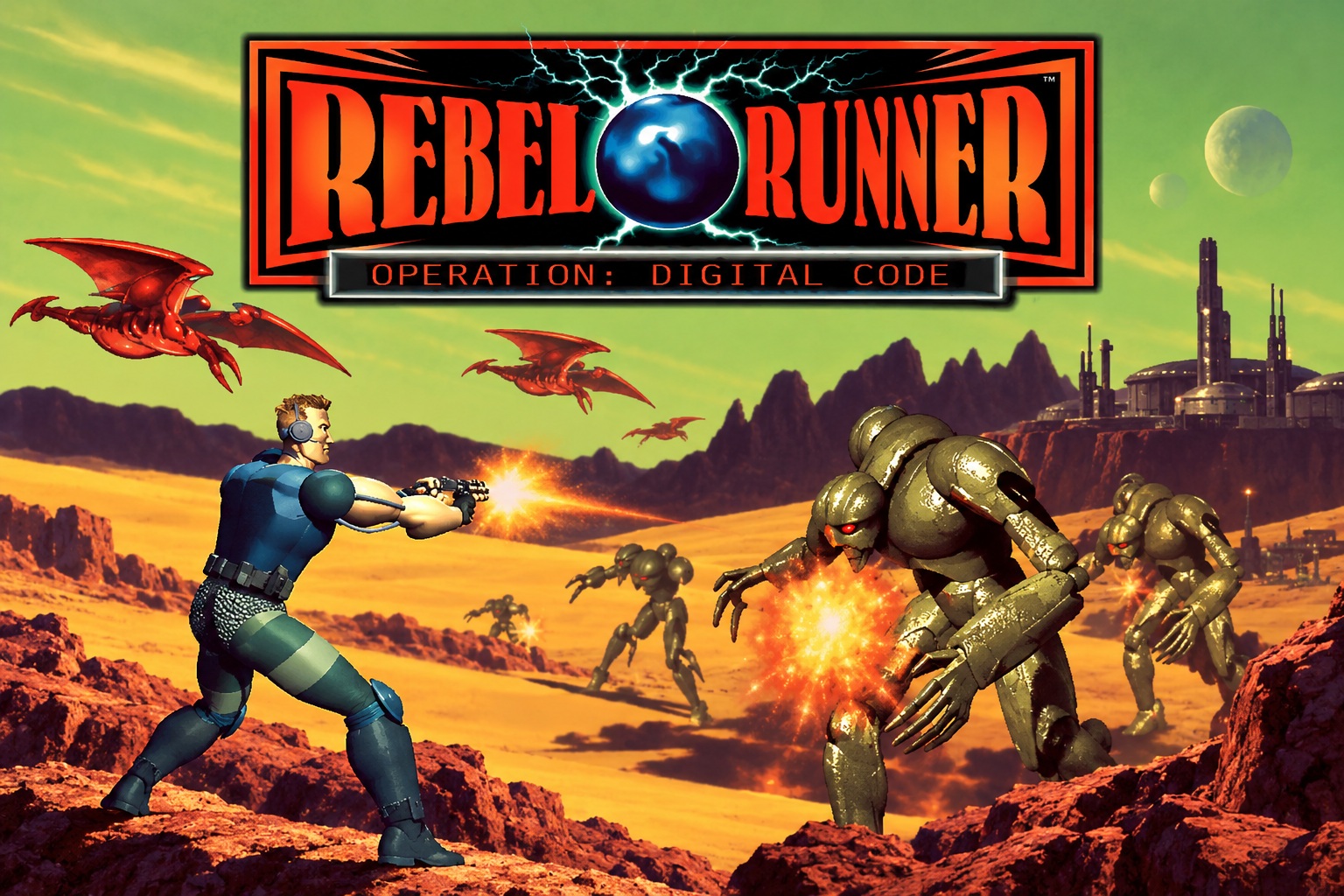
Rebel Runner: Operation – Digital Code is a 1996 DOS action-platformer from Family Production that blends science-fiction storytelling, pre-rendered visuals, fast movement, precision jumping, and arcade-style combat into one unusual adventure. Set on the distant planet Ranax, the game follows the last surviving soldier of a defeated resistance force after the invading Maaron Empire takes control using a powerful mind-influencing satellite. With the planet effectively conquered, the player is given one final objective: locate the mysterious digital code capable of disabling the satellite and breaking the Empire's control. The result is a compact but demanding platform game built around quick reactions and memorizing increasingly dangerous stages.
Unlike slower exploration-focused platformers, Rebel Runner constantly encourages forward momentum. The hero runs through hostile landscapes, jumps across dangerous gaps, avoids alien creatures, and attacks enemies by firing bursts of energy directly from his hands. Many hazards can cost a life almost immediately, making every unfamiliar section potentially dangerous until the player learns what is waiting ahead. Each failed attempt becomes part of the learning process, gradually revealing where enemies appear, which jumps require careful timing, and when slowing down is safer than rushing forward.
Now playable online through Lemon Web Games, Rebel Runner: Operation – Digital Code brings its post-apocalyptic science-fiction setting, fast DOS platforming, hand-fired energy attacks, limited-life structure, pre-rendered environments, and mission to free Ranax directly into the web browser. Players must guide the final resistance soldier through successive stages, survive hostile creatures, cross dangerous terrain, and gradually move closer to obtaining the code needed to shut down the Maaron Empire's satellite. Progress is preserved between completed stages, but individual levels still demand careful execution because losing all available lives means repeating that stage from the beginning. For players interested in obscure DOS games and unusual mid-1990s platformers, Rebel Runner offers a distinctive challenge that feels very different from the better-known action games of the period.
A Last Soldier Against an Entire Empire
The story establishes a hopeless situation almost immediately. Ranax has been defeated, the Maaron Empire controls the planet, and the resistance has effectively been destroyed. The player represents the final chance to reverse that outcome.
Instead of commanding an army, the hero operates alone. This gives the adventure a stronger sense of urgency because every stage feels like another desperate push through enemy-controlled territory. There are no reinforcements waiting if the mission fails.
The objective also remains clear from beginning to end. Find the digital code, disable the satellite, and break the mechanism allowing the Maaron Empire to maintain its control over Ranax.
The Mind-Control Satellite Gives the Mission Purpose
The satellite is more than a background story element. It explains why the occupation of Ranax is so complete and why simply defeating individual enemies is not enough to win the war.
As long as the system remains active, the Maaron Empire retains a decisive advantage. The resistance therefore needs a technological solution rather than a conventional military victory.
This gives the mysterious digital code real importance. Every dangerous platforming section is another step toward shutting down the system that made the invasion possible.
Fast Movement Defines the Gameplay
Rebel Runner feels built around momentum. The hero moves quickly, giving stages a strong arcade rhythm where hesitation and overconfidence can both create problems.
Moving too slowly can make certain hazards more difficult to approach, while rushing blindly often leads directly into enemies or gaps. The player needs to develop a controlled pace.
This makes repeated attempts especially important. Once a section becomes familiar, the player can move through it far more confidently because the location of major threats is already known.
Jumping Requires Precise Timing
Platforming is one of the central challenges. Gaps, raised surfaces, dangerous terrain, and environmental obstacles regularly interrupt the path forward.
A mistimed jump can immediately cost a life, especially in areas where there is no safe lower platform to recover onto. Players therefore need to learn how far the hero travels during each leap.
The speed of movement makes this more demanding. Good players begin preparing jumps before reaching the edge instead of reacting only at the last possible moment.
Energy Blasts Provide the Main Attack
The hero does not carry a conventional firearm. Instead, he launches powerful energy shots directly from his hands.
These attacks provide ranged protection against the hostile creatures blocking the path. Eliminating an enemy from a safe distance is often much smarter than attempting to jump past it.
The hand-fired attack also gives Rebel Runner a distinctive science-fiction identity. It visually separates the protagonist from the gun-carrying heroes found in many other DOS action games.
Enemies Are Extremely Dangerous
Many hostile creatures can remove a life very quickly if they make contact with the player. This makes even apparently simple enemy encounters dangerous.
The safest approach is often to attack before moving closer. Rushing toward an unfamiliar creature without first understanding its behaviour can end a run almost instantly.
Enemies therefore function as both combat targets and moving platforming hazards. Their placement influences how and when the player should advance.
Memorizing Enemy Positions Is Essential
Rebel Runner follows the traditional arcade philosophy that repeated attempts gradually reveal how each stage works. Enemy positions become easier to predict after the player has seen them once.
This means failure still provides useful information. The next attempt begins with knowledge of what previously caused the mistake.
Eventually, stages that originally felt unpredictable become much more structured. The player starts anticipating danger before it actually appears on screen.
Limited Lives Increase the Pressure
Each stage begins with a limited number of lives, making careless mistakes expensive. Repeatedly failing the same obstacle can quickly consume the available attempts.
This gives every successful section additional weight. Reaching a difficult area while still holding several lives provides much more room for experimentation than arriving there after a series of earlier mistakes.
The system encourages consistency. Surviving the easy sections reliably becomes just as important as mastering the hardest jumps.
Stage-Based Saving Prevents Complete Restart Frustration
Although individual stages can be punishing, completed levels remain meaningful milestones because progress is saved between them.
This prevents one late mistake from forcing the player all the way back to the beginning of the entire game. Instead, the challenge remains concentrated around mastering the current level.
The structure creates a useful balance between difficulty and persistence. Players still need to earn each stage completion, but previous victories remain valuable.
The Pre-Rendered Visual Style Stands Out
Rebel Runner uses pre-rendered 3D artwork converted into 2D game graphics, a visual technique that became increasingly popular during the mid-1990s.
Characters, environments, and objects have a rendered appearance that looks very different from traditional hand-drawn pixel art. This gives the game a distinctive visual identity even among other DOS platformers.
The technique reflects a period when developers were experimenting heavily with computer-generated graphics while still building games around fundamentally 2D mechanics.
The Environments Feel Alien and Hostile
Ranax is presented through unusual landscapes that reinforce the sense of travelling across a conquered extraterrestrial world.
The scenery often feels barren, artificial, or dangerous rather than welcoming. This fits the premise of a planet transformed by invasion and control.
The backgrounds may be visually unusual, but they remain functional as gameplay spaces. Platforms, enemies, and hazards are generally the elements demanding the player's immediate attention.
Science Fiction Gives the Game a Strong Identity
The combination of an alien empire, mind-control technology, energy attacks, and a lone resistance fighter creates a clear science-fiction atmosphere.
The story does not need lengthy dialogue because the central conflict is easy to understand. Ranax has been conquered, and the player is trying to disable the system keeping it under enemy control.
This straightforward setup works well for an action game. The narrative provides enough motivation without slowing down the platforming.
The Game Rewards Controlled Aggression
Rebel Runner can punish players who move too cautiously, but it is equally harsh toward reckless play. The ideal approach lies somewhere between the two.
Enemies should often be eliminated quickly, while jumps should be taken confidently once their timing is understood. Hesitation can create awkward situations, but rushing into an unknown area is even more dangerous.
Experienced players gradually develop a rhythm where movement and attacks flow together. The stage becomes much smoother once every action is intentional.
Positioning Before an Attack Matters
Because enemies can be dangerous at close range, approaching from the correct distance can make combat significantly safer.
Firing too early may waste attacks outside effective range, while moving too close leaves very little time to react if the enemy survives.
Learning the practical range of the hero's energy blasts therefore becomes another important skill. Good positioning reduces unnecessary risks.
Some Obstacles Are More Dangerous Than the Enemies
Hostile creatures may attract most of the attention, but environmental hazards are often equally capable of ending the run.
A player can defeat several enemies flawlessly and then lose a life to one poorly judged jump seconds later.
This keeps the game from becoming a pure shooter. Combat and platforming constantly alternate, requiring players to remain comfortable with both.
The Short Reaction Window Creates Tension
Rebel Runner frequently gives players only a limited amount of time to respond once a threat becomes visible.
Fast movement means that an enemy or gap can approach quickly, especially when the player is already running at full speed.
This is where memorization becomes most valuable. Knowing what lies ahead effectively increases the reaction window because the player can prepare before the obstacle even appears.
The Game Reflects Mid-1990s DOS Experimentation
By 1996, PC developers were experimenting with pre-rendered graphics, CD-ROM presentation, 3D technologies, and new visual techniques while still producing traditional 2D action games.
Rebel Runner fits neatly into that transitional period. Its underlying mechanics remain rooted in classic platforming, but its presentation attempts to look more modern and dimensional.
That makes the game interesting historically even beyond its gameplay. It represents a period when developers were searching for new visual identities before fully polygonal 3D became dominant.
Its Obscurity Adds to the Appeal
Rebel Runner never achieved the widespread recognition of major DOS platformers, which makes discovering it today feel almost like uncovering a forgotten release.
Its unusual name, rendered graphics, science-fiction setting, and demanding structure give it enough personality to stand apart from more generic shareware-era action games.
For retro players who have already explored the major PC classics, games like Rebel Runner provide an opportunity to experience something less familiar.
Repeated Attempts Transform the Experience
The first run through a stage can feel harsh because the player does not know where major hazards appear.
After several attempts, the same stage begins feeling significantly easier. Enemy locations become familiar, jump timing improves, and unsafe routes are naturally avoided.
This learning curve gives the game its main sense of progression. The hero does not necessarily become dramatically stronger; the player becomes more knowledgeable.
Failure Is Usually Informative
When a life is lost, the reason is often clear. The jump was mistimed, an enemy was approached incorrectly, or the player moved too quickly into an unfamiliar section.
This makes immediate retries appealing because the solution frequently seems obvious in hindsight.
The next attempt then becomes a test of whether the player can execute that lesson properly. Improvement happens through correction rather than upgrades.
The Game Works Best With Patience
Despite the title Rebel Runner, constant full-speed movement is not always the smartest strategy. Some areas reward slowing down enough to understand what lies ahead.
The challenge is knowing when caution is necessary. Once the stage has been learned, those same sections can often be crossed rapidly.
This creates a satisfying transition from cautious exploration to confident execution. Familiarity turns dangerous stages into increasingly smooth runs.
Playing Rebel Runner: Operation – Digital Code Online Today
Through Lemon Web Games, Rebel Runner: Operation – Digital Code can now be played directly in your web browser with no downloads or setup required. Features of the web-based version include:
New players should resist the temptation to rush blindly through every stage. Move quickly when the route is clear, but slow down whenever an unfamiliar enemy or jump appears. Preserving lives early in a stage provides much more freedom to learn difficult sections later.
It is also useful to attack enemies before entering their immediate range whenever possible. The hero's energy blasts are one of the safest tools available, and using distance intelligently can prevent many unnecessary deaths.
Who Should Play Rebel Runner: Operation – Digital Code
Rebel Runner is particularly suitable for players who enjoy learning stages through repeated attempts. The game can feel unforgiving at first, but familiarity makes a dramatic difference. What once looked impossible gradually becomes predictable.
It should also appeal to retro players interested in games outside the usual DOS classics. Rebel Runner's unusual visual presentation and obscure history make it an interesting discovery for anyone exploring deeper into the platform's library.
Play Rebel Runner: Operation – Digital Code Online Now
Rebel Runner: Operation – Digital Code places the fate of Ranax in the hands of its last surviving resistance fighter. Race through hostile landscapes, leap across dangerous gaps, blast alien enemies with energy attacks, and survive long enough to locate the digital code capable of disabling the Maaron Empire's mind-control satellite.
Through Lemon Web Games, players can experience this obscure 1996 DOS platformer directly in a modern browser and discover a game built around speed, memorization, and careful execution. Every completed stage moves the mission forward, but every mistake provides another lesson for the next attempt.
Final Thoughts
Rebel Runner: Operation – Digital Code is memorable because it combines familiar platforming mechanics with a visual and narrative style that feels distinctly mid-1990s. The pre-rendered graphics, alien world, hand-fired energy attacks, and mind-control storyline give it more personality than its relatively simple mechanics might suggest. It is a game shaped by an era when developers were experimenting with new presentation techniques while still relying on classic arcade design.
Its challenge comes from precision and knowledge. Enemy placement, dangerous jumps, and limited lives can make early attempts difficult, but repeated play steadily transforms uncertainty into familiarity. The game rewards players who learn from mistakes rather than expecting constant character upgrades to solve every problem.
Through Lemon Web Games, Rebel Runner can now be experienced directly in the browser as a forgotten piece of DOS action history. It may not have the fame of the platform's biggest titles, but its unusual visual style, demanding stages, and straightforward science-fiction mission make it worth rediscovering. For players who enjoy obscure retro games and the satisfaction of mastering a difficult route one stage at a time, the fight to free Ranax still has plenty of appeal.











Comments 0