

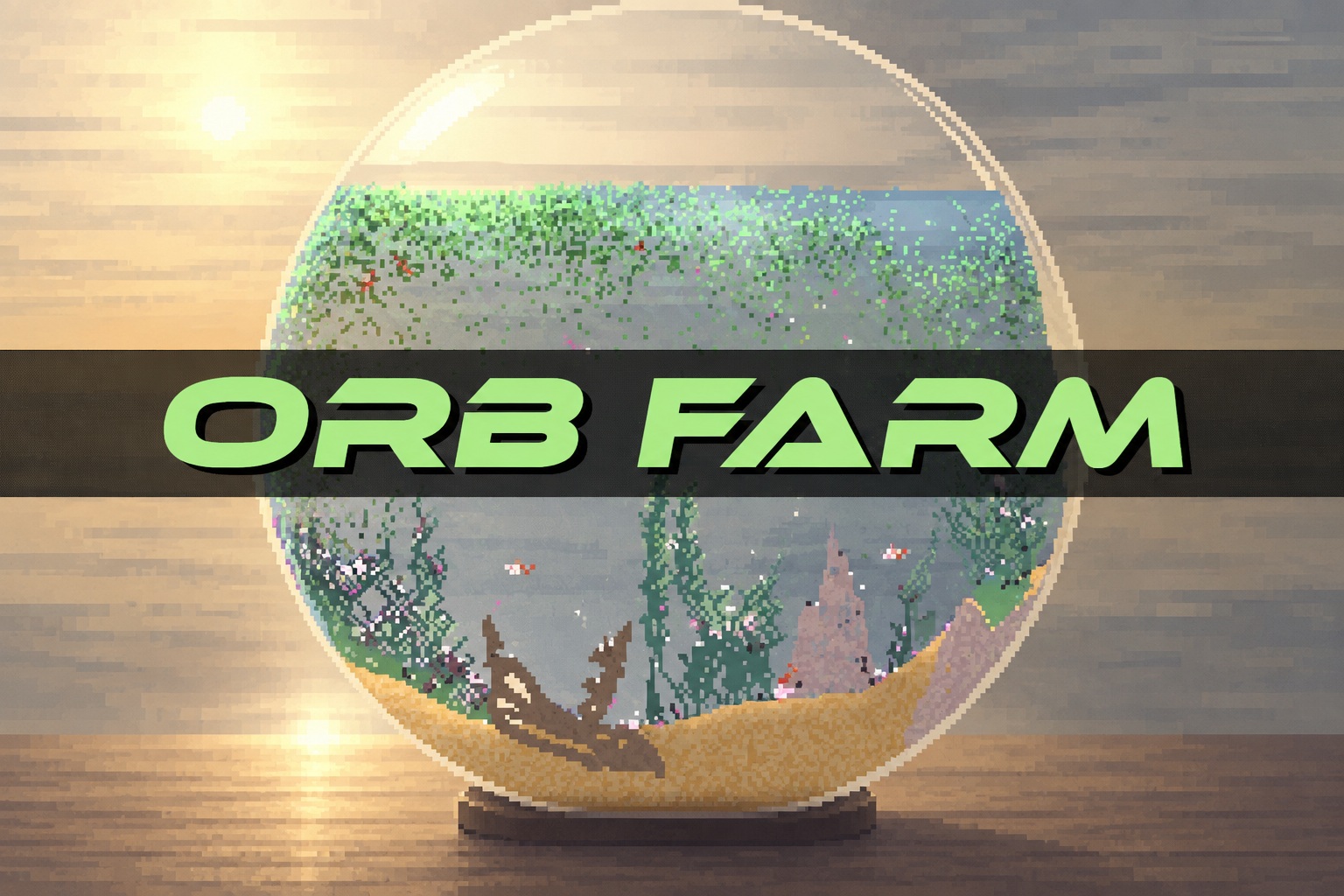
Orb Farm is a wonderfully unusual ecosystem sandbox that turns an empty glass sphere into a miniature living world. Instead of completing levels, defeating enemies, or chasing a high score, players create an aquatic environment using materials such as water, sand, stone, wood, algae, grass, bacteria, daphnia, fish, and goldfish, then watch as those elements begin interacting with one another. Plants grow, tiny organisms search for food, fish swim through the environment, waste accumulates and breaks down, and the balance between oxygen and carbon dioxide constantly changes. What begins as a few pixels placed inside an empty orb can gradually develop into a surprisingly complex ecosystem.
Created by Max Bittker, Orb Farm draws inspiration from both self-contained aquatic ecospheres and falling-sand simulations, where individual particles follow simple rules that produce surprisingly complicated behavior. Water flows around obstacles, sand settles into layers, vegetation spreads where conditions allow it, and living organisms respond to the environment the player creates. There is no prescribed design for the perfect aquarium and no single correct strategy to follow. Players are encouraged to experiment, observe what survives, discover why something failed, and use that knowledge to construct an increasingly stable little world.
Now playable online through Lemon Web Games, Orb Farm can be experienced directly in the web browser as a relaxing ecological sandbox where players can create landscapes, establish aquatic food chains, monitor oxygen and carbon dioxide, observe changing day-and-night conditions, and simply watch life develop at its own pace. A session can be approached seriously as an attempt to build a stable self-sustaining ecosystem, creatively as an aquascaping sandbox, or experimentally by deliberately changing one component and observing the consequences. Because there is no conventional victory screen forcing players toward a specific objective, the experience can be as calm or as scientific as the player wants it to be. Orb Farm is ultimately less about winning and more about understanding how a collection of simple systems can combine to create something that feels unexpectedly alive.
Starting With an Empty Glass World
A new Orb Farm begins with something remarkably simple: an empty glass sphere. There are no fish waiting to be fed, no predetermined landscape, and no tutorial environment already arranged for the player. Every major component of the ecosystem needs to be introduced manually. The blank orb effectively becomes a canvas for both biological experimentation and visual creativity.
Players can begin by adding water and creating a physical landscape using sand, stone, wood, and glass. Sand settles naturally under gravity, while water moves around whatever structures have been placed inside the sphere. Rocks and pieces of wood can be used to shape different areas, producing deeper pools, sheltered spaces, raised sections, or decorative formations. Even before any living organisms are added, experimenting with the physical materials can be entertaining.
This freedom immediately distinguishes Orb Farm from conventional aquarium games. There is no fixed tank layout that every player receives. Two ecosystems can begin with exactly the same selection of organisms yet behave differently because their physical environments are arranged in different ways. The shape of the habitat becomes part of the experiment.
Build the Habitat Before Adding Life
It can be tempting to immediately fill the orb with fish, but building a suitable environment first generally produces much better results. A stable ecosystem needs more than water and animals. Plants need somewhere to grow, organisms need enough space to move, and the biological system needs time to establish itself. Rushing directly toward a crowded aquarium often creates instability.
A layer of sand can provide a natural-looking substrate along the bottom of the sphere, while stone and wood can add physical structure. Players can create open swimming areas alongside smaller sheltered sections. There is no requirement to make the environment symmetrical or realistic, so unusual layouts are completely possible.
The important part is remembering that Orb Farm is a simulation rather than a decorative aquarium alone. A beautiful arrangement can still fail biologically if the environment cannot support the organisms placed inside it. Form and function gradually become connected.
Water Behaves Like Part of the Simulation
Water is not simply a static blue background painted behind the fish. It occupies physical space inside the orb and interacts with other materials. Adding water around rocks, sand, and structures demonstrates the falling-sand foundation underneath the ecosystem simulation. The environment is constructed from many individual elements rather than one fixed aquarium image.
This makes experimentation with terrain surprisingly entertaining. Players can alter the shape of the substrate and watch water settle into the available areas. Glass can be used creatively to divide or shape sections, while stone and wood create boundaries that affect the appearance of the habitat. The physical environment can become almost as interesting as the organisms living inside it.
Once life has been added, those early design decisions become the stage on which the ecosystem develops. Fish move through the available water, plants occupy certain regions, and organic material gradually becomes part of the environment. The orb stops looking like something deliberately constructed and begins looking like somewhere things actually live.
Plants and Algae Begin the Biological Cycle
A functioning ecosystem needs producers, and algae and grass play an important role in establishing the biological foundation of Orb Farm. Under suitable conditions, plant life uses available carbon dioxide and contributes oxygen to the environment through photosynthesis. That oxygen becomes essential once animals are introduced. A tank full of consumers with no meaningful producer base is unlikely to remain healthy for long.
Watching algae spread is one of the most visually satisfying parts of the simulation. Small amounts can gradually become larger patches, particularly when environmental conditions support growth. What looked like an almost empty orb begins developing color and texture. The environment starts changing even when the player is doing nothing.
Too much growth can also change the balance of the system. Orb Farm encourages observation rather than assuming that more of something beneficial is always better. The goal is not necessarily to maximize one component but to allow several biological processes to coexist. Balance matters more than abundance.
Light Helps Drive the Ecosystem
Orb Farm includes changing light conditions that affect the biological activity inside the sphere. The simulated sun rises and falls, creating a visible day-and-night cycle rather than keeping the aquarium under permanent illumination. This gives the environment a natural rhythm. The orb can look noticeably different depending on when it is observed.
Light is particularly important because photosynthetic organisms depend on it. During periods of suitable illumination, plant life contributes to the oxygen cycle that supports animals. Darkness changes those conditions, meaning the system needs enough stability to survive natural fluctuations rather than depending on constant ideal circumstances. The environment is always changing slightly.
Watching several simulated days pass can therefore reveal information that is not immediately obvious after constructing the aquarium. An ecosystem might appear healthy for a short period before oxygen begins declining or a population starts changing. Patience becomes an important part of experimentation.
Oxygen Is One of the Most Important Resources
Fish and other aquatic animals need sufficient oxygen to survive. As more organisms are introduced, the demand for oxygen increases. A small number of fish may live comfortably in an established environment, while suddenly adding many animals can overwhelm the biological system. Population size needs to match what the ecosystem can support.
The oxygen indicator gives players an important way to understand what is happening beyond what can be seen visually. An aquarium may look beautiful while its underlying gas balance is becoming unstable. Monitoring oxygen therefore helps explain why creatures that appeared healthy can suddenly begin dying. The system provides feedback rather than leaving every biological change mysterious.
Players gradually learn that stability is usually more useful than maximum population. A modest ecosystem capable of sustaining itself can survive far longer than a spectacular tank overloaded with fish. Orb Farm rewards restraint.
Carbon Dioxide Completes the Other Side of the Cycle
Carbon dioxide provides another useful indication of the ecosystem's condition. Plants and animals participate in different parts of the gas cycle, meaning changes in one population can influence the environment available to others. Oxygen and carbon dioxide should therefore be considered together rather than as completely separate statistics. The health of the orb emerges from their relationship.
This gives players a reason to observe trends instead of reacting to one momentary reading. Biological systems naturally fluctuate. A temporary change is not necessarily evidence that the entire aquarium is failing. More important patterns become visible over longer periods.
That slower feedback makes Orb Farm particularly satisfying for patient players. The simulator does not always respond immediately to an intervention. Sometimes the best action is simply to stop adding things and watch what happens.
Daphnia Form an Important Part of the Food Web
Daphnia are tiny aquatic organisms commonly known as water fleas, and they occupy an important position inside Orb Farm's food chain. They interact with smaller biological resources while also becoming potential food for larger animals. Introducing them helps create another layer between basic producers and fish. The aquarium begins behaving less like a collection of independent objects and more like a connected ecosystem.
A healthy daphnia population can be an encouraging sign that the lower levels of the food web are functioning. If they disappear rapidly, something in the environment may no longer be supporting them. That change can then affect fish that depend on smaller organisms for food. Problems can travel upward through the ecosystem.
This relationship makes population changes interesting to observe. A sudden increase in one organism might initially look positive but can eventually consume too much of another resource. Orb Farm repeatedly demonstrates that ecological success depends on relationships rather than individual species alone.
Fish Should Be Introduced Carefully
Fish are naturally among the most appealing organisms to add because they make the aquarium immediately feel alive. They move through the water, interact with the environment, and give the player something obvious to watch. However, fish also place greater demands on the ecosystem. Adding them too early can destabilize a world that has not yet established enough food and oxygen.
Starting with a small population makes it much easier to understand whether the environment can support them. If the fish remain healthy across several cycles, additional animals can be considered gradually. Adding many at once makes it difficult to identify exactly what went wrong if the system collapses. Slow changes provide clearer information.
This teaches one of Orb Farm's most useful lessons: biological systems need time. Constructing an environment and immediately filling every empty space may look impressive, but patience usually produces a healthier aquarium. The simulation rewards players willing to wait.
Goldfish Add Another Visible Layer of Life
Goldfish provide another recognizable aquatic inhabitant that can be introduced into the orb. Their larger visual presence makes them particularly noticeable as they move through the water. A healthy goldfish swimming among plants and structures can make the ecosystem feel far more like a miniature aquarium. They become one of the most visually satisfying rewards for establishing stable conditions.
Like other animals, however, goldfish cannot exist independently of the environment supporting them. They consume resources and contribute waste, increasing the biological load inside the sphere. A habitat that supports smaller organisms comfortably may struggle after larger animals are introduced. Their presence therefore becomes another test of ecosystem capacity.
This creates a natural progression even without conventional levels. Players often begin with basic physical materials, establish plant life, introduce smaller organisms, and only later experiment with larger creatures. The ecosystem itself creates the progression structure.
Bacteria Quietly Keep the System Moving
Bacteria may not be as visually exciting as fish, but they represent one of the most important parts of the miniature ecosystem. Organic matter does not simply disappear when an organism dies or waste accumulates. Decomposition returns material to the wider environmental cycle. Bacteria help make that process possible inside the simulation.
Their importance demonstrates how Orb Farm values organisms that traditional games might ignore completely. The ecosystem is not only about the creatures that are easy to see. Invisible or tiny processes can determine whether the entire system remains viable. A healthy world depends on more than its most attractive inhabitants.
This also makes the simulation educational without becoming a formal lesson. Players discover these relationships because they affect whether their aquarium survives. Understanding ecology becomes useful gameplay knowledge.
Death Is Part of the Ecosystem Rather Than Simply Failure
When a fish dies in Orb Farm, it can initially feel like something went wrong. Sometimes it did—the aquarium may lack oxygen, food, or appropriate balance. But death itself is also part of natural ecological systems. Organic material returns to the environment and becomes involved in other biological processes.
This means players should avoid treating every individual death as proof that the entire experiment has failed. Population trends provide much more useful information. One organism dying in an otherwise stable ecosystem can be very different from every fish disappearing while oxygen collapses. Context matters.
Orb Farm becomes much more interesting once players stop trying to freeze the ecosystem into one perfect moment. Healthy environments change over time. Populations rise and fall, plants spread, organisms disappear, and new balances emerge. The world feels alive precisely because it does not remain static.
A Stable Ecosystem Is More Interesting Than an Overcrowded One
The empty spaces inside the orb can make new players want to continually add more life. More fish, more daphnia, more plants, and more decorative materials seem like obvious improvements. Yet biological capacity is limited. Every additional organism changes what the rest of the system needs.
Overcrowding can increase oxygen demand and place more pressure on available food. A population that initially looks impressive may collapse after the environment can no longer support it. The healthiest orb may actually contain far fewer animals than the player initially expected. Stability can look surprisingly modest.
Learning when to stop adding things is therefore an important skill. Orb Farm rewards players who allow the ecosystem to regulate itself. Sometimes the best move is doing nothing.
The Day-and-Night Cycle Makes Observation Rewarding
Because the environment changes over time, Orb Farm encourages players to watch rather than constantly interact. The transition between light and darkness creates a natural cadence. Plants and organisms continue responding to the environment while the player simply observes. The orb becomes something closer to a living desktop companion than a traditional game demanding constant input.
Speed controls can make longer biological changes easier to observe. Instead of waiting through every natural cycle in real time, players can accelerate the simulation and watch populations develop more quickly. This is especially useful when testing whether a newly created ecosystem will remain stable. Problems that might take longer to appear become visible sooner.
Fast-forwarding also makes experimentation more practical. Build an environment, let several cycles pass, observe what happens, then adjust the design. The game naturally encourages a process similar to running small experiments.
Orb Farm Is Also a Falling-Sand Sandbox
Underneath the ecosystem is a simulation style related to classic falling-sand games. Materials behave according to simple physical rules, allowing players to draw, pour, and arrange them rather than placing only fixed decorative objects. Sand falls, water spreads, and physical structures influence where materials can move. The aquarium is literally built from interacting particles.
This gives Orb Farm a tactile quality unusual for biological simulations. Creating the environment is not performed entirely through menus and statistics. Players directly draw shapes and watch materials settle into place. It feels more like constructing a tiny world by hand.
The falling-sand foundation also means that visual outcomes can be unpredictable. A carefully placed section may gradually shift once water is added, while plant growth can alter the appearance further. The environment develops its own visual history.
Stone and Wood Make Aquascaping Surprisingly Fun
Not every decision needs to be about survival. Stone and wood can be used to create attractive environments simply because the player likes how they look. A curved piece of driftwood surrounded by grass can create a very different atmosphere from a rocky landscape with open water. Orb Farm works surprisingly well as a miniature aquascaping toy.
This creative side of the game can become just as engaging as the ecosystem simulation. Players may spend considerable time shaping the substrate before introducing any animals. Different combinations of material can create caves, terraces, open areas, and decorative structures. There is no requirement that every orb look natural.
Once plants and animals begin interacting with the design, the environment gains another layer of character. A carefully planned aquarium gradually becomes less controlled as life spreads through it. That transition from designed object to living system is one of the game's most satisfying qualities.
Glass Can Be Used Creatively Inside the Orb
Glass is particularly interesting because it allows players to create physical boundaries within the environment. Rather than accepting one undivided volume of water, players can experiment with partitions and unusual structures. The ecosystem can be shaped into different zones or artificial chambers. This expands the sandbox beyond conventional aquarium decoration.
Creative players can use these barriers to investigate how isolated spaces behave. One section might contain different materials or organisms from another. Even when the experiment does not produce a stable ecosystem, the process can reveal how strongly physical structure influences what happens.
This reinforces the idea that Orb Farm is not asking players to follow one intended design. The tools are provided, but the objective is largely self-defined. Curiosity becomes the main progression system.
You Can Experiment Instead of Trying to Win
One of the most refreshing aspects of Orb Farm is the absence of a conventional victory condition. There is no final boss, required score, campaign ending, or predetermined number of ecosystems to complete. The player decides what counts as success. Maintaining healthy fish for a long period can be one objective, while creating the strangest possible environment can be another.
This removes much of the pressure commonly associated with management simulations. A failed aquarium is not wasted progress if the player learned something from it. Clearing the orb and beginning again is part of experimentation. The game encourages curiosity rather than perfection.
That freedom can also make Orb Farm surprisingly relaxing. There is no timer demanding immediate decisions. Players can simply watch the environment and intervene only when they feel like changing something. The orb exists at the player's pace.
Small Changes Can Have Large Consequences
Because the system is interconnected, adding one element can produce consequences much later. Additional algae may initially increase available resources, but that growth could support a larger daphnia population, which then changes conditions for fish. Removing too much plant life can alter oxygen levels. Introducing more animals can increase demand throughout the food web.
These relationships are what make repeated experiments interesting. Players begin forming hypotheses about what will happen before making a change. Sometimes the result matches expectations, while other times the ecosystem behaves unexpectedly. Each outcome provides information.
Orb Farm therefore creates complexity without requiring an overwhelming interface. The rules emerge through observation. The player gradually learns what the simulation is doing simply by watching it respond.
Changing One Thing at a Time Makes Experiments Easier
When an ecosystem begins failing, the instinctive response may be to change several things immediately. Add more plants, reduce fish, introduce bacteria, alter the environment, and hope something improves. The problem is that if the aquarium recovers, it becomes difficult to know which change actually helped. The same applies when several changes make the situation worse.
A more useful approach is to adjust one major variable and observe the result. If oxygen is declining, consider whether more producers or fewer consumers are needed, then allow time for the system to respond. If a population is disappearing, examine what it depends on before introducing something else. Orb Farm becomes much easier to understand when experimentation is deliberate.
This method also makes the simulator surprisingly suitable for informal science learning. Players naturally begin thinking in terms of cause and effect. The game provides immediate visual feedback to ecological ideas that can otherwise feel abstract.
Population Booms Can Become Population Crashes
A rapidly growing population can initially look like proof that the ecosystem is thriving. In reality, rapid growth may consume resources faster than they can recover. If too many organisms depend on the same food source, the population can eventually exceed what the environment can support. What looks successful in the short term can become unstable later.
Watching these cycles develop is fascinating because no scripted event needs to announce that something has changed. The evidence appears directly in the behavior of the organisms. Numbers rise, food becomes scarcer, conditions shift, and populations respond. The player is observing a system rather than triggering a predetermined cutscene.
This can produce surprisingly dramatic moments for such a calm-looking game. An ecosystem that survived comfortably for many cycles may suddenly begin declining. Understanding why becomes the next experiment.
Algae Can Be Both Valuable and Difficult to Control
Algae are extremely useful because they contribute to the producer base supporting the ecosystem. Without sufficient biological production, animal populations may struggle. Yet algae can also spread extensively under favorable conditions, changing the appearance and balance of the aquarium. Their growth provides an obvious visual indicator that the environment is active.
Daphnia and other organisms help connect algae to the wider food web. Instead of treating algae only as decoration, the simulation gives their presence ecological meaning. A growing patch can ultimately influence creatures elsewhere in the orb. That interconnectedness is central to Orb Farm.
Players gradually stop asking whether algae are simply "good" or "bad." The more useful question becomes whether the current amount supports the balance they are trying to create. Orb Farm consistently rewards that type of thinking.
Fish Behavior Makes the Orb Feel Alive
Once fish are established, the environment becomes noticeably more dynamic. They travel through open water, move around structures, and interact with biological resources rather than remaining fixed decorations. Even when the player is not actively changing anything, there is movement somewhere inside the sphere. The aquarium becomes enjoyable simply to watch.
Different landscape designs can influence the visual character of that movement. A wide open tank looks different from an environment filled with narrow passages and structures. Aquascaping therefore affects not only appearance but how the activity inside the orb is perceived. The player becomes both designer and observer.
This is one reason Orb Farm can work as a background experience. After building a stable environment, there is no requirement to continue manipulating it constantly. Watching the tiny inhabitants live inside the world can be enough.
The Simulation Can Be Calming Rather Than Competitive
There is something inherently relaxing about watching a small artificial ecosystem change gradually. The pixel-scale graphics avoid visual clutter, while the slow biological processes encourage observation rather than frantic response. Even when an ecosystem fails, there is rarely a sense of competitive punishment. The player simply learns and tries again.
This makes Orb Farm very different from resource-management games where every decision is tied to money, objectives, or efficiency scores. There is no corporation demanding higher fish production. The aquarium exists for its own sake. The pleasure comes from seeing whether the system works.
Players can therefore interact with the game according to their mood. Some sessions may involve careful ecological experimentation, while others become nothing more than relaxing aquascaping. The same tools support both approaches.
The Pixel Presentation Fits the Simulation Perfectly
Orb Farm uses a small-scale pixel presentation that makes individual materials easy to recognize while preserving the feeling of a tiny artificial world. Water, sand, vegetation, organisms, and structures remain visually distinct even when the orb becomes crowded. The simplicity makes biological changes easier to notice. A growing patch of algae or declining population can be seen without opening complicated menus.
The artwork also gives the game a charming quality. Tiny fish swimming through a sphere of individually simulated particles feel somewhere between a scientific model and digital terrarium. The environment never needs detailed 3D graphics to communicate life. Movement and interaction provide the personality.
Pixel-scale simulation is also perfectly suited to the underlying falling-sand mechanics. Every part of the world appears as something that belongs to the same physical system. Nothing looks disconnected from the environment.
Orb Farm Can Be Surprisingly Educational
Although the game never turns into a formal biology lesson, many of its mechanics naturally demonstrate ecological principles. Producers support consumers, organisms depend on available resources, populations influence one another, and decomposers return organic material to the environment. Oxygen and carbon dioxide connect living organisms through processes that cannot be ignored. The player learns because these relationships determine what survives.
This makes ecological concepts easier to understand visually. A textbook explanation of food webs can feel abstract, but watching fish disappear after their supporting population collapses creates an immediate connection between cause and effect. The same is true when vegetation changes gas levels inside the orb. Systems become easier to grasp when the player can manipulate them.
The simulator also teaches that ecosystems are rarely simple. Fixing one problem can create another somewhere else. There is no universal "more is better" solution. Balance emerges from relationships.
Failure Encourages Another Experiment
A completely collapsed ecosystem does not mean the session was pointless. Players can identify what happened, clear the orb, and attempt another design. Perhaps the fish were introduced too quickly, the producer population was too small, or the environment simply contained too many organisms. Every failure suggests another question.
This creates a satisfying experimental loop. Build, observe, identify a problem, adjust, and watch again. There is no pressure to discover the perfect configuration immediately. The process itself is the game.
Experienced players may even begin deliberately creating unstable situations simply to see what happens. What if the orb contains enormous amounts of algae? What happens if too many fish are introduced at once? How does the ecosystem respond when one component is removed? Curiosity can provide endless objectives.
Unusual Elements Add a Playful Side
Orb Farm is mostly grounded in recognizable ecological relationships, but it is not afraid to include a little absurdity. Among the available elements and occasional surprises are playful additions such as donuts, reminding players that this is still a creative digital sandbox rather than a strict scientific laboratory. Experimenting with unusual elements adds another layer of discovery.
These touches prevent the simulation from becoming overly serious. Players can build a realistic aquatic ecosystem one moment and deliberately create something ridiculous the next. The tools do not demand one correct style of play. Scientific curiosity and playful experimentation comfortably coexist.
This sense of humor suits Max Bittker's broader sandbox approach. The simulation provides meaningful systems while still encouraging players to poke at them simply because doing so is fun. Not every experiment needs a practical purpose.
Speed Controls Make Long-Term Changes Easier to Watch
Ecological processes can take time, and Orb Farm allows the simulation to be accelerated so players do not always need to wait through slow changes. This is particularly useful after adding a new organism or changing the environment. Increasing the speed can reveal whether the system stabilizes or begins failing. Longer trends become visible much more quickly.
Fast simulation also makes population dynamics more dramatic to watch. Algae can spread, organisms can reproduce or disappear, and the general appearance of the orb can change substantially over a relatively short period. Slowing down afterward allows the player to inspect the new state carefully. Speed becomes another observational tool.
This feature helps the game remain relaxing without becoming tedious. Players decide how quickly they want to see consequences. A carefully built aquarium can be watched slowly, while an experimental setup can be accelerated to reveal its outcome.
A Desktop Companion as Much as a Game
Once a reasonably stable ecosystem has been created, Orb Farm can become something players simply leave running and occasionally revisit. The world continues changing while visible in the browser, making it enjoyable to check periodically. Has the algae spread? Are the fish still healthy? Did the daphnia population change? The aquarium creates its own small stories.
This passive quality is unusual in games. Most titles constantly demand input, while Orb Farm is often at its best when the player stops interfering. Observation becomes part of participation. The player created the conditions, but the simulation determines what happens next.
That makes it particularly appealing as a relaxing side activity. Build an orb, let it run, then return later and see what survived. The anticipation of checking on the ecosystem can become surprisingly engaging.
Every Orb Develops Its Own Character
Because players choose the physical layout, population, plant density, and timing of additions, two Orb Farm ecosystems rarely develop identically. One may become densely planted with only a few fish, while another develops large open-water sections dominated by moving animals. Some worlds remain stable for long periods, while others experience dramatic population changes. The simulation naturally creates variety.
This gives players a sense of ownership even without conventional customization screens. The ecosystem looks the way it does because of decisions made earlier. A particular arrangement of rocks or piece of wood can become a recognizable feature after hours of biological development. The orb gradually acquires history.
Starting over therefore feels different from resetting a normal game level. The previous world may never be reproduced exactly. Each new attempt becomes another ecosystem with its own trajectory.
Why Orb Farm Feels Different From Traditional Simulation Games
Many simulations revolve around optimization. Players maximize profit, increase production, expand territory, or achieve numerical objectives. Orb Farm has no interest in those conventional goals. Success can simply mean that the fish are still alive and the oxygen level remains stable. The scale is intentionally tiny.
This small scale allows individual relationships to feel more meaningful. A disappearing daphnia population matters because there are only a few layers in the food web. A growing patch of grass is visually obvious. The entire ecosystem fits inside one sphere where changes can be watched directly.
There is also no pressure to expand forever. In fact, excessive expansion can be exactly what destabilizes the system. Orb Farm rewards sustainability instead of endless growth. That makes its design feel refreshingly different.
The Best Strategy Is Often Patience
Many games reward constant activity. Orb Farm frequently rewards the opposite. After making a significant change, adding something else immediately can make it difficult to understand what the first intervention actually did. Waiting allows the biological system to respond. Observation provides information that more clicking cannot.
Patience is especially valuable when introducing animals. A newly established plant or daphnia population needs time to reveal whether it is genuinely stable. Adding fish immediately may hide the underlying problem until the system collapses. Allowing several cycles to pass produces much more useful evidence.
Eventually, players become comfortable leaving parts of the orb alone. A mature ecosystem does not necessarily need continuous improvement. Sometimes surviving without intervention is the greatest sign of success.
Playing Orb Farm Online Today
Through Lemon Web Games, Orb Farm can now be played directly in your web browser with no downloads or setup required. Features of the web-based version include:
Orb Farm works particularly well in a browser because its entire design is based around experimentation and observation rather than lengthy missions. Players can build a new ecosystem in a few minutes, leave it running, then return to see how conditions have changed. A short session can involve adjusting one part of the environment, while a longer session can become a complete attempt at constructing a stable food web. The simulator places very few restrictions on how it should be enjoyed.
New players will usually have better results by beginning slowly. Build the physical environment first, establish algae and other plant life, allow smaller organisms such as daphnia to become part of the food web, and introduce fish gradually rather than filling the sphere immediately. Watch oxygen and carbon dioxide instead of judging the ecosystem only by appearance. Most importantly, give the simulation time to respond before making another major change.
Who Should Play Orb Farm
Orb Farm is particularly enjoyable for players who like games that allow them to create their own objectives. One person may attempt to keep several fish alive for as long as possible, while another may focus entirely on building an attractive underwater landscape. Someone else might intentionally create unstable environments simply to observe how the food web responds. All of these approaches are equally valid.
It is also a surprisingly good choice for anyone interested in learning through experimentation. Oxygen, carbon dioxide, producers, consumers, decomposers, population balance, and food availability become practical systems rather than abstract terms. The game never forces players to treat it like a science exercise, but the ecological relationships naturally become understandable through play. That combination of relaxation and learning gives Orb Farm a unique appeal.
Play Orb Farm Online Now
Orb Farm turns an empty glass sphere into a miniature world where every new organism changes the environment around it. Players can shape the landscape with sand, stone, glass, and wood, add water, establish algae and grass, introduce bacteria and daphnia, and eventually populate the environment with fish and goldfish. Oxygen, carbon dioxide, food, decomposition, and population changes all interact, meaning a beautiful aquarium can still fail if its biological balance is unstable. The challenge is not simply creating life but creating conditions where that life can continue.
Through Lemon Web Games, players can experience Orb Farm directly in a modern browser and experiment with ecosystems at their own pace. There is no requirement to build the same environment twice, no score forcing one strategy, and no final level waiting at the end. Each orb becomes its own experiment, landscape, and tiny story. Whether the goal is long-term stability, creative aquascaping, ecological experimentation, or simply watching pixel fish move through an artificial world, Orb Farm provides the tools and lets the simulation do the rest.
Final Thoughts
Orb Farm is compelling because it makes something extremely complicated feel approachable. Real ecosystems contain countless relationships between organisms, resources, chemistry, and physical environments, yet the game reduces those ideas into a small selection of elements that players can manipulate directly. Add algae and oxygen changes. Introduce daphnia and the food web develops. Add too many fish and a seemingly healthy environment may suddenly struggle. Every interaction helps reveal how dependent each part of the system is on everything around it.
Its greatest strength is that the player is never required to treat these systems as a puzzle with one correct answer. A successful orb can be densely planted or relatively sparse, carefully designed or experimentally chaotic. Failure is equally useful because a collapse creates another opportunity to understand what happened and build differently next time. The absence of traditional scoring allows observation itself to become rewarding.
Through Lemon Web Games, Orb Farm can be enjoyed directly in the browser as a relaxing aquarium, an ecological experiment, a creative falling-sand sandbox, or simply a tiny living world to keep open and check occasionally. Watching a few pixels of algae gradually support daphnia, fish, plants, bacteria, and an entire miniature biological cycle is surprisingly absorbing. For players who appreciate slow experimentation, natural systems, and games that create interesting behavior from simple rules, Orb Farm offers one of the most distinctive sandbox experiences available in a browser.











Comments 0