

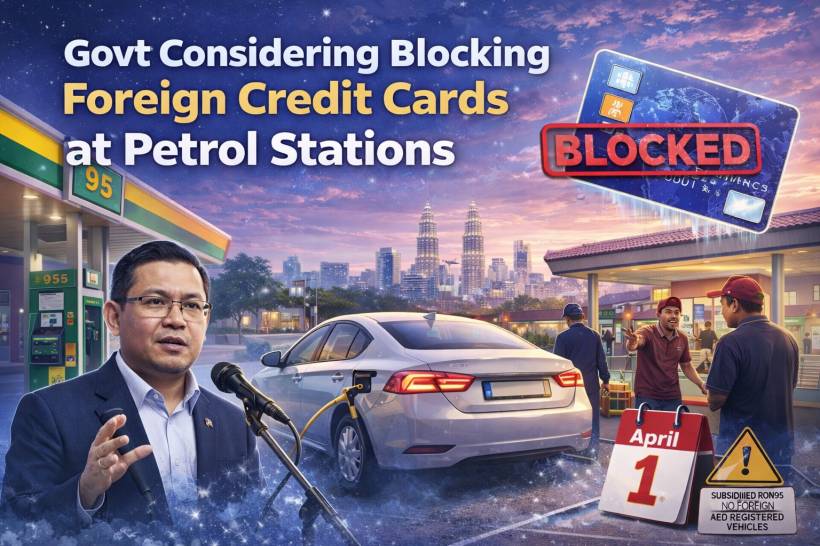
If you've ever paid for petrol using the outdoor "pay-at-pump" terminal, you'll know how quick and convenient it is. But that convenience is now part of a bigger discussion, because the government is looking at whether overseas-registered credit cards should be blocked at these terminals, especially at petrol stations.
According to Domestic Trade and Cost of Living Minister Datuk Armizan Mohd Ali, a study is currently being done to see if barring foreign credit cards at outdoor payment terminals could help reduce "leakages" linked to the Budi 95 RON95 targeted subsidy effort.
Why this is even on the table
The main concern is pretty straightforward: subsidised RON95 is meant for locals under the government's subsidy structure. If foreigners or ineligible users find ways to access subsidised fuel, it defeats the purpose and drains public funds.
Armizan's point is that enforcement can't only rely on manual checks or petrol station operators spotting suspicious customers. If there are loopholes through technology and payment methods, then the controls also need to happen at the payment layer.
So one idea being explored is: if the card is issued overseas, it may be blocked from being used at the outdoor terminals for subsidised fuel purchases.
More enforcement at "hotspots" and undercover monitoring
Alongside payment controls, the ministry is also planning stronger ground enforcement. Armizan mentioned that plainclothes officers will be deployed for monitoring and operations at locations identified as known hotspots.
This matters because fuel misuse is rarely random. If there are patterns, there are usually places where it happens more frequently, such as border areas, busy highway stations, or locations where enforcement is harder to maintain consistently.
Threats against petrol station operators: ministry says it's criminal
Armizan also raised another issue that tends to get less attention: petrol station operators allegedly receiving threats linked to the sale of RON95.
The minister made it clear that intimidation and threats are criminal offences, and station operators who face such pressure should lodge police reports.
That statement is important, because it signals the government recognises that operators aren't always in a comfortable position. Enforcement isn't just about rules, it's also about safety and preventing coercion.
April 1 enforcement: foreign-registered vehicles barred from subsidised RON95
A major date to note is April 1, when regulations barring occupants of foreign-registered vehicles from purchasing subsidised RON95 will be enforced.
At the moment, enforcement rules are said to focus heavily on petrol station operators and licence holders, meaning the operator can get blamed if foreigners manage to buy subsidised fuel.
Armizan said the ministry is reviewing possible legislative amendments so that individuals attempting to pump subsidised petrol illegally can also be held accountable. This comes after calls for responsibility to be shared, instead of placing the burden almost entirely on station operators.
Not just fuel: new e-commerce laws and controlling foreign dominance in local markets
Interestingly, the minister also touched on a wider set of issues the ministry is working on, and it's not limited to petrol.
One big item is new e-commerce legislation, which the ministry is finalising and aims to table in the next Parliament meeting. The goal is to better regulate online commerce, especially as digital trade grows faster than older laws were designed for.
At the same time, the ministry says it's using existing laws such as the Consumer Protection Act 1999 and Competition Act 2010 to tighten enforcement against an influx of foreign products and services flooding the local market.
Armizan also mentioned updated guidelines on foreign business involvement that are expected to be tabled soon. The intention here is to prevent the domestic market from being dominated by foreign entities, while creating a fairer playing field for micro, small and medium enterprises.
He also acknowledged that while e-commerce falls under the ministry's jurisdiction, it sits inside a broader digital ecosystem involving multiple ministries and agencies. So the approach being taken is a more coordinated one across agencies, while also strengthening the role of digital platforms in enforcement.
Madani Rahmah sales: small traders encouraged to join, not pushed aside
Finally, Armizan responded to concerns that Madani Rahmah sales programmes could hurt smaller traders by pulling customers toward large-scale discount operations.
His response was basically: small traders are welcome to participate as strategic partners, and participation is encouraged for local sundry store operators and cooperatives as well.
He also noted that a large portion of the 2,100 Madani Rahmah operators nationwide are actually smaller stores and retailers, not only big chains.
Final thoughts
When you put everything together, the message is clear: the government is trying to close loopholes in how subsidised petrol is accessed, and that may include using payment restrictions like blocking foreign cards at the pump. At the same time, they're signalling a broader push to tighten rules in fast-moving areas like e-commerce and foreign market participation, while still trying to keep small businesses involved rather than sidelined.











Comments 0