

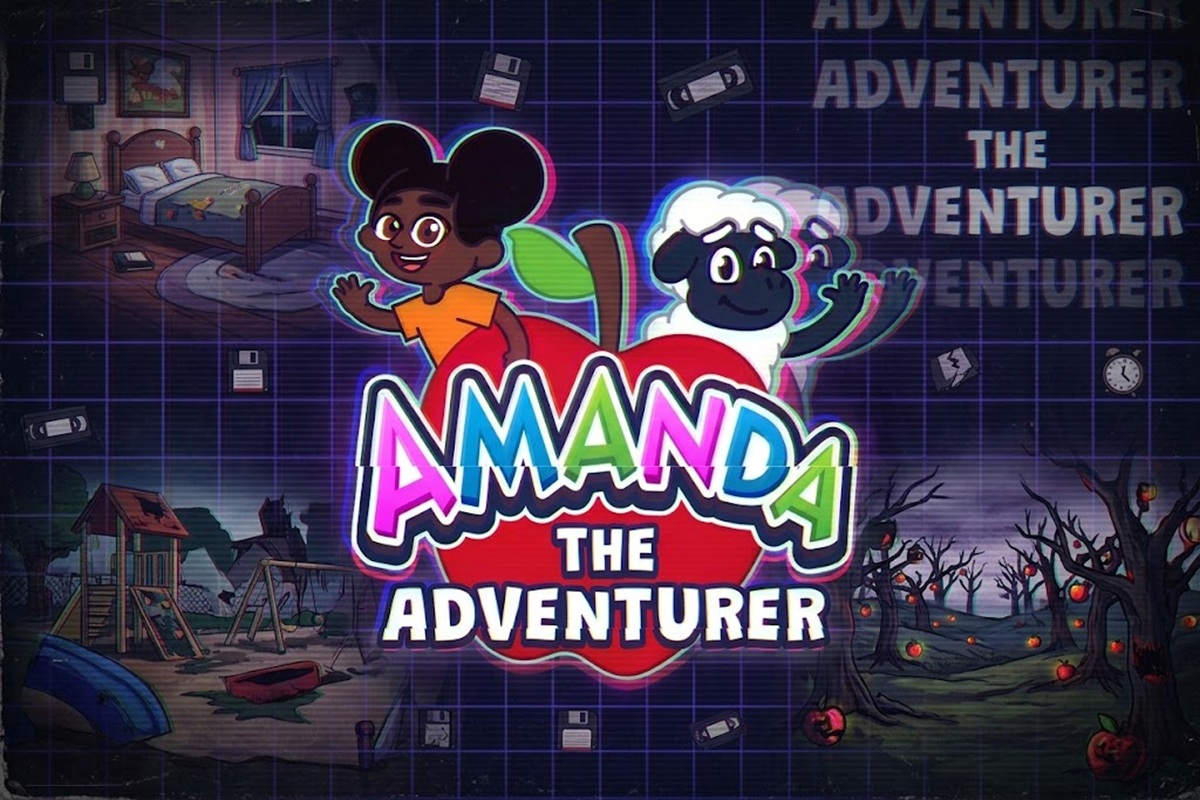
Amanda the Adventurer takes something that should feel completely harmless—a cheerful educational cartoon for children—and slowly turns it into a deeply unsettling psychological horror experience. Players take the role of Riley Park, who inherits the home of their late Aunt Kate and discovers a collection of mysterious VHS tapes inside the attic. The recordings appear to contain episodes of an old children's program starring an enthusiastic girl named Amanda and her nervous companion Wooly the Sheep. What begins as a strange piece of forgotten television quickly becomes much more disturbing when Amanda starts behaving as though she knows someone is watching.
Rather than relying entirely on sudden scares, the game builds tension through interaction, observation, and the growing realization that the tapes are affecting the world outside the television. Amanda frequently asks questions, expects specific responses, and can become increasingly uncomfortable when the player refuses to cooperate. Wooly often appears far less enthusiastic about what is happening, creating a strange contrast between Amanda's forced cheerfulness and his visible concern. The attic itself gradually becomes part of the mystery as clues from the tapes lead to puzzles, hidden objects, additional recordings, and increasingly disturbing discoveries.
Now playable online through Lemon Web Games, Amanda the Adventurer brings this unusual combination of psychological horror, VHS mystery, and escape-room-style puzzle solving directly into the web browser. Players can investigate Aunt Kate's attic, watch the strange episodes, respond to Amanda's questions, examine objects, and gradually uncover the story hidden beneath the colorful children's program. The game is relatively compact, but its secrets, alternate routes, hidden tapes, and multiple endings encourage players to revisit earlier discoveries with new knowledge. What initially appears to be a short horror experience gradually reveals a much larger mystery waiting beneath the surface.
A Children's Cartoon That Should Feel Safe
The fictional Amanda the Adventurer television program deliberately resembles the type of inexpensive educational entertainment that many children grew up watching during the late 1990s and early 2000s. Amanda speaks directly to the viewer, asks basic questions, identifies everyday objects, and explores simple topics alongside Wooly. The low-budget computer animation and intentionally simplistic presentation initially make the episodes seem more awkward than frightening. That familiarity is exactly what allows the horror to work.
The problems begin when Amanda responds to the player's answers in ways that should not be possible for a prerecorded VHS tape. She reacts when the player refuses to cooperate, occasionally becomes visibly frustrated, and seems capable of changing what happens inside the program based on the viewer's input. The cheerful educational format gradually becomes restrictive, as though the tape is less interested in teaching the player and more interested in controlling the conversation. Even simple questions begin to feel threatening.
Wooly's reactions make these situations even more uncomfortable. He often looks nervous when Amanda becomes angry and occasionally appears to understand more about their situation than he is willing or able to explain. His attempts to warn the player are frequently interrupted or redirected. This creates a constant feeling that something is happening behind the cartoon that neither character can openly discuss.
Riley Park and Aunt Kate's Mysterious Attic
Outside the tapes, the entire adventure primarily unfolds within Aunt Kate's attic. Riley has inherited the house following Kate's death and begins investigating the belongings she left behind. The old television and VCR immediately become the focus, but the surrounding room contains far more than background decoration. Nearly every object eventually becomes connected to the larger puzzle.
At first, the attic seems cluttered with ordinary storage items, children's toys, furniture, clocks, and boxes. As more tapes are watched, however, objects can appear, disappear, change position, or suddenly become important. A clue shown briefly inside an episode may reveal how to operate something in the room. This connection between television and reality is one of the game's strongest ideas.
The attic gradually functions like a compact escape room where almost everything deserves attention. Players need to remember numbers, colors, symbols, musical notes, spoken phrases, and unusual visual details that may become useful later. The limited environment makes observation especially important because the answer is often already somewhere nearby. The challenge comes from understanding which detail matters and when.
Watching the Tapes Is Only Half the Game
The VHS recordings provide the narrative foundation, but Amanda the Adventurer is not simply an interactive horror movie. Each tape contains information that can affect the physical attic, and solving those connections is necessary to discover additional episodes. Players frequently move between watching television and examining the environment, creating a repeating cycle of observation and experimentation. The two parts of the game constantly influence one another.
For example, an episode may demonstrate a simple activity such as cooking, visiting stores, or dealing with an accident. Details that appear harmless during the cartoon can later become instructions for solving a physical puzzle. An object might appear in the attic after the tape finishes, giving the player an opportunity to reproduce something Amanda demonstrated. Completing that puzzle then reveals another recording.
This structure creates a satisfying sense that every episode needs to be watched carefully. Players who treat the tapes as passive story scenes can easily overlook important information. Small details in the background, unusual dialogue, and seemingly unnecessary numbers may all become meaningful. The game rewards players who pay attention rather than simply waiting for the next scare.
Amanda Talks Directly to the Player
The interaction between Amanda and the player is central to the horror. During several episodes, Amanda asks questions that require typed responses or direct selections. At first, these requests resemble the participation segments found in ordinary educational television. The difference is that Amanda actually acknowledges what the player enters.
Typing an incorrect answer can produce increasingly strange reactions. Sometimes Amanda gives another opportunity, while in other situations the game begins limiting what the player is allowed to do. Objects may disappear or the expected answer may become impossible to avoid. The illusion of choice gradually gives way to the disturbing realization that Amanda may only tolerate participation when the viewer behaves correctly.
This makes even simple dialogue prompts feel tense. Players begin wondering whether telling Amanda what she wants to hear is safer than challenging her. At the same time, deliberately giving unexpected responses can reveal unusual dialogue or alternative outcomes. The game turns the act of typing a word into something far more uncomfortable than it should be.
Wooly Is More Than Amanda's Sidekick
Wooly initially appears to be the typical friendly companion found in children's educational programs. He follows Amanda between locations, participates in conversations, and generally reacts to whatever activity she has planned. However, his body language often suggests that he is uncomfortable with the direction the episode is taking. That nervousness quickly becomes one of the most important sources of tension.
There are moments when Wooly appears to disagree with Amanda or tries to draw attention toward something she would rather ignore. His reactions make the player question whether he is simply another cartoon character or someone trapped in a situation he understands better than the viewer. Amanda's attitude toward him also changes depending on what is happening. Their relationship becomes increasingly difficult to interpret.
The uncertainty surrounding Wooly encourages players to pay close attention whenever he appears. A small look toward the camera or interrupted comment may suggest much more than the dialogue says directly. The game rarely explains everything immediately, allowing players to build theories as more recordings are discovered. This ambiguity is one of the reasons the mystery remains interesting across multiple playthroughs.
Escape-Room Puzzles Fill the Attic
Amanda the Adventurer uses a wide range of puzzle types despite taking place inside a relatively small environment. Players manipulate clocks, musical instruments, toys, locks, containers, cooking equipment, and other objects while searching for the next tape. Each puzzle usually draws information from something previously seen or heard. This makes observation more important than complicated mechanical skill.
Some solutions involve reproducing a sequence from a VHS episode. Others require interpreting a visual clue, remembering a spoken time, arranging objects correctly, or connecting information found in different parts of the room. The puzzles are generally logical once the relevant clue has been recognized. The challenge is often identifying which details are actually instructions.
As the game progresses, puzzles also begin overlapping with one another. An object discovered through one solution may later become important for a completely different sequence. Codes learned during an earlier run can unlock alternative paths when the game is restarted. This gives the attic a layered structure where knowledge becomes a form of progression.
The Attic Changes as the Mystery Deepens
One of the most effective tricks in Amanda the Adventurer is the way the attic refuses to remain completely stable. Watching a tape can cause new objects to appear, while other items may move or behave differently. These changes are often subtle enough that players may initially wonder whether they simply overlooked something. The effect creates a constant sense that the environment cannot be trusted.
A toy oven may suddenly become relevant after watching a cooking episode, while another tape might cause clocks or musical objects to take on new importance. The television itself becomes increasingly threatening as the story develops. Ordinary household objects gradually feel connected to whatever supernatural force exists inside the recordings. The attic stops feeling like a safe place between episodes.
Because the room is relatively small, players naturally become familiar with where everything should be located. This familiarity makes changes more noticeable and disturbing. Horror does not always require introducing a new monster when something as simple as an object appearing where it was not before can create uncertainty. The game repeatedly uses that idea to maintain tension.
Classic CGI Creates an Uncomfortable Nostalgia
The visual style of the tapes deliberately imitates early computer-generated children's television. Character models are simple, environments are brightly colored, and animation can feel slightly stiff or unnatural. Under normal circumstances, this would simply resemble low-budget educational media from an earlier era. Within a horror game, those limitations become unsettling.
Amanda's facial expressions can change suddenly from cheerful to irritated, making the simplistic animation feel surprisingly threatening. Wooly's nervous movements also stand out because the player quickly learns to watch his reactions. As the recordings become more unstable, visual glitches and unnatural transitions make the artificial world feel increasingly corrupted. The contrast between bright colors and disturbing subject matter is especially effective.
The VHS presentation adds another layer of nostalgia. Static, tracking problems, distorted audio, and degraded footage make the recordings feel like physical artifacts rather than ordinary digital videos. Players who remember watching old tapes may recognize the familiar imperfections. The game transforms that nostalgia into something uncomfortable.
Psychological Horror Without Constant Combat
Amanda the Adventurer does not build its horror around weapons, ammunition, or repeated enemy encounters. Most of the game is spent watching tapes, solving puzzles, and trying to understand what is happening. This slower approach allows tension to accumulate gradually rather than constantly interrupting the player with direct threats. The uncertainty becomes the danger.
The player knows relatively early that something is deeply wrong, but the exact nature of the threat remains unclear. Amanda's behavior, Wooly's fear, Aunt Kate's involvement, and the changing attic all suggest different possibilities. Each new answer creates additional questions. That uncertainty encourages continued exploration even when the player knows that discovering more may lead somewhere unpleasant.
When direct horror eventually appears, it feels more effective because the game has spent so much time establishing unease beforehand. The player has already become suspicious of the television and uncomfortable with Amanda's questions. A sudden escalation therefore feels like the consequence of something that has been building for a long time. The pacing relies more on anticipation than constant action.
Aunt Kate's Investigation Adds a Deeper Mystery
Aunt Kate becomes increasingly important as players discover more about why the tapes were inside her house. She clearly knew something unusual was happening and had investigated the program before Riley arrived. Notes, recordings, and hidden information suggest that her involvement went considerably deeper than simply collecting strange children's videos. Understanding what happened to her becomes part of the larger mystery.
The game gradually hints that other people have also been affected by the program. References to missing individuals, the production behind Amanda's show, and strange events connected to viewers suggest that the tapes have a history beyond Riley's attic. These clues expand the story without removing the mystery too quickly. Players are encouraged to piece together information rather than receiving one straightforward explanation.
Secret recordings are especially important for understanding this background. They reveal events that are not shown during the normal sequence of Amanda episodes and provide additional context about the people connected to the program. Finding them can significantly change how certain characters and events are interpreted. The deeper story rewards players who are willing to investigate beyond the most obvious path.
The Story Behind Amanda Becomes Increasingly Disturbing
Amanda initially appears to be nothing more than a fictional cartoon character, but the game's hidden story gradually challenges that assumption. Clues suggest connections between the animated program and real people involved in its creation. The cheerful character seen on the tapes may represent something much more complicated than a simple television mascot. Discovering that connection becomes one of the central mysteries.
The production company associated with the show also becomes increasingly suspicious as more information is uncovered. What appears to have been an ordinary children's entertainment project seems connected to unexplained disappearances and disturbing experimentation. The game deliberately reveals these ideas in fragments rather than providing a complete explanation immediately. Players need to combine information from multiple tapes and environmental clues.
This fragmented storytelling works especially well for horror because certainty is delayed. Players may understand one piece of the mystery while remaining unsure how it connects to another. Each secret tape can challenge an earlier theory. The story therefore continues developing even after the basic gameplay mechanics are familiar.
Choices Can Lead to Different Outcomes
Amanda the Adventurer contains multiple endings, and reaching them depends on what the player discovers and how certain situations are handled. A first playthrough can end surprisingly quickly, but that does not mean the entire game has been completed. Information learned during one run can reveal new possibilities when the attic resets. This makes replaying an intentional part of the experience rather than simple repetition.
Certain choices during the tapes can influence what follows. The player may have opportunities to cooperate with Amanda, resist her, or investigate something she does not want explored. These decisions can lead toward very different conclusions. Some endings reveal substantially more about the mystery than others.
There are five endings to discover in the full game, giving completion-focused players a clear reason to investigate alternative routes. Finding them all requires more than simply repeating the same puzzle sequence. Secret information, hidden tapes, and knowledge obtained during previous runs gradually open additional possibilities. The game becomes more interesting once players realize that apparently finished puzzles may still contain another layer.
Secret Tapes Expand the Story
Hidden tapes provide some of the game's most important optional discoveries. Unlike the normal episodes required for progression, these recordings contain additional information about the people and events surrounding Amanda's program. They may appear after performing unusual actions or interpreting clues that are easy to miss during a first run. Finding one often feels like discovering evidence that was never intended to be seen.
The secret recordings also change the way players understand the main episodes. Dialogue that seemed meaningless during an earlier playthrough may suddenly have new significance. Characters who initially appeared straightforward become more complicated once their background is revealed. The game rewards players for reconsidering earlier assumptions.
Collecting these tapes becomes especially important for reaching the deepest parts of the story. Players interested only in obtaining an ending can finish much sooner, but those who want to understand what happened need to investigate far more thoroughly. This layered approach makes the relatively short game feel much larger than its physical environment suggests.
Knowledge Becomes the Real Form of Progression
Amanda the Adventurer does not use experience points, equipment upgrades, or conventional character progression. Instead, the player's knowledge becomes the most important thing carried between attempts. A code discovered near the end of one route may be useful much earlier after restarting. This fundamentally changes how subsequent playthroughs are approached.
The attic may reset, but the player remembers which objects matter and which clues have alternative interpretations. Puzzles that required careful investigation initially can be completed quickly once their solutions are understood. This frees the player to experiment with different choices and search for hidden content. Progress therefore happens outside the character rather than through an inventory screen.
This design fits the mystery genre extremely well. Riley may begin each route in a familiar situation, but the person controlling them knows increasingly more about what is happening. The player gradually becomes less vulnerable to the game's misdirection. Eventually, knowledge provides access to paths that seemed impossible during the first attempt.
The Original Concept Grew into a Much Larger Game
Amanda the Adventurer began as a much smaller horror project before being expanded into the full 2023 release. The early concept already contained the central idea of watching an increasingly disturbing children's program, but the larger game developed the premise considerably further. The attic became a more substantial puzzle environment, while Amanda and Wooly's story gained additional layers. Multiple endings and secret recordings transformed the idea into a much broader mystery.
This evolution helps explain why the final game feels unusually focused. Its central concept was simple enough to communicate immediately: watch strange children's tapes and realize something is wrong. Instead of abandoning that idea when the project expanded, the developers built additional mechanics around it. Nearly everything still revolves around the relationship between the television and the attic.
The expanded version also benefits from understanding exactly what made the original concept unsettling. Amanda does not need to become a conventional horror villain immediately. The most effective moments are often the smaller ones, such as a strange response to the player's answer or Wooly looking nervously toward the viewer. The full game gives those ideas more room to develop.
The Sound Design Makes the Silence Uncomfortable
Sound plays an important role in establishing atmosphere. The VHS episodes contain deliberately cheerful voices and simple educational dialogue, while the attic itself can become eerily quiet between recordings. That contrast makes small noises especially noticeable. A mechanical sound from elsewhere in the room can immediately suggest that something has changed.
Amanda's tone of voice is particularly important. Her cheerful delivery can shift toward irritation or aggression without completely abandoning the style of a children's presenter. Wooly's nervous speech creates the opposite effect, making even ordinary dialogue sound uncertain. Their vocal performances help communicate emotions that the intentionally simple character models cannot always express alone.
Static and distorted tape audio further reinforce the analogue horror atmosphere. Glitches are not merely visual; sound can also break, repeat, or become uncomfortable when the episode begins behaving incorrectly. These effects make the television feel increasingly unstable. The player learns to associate distortion with the possibility that something is about to go wrong.
Why the Game Works Without a Large Environment
The attic is a very small location compared with the sprawling environments found in many horror games, yet that limitation becomes one of Amanda the Adventurer's strengths. Players quickly memorize the room and develop expectations about where objects belong. This makes every change meaningful. The environment becomes familiar enough that even subtle alterations can feel suspicious.
A larger setting could have encouraged players to spend more time simply navigating between objectives. Keeping everything close together allows the game to focus on puzzles and observation instead. When a clue points toward an object, the challenge is understanding the relationship rather than travelling across a huge map. This keeps the pacing tight.
The limited environment also creates a claustrophobic feeling. Riley cannot simply walk away from the tapes and explore somewhere safer. The television remains nearby throughout almost the entire experience. As the mystery becomes more threatening, the attic begins feeling less like a room and more like a trap.
Why Amanda the Adventurer Remains Memorable
Amanda the Adventurer stands out because it understands that something familiar can become far more frightening when it behaves incorrectly. Children's educational television is supposed to be repetitive, reassuring, and safe. The game preserves those qualities just long enough for players to recognize them before gradually introducing behaviour that should never occur. That contrast is much more unsettling than simply beginning with obvious horror.
The interactive structure also makes the experience more personal. Amanda is not merely speaking to an unseen cartoon audience; she appears to be speaking directly to the person playing the game. Typing responses creates the uncomfortable feeling of participating in the episode rather than simply observing it. Even when choices are limited, the illusion of direct communication is effective.
The mystery provides the final layer. Players who finish one route often leave with more questions than answers, encouraging them to explore again. Hidden tapes, alternate endings, and environmental secrets gradually reveal a much larger story. The result is a horror game that remains interesting after the initial scares are already known.
Playing Amanda the Adventurer Online Today
Through Lemon Web Games, Amanda the Adventurer can now be played directly in your web browser with no downloads or setup required. Features of the web-based version include:
Playing Amanda the Adventurer through a browser suits the game's compact and focused structure particularly well. Players can immediately enter the attic, begin watching the tapes, and start investigating without needing to learn complicated controls or combat mechanics. Most interactions involve observing objects, entering answers, manipulating puzzle elements, and understanding clues. The simplicity of the controls allows the mystery itself to remain the primary challenge.
The game is also ideal for repeated sessions because information discovered during one run can completely change how the next attempt unfolds. A player may immediately recognize a code, hidden object, or alternative choice that was meaningless earlier. Each revisit becomes less about repeating the same experience and more about investigating unanswered questions. That structure gives the game significantly more replay value than its relatively small environment initially suggests.
Who Should Play Amanda the Adventurer
Amanda the Adventurer is particularly suitable for players who enjoy examining small details and forming theories about what they have discovered. Much of the satisfaction comes from realizing that an apparently meaningless number, object, or line of dialogue actually connects to another part of the game. Players who enjoy taking notes and revisiting earlier clues will likely discover far more than someone who simply follows the most obvious route. The game rewards curiosity almost constantly.
It is also a strong choice for horror fans who prefer atmosphere over continuous action. There are frightening moments, but the majority of the tension comes from waiting for Amanda to react, wondering whether Wooly is trying to communicate something, and watching the attic behave in ways it should not. The player spends more time thinking than fighting. That slower approach makes the eventual horror considerably more effective.
Play Amanda the Adventurer Online Now
Amanda the Adventurer turns a television, a stack of VHS tapes, and a cluttered attic into the foundation for an unusually effective horror mystery. Players begin with almost no understanding of what the recordings are or why Aunt Kate kept them, but every episode adds another piece of information. Amanda's increasingly disturbing behaviour, Wooly's fear, the changing attic, and the hidden recordings gradually build a story much larger than the room in which the game takes place. Solving the puzzles becomes inseparable from understanding what happened.
Through Lemon Web Games, players can enter this strange attic directly through a modern web browser and experience the mystery at their own pace. The game works especially well for players willing to investigate beyond the first ending, because each new discovery can reveal another route or reinterpret something seen earlier. Secret tapes and alternative outcomes provide plenty of reasons to experiment. The deeper players look, the less innocent Amanda's cheerful television program begins to appear.
Final Thoughts
Amanda the Adventurer succeeds because it understands that horror does not always need darkness, abandoned hospitals, or monsters waiting around every corner. Its most effective weapon is contrast. Amanda's brightly colored educational program looks cheerful and harmless, yet her reactions quickly make the viewer uncomfortable, while Wooly's growing anxiety suggests that something is deeply wrong. The game takes the familiar language of children's television and gradually turns every reassuring element into a reason for suspicion.
Its puzzle design strengthens that atmosphere by connecting the VHS episodes directly to the physical attic. Watching a tape is rarely a passive activity because dialogue, numbers, visual details, and background objects may provide the answer to another mystery. The small environment becomes increasingly layered as knowledge from earlier runs opens new possibilities. Multiple endings and hidden recordings reward players who refuse to accept the first explanation they are given.
What ultimately makes Amanda the Adventurer memorable is the feeling that the game is watching the player almost as closely as the player is watching Amanda. Every question creates uncertainty about whether the answer actually matters, every glitch suggests something hidden beneath the cartoon, and every new tape promises information that may be better left undiscovered. Through Lemon Web Games, players can experience this disturbing mixture of interactive television, escape-room puzzles, analogue horror, and psychological mystery directly in their browser. For anyone who enjoys horror built around curiosity, observation, and the uneasy feeling that something familiar has gone terribly wrong, Amanda the Adventurer remains a compelling experience.











Comments 0