

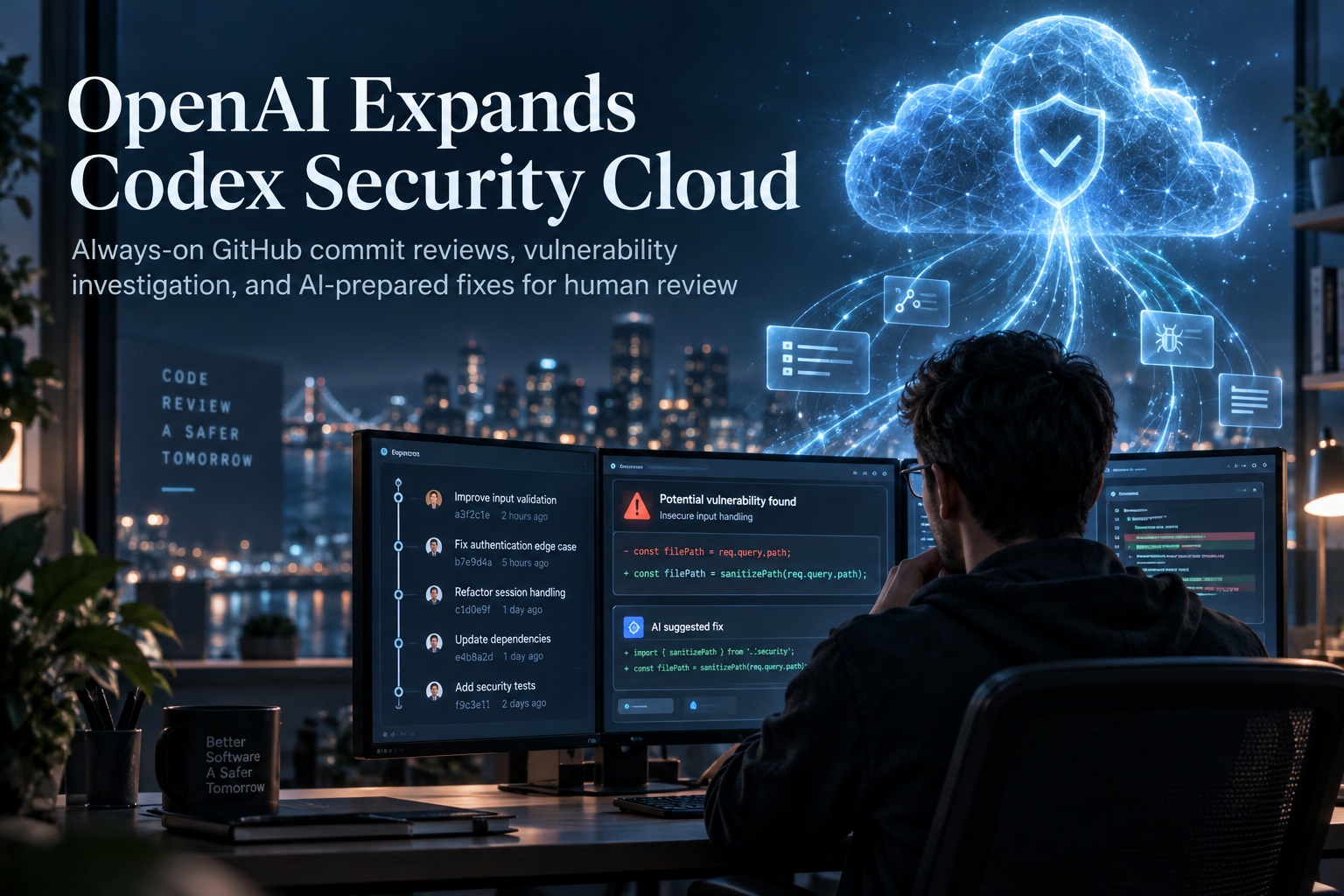
OpenAI has expanded Codex Security Cloud with always-on application security capabilities designed to continuously review GitHub repositories, investigate potential vulnerabilities and prepare proposed fixes for developers to examine. The service operates through a cloud-based workflow, meaning security analysis can continue even when an engineer is not actively working on their local machine.
The platform is available through Codex on desktop and web, with access to cyber-capable models through Daybreak Blue included by default. According to OpenAI, Codex Security Cloud can analyse entire repositories rather than only individual files or pull requests, giving it broader context when looking for security weaknesses.
Security Analysis Continues Even When Your Laptop Is Closed
One of the main advantages OpenAI is highlighting is that the scanning process does not depend on a developer keeping a local development environment running. Once a GitHub repository has been connected, the service can continue analysing code remotely in the cloud.
OpenAI describes this as a way for security work to continue "even when your laptop is closed". In practice, this means repository reviews and investigations can run independently of a developer's workstation, potentially reducing reliance on manually triggered local scans.
This also makes the platform closer to a continuous security service than a traditional code analysis tool that only runs when someone launches it.
Full GitHub Repositories Can Be Analysed
Codex Security Cloud is designed to inspect complete GitHub repositories rather than treating each file as an isolated unit. This gives the system more context about how different parts of an application interact.
Some security vulnerabilities only become apparent when several components are considered together. An authentication function may appear secure on its own, for example, but a configuration file or another service may introduce a path that bypasses the expected control.
Repository-wide analysis could potentially help identify issues involving:
However, OpenAI has not published measured results showing how accurately the system detects these cross-component vulnerabilities.
New Commits Are Reviewed Continuously
Once integrated with a repository, Codex Security Cloud can continuously review newly committed code. This places security analysis directly into the development lifecycle rather than treating it as something that happens only before a release.
New code entering the repository can therefore be examined for potential vulnerabilities shortly after it is committed. The intended benefit is to identify security problems closer to the point where they are introduced, when developers may still have the relevant code and context fresh in mind.
Exactly how quickly vulnerabilities are detected will depend on the platform's actual performance. OpenAI has not provided benchmark data showing the average time between a vulnerable commit being added and the system identifying it.
Codex Investigates Findings Instead Of Only Flagging Them
The workflow goes beyond simply generating a list of suspicious code locations. OpenAI says Codex Security Cloud can investigate suspected vulnerabilities to better understand what is happening and how the issue may affect the application.
This is an important distinction because traditional security scanners often produce large numbers of findings that developers must manually interpret. A raw alert may identify a potentially unsafe function but provide little context about whether the issue is actually exploitable.
By investigating the surrounding code and repository context, Codex is intended to produce more useful findings rather than simply flagging isolated patterns.
Duplicate Findings Can Be Consolidated
OpenAI also says the service can deduplicate vulnerability findings. This is intended to reduce situations where one underlying problem creates several separate alerts across different parts of the application.
Alert duplication is a common problem in application security because the same weakness can appear through several scanning paths or trigger multiple rules. Security teams then spend time reviewing several alerts that ultimately point to the same root cause.
Codex Security Cloud aims to group those findings together so teams can focus on distinct vulnerabilities rather than repeated reports. However, OpenAI has not published figures showing how much the system reduces duplicate alerts in real-world environments.
The Platform Can Prepare Proposed Fixes
After identifying and investigating a vulnerability, Codex Security Cloud can prepare a proposed remediation. Rather than stopping at "this code may be vulnerable", the system can suggest how the affected code could be changed.
That could make the security workflow considerably faster for developers because investigation and remediation preparation happen within the same platform. A developer could potentially receive both an explanation of the issue and a candidate patch to review.
The important word, however, is proposed. The generated fix is not automatically assumed to be correct.
Human Review Remains Part Of The Process
OpenAI's workflow keeps human approval between the generated recommendation and any actual code change. Developers and security engineers remain responsible for examining the proposed patch before accepting it.
That review is important because a security fix can introduce new problems even when it successfully addresses the original vulnerability. A patch could affect application behaviour, introduce compatibility issues or break functionality elsewhere in the system.
Teams therefore still need to perform normal validation such as:
AI can accelerate parts of the process, but responsibility for accepting the change remains with the development team.
The Workflow Covers Detection, Investigation And Remediation Preparation
Codex Security Cloud essentially brings three stages of application security into one continuous workflow. First, it searches for potentially vulnerable code. Next, it investigates the issue using broader repository context. Finally, it prepares a remediation proposal for human review.
This is a different model from security tools that simply produce a vulnerability report and leave everything else to the developer. OpenAI is positioning Codex as an assistant capable of following the issue further through the security lifecycle.
For teams already using Codex for development, integrating these functions into the same environment could reduce the number of separate tools developers need to move between during vulnerability investigation.
Daybreak Blue Provides Cyber-Capable Models
Access to cyber-capable AI models through Daybreak Blue is included by default with the service. These models are intended to handle security-focused reasoning tasks such as vulnerability analysis and code investigation.
The addition reflects a broader trend where AI coding assistants are becoming increasingly specialised. Instead of only helping developers write functions or explain code, newer systems are being designed to inspect application architecture, identify weaknesses and propose security improvements.
This moves AI-assisted development closer to traditional application security workflows.
Always-On Scanning Changes How Security Fits Into Development
Cloud-based continuous analysis could also change when developers receive security feedback. Traditional application security testing is often performed at particular checkpoints, such as during a pull request, before deployment or during a scheduled security review.
An always-on service instead treats the repository itself as something that can be monitored continuously. Every new commit becomes another opportunity for analysis.
This approach could potentially shorten the time between introducing a vulnerability and discovering it. However, OpenAI has not provided data demonstrating how much faster detection becomes compared with existing application security products.
Performance Claims Still Need Independent Evidence
One important limitation is that the effectiveness of Codex Security Cloud is currently based largely on OpenAI's own description of the product. The company has not published detailed measurements for detection accuracy, false-positive rates or the quality of proposed patches.
Those metrics will matter significantly for security teams evaluating the platform. A scanner that finds many vulnerabilities but produces too many false alarms can create additional workload rather than reducing it.
Similarly, generated fixes need to be judged not only on whether they compile but whether they actually resolve the security issue without damaging application behaviour.
False Positives Could Still Create Alert Fatigue
AI-based analysis does not automatically eliminate the problem of false positives. If the system incorrectly identifies safe behaviour as vulnerable, developers still need to spend time investigating the report.
Deduplication may reduce repeated alerts, but it does not guarantee that the remaining findings are correct. Security teams will likely need to build confidence in the platform gradually by comparing its findings against manual review and existing scanning tools.
For that reason, Codex Security Cloud is best viewed as an additional application security capability rather than an automatic replacement for existing security testing.
AI Could Make Security Reviews More Accessible To Developers
One potential advantage of this type of system is that it could make vulnerability analysis easier for developers who are not security specialists. A conventional scanner may provide technical output that requires substantial security knowledge to interpret.
An AI system capable of explaining the vulnerability, showing how different pieces of code interact and suggesting a fix could make the result more actionable. Developers can potentially understand not only that something is wrong but why it matters.
That could help shift security further into normal development workflows instead of leaving every issue to a dedicated security team.
Final Thoughts
OpenAI's expansion of Codex Security Cloud pushes Codex further beyond traditional coding assistance and into continuous application security. The ability to analyse entire GitHub repositories, monitor new commits, investigate potential vulnerabilities, consolidate duplicate findings and prepare remediation proposals creates a much broader security workflow than simply scanning individual files.
The cloud-based design also means analysis can continue without a developer keeping a local session active, making the service effectively always on once a repository is connected. The biggest unanswered question is how well it performs in real-world environments, since OpenAI has not yet published detailed detection accuracy, false-positive or patch-quality metrics.
For now, the most sensible role for Codex Security Cloud is as an AI-assisted security reviewer rather than an autonomous security authority. It can help developers investigate and respond to potential vulnerabilities faster, but human review, testing and security judgement remain essential before any generated fix reaches production.











Comments 0