

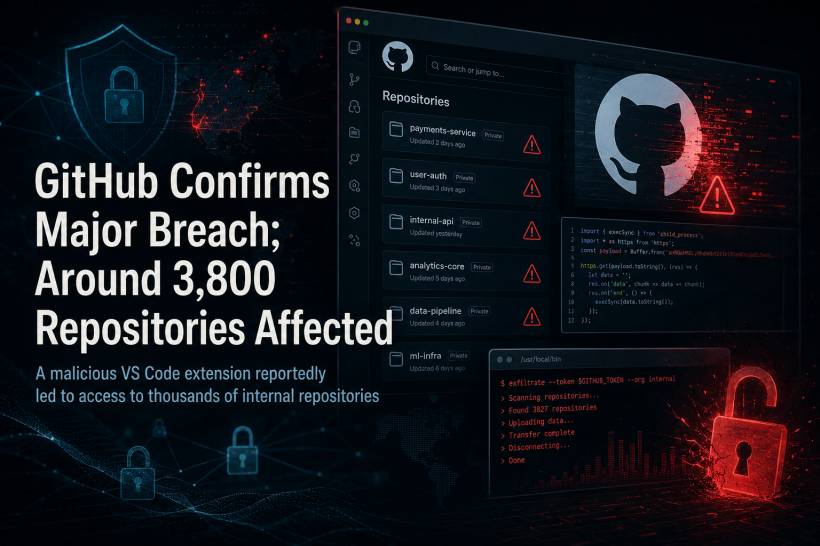
GitHub has confirmed a serious internal security incident involving around 3,800 of its own code repositories. According to the company, the breach began after an employee's device was compromised through a malicious Visual Studio Code extension, allowing attackers to steal credentials and gain access to internal GitHub repositories.
The incident was detected on 19 May and is still under investigation. While GitHub has not yet published a full technical breakdown, the early details suggest this was not a simple password leak or basic phishing attempt. Instead, it appears to be part of a wider software supply chain attack, where trusted developer tools are abused to reach high-value systems.
The attack has been linked to a cybercrime group known as TeamPCP, which later claimed responsibility on dark web forums. The group claims it obtained GitHub source code and internal project data and is allegedly trying to sell the stolen information for at least US$50,000, or around RM198,000. It also reportedly threatened to leak the data publicly if no buyer comes forward.
How The Breach Happened
Based on GitHub's explanation, the attackers gained their initial foothold after an employee installed a poisoned VS Code extension. Once the extension was running on the device, it was able to compromise the system and steal credentials.
Those credentials then gave the attackers access to GitHub's internal repositories. GitHub has said that TeamPCP's claim of roughly 3,800 affected repositories is "directionally consistent" with what the company has found so far.
This is the part that makes the incident especially concerning. Developers often rely heavily on extensions, plugins, command-line tools, package managers, and automation scripts to do their work. Many of these tools require access to code, credentials, tokens, or development environments. If one of those tools is compromised, the attacker does not need to break through the front door. They can quietly ride along inside something the user already trusts.
Customer Repositories Were Not Affected
One important clarification from GitHub is that the breach involved internal repositories only. The company has stressed that customer projects, public repositories, and private repositories hosted by users on the platform were not affected by this incident.
That distinction matters because GitHub is one of the most important platforms in the software development world. Millions of developers, businesses, open-source projects, and enterprises depend on GitHub to host and manage code. Any suggestion of a platform-wide breach would naturally raise major concerns.
In this case, the exposed data appears to involve GitHub's own internal systems and projects. Reports mention code connected to areas such as GitHub Actions, Copilot-related projects, agentic workflow systems, and Rails controllers used for pull request management.
Even though customer repositories were reportedly not impacted, internal source code exposure is still serious. It could give attackers insight into how GitHub's systems are structured, how certain workflows are built, or where future weaknesses might exist.
Possible Link To The Nx Console Supply Chain Attack
GitHub has not publicly named the specific malicious VS Code extension involved in the breach. However, security researchers believe the incident may be connected to a recent supply chain attack involving the Nx Console extension for Visual Studio Code.
Nx Console is a popular development extension with more than 2.2 million installs. According to reports, the extension was briefly compromised after attackers gained access to a developer token. That access allegedly allowed them to push a malicious update to users.
The compromised update is said to have harvested sensitive developer credentials, including GitHub access tokens, SSH keys, cloud credentials, and API keys linked to services such as AWS and Claude Code. Once those credentials were stolen, attackers could use them to move deeper into developer environments and potentially compromise other systems.
This type of attack is especially dangerous because it targets the development ecosystem itself. Instead of attacking one company directly, attackers compromise a trusted tool used by many developers. From there, they can collect credentials from multiple environments and expand the attack chain.
The Role Of Self-Spreading Malware
Researchers have also linked TeamPCP to a self-propagating malware strain known as Mini Shai-Hulud. This malware is believed to automate parts of the attack process, making it easier for the attackers to spread and collect more credentials.
The worm reportedly creates new GitHub repositories to store stolen credentials and can help push compromised updates to other software packages or tools. That makes the attack more than a one-time breach. It becomes a spreading campaign that can move through developer environments if not stopped quickly.
This is why supply chain attacks are so difficult to contain. A single compromised extension or package can affect many users, and each affected user may have access to different repositories, services, cloud platforms, and internal systems.
What GitHub Has Done So Far
After discovering the breach, GitHub says it acted quickly to contain the incident. The company isolated the compromised employee device, removed the malicious extension from the VS Code Marketplace, and rotated critical secrets and credentials overnight.
Credential rotation is one of the most important steps in this kind of incident. Once tokens, keys, or secrets may have been exposed, they can no longer be trusted. Replacing them quickly helps reduce the chance that attackers can continue using stolen access after the initial breach has been discovered.
GitHub also says it has reviewed logs, monitored for further suspicious activity, and launched a broader incident response investigation. A more detailed report is expected once the investigation is complete.
Why This Incident Matters
This breach is another reminder that developer environments are now major security targets. In the past, companies were mostly worried about exposed passwords, vulnerable servers, or direct attacks against production systems. Today, attackers are increasingly going after the tools developers use every day.
A compromised extension, package, dependency, or build tool can be extremely powerful because it may run inside trusted environments. It may also have access to source code, credentials, internal APIs, deployment workflows, and cloud infrastructure.
For developers and organisations, this means software supply chain security can no longer be treated as a secondary concern. Extension permissions, package integrity, token storage, secret scanning, endpoint protection, and least-privilege access all matter.
It also highlights the risk of long-lived credentials. If a stolen token provides broad access and does not expire quickly, attackers have more time to abuse it. Short-lived tokens, scoped permissions, and strict access controls can reduce the damage when something goes wrong.
A Wake-Up Call For Developer Tooling
VS Code extensions are convenient and often essential for modern development, but this incident shows why they should be treated with the same caution as any other software installed on a work machine.
Developers should be careful about which extensions they install, especially in corporate or production-connected environments. Organisations may also need to review whether developers can freely install marketplace extensions, or whether approved extension lists and additional scanning should be used.
This does not mean developers should stop using extensions entirely. The point is that trusted tooling needs governance. Popular tools can still be compromised, and even legitimate projects can become attack vectors if an attacker gains access to their publishing pipeline.
Final Thoughts
GitHub's confirmed breach is a major security incident, not because customer repositories were affected, but because it shows how dangerous a compromised developer tool can become. Around 3,800 internal repositories were reportedly exposed after an employee device was compromised through a malicious VS Code extension, turning a trusted development workflow into an entry point for attackers.
GitHub's quick response, including isolating the device, removing the malicious extension, rotating secrets, and reviewing logs, should help limit further damage. However, the broader lesson goes beyond GitHub.
Modern software development depends on layers of tools, extensions, packages, APIs, and automation. When one trusted piece of that chain is poisoned, the impact can spread quickly. This incident is another strong reminder that securing developer environments is just as important as securing production systems.











Comments 0