

MyRepublic has launched Hyperpeer in Malaysia and Singapore, introducing a gaming-focused network service designed to improve how traffic travels between players and supported game servers. Unlike a faster broadband package, Hyperpeer is not meant to increase download or upload speeds. Instead, it focuses on reducing latency, packet loss and route instability by choosing a more efficient path between the gamer and the destination server.
That distinction is important because a high-speed internet connection does not always guarantee a good gaming experience. A player may have hundreds of megabits of available bandwidth and still suffer from lag if their traffic takes an inefficient route across the internet. Hyperpeer is aimed specifically at that problem, with MyRepublic claiming that the service can reduce ping by up to 30% under supported conditions.
Hyperpeer Focuses on Routing Rather Than Raw Internet Speed
Online games generally do not need enormous amounts of bandwidth, but they are extremely sensitive to latency. A delay of even a few dozen milliseconds can affect responsiveness in competitive titles, particularly in shooters, fighting games and other fast-paced multiplayer experiences.
Hyperpeer attempts to improve this by automatically selecting what MyRepublic describes as the shortest available route to the game server. Instead of relying entirely on the default routing chosen by a user's internet service provider, the service directs supported gaming traffic through MyRepublic's own network infrastructure where possible.
The goal is to make the connection more direct and predictable. A better route can potentially reduce the time it takes for data to travel between the player and the game server, while also helping to reduce packet loss and sudden latency spikes.
A Faster Connection Does Not Always Mean Lower Ping
This is where Hyperpeer differs from a conventional broadband upgrade. Moving from a 300Mbps connection to a 1Gbps connection can make large downloads considerably faster, but it may have very little effect on gaming latency if both plans use the same inefficient route to a server.
Latency depends on several factors, including physical distance, network congestion, peering arrangements and the number of intermediate networks a connection has to cross. If game traffic is being sent along an unnecessarily long path, increasing bandwidth does not necessarily solve the issue.
Hyperpeer is therefore positioned more like a gaming route optimisation service than a broadband speed booster. The service does not create additional bandwidth; it tries to make better use of the connection the customer already has.
MyRepublic Says Gaming Traffic Uses a Dedicated Private Network
Another part of the Hyperpeer design is the separation of gaming traffic from other bandwidth-heavy activity. MyRepublic says supported traffic travels through a private network dedicated to gaming, rather than competing directly with activities such as large downloads, file transfers or video streaming.
The idea is to provide a more consistent route for latency-sensitive traffic. In a typical household, several devices may be streaming videos, downloading updates or synchronising files at the same time someone is playing an online game. Even if the local connection is fast enough to handle all of that activity, congestion elsewhere on the network can still introduce instability.
By placing game traffic onto a dedicated route, MyRepublic is aiming to minimise some of those variables. Whether the improvement is noticeable will still depend on the user's existing connection, location, ISP and the game server being used.
The Claimed 30% Ping Reduction Will Vary by Game and Connection
The headline figure is a reduction of up to 30% in ping, but users should interpret that as a best-case improvement rather than something guaranteed for every game. If a player's existing ISP already provides an efficient route to a particular server, Hyperpeer may have relatively little room to improve it.
The biggest gains are more likely to appear when the normal route is unnecessarily long, congested or affected by inefficient peering. In those cases, shortening the network path could produce a more noticeable improvement.
For example, a player getting 70ms to a server because of poor routing might potentially see a meaningful reduction. Someone already achieving 10ms to a nearby server, however, is unlikely to suddenly experience dramatically lower latency because the physical distance itself imposes limits.
You Do Not Need to Be a MyRepublic Broadband Customer
One of the more interesting aspects of Hyperpeer is that it is not limited to MyRepublic broadband subscribers. The company says the service can be used regardless of the customer's existing internet service provider.
That makes Hyperpeer a standalone gaming service rather than a feature locked exclusively to MyRepublic's own fixed broadband network. A Malaysian user on another ISP can therefore subscribe and test whether Hyperpeer provides a better route to the games they regularly play.
This broader compatibility could make the service more appealing because users do not need to switch internet providers just to experiment with improved gaming routes. It also puts Hyperpeer into competition with other gaming-focused routing and latency optimisation services already available internationally.
Getting Started Is Designed to Be Simple
MyRepublic says users can connect to Hyperpeer through a desktop application with a single click. Once enabled, the software handles the routing optimisation automatically rather than requiring players to manually configure network settings.
That simplicity matters because network routing can be technically complicated. Most gamers do not want to spend time changing routes, configuring VPN-like tunnels or troubleshooting network paths every time they launch a game.
A one-click approach makes the service much more accessible to ordinary users. The company also says subscribers will have access to a dedicated 24/7 helpdesk, which could be useful if users encounter connection problems or are unsure whether a specific game or server is supported.
Hyperpeer Is Similar to a Gaming VPN, but the Goal Is Different
At first glance, Hyperpeer may sound similar to a VPN because both can change the route traffic takes across the internet. However, the intended purpose is different.
A traditional VPN is primarily designed around privacy, security or location masking. It may actually increase latency because traffic is first routed through an additional VPN server before reaching its destination.
A gaming optimisation service instead chooses routes with latency and stability as the priority. The objective is not to hide where the player is located but to find a more efficient way of reaching the game server.
The experience therefore depends heavily on how well Hyperpeer's network connects with the servers used by each particular game.
Pricing Starts at Around RM22 Per Month for Early Customers
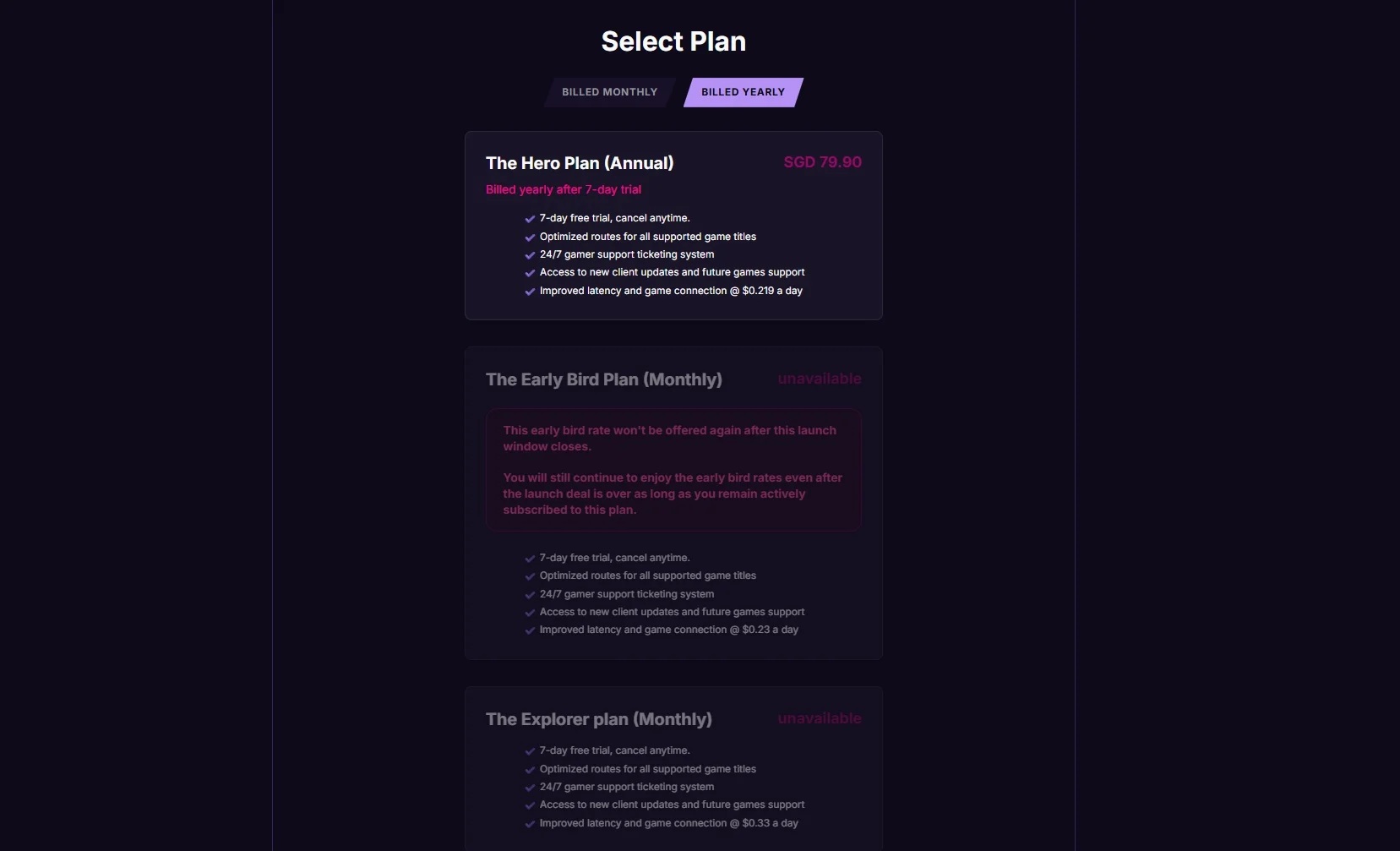
Hyperpeer is being introduced with promotional pricing for its first 100 customers. The initial subscription costs SGD6.90 per month, which works out to roughly RM22 based on the conversion provided by MyRepublic.
Once the introductory allocation is filled, the service will move to its standard monthly price of SGD9.90, or approximately RM31. There is also an annual plan priced at SGD79.90, equivalent to roughly RM254 per year.
For users who already spend money on competitive gaming equipment, faster broadband plans or game subscriptions, the pricing may be reasonable if Hyperpeer delivers a noticeable and consistent reduction in latency. On the other hand, casual players who already experience stable connections may find the benefit harder to justify.
A Seven-Day Free Trial Makes Testing Particularly Important
MyRepublic is offering new users a complimentary seven-day free trial, and that may be one of the most valuable aspects of the launch. Network performance varies so much between users that testing the service personally is more meaningful than relying entirely on advertised figures.
During the trial, gamers should compare their connection with and without Hyperpeer enabled. Useful things to observe include average ping, sudden latency spikes, packet loss and how stable the connection feels during longer gaming sessions.
It is also worth testing at different times of the day. A connection that performs perfectly in the afternoon may behave differently during peak evening hours when networks are under heavier load.
Rather than looking only at the lowest ping recorded, players should pay attention to consistency. A stable 35ms connection may provide a better gaming experience than one that jumps constantly between 20ms and 80ms.
Which Games Could Benefit the Most?
Latency optimisation is most noticeable in games where reaction time matters. Competitive multiplayer titles are therefore the most obvious use case.
Players may benefit most in games involving:
In slower games, an improvement of 10ms or 20ms may not be particularly noticeable. But in highly competitive environments, players often pay close attention to even small differences in latency.
The usefulness of Hyperpeer will also depend on whether the player's preferred game servers are supported and where those servers are physically located.
Packet Loss Can Matter Just as Much as Ping
Gamers often focus heavily on ping, but latency is only one part of the connection-quality equation. Packet loss can create stuttering, delayed actions, rubber-banding or temporary disconnections even when the average ping looks acceptable.
Connection stability is equally important. A network that remains consistently at 40ms can feel much smoother than one that regularly fluctuates between 20ms and 100ms.
MyRepublic says Hyperpeer is designed to improve all three areas: latency, packet loss and stability. If the routing system can successfully avoid problematic network paths, the practical improvement may therefore be more noticeable than the raw ping reduction alone suggests.
Your Home Network Can Still Be the Bottleneck
A route optimisation service cannot fix every source of gaming lag. Problems inside the home can still affect performance before traffic even reaches Hyperpeer.
Weak Wi-Fi signals, congested wireless channels, overloaded routers and background downloads can all introduce latency. A player using unstable Wi-Fi may therefore see limited improvement until those local issues are addressed.
For the best results, competitive gamers should still consider using a wired Ethernet connection where possible. If Wi-Fi is necessary, modern Wi-Fi standards and a strong signal can help minimise local delays.
Hyperpeer can optimise the route beyond the home network, but it cannot completely compensate for a poor connection between the gaming device and the router.
GAMER+ Broadband Includes a Longer Hyperpeer Subscription
MyRepublic is also bundling 24 months of Hyperpeer access with its GAMER+ Broadband Plans. At the moment, however, those broadband packages appear to be available only in Singapore.
Malaysian users can still subscribe to Hyperpeer independently, which means the service remains accessible even without a MyRepublic broadband account. This standalone availability is particularly important for Malaysia because it allows MyRepublic to reach gamers outside its own broadband footprint.
It also means users can potentially retain their existing fibre provider while adding Hyperpeer purely as a gaming optimisation layer.
Gaming Networks Are Becoming a Separate Service Category
Hyperpeer reflects a broader change in how gaming connectivity is being treated. For many years, internet providers competed primarily around headline download speeds. As broadband speeds increased, however, raw bandwidth stopped being the only meaningful measurement of network quality.
For online gaming, latency, jitter, packet loss and routing quality can be more important than whether a connection is rated at 500Mbps or 1Gbps. This has created an opportunity for specialised network services that optimise traffic based on what users are actually doing.
Gaming-focused routes, private backbones and smart traffic optimisation could therefore become increasingly common as providers look for ways to differentiate services beyond speed alone.
Whether Hyperpeer Is Worth Paying for Depends on Your Existing Route
For Malaysian gamers, the biggest question is not whether Hyperpeer works in general but whether it improves the specific routes they currently use. Network conditions vary considerably between ISPs, games and server regions.
A user whose ISP already provides excellent connectivity to Singapore-based game servers may see only a small difference. Another player whose connection is being routed inefficiently may experience a much larger improvement.
That is why the free trial is particularly useful. Gamers can measure the actual difference rather than assuming that an advertised 30% improvement will automatically apply to them.
The most sensible approach is to test Hyperpeer with the games you already play regularly and compare results under the same conditions.
Final Thoughts
MyRepublic's launch of Hyperpeer in Malaysia gives gamers another option for improving online performance without changing their existing internet provider. Instead of promising faster download speeds, the service focuses on something that matters more to competitive gaming: finding a better route between the player and the game server.
The company claims Hyperpeer can reduce ping by up to 30% while also improving packet loss and connection stability through a private network dedicated to gaming traffic. Whether those improvements are substantial will depend heavily on the user's ISP, location, existing routing and chosen game servers.
With prices starting at around RM22 per month for the first 100 customers and a seven-day free trial available, the easiest way to determine its value is simply to test it. If Hyperpeer turns an unstable or unnecessarily high-latency connection into something noticeably smoother, the subscription could make sense for serious gamers.
For everyone else, the launch is still an interesting reminder that faster internet and better gaming internet are not always the same thing. Sometimes the biggest improvement does not come from adding more bandwidth, but from making sure your data takes a smarter route to where it needs to go.











Comments 0