

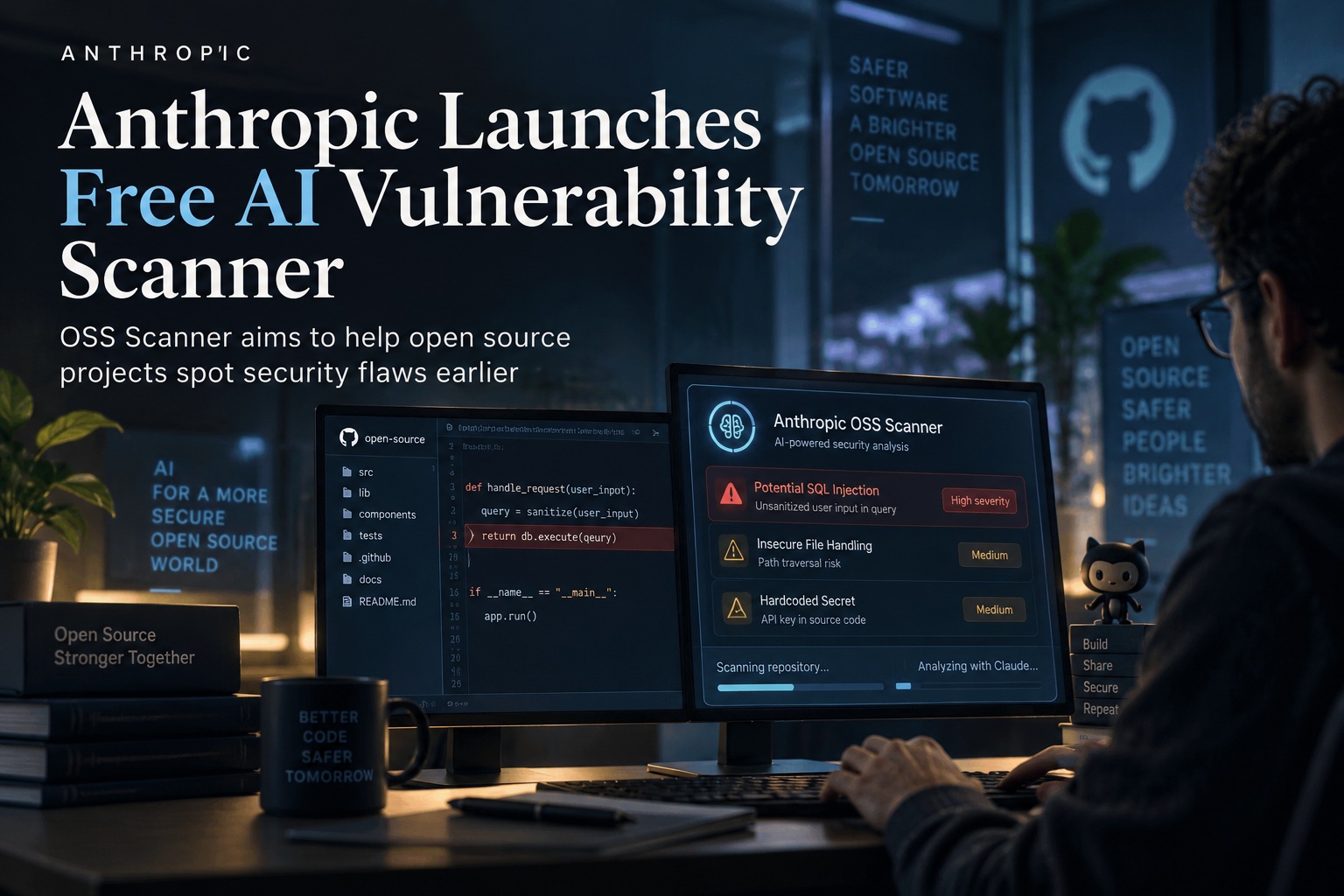
Anthropic has introduced a new free service called OSS Scanner, designed to help open source developers identify potential security vulnerabilities in their projects using artificial intelligence. The opt-in service uses some of Anthropic's strongest language models, including Claude Mythos, to analyse code and generate vulnerability reports. The idea is to give maintainers earlier warnings about possible security weaknesses without requiring them to wait for traditional manual reviews.
The launch reflects a growing trend of using advanced AI models for cybersecurity work. The same reasoning capabilities that allow AI systems to explore complex software environments can also be applied to finding coding mistakes, insecure assumptions and weaknesses that could potentially be exploited. Anthropic is now turning those capabilities into a dedicated security tool aimed specifically at the open source community.
Inspired By Google's OSS-Fuzz
Anthropic says OSS Scanner was inspired by Google's OSS-Fuzz, a long-running service that helps open source projects identify software vulnerabilities through automated fuzz testing. The overall objective is similar: find security problems earlier, before attackers have an opportunity to discover and exploit them.
The key difference is the technology being used. Instead of relying primarily on traditional fuzzing techniques, OSS Scanner uses large language models to analyse projects and generate findings. This allows the service to approach code from a reasoning perspective, potentially identifying issues that are difficult to uncover through conventional automated testing alone.
AI Models Generate The Reports Automatically
One of the most notable aspects of OSS Scanner is that its findings are generated entirely by Anthropic's AI models. The reports are not manually reviewed or triaged by human security researchers before being sent to participating developers. Anthropic says this allows the system to scan projects more frequently and provide results more quickly.
Removing the human review stage also makes the service easier to scale across a larger number of open source projects. Traditional vulnerability research can be highly time-consuming because every potential issue has to be investigated, reproduced and documented manually. AI can potentially accelerate the early discovery stage by analysing large amounts of code and highlighting areas that deserve attention.
There Is Still A Risk Of Incorrect Findings
The trade-off is that AI-generated security reports may not always be correct. Large language models are capable of producing inaccurate conclusions or inventing details, a behaviour commonly referred to as hallucination. In a cybersecurity context, this could mean reporting a vulnerability that does not actually exist or misunderstanding how a piece of code behaves.
Anthropic acknowledges this limitation and is not presenting OSS Scanner as an infallible replacement for human security analysis. Developers receiving reports will still need to investigate the findings and determine whether the identified issue is genuine. The service is therefore better understood as an early-warning system rather than an automatic authority on whether software is vulnerable.
Early Testing Showed Encouraging Results
Anthropic says it evaluated findings from an early version of OSS Scanner to measure how useful the reports were. According to the company, 88% of the identified issues met the standards required for its coordinated vulnerability disclosure, or CVD, process. This suggests that a large majority of the findings were considered significant enough to warrant further security handling.
Among the remaining reports, Anthropic says only one was determined to be a false positive. The results indicate that the scanner can produce useful security findings, although they also reinforce the point that the technology is not perfect. Anthropic says it intends to continue improving the service based on feedback from participating developers.
Human-Verified Vulnerability Reports Will Continue Separately
The introduction of OSS Scanner does not mean Anthropic is abandoning its existing vulnerability disclosure process. The company says it will continue manually reviewing and disclosing human-verified vulnerability reports through its coordinated vulnerability disclosure programme. This remains the more traditional route for reports that have been validated by security researchers.
OSS Scanner is intended to provide something slightly different: speed. Developers who want to see potential findings as soon as they are generated can opt into the automated service, even though the reports may not yet have received human confirmation. This gives project maintainers the option of investigating issues earlier rather than waiting for a complete disclosure process.
Why Open Source Projects Could Benefit
Open source software forms a major part of modern technology infrastructure, but many projects are maintained by small teams or individual developers with limited security resources. A widely used library may be relied upon by thousands of applications even when the maintainers do not have a dedicated security team. This creates an obvious challenge when vulnerabilities need to be discovered and fixed quickly.
A free automated scanner could help reduce that gap by providing additional security analysis without requiring maintainers to purchase commercial tools. Even if every report requires verification, having AI flag potentially dangerous areas could help developers focus their attention. For projects with limited time and resources, that could be valuable.
Faster Scanning Could Mean Earlier Fixes
Security vulnerabilities become more dangerous the longer they remain unnoticed. If an automated system can repeatedly scan a project and identify suspicious code shortly after it is introduced, maintainers may have an opportunity to fix the issue before it reaches a large number of users.
That is where AI-assisted scanning could complement existing security practices. It does not necessarily replace static analysis, fuzzing, code review or penetration testing. Instead, it can provide another layer of analysis that approaches the software differently and may identify patterns traditional tools miss.
Claude Security Remains The Paid Enterprise Option
Anthropic is also keeping Claude Security available as a separate paid offering. While OSS Scanner is focused on eligible open source projects, Claude Security provides broader code scanning and patching capabilities for enterprise customers. This allows organisations to use Anthropic's AI security tools within more general commercial environments.
The distinction gives Anthropic two different approaches to software security. Open source maintainers can potentially receive free automated vulnerability reports through OSS Scanner, while businesses requiring more comprehensive capabilities can use the company's commercial offering. Both rely on AI-assisted code analysis, but they serve different audiences and use cases.
Not Every Open Source Project Will Necessarily Qualify
Developers interested in OSS Scanner will need to enrol their projects through Anthropic's service. However, the company notes that only certain projects may be eligible, meaning registration does not necessarily guarantee that every repository will be accepted for scanning.
The eligibility requirement is likely important as Anthropic manages the computational resources required to analyse potentially large codebases. It also gives the company some control over which projects are included while the service continues to develop. More details about participation are expected to be provided through the enrolment process.
AI Is Becoming A More Active Part Of Cybersecurity
The broader significance of OSS Scanner lies in how AI is moving beyond basic coding assistance and into active security analysis. Modern models can inspect source code, reason about program behaviour and identify suspicious interactions between different components. Those capabilities make vulnerability research a natural area for further development.
At the same time, security work highlights the limitations of current AI systems particularly clearly. A convincing but incorrect vulnerability report can waste developer time, while overlooking a genuine weakness creates false confidence. Effective AI security tooling therefore needs to combine speed with careful validation and transparent uncertainty.
Final Thoughts
Anthropic's OSS Scanner offers an interesting new approach to securing open source software by giving eligible projects access to free AI-powered vulnerability analysis. Using models such as Claude Mythos, the service can generate reports without waiting for human triage, potentially allowing developers to identify problems earlier and scan their projects more frequently.
The main limitation is that the reports remain AI-generated and can still be wrong, so maintainers should treat them as leads rather than unquestionable findings. With Anthropic reporting that 88% of early findings met its coordinated disclosure standards, however, the technology shows promising potential. If the system continues to improve, AI-powered vulnerability scanning could become an increasingly useful companion to traditional security testing rather than a replacement for it.











Comments 0