

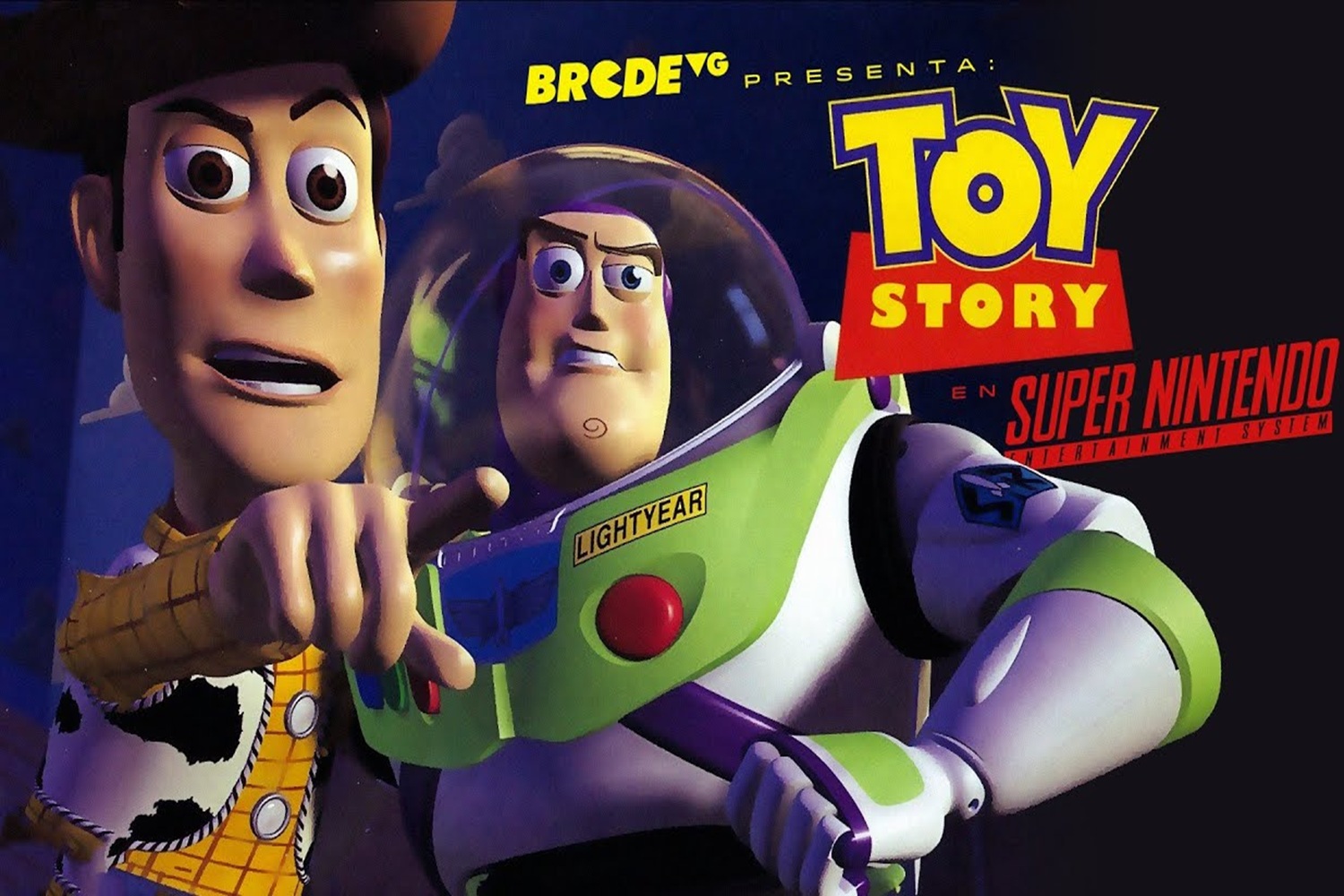
Toy Story is a 1995 platform game based on Pixar's groundbreaking animated film, translating Woody and Buzz Lightyear's adventure into a colourful series of side-scrolling stages for the Super Nintendo. Players primarily control Woody as he races through familiar locations including Andy's bedroom, Pizza Planet, Sid's house, and the streets surrounding Andy's moving van. Rather than simply retelling the movie through cutscenes, the game turns many memorable moments into playable challenges involving jumping, swinging, chasing, escaping, riding moving objects, and avoiding increasingly dangerous hazards. The result is a licensed platformer that feels closely connected to the film while still offering its own distinctive gameplay.
Woody's main ability is his pull-string, which can be swung like a whip to stun enemies, activate switches, grab onto hooks, and interact with parts of the environment. Traditional platforming remains the foundation, but Toy Story regularly changes its mechanics to reflect different scenes from the movie. One level may focus on climbing through Andy's room, while another becomes a fast-moving chase involving RC or a dangerous escape through Sid's house. These changes help the game avoid feeling repetitive even as the difficulty increases significantly during the later stages.
Now playable online through Lemon Web Games, Toy Story brings its 16-bit platforming, Woody's pull-string mechanics, movie-inspired stages, chase sequences, and familiar characters directly into the web browser. Players can explore Andy's room, navigate Pizza Planet, survive Sid's dangerous toys, and follow Woody's journey as he attempts to reunite with Buzz and reach Andy before the family moves away. The game remains challenging enough to demand careful timing and precision, especially during stages that rely on moving platforms or fast reactions. For fans of classic licensed games and 16-bit platformers, Toy Story remains one of the more memorable adaptations of a major animated film.
A Platform Game Built Around Woody
Woody is the primary playable character and naturally becomes the centre of the game's mechanics. He can run, jump, duck, and use his pull-string to interact with enemies and environmental objects. His movement is responsive, but many stages demand more precision than the colourful presentation initially suggests.
The pull-string is particularly important because it performs several different functions. Woody can swing it toward enemies to stun them, strike certain objects, activate switches, and grab onto hooks that allow him to swing across gaps. Learning when to use the string and when to rely on jumping becomes essential as the levels grow more complicated.
Because the game is based closely on the movie, Woody's abilities remain grounded in his character rather than turning him into a conventional action hero. He does not carry guns or magical powers. His limited tools help preserve the playful tone of Toy Story while still giving players enough mechanics to solve platforming challenges.
Andy's Room Creates the Perfect Opening
The early stages take place inside Andy's bedroom, one of the most recognizable locations from the film. Familiar furniture, toys, shelves, beds, and decorations are transformed into large platforming structures from Woody's miniature perspective.
This scale immediately helps the game feel connected to the movie. Ordinary household objects become enormous obstacles simply because the player is controlling a toy. Reaching the top of a table or crossing a bedroom floor suddenly feels like navigating a much larger environment.
The first stages also introduce the core mechanics gently. Players learn how to jump, use the pull-string, interact with hooks, and avoid hazards before the game begins introducing faster and more complicated sequences.
The Pull-String Works as Woody's Signature Tool
Woody's pull-string is the mechanic that gives Toy Story its own identity among 16-bit platform games. Rather than relying on a traditional attack, Woody swings the string outward to affect enemies and objects.
Against many enemies, the string temporarily stuns them rather than destroying them outright. This encourages players to move past threats rather than treating every encounter as something that must be eliminated.
Hooks provide another important use. By attaching the string to certain points, Woody can swing across gaps or reach areas that would otherwise be inaccessible. These sections require timing because releasing the swing at the wrong moment can send Woody falling back to a lower platform.
Enemies Are Usually Obstacles Rather Than Combat Targets
Toy Story is not primarily a combat game. Most enemies exist to complicate movement and force the player to think about timing. Small toys, environmental hazards, and other threats often move across the platforming route rather than aggressively chasing Woody.
The pull-string can make many of these encounters easier by briefly stunning the threat. This creates enough time to jump past or continue climbing without taking damage.
This design fits the source material surprisingly well. Woody feels like a toy trying to survive an oversized environment rather than a warrior clearing enemies from every room. Movement remains the main challenge.
Buzz Lightyear Drives Much of the Story
Buzz Lightyear is central to both the film and the game. Woody's jealousy of Buzz helps create the situation that eventually leaves both toys separated from Andy, and several stages revolve around trying to find or rescue him.
Although Woody remains the primary playable character, Buzz appears throughout the adventure and influences the objectives of several levels. The game follows their changing relationship from rivalry toward cooperation.
This story connection helps give individual stages more meaning. Players are not simply moving from one platforming environment to another. Each location represents another step in Woody and Buzz's attempt to return home.
The Game Closely Follows the Film
Toy Story recreates many important moments from the movie rather than inventing an entirely unrelated adventure. Andy's birthday, Buzz's arrival, the trip to Pizza Planet, Sid's house, and the final chase all appear in recognizable forms.
The stages do not reproduce these scenes exactly because they need to function as video game levels. Events are expanded, rearranged, or transformed into platforming challenges.
This approach works well because players familiar with the movie can immediately understand where they are and what is happening. At the same time, the game adds enough interactive material to make the journey feel like more than a simple retelling.
RC Introduces Faster Gameplay
RC, the remote-controlled car from the movie, appears in several memorable sequences. These stages shift away from ordinary platforming and introduce faster movement where the player needs to react quickly to obstacles.
The change in pace provides useful variety. After several stages of careful jumping and swinging, suddenly controlling movement at higher speed creates an entirely different challenge.
RC also plays an important role during the final portion of the story, helping Woody and Buzz pursue Andy's moving van. Turning these moments into gameplay makes them feel more exciting than simply showing them through a cutscene.
Pizza Planet Changes the Environment Completely
Pizza Planet provides one of the most visually distinctive sections of the game. The colourful arcade setting replaces Andy's familiar bedroom with machines, decorations, lights, and hazards inspired by the restaurant from the film.
From a gameplay perspective, the new location introduces different platforming layouts and environmental threats. Players need to adjust to unfamiliar objects rather than relying on what they learned inside Andy's room.
The change of scenery also reinforces the sense of adventure. Woody and Buzz are now far from home, and everything feels more dangerous because the surroundings are unfamiliar.
The Claw Machine Becomes a Platforming Challenge
The claw machine filled with three-eyed alien toys is one of the most memorable locations in the movie, and the game turns it into another unique platforming sequence.
The cramped interior and unusual moving objects create a very different rhythm from the open areas found earlier. Players need to watch the movement of hazards and carefully time their progress through the machine.
The three-eyed aliens also add some of the film's personality to the stage. Their recognizable design immediately connects the game back to the movie even when the level mechanics have been expanded significantly.
Sid's House Raises the Difficulty
Once Woody and Buzz end up inside Sid's house, the tone becomes noticeably more threatening. The environment is darker, the hazards are more dangerous, and the strange toys scattered around the house initially appear frightening.
The platforming becomes more demanding as well. Players face tighter jumps, moving hazards, and sections where mistakes can quickly cost health or lives.
Sid's house works well as a late-game location because it feels genuinely more dangerous than Andy's room. The cheerful domestic environment from the beginning has been replaced by a place where toys are dismantled and rebuilt into strange combinations.
Sid's Mutant Toys Are More Helpful Than They Appear
One of the movie's memorable twists is that Sid's strange assembled toys are not actually villains. Their unusual appearance initially makes them seem dangerous, but they ultimately help Woody and Buzz.
The game preserves this sense of uncertainty by presenting the toys within the threatening environment of Sid's room. Their bizarre designs stand out immediately from the more familiar toys encountered earlier.
This adds personality to the later stages and helps the game reflect the emotional shift of the film. Woody gradually learns that appearances can be misleading, while Buzz also begins understanding his true identity as a toy.
The Final Escape Becomes Increasingly Urgent
The last portion of Toy Story focuses on Woody and Buzz attempting to catch up with Andy before the moving van leaves. This naturally creates some of the fastest and most stressful stages in the game.
Instead of relaxed exploration, the player is pushed forward through chase sequences where hesitation can be costly. RC becomes especially important as Woody and Buzz race after the van.
The urgency matches the film well. The player already understands how much is at stake, so the faster mechanics feel like a natural escalation rather than an arbitrary difficulty spike.
Precise Jumping Becomes Essential
Toy Story can be surprisingly difficult, particularly in the later stages. Platforms become smaller, moving objects become less forgiving, and several sections demand exact timing.
Woody's jumping ability is simple, but players need to understand how much horizontal distance can be covered and how momentum affects landing. Missing by only a small amount can result in falling back several sections.
This difficulty is one reason the game is remembered as more than a simple licensed product. It expects genuine platforming skill rather than assuming the movie license alone will carry the experience.
Hooks Add Vertical Movement
Hook points allow Woody to use his pull-string to swing across spaces that ordinary jumping cannot reach. These mechanics create some of the game's most distinctive platforming moments.
Timing is important because Woody needs to release the string at the correct point in the swing. Letting go too early may cause him to miss the destination, while holding too long can send him back in the opposite direction.
The mechanic also makes the levels feel more dynamic. Woody is not restricted to simply jumping from one flat platform to another. Swinging gives the game a stronger sense of movement.
Collectibles Reward Exploration
Many stages contain stars and other collectible objects placed throughout the environment. Some are easy to reach, while others require players to explore alternative routes or attempt more difficult jumps.
Collecting these items provides an extra reason to investigate areas rather than racing directly toward the exit. Skilled players can attempt to gather more of them while still completing the level safely.
The system adds light replay value. A player who initially focuses only on surviving may return later and attempt to collect more items once the stage layout becomes familiar.
Level Variety Keeps the Game Moving
Toy Story regularly changes how it presents the basic platforming formula. Traditional side-scrolling sections are mixed with chase sequences, vehicle moments, vertical climbing, environmental puzzles, and other special challenges.
This variety helps the game mirror the rapidly changing events of the movie. One stage takes place inside a bedroom, another inside an arcade, and another inside Sid's dangerous house.
The constant environmental changes also prevent the game from becoming visually repetitive. Each major part of the story has its own personality.
Detailed Animation Gives Woody Personality
The character animation is one of Toy Story's strongest visual features. Woody moves with exaggerated but recognizable motions that help preserve the personality seen in the film.
Running, jumping, swinging the pull-string, and reacting to damage all contain more animation than many ordinary 16-bit platformers. These details make Woody feel like a character rather than simply a small sprite.
The animation also helps the controls remain readable. Players can usually understand exactly what Woody is doing, which becomes important during more precise platforming sections.
The Graphics Capture the Toy-Sized Perspective
The backgrounds and objects are designed to emphasize how small Woody is compared with the human world. Beds, desks, shelves, arcade machines, furniture, and household items tower above him.
This creates a strong sense of scale that works especially well in a platform game. A simple bedroom naturally becomes a giant obstacle course when viewed from the perspective of a toy.
The colourful 16-bit presentation cannot reproduce the film's computer-generated visuals directly, but it translates the characters and environments effectively into traditional sprite-based graphics.
The Soundtrack Supports the Movie Atmosphere
Toy Story uses music and sound effects inspired by the tone of the film, helping familiar locations feel connected to their cinematic counterparts.
The soundtrack changes between stages and supports the mood of each environment, whether the player is exploring Andy's room, navigating Pizza Planet, or escaping from Sid's house.
Sound effects also provide important feedback during gameplay. Hits, jumps, item collection, and environmental interactions are easy to recognize, helping the action remain clear even when the screen becomes busy.
The Game Is Harder Than Its Appearance Suggests
The colourful Pixar theme might suggest a very easy platformer aimed only at younger players, but Toy Story can become genuinely challenging.
Later stages demand precise movement, quick reactions, and knowledge of the level layout. Some sequences are difficult enough that repeated attempts are normal.
This difficulty gives the game longer-lasting appeal for experienced platforming fans. Completing the adventure requires more than simply recognizing characters from the movie.
Memorization Helps With Later Stages
Many difficult sections become easier once players know what is coming. Enemy placement, moving hazards, hook positions, and chase sequences often follow predictable patterns.
A failed attempt therefore provides useful information. Players can return knowing where to jump, when to swing, or which side of the screen is safest.
This creates a traditional 16-bit learning curve. Progress comes from improving execution and remembering the level rather than unlocking permanent upgrades.
The Game Represents an Important Era of Licensed Platformers
During the 16-bit era, major films were frequently adapted into platform games. Quality varied dramatically, but Toy Story stands out because the developers attempted to reflect the actual events and environments of the movie.
The source material influences more than just the graphics. Woody's pull-string, RC, Buzz, the claw machine, Sid's toys, and the moving van all become part of the gameplay.
This makes the game feel more connected to the film than many licensed games of the period. Players familiar with Toy Story can recognize almost every major section of the adventure.
Playing Toy Story Online Today
Through Lemon Web Games, Toy Story can now be played directly in your web browser with no downloads or setup required. Features of the web-based version include:
New players should take time to become comfortable with Woody's jump distance and pull-string timing before rushing through the early stages. Hooks in particular require accurate releases, and mastering them early makes later sections considerably easier.
It is also worth exploring each stage rather than immediately heading toward the exit. Collectibles, safer routes, and useful shortcuts can be hidden away from the most obvious path. Learning the layout is often the best way to prepare for the game's more difficult later stages.
Who Should Play Toy Story
Toy Story is particularly suitable for players who enjoy platform games that constantly introduce new situations. The basic controls remain familiar throughout, but the stages frequently change the environment or objective enough to keep the adventure varied.
It is also worth experiencing for fans of the movie who want to revisit its major locations in interactive form. Andy's room, Pizza Planet, Sid's house, and the final chase all become playable parts of the journey.
Play Toy Story Online Now
Toy Story transforms Pixar's original film into a colourful 16-bit platform adventure filled with familiar characters, memorable environments, and surprisingly challenging gameplay. Guide Woody through Andy's room, use the pull-string to stun enemies and swing across gaps, follow Buzz through Pizza Planet, survive Sid's house, and race to reunite with Andy before the moving van disappears.
Through Lemon Web Games, players can experience this classic platformer directly in a modern browser and revisit one of the most recognizable licensed games of the 16-bit era. Whether returning for nostalgia or discovering the adventure for the first time, the game offers a satisfying mixture of movie memories and traditional platforming challenge.
Final Thoughts
Toy Story succeeds because it does more than place familiar characters inside a generic platform game. The environments, mechanics, and special stages repeatedly connect back to moments from the film, giving the adventure a strong sense of identity. Woody's pull-string provides a distinctive tool, while locations such as Andy's room, Pizza Planet, and Sid's house ensure that each major section feels different from the last.
The game is also considerably more demanding than its colourful presentation might suggest. Precise jumps, timed swings, fast chase sequences, and increasingly dangerous hazards require genuine platforming skill. Repeated attempts become part of the experience, especially during the later stages, where knowing the layout can be just as important as quick reactions.
Through Lemon Web Games, Toy Story can now be enjoyed directly in the browser as a memorable piece of 16-bit licensed-game history. Its detailed animation, varied stages, recognizable movie moments, and challenging platforming still give it plenty of character. For fans of Woody, Buzz Lightyear, classic platformers, or the original Pixar film, this adventure remains well worth revisiting.











Comments 0