

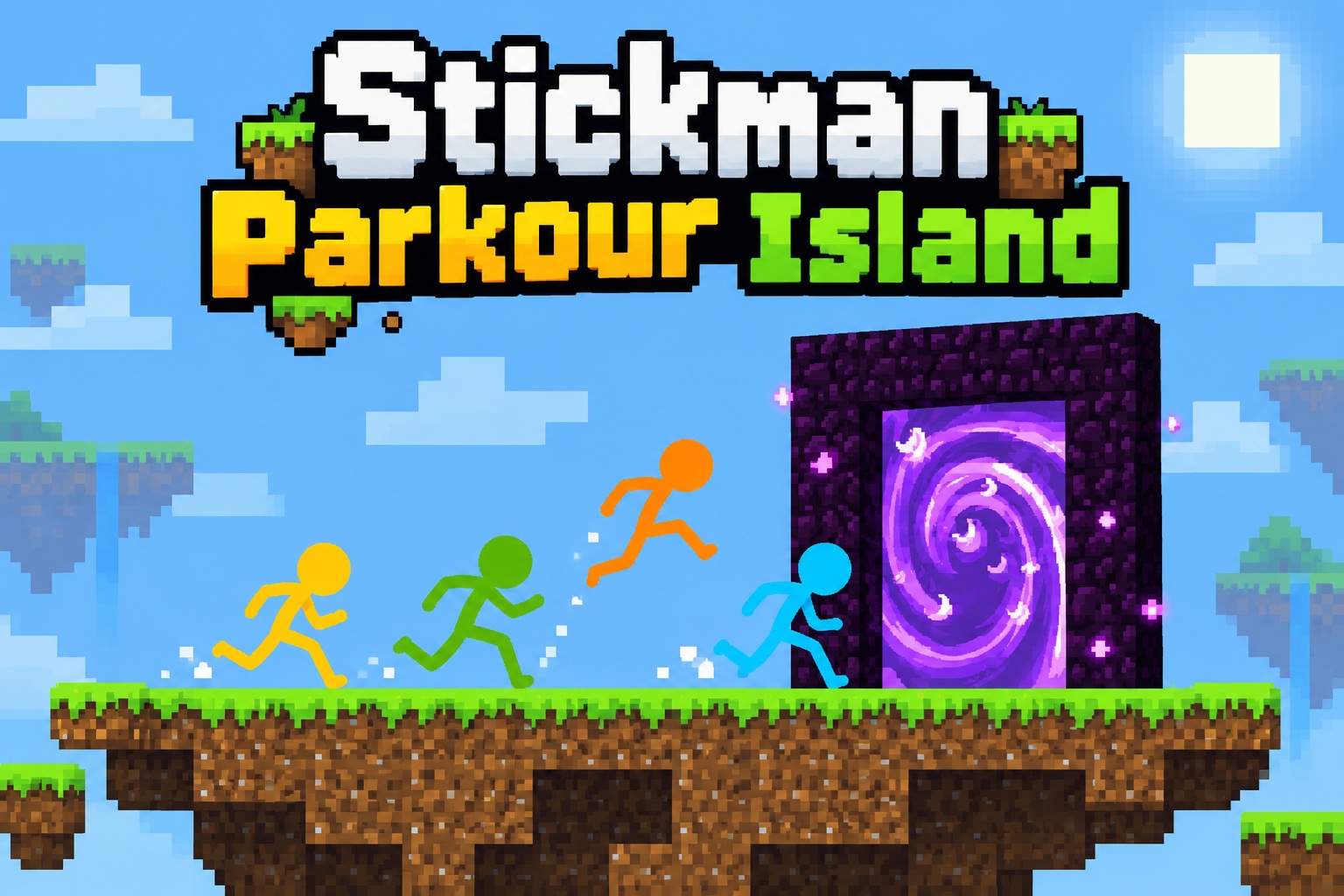
Stickman Parkour Island turns a simple platforming concept into a focused test of timing, movement, and confidence. Players guide a stickman across a series of floating islands filled with narrow pathways, moving platforms, disappearing blocks, hazardous gaps, and increasingly demanding jumps. There is no need to manage weapons, inventories, or complicated abilities because almost every challenge revolves around movement. The objective is straightforward: stay on the course, avoid falling into the void, reach checkpoints when available, and make it safely to the finish.
What begins as relatively approachable platforming gradually becomes much more demanding as the stages combine several hazards into longer sequences. A simple jump may be followed immediately by a moving platform, a narrow landing area, or a disappearing block that leaves little time to hesitate. Momentum becomes useful for larger gaps, but moving too quickly can make accurate landings difficult. Stickman Parkour Island therefore rewards a balance between confidence and control rather than constant rushing.
Now playable online through Lemon Web Games, Stickman Parkour Island brings its floating-island parkour challenge directly into the web browser without requiring a separate installation. Players can work through obstacle courses, learn the timing of moving platforms, master difficult jumps, use checkpoints to preserve progress, and gradually become more comfortable with the game's movement. Each stage is built around the same simple idea of reaching the end, yet changing platform arrangements continually create new situations to solve. For players who enjoy precision platforming and obstacle-course games, Stickman Parkour Island delivers an accessible but increasingly demanding challenge.
A Platformer Focused Almost Entirely on Movement
Stickman Parkour Island keeps its mechanics deliberately straightforward. The stickman moves, jumps, lands, and attempts to remain on increasingly difficult pathways suspended above empty space. There is little to distract from the central challenge. Success comes almost entirely from understanding how the character moves.
This focus makes the game immediately approachable. New players do not need to memorize a complicated set of commands before starting the first course. The basic controls become understandable quickly, allowing the levels themselves to provide the challenge. Difficulty grows through obstacle placement rather than control complexity.
That simplicity also makes mistakes easy to understand. Missing a platform usually means the jump started too early, too late, or without enough momentum. Landing badly on a narrow surface suggests that movement needed to be more controlled. Each failure provides useful information for the next attempt.
Floating Islands Create Constant Risk
The floating-island setting is more than a visual theme. It means that almost every edge represents genuine danger because there is rarely solid ground beneath the course. One missed jump can immediately send the stickman into the void. This gives even simple movement a sense of tension.
Wide platforms provide temporary relief, but narrow routes quickly bring the pressure back. Players need to pay attention to where they are standing rather than focusing only on the next destination. Approaching a jump from the wrong part of a platform can reduce the amount of space available for preparation.
The open environment also makes progress visually satisfying. Looking across several floating sections creates a clear sense of where the route is heading. Reaching another island feels like completing a small step toward the finish. The environment constantly reinforces the idea of moving through an obstacle course suspended in mid-air.
Early Levels Teach the Basics Without Overwhelming the Player
The opening stages give players time to understand how far the stickman can jump and how quickly movement responds. Platforms are generally easier to reach, and hazards are presented individually rather than immediately combining several difficult mechanics. This allows players to develop confidence. The game introduces its movement language gradually.
These levels are important because later challenges assume the player already understands the basics. A jump that felt difficult at the beginning may eventually become routine. The game then increases difficulty by reducing landing space or adding moving objects. Familiar actions need to be performed under greater pressure.
The progression therefore feels natural. The controls never fundamentally change, but the player's understanding becomes more sophisticated. Improvement comes from experience rather than unlocking stronger abilities.
Jump Timing Is the Most Important Skill
Almost every difficult section eventually comes down to timing. Jump too early and the stickman may lose useful momentum before reaching the destination. Jump too late and there may not be enough platform remaining to launch safely. The correct moment often depends on the size of the gap and the shape of the landing area.
Good timing becomes particularly important when the next platform is narrow. Reaching it is only half the challenge; the stickman also needs to land with enough control to avoid immediately falling from the other side. A successful jump therefore requires thinking about both takeoff and landing.
With practice, players begin recognizing distances more naturally. What once required cautious estimation becomes almost instinctive. This improvement is one of the most satisfying parts of the game because difficult jumps gradually feel predictable rather than intimidating.
Momentum Helps With Larger Gaps
Some jumps cannot be approached effectively from a stationary position. Building forward momentum gives the stickman additional movement across larger distances. Players therefore need to understand when a short run-up is necessary. The platform itself becomes part of the preparation.
Momentum also introduces risk. Running too aggressively toward an edge can leave almost no time to correct the jump. Even if the character reaches the next platform, excessive speed may carry them too far after landing. Bigger jumps require confidence but not recklessness.
The best approach is often a controlled run followed by a carefully timed jump. Players gradually learn how much preparation each gap requires. This creates a satisfying rhythm of running, jumping, landing, and immediately preparing for the next obstacle.
Precision Matters More Than Constant Speed
Parkour games can encourage players to move quickly because smooth movement looks impressive. Stickman Parkour Island certainly rewards confidence, but speed alone does not guarantee success. Many sections are easier when approached deliberately. A careful landing is usually more valuable than reaching the platform half a second faster.
This becomes especially obvious on narrow surfaces. Moving too quickly after landing can send the stickman straight into the void. Players need to regain control before committing to the next jump. Patience can prevent unnecessary restarts.
As stages become familiar, players can gradually increase their speed without sacrificing accuracy. Clean movement naturally becomes faster through practice. The best runs often look quick because the player already knows exactly where to move.
Narrow Platforms Demand Controlled Landings
Large platforms allow players to recover from imperfect jumps, but narrow ones provide very little margin for error. Landing slightly too far toward one side can immediately become dangerous. Players need to control horizontal movement throughout the jump rather than assuming the hard part ends after takeoff.
These platforms are especially challenging when another jump follows immediately. The stickman may need to land, stabilize, and reposition within a very small area. There is little room for unnecessary movement. Precision becomes more important than momentum.
Repeated practice helps players learn how much input is needed after landing. A tiny correction may be enough. Overcorrecting can be worse than doing nothing. Stickman Parkour Island constantly rewards restraint.
Moving Platforms Add a Timing Puzzle
Moving platforms transform ordinary jumping into a problem of synchronization. The player needs to consider not only where the platform is but where it will be by the time the stickman reaches it. Jumping toward its current position can result in landing on empty space if it moves away during the flight. Observation becomes essential.
The safest strategy is often to watch one complete movement cycle before attempting the jump. This reveals how far the platform travels and how quickly it changes direction. Once the pattern is understood, players can choose a reliable moment to begin. Patience reduces guesswork.
Later challenges become harder when moving platforms appear as part of longer sequences. Reaching one platform may only provide a brief opportunity to jump toward the next. These sections turn movement into a rhythm. Successful timing feels almost choreographed.
Disappearing Blocks Punish Hesitation
Disappearing blocks introduce a different kind of pressure. Unlike ordinary platforms, they cannot necessarily be treated as safe places to pause indefinitely. Once the player reaches them, the next movement may need to happen quickly. Hesitation becomes dangerous.
These blocks create a useful contrast with the slower observation required by moving platforms. Sometimes patience is the correct strategy, while other sections demand immediate action. Players need to recognize what kind of obstacle they are dealing with. One approach cannot solve everything.
The mechanic also encourages route planning before landing. If the player already knows where the next jump needs to go, there is less time wasted deciding what to do. Preparation becomes part of survival.
Long Obstacle Sequences Test Consistency
Individual jumps may not be extremely difficult on their own, but combining several together can create a much greater challenge. A player might need to clear one gap, land on a narrow platform, wait for a moving section, cross another hazard, and then immediately use a disappearing block. Each successful movement leads directly into another. Consistency becomes essential.
These longer sequences can be frustrating because one mistake near the end may require repeating the earlier parts. However, they also make progress easy to recognize. A player who initially fails near the beginning may gradually reach farther with each attempt. Improvement is visible.
Once the entire sequence is mastered, completing it cleanly feels extremely satisfying. The player has not simply solved one jump but learned an entire movement pattern. These are often the most memorable sections of precision platformers.
Checkpoints Make Difficult Sections More Manageable
Checkpoints help prevent demanding stages from becoming unnecessarily punishing. Reaching one creates a new point from which the player can continue after a mistake. This allows the game to introduce longer courses without forcing every attempt to begin from the very start. Progress remains meaningful.
The presence of checkpoints also changes how players approach difficult sections. Reaching the next one becomes a short-term objective within the larger level. Instead of thinking about the entire course at once, players can focus on surviving one segment. This makes challenging stages feel more achievable.
Checkpoints also encourage experimentation. Once progress has been secured, players can test different approaches to the next obstacle without worrying about replaying everything behind them. The game becomes easier to learn through trial and error.
Failure Is Part of Learning the Course
Falling into the void is inevitable while learning unfamiliar stages. Stickman Parkour Island expects players to fail occasionally and use those attempts to understand the movement better. A missed landing provides information about jump distance, while a collision with a moving obstacle reveals something about its timing. Failure becomes part of practice.
The important difference is whether the player learns from each mistake. Repeating exactly the same failed movement will naturally produce the same result. Adjusting the takeoff point, waiting for a better platform position, or using less momentum creates new possibilities. Improvement comes through small corrections.
This makes the game especially appealing to players who enjoy mastery-based challenges. Progress is not primarily awarded through character statistics. The player's own understanding becomes the upgrade.
Observation Can Be More Valuable Than Reflexes
Fast reactions help, but many difficult sections become much easier once the player studies them. Moving platforms follow patterns, disappearing surfaces provide recognizable windows, and complicated routes often have a clear sequence once viewed carefully. Running forward immediately is not always the best choice. Sometimes the smartest move is simply to watch.
This is particularly useful when encountering a new obstacle combination. Spending a few seconds understanding how everything moves can save several failed attempts. The player can mentally plan the route before committing. Preparation reduces panic.
The game therefore mixes platforming reflexes with environmental reasoning. Players need to execute accurately, but they also need to understand what they are executing. Good decisions make difficult jumps far easier.
Camera Awareness Helps With Difficult Routes
In platforming games built around floating environments, understanding the surrounding space is extremely important. Players need to judge both the current platform and the destination. Approaching an obstacle without seeing the next safe area clearly can lead to unnecessary mistakes. Awareness of the environment matters as much as movement.
Looking ahead also helps with longer sequences. Players can identify where the route continues after the immediate jump and position themselves accordingly. A landing becomes much easier when the next move has already been considered. This prevents the player from arriving on a small platform with no plan.
As players become familiar with a stage, this awareness develops naturally. The environment stops feeling like isolated platforms and begins looking like one continuous route. That change makes movement much smoother.
The Void Makes Every Mistake Feel Immediate
There is something particularly effective about platforming above open space. A mistake does not merely reduce a health bar or cause a small setback. The stickman immediately falls away from the course, making the failure visually obvious. The consequence is simple and easy to understand.
This clarity helps keep the game focused. There is no need for complicated damage systems. Either the character remains on the obstacle course or falls. The result is immediate.
The void also adds tension to sections that would otherwise be simple. Walking across a narrow platform becomes more stressful when there is nothing underneath it. The environment turns basic movement into a challenge.
Simple Controls Allow the Level Design to Create Difficulty
Stickman Parkour Island does not become difficult by introducing an overwhelming control scheme. The character continues using the same basic movement throughout the adventure. The levels themselves become harder. Narrower landings, moving objects, disappearing platforms, and longer gaps provide the increased challenge.
This creates a fair learning curve because players rarely need to stop and remember a new command. They already know what the character can do. The question is whether they can use those abilities accurately enough. Difficulty comes from execution.
It also makes the game easy to return to after time away. Basic movement is quickly remembered. Players can concentrate on relearning the stages rather than the controls.
The Stickman Presentation Keeps Everything Clear
A stickman character is visually simple, which works well in a game built around precise movement. The player can easily see where the character is standing and whether a landing has succeeded. The environment remains more important than elaborate animation. Clarity supports the gameplay.
The simple design also suits the obstacle-course theme. Stickman games often focus on direct mechanics rather than detailed storytelling, and Parkour Island follows that tradition. The character exists primarily as something the player controls through increasingly dangerous environments. The challenge remains central.
This minimalist character design also contrasts nicely with the colorful floating islands. The player remains easy to identify even when the environment becomes visually busier. That readability is valuable during difficult jumps.
Colorful Islands Give the Challenge a Lighter Tone
Although falling repeatedly can become demanding, the colorful island environments keep the experience visually approachable. The game does not present its obstacle courses as dark or threatening locations. Instead, the stages feel more like playful parkour challenges suspended in the sky. The atmosphere remains casual even when the platforming becomes difficult.
This makes repeated attempts easier to tolerate. The presentation supports experimentation rather than creating constant tension. Players can concentrate on improving movement without the game feeling excessively serious.
The bright environments also help different platforms and hazards remain visible. Players can quickly identify the route ahead. Good visual separation supports precise movement.
There Is No Combat Distracting From the Parkour
Many platform games combine movement with enemies, weapons, or combat abilities. Stickman Parkour Island focuses much more heavily on traversal. The main opponent is the obstacle course itself. The challenge comes from gaps, moving surfaces, disappearing blocks, and dangerous layouts rather than fighting enemies.
This gives the game a very clean identity. Players who enjoy platforming for the movement itself do not need to stop repeatedly for combat encounters. The flow remains centered on running, jumping, balancing, and recovering from difficult landings. Every section supports the same central theme.
The absence of combat also makes mechanical improvement easier to evaluate. When a level is completed, the success comes primarily from better movement. The player knows exactly which skill improved.
Momentum Control Becomes More Important Later
Early stages may allow players to treat movement fairly casually, but later courses demand much better control of speed. Large gaps require enough momentum to cross, while narrow platforms require that momentum to be reduced before landing. The same speed that helps one obstacle can ruin the next. Players need to adjust constantly.
This is where experience becomes most visible. Beginners often move at one speed until something goes wrong. Skilled players vary movement according to what is ahead. They know when to accelerate and when to slow down.
Learning to control momentum gives the stickman a much more responsive feeling. The character itself has not changed; the player simply understands how to use movement more effectively. Mastery makes the game feel better.
Moving Platforms Reward Early Planning
When several moving platforms appear in sequence, reacting only to the nearest one can make the route much harder. Players benefit from watching the entire arrangement and identifying where the platforms will be after the first jump. This allows movement to be planned as one sequence. Early planning creates smoother execution.
For example, a player might deliberately wait for the first platform to reach a specific position because that timing also lines up the second platform. The immediate jump becomes part of a larger plan. This is where the game begins feeling almost puzzle-like.
The best runs through these sections often involve very little hesitation. The player has already understood the pattern before starting. Once movement begins, the sequence flows naturally.
Disappearing Platforms Encourage Commitment
Some players naturally hesitate before difficult jumps, making tiny movements while deciding whether to continue. Disappearing platforms punish that habit by forcing commitment. Once the character reaches them, waiting too long can remove the safe surface entirely. The player needs to trust the plan.
This adds psychological pressure even after the route is understood. Knowing what to do does not automatically make it easy to execute. Players need enough confidence to move without second-guessing every action.
Successfully crossing a disappearing-platform sequence can therefore feel especially rewarding. The player had to commit and perform the movements cleanly. There was little room for indecision.
Repeating a Level Builds Muscle Memory
After enough attempts, players begin remembering movement without consciously thinking about every input. A particular jump becomes associated with a certain run-up, while a moving platform becomes linked to a specific timing. These patterns gradually enter muscle memory. The level starts feeling familiar.
This reduces the mental load during longer sequences. Instead of carefully solving the opening obstacles again, the player moves through them almost automatically and saves concentration for the section that still causes trouble. Progress becomes more efficient.
Eventually, even difficult stages can feel smooth. What looked impossible during the first attempt may later be completed almost casually. That transformation is one of the strongest rewards offered by precision platforming.
Speedrunning Naturally Becomes Tempting
Once a level is understood, players may begin wondering how quickly it can be completed. Safe pauses that were useful during early attempts can gradually be removed. Jumps can be chained together, and moving platforms can be approached more aggressively. The obstacle course begins turning into a route to optimize.
This is not necessary for ordinary progression, but it provides an additional layer of replay value. Players can challenge themselves to maintain momentum without sacrificing accuracy. Clean, fast movement feels especially satisfying.
Speed also reveals how much the player has improved. Someone who once needed several minutes and many restarts may eventually complete the same section almost continuously. Mastery becomes visible through movement.
The Game Rewards Confidence Without Encouraging Recklessness
Confidence matters because hesitation can disrupt momentum and make disappearing-platform sections more difficult. However, blindly rushing through an unfamiliar course usually ends badly. The ideal approach is informed confidence. Players should move decisively once they understand the obstacle.
This balance develops naturally through repeated play. First attempts are cautious because the route is unknown. Later attempts become faster because the player has learned what is safe. Confidence is earned.
That progression gives the game a satisfying feeling of personal growth. The levels do not become less dangerous. The player simply becomes more capable of navigating them.
Checkpoints Create Natural Short-Term Goals
A long stage can feel intimidating if viewed as one continuous challenge. Checkpoints divide the course into more manageable sections. Reaching the next checkpoint becomes a small victory even before the entire level is complete. This helps maintain motivation.
They also provide a useful sense of progress. Players can recognize that they have mastered the previous section and can now concentrate entirely on what lies ahead. Difficulties become isolated rather than overwhelming.
This structure works particularly well with repeated attempts. Instead of replaying several minutes of mastered content, the player can focus on the current problem. Learning becomes faster and less frustrating.
The Portal or Finish Point Provides a Clear Objective
The end of each course is easy to understand: reach the portal or designated finish point. There are no complicated secondary conditions required before success can be recognized. The obstacle course itself is the challenge. Reaching the end proves that the player survived it.
A visible goal can also provide motivation during difficult sections. Knowing that the finish is nearby makes the final few jumps feel more intense. Players may become more cautious because they do not want to lose progress so close to success. This can ironically create mistakes.
Completing the last jump and reaching safety produces immediate satisfaction. The game does not need an elaborate reward sequence. Successfully crossing the course is enough.
Later Levels Combine Everything Learned Earlier
As the game progresses, the obstacles stop appearing as isolated mechanics and begin interacting with one another. A moving platform may lead directly into a narrow landing, followed by a disappearing block and another long jump. Players need to combine timing, momentum, observation, and precision. The challenge becomes more complete.
These stages reveal whether the earlier lessons have truly been learned. Knowing how to handle one moving platform is not enough if the next obstacle requires immediate momentum control. Skills need to work together.
The result is a natural difficulty progression. The game does not suddenly invent a completely unrelated mechanic near the end. It asks players to use familiar ideas more consistently.
Patience Can Prevent Unnecessary Restarts
When a stage becomes frustrating, players may begin moving faster simply because they want to return to the difficult section quickly. This often creates new mistakes in areas that were already understood. Taking an extra moment to stabilize after each landing can prevent these avoidable failures. Patience preserves progress.
This is particularly important when checkpoints are far apart. A careless mistake can erase several successful obstacles. Controlled movement is usually worth the small additional time. Consistency matters more than speed.
Once the course is mastered, players can safely become more aggressive. Until then, patience is one of the strongest tools available. Stickman Parkour Island rewards players who respect the obstacles.
Why Stickman Parkour Island Can Become Addictive
The game creates a strong loop of failure, adjustment, and immediate improvement. Missing a platform usually leaves the player convinced that the next attempt can succeed with one small change. That feeling makes restarting easy. Difficult sections invite repeated attempts rather than encouraging players to give up.
The controls also remain simple enough that progress feels personal. There is no new equipment suddenly making the jump easier. The player succeeds because their timing improved. This makes victories more satisfying.
Short obstacle sections and checkpoints reinforce the same loop. Each successful movement creates another small achievement. The game continually provides reasons to try one more time.
A Good Choice for Precision-Platforming Fans
Players who enjoy games built around accurate movement will feel immediately comfortable with Stickman Parkour Island. The emphasis is on reading the environment and controlling the character rather than managing unrelated systems. Platforming remains the main attraction from beginning to end. Every stage is another movement problem.
The game is also approachable enough for players who are newer to the genre. Early stages provide time to understand the mechanics, while checkpoints make later challenges less punishing. Difficulty increases gradually rather than immediately demanding expert-level execution.
This combination gives Stickman Parkour Island broad appeal. Casual players can enjoy clearing the courses, while more experienced players can focus on smoother and faster runs. The same levels support both approaches.
Playing Stickman Parkour Island Online Today
Through Lemon Web Games, Stickman Parkour Island can now be played directly in your web browser with no downloads or setup required. Features of the web-based version include:
Playing Stickman Parkour Island through a browser makes it easy to attempt a few obstacles during a short session or continue through several courses when more time is available. New players should spend the opening levels learning how much momentum is needed for different jump distances. Trying to rush before understanding the movement usually causes more falls. Controlled landings are the foundation of consistent progress.
Players struggling with a particular obstacle should also watch its movement before immediately attempting it again. Moving platforms become much easier once their timing is understood, while disappearing blocks are best approached with the next jump already planned. Checkpoints provide opportunities to experiment without losing too much progress. The game rewards observation just as much as quick reactions.
Who Should Play Stickman Parkour Island
Stickman Parkour Island is especially suitable for players who enjoy seeing their own skill improve from one attempt to the next. Early failures help establish how far the character can jump and how much control is available during movement. Before long, difficult sections begin feeling much more predictable. The improvement happens in the player's hands rather than through character upgrades.
It is also a good choice for anyone who prefers platforming without constant combat interruptions. The floating islands themselves provide the challenge, allowing players to concentrate on timing, momentum, landing, and route planning. Every completed course feels like a direct result of better movement. That straightforward focus gives the game much of its appeal.
Play Stickman Parkour Island Online Now
Stickman Parkour Island transforms floating platforms into increasingly demanding obstacle courses where one poorly timed jump can send the player into the void. Moving platforms require observation, disappearing blocks demand quick commitment, narrow surfaces punish inaccurate landings, and larger gaps challenge players to build the correct amount of momentum. Checkpoints help break difficult stages into manageable sections while preserving the excitement of mastering each obstacle. The controls remain straightforward even as the routes become considerably harder.
Through Lemon Web Games, players can experience Stickman Parkour Island directly in a modern browser and begin testing their platforming skills almost immediately. There are no complicated systems to learn before the challenge begins. Run, jump, observe the course, and gradually develop the confidence needed to cross increasingly dangerous sections. For players who enjoy improving through repetition, every successful landing becomes another small step toward mastering the island.
Final Thoughts
Stickman Parkour Island succeeds because it concentrates on what makes obstacle-course platforming enjoyable in the first place: movement, timing, precision, and the satisfaction of finally landing a difficult jump. The floating-island environments create constant danger without needing enemies or complicated combat systems. Moving platforms, disappearing blocks, narrow pathways, and long gaps provide enough variety to keep the challenge evolving. Everything revolves around controlling the stickman more confidently.
The game's progression also makes improvement easy to recognize. Early levels help players understand momentum and landing distance, while later courses combine those skills into longer sequences where consistency matters just as much as reflexes. Checkpoints prevent difficult sections from becoming unnecessarily punishing, yet the player still needs to perform every jump personally. Success always feels earned.
Through Lemon Web Games, Stickman Parkour Island can be played directly in the browser as a straightforward but increasingly demanding parkour challenge. It is easy to understand, quick to restart, and rewarding to master because the solution is rarely hidden behind complicated mechanics. For players who enjoy floating obstacle courses, precise jumping, and the constant temptation to try a difficult section one more time, Stickman Parkour Island delivers a focused platforming experience where every landing matters.











Comments 0