

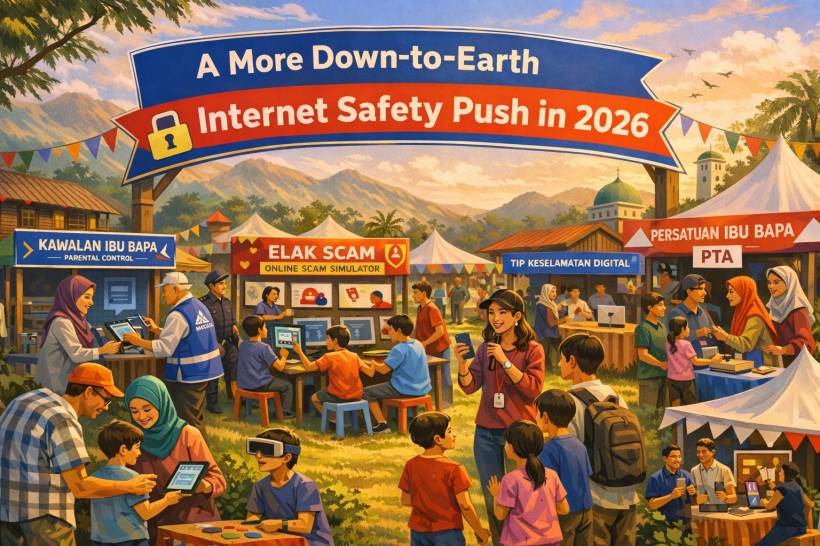
For 2026, the Malaysian Communications and Multimedia Commission (MCMC) is taking a noticeably more "meet people where they are" approach with its Internet Safety Campaign (KIS). Instead of relying mainly on formal talks and broad messaging, the focus is shifting toward grassroots engagement, making digital safety feel less like a lecture and more like something communities can experience, discuss, and actually practice.
Why the Strategy Is Changing
Internet risks have become more everyday and more personal. Scams don't only target tech-savvy adults; they target retirees, busy parents, students, and first-time online shoppers. At the same time, kids and teens are growing up online by default. So the challenge isn't just awareness anymore, it's helping people build practical habits in a way that sticks.
That's why MCMC says the key move in 2026 is building community-friendly spaces where internet safety can be learned in a relaxed, interactive environment.
Community Carnivals, Not Just Briefings
One of the most interesting parts of KIS 2026 is the plan to run community carnivals at village, sub-district, and district levels across the country. The idea is simple: when people feel comfortable, they're more likely to engage, ask questions, and remember what they learned.
This face-to-face format also helps reach groups that may not respond well to online announcements or formal programmes, including communities with limited digital exposure or those who prefer learning through direct guidance.
Learning by Doing: Simulations, Games, and Real Device Settings
MCMC is placing strong emphasis on hands-on activities. Instead of just telling people "be careful," the campaign aims to show what risks look like in real life and what steps to take immediately.
That includes things like online scam simulations, interactive games, and digital safety demonstrations. More importantly, it includes direct guidance on how to activate basic security features on devices, including parental control tools.
This part matters because many parents and guardians know "the internet can be risky," but still feel unsure about what to actually do on a phone or tablet. Turning awareness into action is often the missing piece.
Parents and Communities as the First Line of Defence
A key theme in KIS 2026 is that internet safety is not only an individual responsibility. MCMC is framing it as something that needs a support ecosystem, starting with families and extending into the community.
Parents, guardians, and the wider community shape how children and teenagers use the internet. When adults understand the risks, set boundaries, and know how to monitor responsibly, young users are far less likely to fall into preventable problems.
In other words, the goal isn't to turn parents into "digital police," but to help them become confident guides.
Reaching Younger Audiences Through Influencers
Another practical angle is MCMC's collaboration with social media influencers to deliver internet safety messages in a more organic way. Like it or not, younger audiences often absorb information through the personalities and platforms they already follow.
When done responsibly, influencer-led advocacy can make topics like scams, privacy, cyberbullying, and oversharing feel more relatable, less preachy, and easier to talk about.
Building a Wider Support Network
To push the campaign deeper into local communities, MCMC is also working with groups that already have influence and trust on the ground. That includes Parent-Teacher Associations (PTAs), community leaders, security agencies, and digital volunteers.
This matters because internet safety isn't a one-off event. It's something that improves when reminders and support come from multiple directions, at school, at home, and within the community.
KIS 2026 Builds on Last Year's Momentum
KIS 2026 was launched on Feb 8 in conjunction with Safer Internet Day by Communications Minister Datuk Fahmi Fadzil. It continues from KIS 1.0, which previously involved more than 8,000 schools and 370,000 students.
That earlier scale shows the campaign isn't starting from zero. Now the shift is about widening the safety net beyond schools, so the messaging reaches households and communities more consistently.
Final Thoughts
What makes KIS 2026 feel different is the tone and delivery. It's less about telling people what they "should" do, and more about creating real-world moments where digital safety becomes understandable, practical, and shared.
If the grassroots carnivals, hands-on demonstrations, and community partnerships are executed well, this approach has a stronger chance of shaping long-term habits, not just short-term awareness. And when parents and communities become more confident in guiding young users, the overall impact of internet safety efforts becomes much more consistent nationwide.











Comments 0