

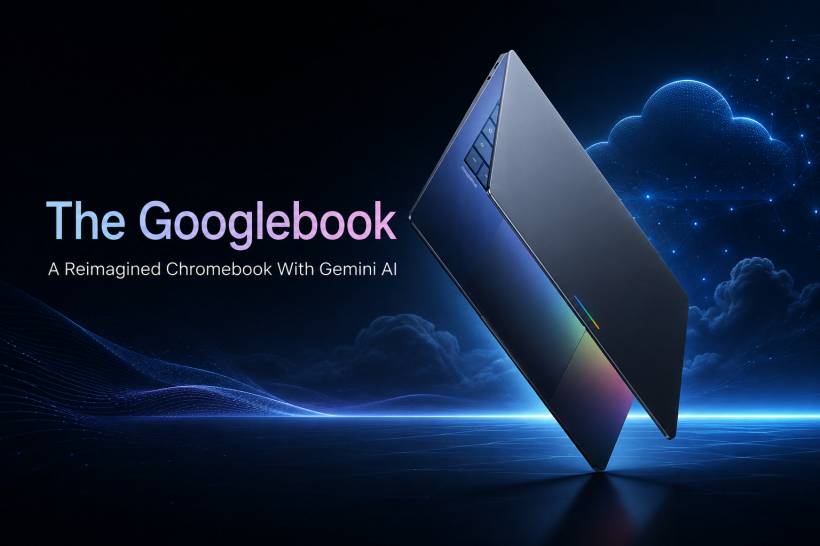
Google has officially introduced the Googlebook, a new laptop concept that appears to rethink what a Chromebook-style device should look like in today's cloud-driven and AI-heavy computing landscape. While Google has long been associated with Chromebooks, this launch is notable because it represents the company's first major laptop direction since the original Chromebook arrived back in 2011.
That gap matters. When Chromebooks first appeared, the idea was simple: lightweight laptops built around the browser, online services, and affordable access to productivity tools. At the time, the cloud was still becoming mainstream. Today, the situation is very different. Apps, files, media, communication, and even creative tools are now deeply connected to cloud platforms. On top of that, artificial intelligence has quickly become the next major layer in personal computing. The Googlebook seems designed to sit right in the middle of that shift.
A Laptop Built Around A Cloud-First World
Google describes the Googlebook as a laptop built for a "cloud-first world", which is a natural evolution of the Chromebook idea. However, this time, the focus is not only on browsing and online productivity. The bigger message is that Google wants the laptop to feel more intelligent, more connected, and more integrated with the rest of a user's digital life.
The company is positioning the Googlebook as a new category of laptop that brings together the strengths of Android and ChromeOS. On one side, Android offers access to the Google Play ecosystem and a large library of apps. On the other, ChromeOS brings Google's browser-first computing experience, which has always been the foundation of Chromebook devices. By combining both, Google appears to be aiming for something broader than a traditional Chromebook refresh.
This also suggests that the Googlebook may not simply be another low-cost laptop for students or basic office work. Instead, Google seems to be pitching it as a more modern device for users who move between phones, tablets, cloud apps, browsers, and AI tools throughout the day.
Gemini AI Sits At The Centre Of The Experience
The biggest difference between the Googlebook and earlier Chromebook-style devices is the role of Gemini. Google is placing Gemini Intelligence at the heart of the experience, making AI less of an optional feature and more of a core part of how the laptop works.
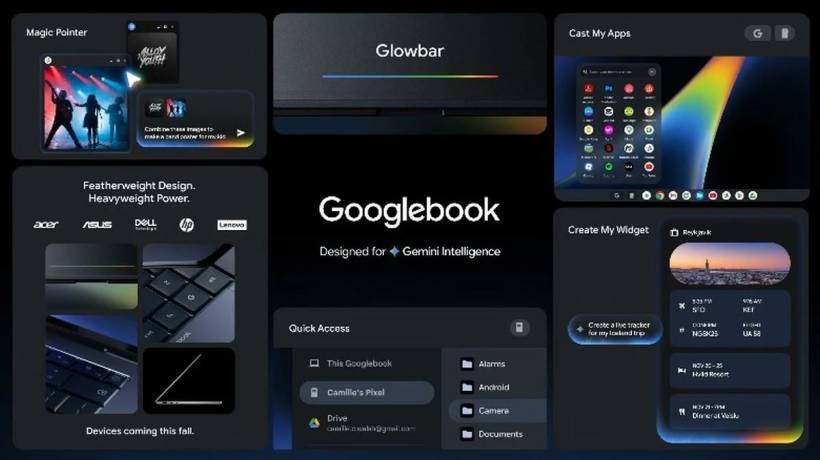
From what Google has shown so far, Gemini on the Googlebook is not limited to answering questions or summarising text. The company has demonstrated creative functions such as combining two images to generate a new image. That points toward a device where AI is directly built into everyday workflows, especially for users who create content, design visuals, prepare presentations, or experiment with ideas.
More interestingly, Google also appears to be exploring AI-generated widgets. Based on the early preview, users may be able to describe what they want using a prompt, and Gemini Intelligence can create a personalised widget from that instruction. This could make the Googlebook feel more adaptive than a normal laptop, because the interface itself may be able to change based on what the user needs.
A Deeper Connection With Android Devices
Another major part of the Googlebook experience is its connection with Android. Google already has a strong ecosystem across Android phones, tablets, smartwatches, earbuds, and other connected devices. With the Googlebook, the company seems to be tightening that ecosystem even further.
The idea is to let users move more smoothly between their laptop and Android devices. In practical terms, this could mean easier file sharing, app continuity, message syncing, notification handling, and possibly deeper cross-device features powered by Gemini. For users already invested in Android, this could make the Googlebook feel like a more natural laptop companion than a Windows or macOS machine.
This is also where Google may be trying to compete more directly with Apple's ecosystem approach. Apple has long benefited from the way iPhones, iPads, Macs, and other devices work together. Google has the Android user base, but the laptop side has always felt less tightly connected. The Googlebook could be Google's attempt to close that gap.
Hardware Details Are Still Mostly Under Wraps
While Google has shared quite a bit about the software direction, it has been much quieter about the hardware. At this stage, the company has not revealed many concrete specifications, which leaves several important questions unanswered.
One of the biggest questions is what kind of processor will power the Googlebook. Since Google already develops its own Tensor chips for Pixel devices, it would not be surprising if the company eventually uses a Tensor-based chip, or a variation of it, for the Googlebook. That would make sense from a strategy perspective, especially if Google wants tighter control over AI performance, battery efficiency, and hardware-software integration.
Using its own silicon could also reduce Google's dependence on external chipmakers. However, until the company confirms the actual hardware, this remains speculation. For now, Google appears more interested in introducing the concept and software direction rather than revealing the full technical package.
Google Will Still Work With Familiar Laptop Partners
Although the name Googlebook makes it sound like a single Google-made laptop, the company is expected to work with familiar hardware partners. Brands such as ASUS, Acer, Dell, Lenovo, and HP are expected to be involved in producing Googlebook devices.
That approach is very similar to how Chromebooks became widely available. Instead of relying only on one in-house model, Google can expand the platform through multiple manufacturers, price ranges, and hardware designs. This could help the Googlebook reach different types of users, from students and casual users to professionals who want a more AI-focused cloud laptop.
The real challenge will be consistency. If Googlebook becomes a broad platform across many manufacturers, Google will need to make sure the Gemini-powered experience feels polished and reliable regardless of which brand builds the device.
Why The Googlebook Matters
The Googlebook is important because it shows how Google sees the future of laptops. The Chromebook was originally built around the browser and the cloud. The Googlebook appears to take that foundation and add a new layer: AI as a built-in assistant, creative engine, and interface tool.
This could make the laptop more useful for everyday tasks, but it also raises the expectations. If Gemini is truly central to the Googlebook, it needs to feel practical, fast, and helpful, not just like another AI feature added for marketing. Users will want to see real benefits, such as faster workflows, better multitasking, smarter app integration, and meaningful cross-device support.
For now, the Googlebook feels like an early look at Google's next computing direction rather than a fully explained product. More details are expected later, especially around hardware, pricing, availability, and the actual user experience. Still, the message is clear: Google wants to move beyond the traditional Chromebook identity and build a laptop platform where cloud computing, Android, ChromeOS, and Gemini AI all work together as one connected experience.
Final Thoughts
The Googlebook feels like Google's attempt to modernise the Chromebook idea for a very different era of computing. Back in 2011, the Chromebook was mainly about simplicity, affordability, and doing most things through the browser. That concept made sense at a time when cloud computing was still growing. Today, however, users expect their devices to be more connected, more flexible, and increasingly more intelligent. That is where the Googlebook seems to fit in.
What makes it interesting is not just that Google is building another laptop category, but that it is putting Gemini AI at the centre of the experience rather than treating it as an extra feature. If Google can make Gemini genuinely useful for daily work, creativity, device continuity, and personalised workflows, the Googlebook could become more than just a refreshed Chromebook. It could represent a new direction for Android and ChromeOS working together in a more unified way.
Of course, the real test will come when Google reveals the full hardware details, pricing, performance, and availability. AI-focused devices can sound impressive during previews, but users will judge them based on how useful they are in real life. For now, the Googlebook looks like a promising step toward a more intelligent, cloud-first laptop experience, but it still needs to prove that it can offer something meaningfully different from the laptops people already use today.











Comments 0