

AI-assisted coding has reached the point where the question is no longer simply whether an AI model can review code. Increasingly, developers are asking something more practical: how much AI do you actually need for a code review, and how much should you be paying for it? A recent comparison shared on Reddit by u/entelligenceai17 puts that question into perspective by testing GPT-5.6 Luna against the considerably more expensive GPT-6 Astra across real-world pull requests. The headline result is difficult to ignore: Luna found about 75% as many verified bugs as Astra while costing roughly 28 times less.
The Reddit post summarizes a benchmark run by Entelligence using 50 pull requests from Cal.com, Sentry, Discourse, Keycloak and Grafana. Rather than asking the models to generate code, the experiment gave both models the same code-review task and measured whether they could identify genuine problems in existing changes. That makes this particularly interesting for development teams, because AI code review is one of those tasks that could potentially run dozens or hundreds of times every day.
The Numbers Immediately Grab Attention
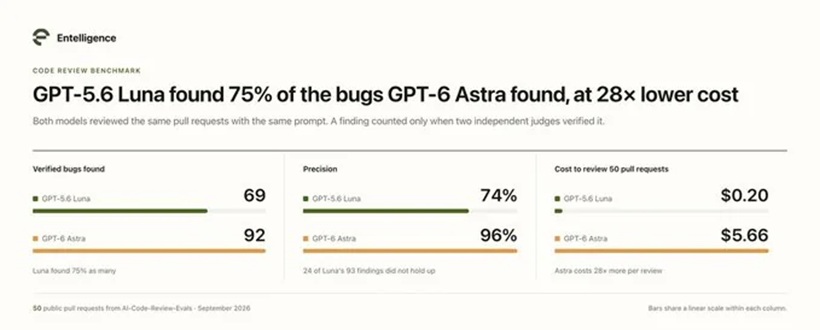
At first glance, GPT-6 Astra clearly found more problems. Across the 50 pull requests, Astra produced 92 verified bugs, while GPT-5.6 Luna produced 69. In raw detection capability, then, Luna did not match the larger model.
But the cost difference changes the conversation considerably.
The benchmark reported the following results:
That last point is especially interesting. Normally, generating three times as many output tokens might sound inefficient. In this case, however, Luna's lower token price means that even a more verbose review remains dramatically cheaper overall.
But 75% of the Bugs Does Not Mean 75% of the Quality
This is where the benchmark becomes more nuanced.
Looking only at the number of bugs discovered makes Luna appear surprisingly close to Astra. Precision tells a different story. Luna's 74% precision means roughly one quarter of its reported findings failed the benchmark's verification process. Astra's precision was 96%, with only four of its 96 findings failing verification.
That difference matters enormously in day-to-day development.
An AI reviewer that frequently produces false alarms can create its own kind of technical overhead. Developers have to stop, read the warning, investigate the surrounding code and determine whether the model has discovered something meaningful or simply misunderstood the implementation.
A single false positive might only waste a minute. Multiply that across hundreds of pull requests, however, and developers may eventually begin ignoring the reviewer entirely. Once that happens, even legitimate warnings become easier to miss.
So Astra's advantage is not simply that it discovered 23 additional verified bugs. Its comments were also substantially more likely to be correct.
Security Bugs Reveal an Even Bigger Difference
The most important detail may actually be buried below the headline statistics.
When Entelligence divided the detected problems into different bug categories, Luna performed relatively well on ordinary logic and data problems. It reportedly found 39 data-and-logic bugs compared with Astra's 47, while concurrency results were 10 versus 13.
Security was another story.
Out of 24 verified security bugs in the benchmark pool, Luna detected only nine, while Astra detected 19. The gap became particularly noticeable in Keycloak, an identity and access-management project where authentication and permissions naturally play a major role. Luna found six verified bugs there compared with Astra's 14, and only half of Luna's Keycloak findings survived verification.
That difference changes how the results should be interpreted.
For routine application code, an inexpensive model catching most obvious logic mistakes could already provide tremendous value. For authentication, authorization, financial transactions, privacy controls or other high-risk areas, missing subtle bugs can have much larger consequences than the cost of running a stronger model.
The cheapest reviewer therefore does not necessarily have to become the only reviewer.
A Tiered Code-Review Strategy Starts to Make Sense
One Reddit commenter raised an interesting possibility: use Luna for an initial review, record the problems it discovers, and then send the remaining work to Astra rather than asking the expensive model to rediscover everything from scratch. The benchmark author responded that this kind of Luna-to-Astra workflow would be worth testing.
This may ultimately be more useful than arguing over which model is universally "better."
Imagine an automated development pipeline where every pull request first passes through a cheap model. Luna could check routine issues such as incorrect conditions, missing error handling, obvious race conditions and common data-flow mistakes. Most pull requests could potentially stop there.
The system could then escalate selected changes to a stronger model whenever it detects files involving authentication, permissions, cryptography, payments, sensitive data or unusually complex architecture.
In other words, model routing could become part of software quality assurance in much the same way that organizations already use different levels of testing.
A small documentation change probably doesn't need the same review budget as a change to an OAuth authorization flow.
Interestingly, Luna Found Bugs Astra Missed
Another reason not to treat this benchmark as a simple hierarchy is that the models did not discover exactly the same problems.
Across the benchmark's pool of 143 verified bugs, 44 were found by both Luna and Astra, while Astra uniquely found 48 and Luna uniquely found 25. Another 26 were missed by both of them and had been identified by other reviewers included in the evaluation pool.
That means a weaker or cheaper model is not merely a reduced version of a stronger one.
Different models can follow different reasoning paths and notice different patterns. Entelligence calculated that running both Luna and Astra across all 50 pull requests would have uncovered 117 of the 143 verified bugs for a combined model cost of approximately $5.86.
That is an intriguing result because adding Luna on top of the Astra run cost only another twenty cents, yet Luna contributed bugs Astra had missed.
For automated review systems, diversity between models could therefore become valuable in its own right.
How the Benchmark Actually Verified a Bug
There is also an important methodological detail behind the word "verified."
Both models reviewed the same diffs using the same prompt. Findings from Astra, Luna, GPT-5.6 Sol and Entelligence's reviewer were then placed into an anonymized pool. GPT-6 Astra and GPT-5.6 Sol separately evaluated those findings against the source diff, and a bug was counted only when both judges agreed that it was genuine. The two judges reportedly agreed on around 91% of findings.
That approach is stronger than simply counting every criticism produced by a model, but it is not equivalent to a complete human audit.
There is also an obvious limitation: Astra was both a contestant and one of the judges. Entelligence acknowledges this and notes that requiring GPT-5.6 Sol to agree helps reduce potential bias, but cannot completely eliminate it.
The benchmark also cannot calculate true recall because there is no exhaustive ground-truth list containing every bug in every pull request. If all reviewers miss the same defect, that defect never enters the verification pool.
That distinction matters when reading statements such as "69 bugs versus 92 bugs." These are verified findings under this particular methodology, not proof that one model discovered a known percentage of every defect actually present in the code.
The Models Were Reviewing Diffs, Not Entire Repositories
Another limitation makes the experiment both useful and somewhat artificial.
The models received the pull-request diff rather than complete knowledge of the repository, runtime behavior, production environment or architectural history.
Human developers frequently rely on exactly that wider context when reviewing code.
A function might look perfectly reasonable until you know it is called simultaneously from four worker threads. A permission check might appear correct until you understand the application's inheritance model. An API call could seem harmless until you know that the production endpoint occasionally redirects requests.
This may partly explain why complicated authorization problems were harder for Luna. Some bugs cannot easily be understood by staring at one changed line; they require reasoning about what the surrounding system allows to happen.
Future AI review tools may therefore improve as much through better context retrieval as through larger language models.
The Cost Difference Becomes Huge at Scale
Twenty cents versus $5.66 does not sound particularly dramatic when talking about only 50 pull requests.
Multiply it across a large development organization and the economics become much more interesting.
A company processing thousands of automated reviews every month may not want its most expensive reasoning model examining every small dependency update, UI adjustment or configuration change. If a cheaper model catches the majority of ordinary mistakes, it could act as an always-on first layer of defense without creating a significant inference bill.
The larger model could then be reserved for situations where additional reasoning depth has measurable value.
This mirrors how human engineering teams already work. Not every code change gets reviewed by the organization's most senior security engineer. Routine work is handled normally, while particularly sensitive changes receive additional scrutiny.
AI models could eventually follow the same hierarchy.
The Reddit Discussion Highlights the Real Question
The Reddit discussion around u/entelligenceai17's comparison reflects this shift nicely. Some developers focused on Luna's extraordinary price-to-detection ratio, while others questioned whether the missed bugs were precisely the difficult ones that justify paying for Astra. Another commenter specifically suggested testing a staged review process where Luna performs the first pass before escalation to a stronger model.
That may be the bigger lesson from this experiment.
The interesting question is no longer simply:
"Which AI model is the best code reviewer?"
A more useful question may be:
Once AI becomes part of normal CI/CD pipelines, cost, latency, precision, false-positive rates and the severity of missed bugs all start mattering alongside raw benchmark performance.
Final Thoughts
The GPT-5.6 Luna versus GPT-6 Astra comparison shared by u/entelligenceai17 offers a fascinating glimpse into where AI-assisted software development may be heading. Luna finding 69 verified bugs against Astra's 92 for only $0.20 compared with $5.66 demonstrates just how capable inexpensive models have become. For routine code review, that economics is difficult to dismiss.
At the same time, Astra's 96% precision, stronger security performance and ability to uncover significantly more subtle problems show why larger reasoning models still have an important role. The benchmark does not suggest that cheap models have made powerful ones unnecessary. Instead, it suggests something potentially more useful: developers may not need to use the most powerful model for everything.
The future of AI code review may therefore be less about choosing one winner and more about building intelligent layers. Let Luna inspect everything cheaply, escalate complicated or sensitive changes to Astra, keep conventional static analysis and automated tests running alongside them, and leave developers with the final judgment.
If the economics demonstrated by this benchmark continue improving, AI code review may soon stop being a premium extra and become something that quietly examines every pull request, every time.











Comments 0