

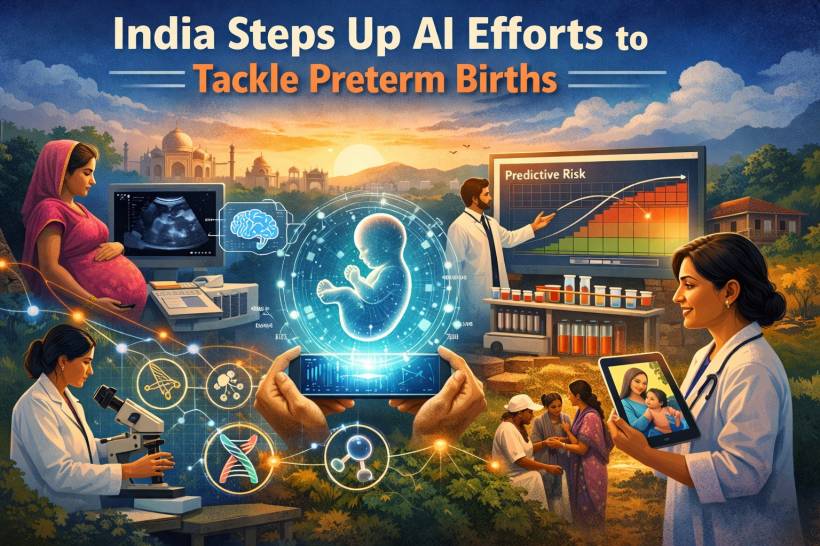
Preterm birth remains one of the biggest challenges in maternal and child health worldwide—and India carries a significant portion of that burden. In response, the country is now taking a more data-driven approach, investing heavily in artificial intelligence (AI) to better predict, prevent, and manage early births.
At the center of this effort is a government-backed programme called GARBH-INi, which is quietly becoming one of the most ambitious pregnancy research initiatives in South Asia.
Building One of South Asia's Largest Pregnancy Datasets
To create meaningful AI solutions, you need data—and lots of it. That's exactly what GARBH-INi has focused on.
The programme has enrolled around 12,000 pregnant women, collecting an enormous volume of biological and imaging data. This includes more than 1.6 million biospecimens and over a million ultrasound images.
What makes this particularly important is not just the scale, but the local relevance. Many existing medical AI models are trained on Western datasets, which may not accurately reflect the genetic, environmental, and lifestyle factors found in India.
By building a dataset tailored to its own population, India is laying the groundwork for AI tools that can deliver far more accurate and personalised insights.
Why Localised AI Matters in Pregnancy Care
India's Science and Technology Minister of State, Jitendra Singh, highlighted a critical issue: global solutions don't always translate well locally.
Preterm birth is influenced by a complex mix of factors—nutrition, genetics, infections, access to care, and even environmental conditions. Without data that reflects these realities, predictive models can miss the mark.
That's why this initiative is not just about AI—it's about context-aware healthcare innovation.
Early Breakthroughs from the GARBH-INi Programme
Even in its early stages, the programme has already produced promising outcomes. Researchers have begun developing:
• Microbiome-based predictors that may signal risk of preterm birth
• Rapid diagnostic tools for earlier detection of complications
• Genetic markers that help identify high-risk pregnancies sooner
Together, these tools aim to shift healthcare from reactive to proactive—identifying risks earlier so interventions can happen before complications escalate.
Beyond Research: Turning Data into Real-World Solutions
One of the standout aspects of GARBH-INi is its focus on translating research into actual clinical tools.
The programme has established a national biorepository along with a data-sharing platform called GARBH-INi-DRISHTI. This allows researchers across institutions to collaborate and build on the dataset, accelerating innovation.
At the same time, partnerships with industry players are helping bring these solutions closer to real-world use. For example:
• Partnerships with Doto Health and Qure.ai to create AI-powered ultrasound reporting and risk prediction systems
This kind of ecosystem—where government, research institutions, and private companies work together—is key to turning innovation into impact.
What Comes Next: Scaling AI in Maternal Healthcare
The next phase of the programme is focused on scaling. That means moving beyond development and testing into real-world deployment.
The goal is to integrate these AI tools into everyday healthcare settings—clinics, hospitals, and even remote care environments—so they can support doctors and healthcare workers on the ground.
There's also a strong emphasis on deeper data analysis and broader collaboration, both within India and internationally.
A Broader Push for AI in Healthcare
This initiative is part of a larger trend in India's healthcare strategy: building diverse, high-quality datasets to fuel AI innovation.
Efforts already underway include national repositories for life sciences data and large-scale cancer databases that capture genomic and clinical information. These resources are helping researchers develop solutions that are not only advanced but also highly relevant to local populations.
At the same time, companies like Doto Health are expanding beyond India. Through partnerships with organisations like FHI 360, they are bringing AI-powered maternal healthcare solutions to countries in Southeast Asia, including Vietnam and Laos.
These solutions focus on areas such as remote monitoring, point-of-care diagnostics, and data-driven decision-making—critical components in regions where access to healthcare can be limited.
Final Thoughts
What's happening with GARBH-INi is more than just another AI project—it's a clear example of how data, technology, and public health priorities can come together to tackle a deeply complex issue.
By focusing on locally relevant data and building tools tailored to real-world conditions, India is setting a strong foundation for improving maternal and neonatal outcomes. If successfully scaled, these AI-driven solutions could not only reduce preterm births but also serve as a model for other countries facing similar challenges.
In the long run, this approach could redefine how we think about pregnancy care—moving from generalised treatment to truly personalised, predictive healthcare.











Comments 0