

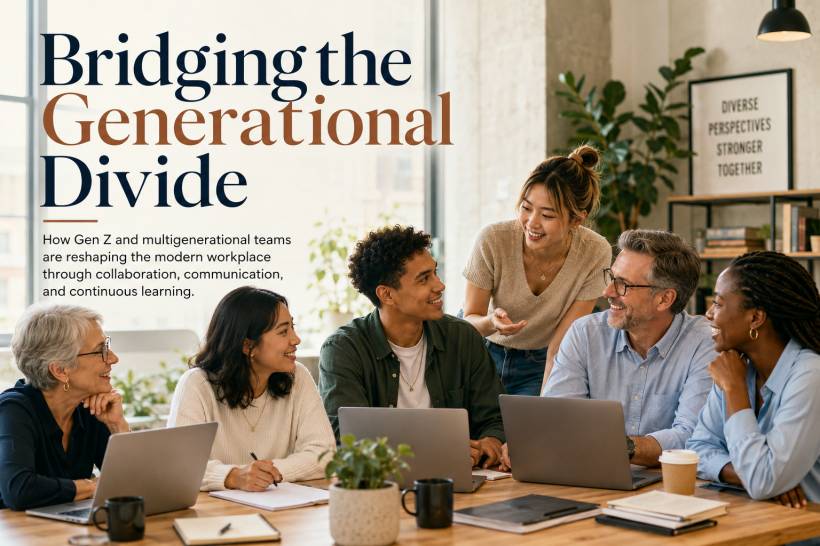
Today's workplace is more age-diverse than ever. Baby boomers, Generation X, millennials and Generation Z may now work within the same organisation, sometimes on the same project or even within the same small team.
That mix can create enormous value. Experienced employees bring institutional knowledge, professional judgement and lessons developed over decades, while younger workers often contribute fresh perspectives, digital confidence and a willingness to question outdated processes.
However, those differences can also create misunderstandings. People may have different expectations about communication, flexibility, career progression, technology and even what a successful working relationship should look like. The challenge for employers is not to force every generation into the same mould, but to create an environment where their different strengths complement one another.
Gen Z Is Entering Work With Different Expectations
Generation Z is generally associated with people born between 1997 and 2012. The oldest members are already established in the workforce, while the younger part of the generation is still in school or beginning to think about future careers.
Unlike previous generations, Gen Z grew up with smartphones, social media, cloud services, instant messaging and always-connected digital platforms as normal parts of life.
This does not mean every Gen Z employee is automatically a technology expert. It does mean many are comfortable experimenting with new tools, learning through digital platforms and questioning inefficient processes.
They are also commonly associated with a desire for meaningful work, diversity, sustainability, flexibility and healthier boundaries between professional and personal life. Many look beyond salary alone and consider whether an employer's culture, values and leadership style align with their own expectations.
For organisations, this represents both an opportunity and a challenge. Gen Z employees can bring energy, curiosity and fresh ideas, but they may disengage quickly when they feel ignored, micromanaged or unable to see how their work contributes to a larger purpose.
Avoid Treating Generations as Personality Types
Generational labels can be useful for understanding broad social and workplace trends, but they should never become rigid stereotypes.
Not every older employee dislikes technology. Not every millennial wants remote work. Not every Gen Z employee communicates only through messaging applications.
Age is only one part of a person's identity. Culture, education, personality, family responsibilities, career stage and professional experience can influence behaviour just as strongly.
The purpose of understanding generational differences should be to improve flexibility and communication—not to place employees into boxes.
Managers should therefore treat generational insights as a starting point for conversation rather than a shortcut for judging people.
Communication Styles Can Easily Create Friction
One of the most visible differences between generations is how they prefer to communicate.
Some experienced employees may favour face-to-face discussions, telephone calls or carefully structured emails. Younger employees may be more comfortable with instant messaging, collaborative platforms and brief digital updates.
Neither approach is automatically better.
A phone call can resolve a complicated issue quickly, while a written message creates a record that employees can refer to later. A face-to-face meeting may be ideal for sensitive conversations, while a project-management platform may be more efficient for tracking tasks.
Problems arise when one group assumes its preferred method is the only professional way to communicate.
For example, an older manager may interpret a short message as careless or disrespectful. A younger employee may see an unexpected phone call as disruptive when the same matter could have been resolved through a message.
Organisations can reduce this tension by establishing communication guidelines. Teams should understand which channels are appropriate for urgent issues, approvals, formal decisions, routine updates and informal collaboration.
Supporting several communication methods also helps employees share information clearly without forcing everyone into a single style.
Different Generations May Define Career Success Differently
Career expectations have changed significantly over time.
Some employees entered the workforce during periods when long-term employment, job security and loyalty to one company were considered signs of success. Younger workers may place more emphasis on rapid development, meaningful responsibilities, mobility and visible career progression.
Gen Z employees may be willing to remain with an organisation, but they often want to understand what opportunities exist and how they can move forward.
When employers do not provide clear development pathways, younger employees may conclude that they need to leave in order to grow.
At the same time, organisations should not assume that experienced employees no longer want advancement or learning opportunities. Many still want challenging assignments, updated skills and recognition for their contributions.
A strong talent strategy should therefore offer several forms of progression. Promotion into management should not be the only path. Employees may also grow through specialised roles, project leadership, professional certification or expanded technical responsibilities.
Balancing security, purpose and advancement can help organisations meet the expectations of employees at different career stages.
Flexibility Is Becoming a Workplace Standard
Flexible work was once treated as an optional benefit offered by a small number of organisations. It is increasingly viewed as an important part of modern employment.
Gen Z employees often value autonomy over how and where work is completed, but flexible arrangements can benefit every generation.
Parents may need schedules that accommodate childcare. Employees caring for elderly family members may require occasional remote work. Older workers may value reduced commuting, while younger employees may appreciate the ability to structure their day more independently.
Flexibility does not have to mean allowing everyone to work anywhere at any time. In hospitals, manufacturing facilities, retail operations and other location-dependent environments, many roles must still be performed on site.
Even in those settings, employers can consider options such as flexible starting times, compressed schedules, shift-swapping arrangements, hybrid administrative roles or greater control over leave planning.
The most important factor is clarity. Flexible work succeeds when employees understand the expected outcomes, availability requirements and accountability measures.
Organisations that adapt thoughtfully may improve employee satisfaction and retention without sacrificing operational needs.
Technology Can Connect Generations Rather Than Divide Them
Technology is sometimes presented as one of the main causes of generational tension. In reality, it can become one of the most effective tools for bridging the gap.
Younger employees may introduce collaborative platforms, automation tools or AI-assisted workflows. More experienced colleagues can evaluate whether those technologies are practical, secure and appropriate for the organisation.
That combination is valuable.
A new tool may appear impressive but fail to account for regulatory requirements, customer expectations or established operational risks. Conversely, an older process may be reliable but unnecessarily slow because nobody has reviewed it for years.
Multigenerational teams can combine experimentation with judgement.
Instead of assuming younger employees should handle all technology-related tasks, organisations should encourage shared learning. New systems should be introduced with proper training, clear governance and opportunities for employees to ask questions without embarrassment.
When technology is used as a collaborative tool rather than a measure of intelligence, it can improve efficiency across the entire workforce.
Work-Life Balance Is Not a Sign of Weak Commitment
Younger workers are sometimes criticised for placing too much emphasis on work-life balance. However, wanting sustainable working conditions does not necessarily indicate a lack of ambition.
Employees who are constantly exhausted are more likely to experience burnout, make mistakes or leave the organisation.
A healthier approach focuses on performance and outcomes rather than glorifying long hours.
Employers can support well-being through reasonable workloads, flexible arrangements, mental-health resources, proper leave planning and managers who respect boundaries outside working hours.
This benefits more than Gen Z. Employees of every age may experience stress, family responsibilities or health concerns.
Work-life balance should therefore be treated as part of workforce sustainability rather than a special concession for younger employees. The goal is to create an environment where people can perform well without sacrificing their long-term well-being.
Mentorship Should Work in Both Directions
Traditional mentorship usually involves an experienced employee guiding a younger colleague.
This remains extremely valuable. Senior employees can share professional judgement, organisational history, industry knowledge and lessons that may not appear in formal training materials.
However, mentorship can also move in the opposite direction.
Through reverse mentorship, younger employees may help experienced colleagues understand new technologies, digital trends, changing customer expectations or emerging forms of communication.
The goal is not to suggest that one generation knows more than another. Each group holds different forms of knowledge.
A senior manager may understand how to navigate a crisis, negotiate with stakeholders or interpret organisational politics. A younger employee may know how to automate a repetitive process, improve a digital service or communicate effectively through a newer platform.
When both sides approach the relationship with humility, mentorship becomes a genuine exchange rather than a one-way transfer of information.
Inclusion Must Extend Beyond Age
Generational diversity should form part of a broader inclusion strategy.
A team may include people from different age groups, cultures, professional backgrounds and educational pathways. Those differences can improve creativity and decision-making, but only when employees feel respected enough to contribute.
A workplace is not truly inclusive simply because it has a diverse workforce. Inclusion means ensuring that employees can speak, participate and influence decisions without being dismissed because of their age or seniority.
Younger employees should not be ignored because they have limited experience. Experienced staff should not be treated as resistant to change simply because they have worked in the organisation for many years.
Leaders can encourage inclusion by inviting different perspectives, rotating meeting responsibilities, ensuring credit is shared fairly and addressing disrespectful behaviour quickly.
The strongest teams do not eliminate disagreement. They create conditions where disagreement can be handled constructively.
Continuous Learning Is Necessary for Everyone
Technology, customer expectations and job requirements are changing too quickly for learning to end after formal education.
Gen Z may enter the workforce with familiarity in newer tools, but younger employees still need to develop professional judgement, business knowledge and interpersonal skills.
Experienced employees may possess deep expertise, but they also need opportunities to update technical skills and adapt to new working methods.
Training should therefore be available across all age groups.
Organisations can support continuous development through professional courses, job rotations, internal workshops, peer learning, certifications and practical project assignments.
Learning becomes most effective when employees can apply it to real work rather than simply complete courses for compliance purposes.
Managers also need to create an environment where asking questions is acceptable. Employees may hide skill gaps when they fear appearing outdated or inexperienced.
A culture that rewards learning is more adaptable than one that expects everyone to already know everything.
Stereotypes Can Damage Team Performance
Generational stereotypes may appear harmless, but they can influence hiring, promotion and everyday collaboration.
Comments such as "young workers are entitled" or "older workers cannot adapt" reduce individuals to assumptions and make genuine communication more difficult.
They can also become self-fulfilling.
A manager who assumes a younger employee will not remain long may avoid investing in that person's development. The employee then sees no future in the organisation and leaves.
Similarly, an organisation that assumes experienced staff cannot learn new systems may exclude them from training and later use their lack of familiarity as evidence that the stereotype was correct.
Overcoming these biases requires leaders to evaluate employees based on performance, capability and behaviour rather than age-based expectations.
Employees should also be encouraged to challenge their own assumptions and interact with colleagues outside their usual age group.
What Managers Can Do Differently
Bridging the generational divide requires more than one awareness session. It must be reflected in everyday management practices.
Leaders should begin by understanding employees as individuals. Regular conversations about career goals, communication preferences and working challenges can prevent assumptions from taking over.
Organisations can also:
These actions are not designed to favour one generation. They help create a workplace in which different employees can contribute effectively.
The Business Value of a Multigenerational Team
Generational diversity is not simply an employee-engagement topic. It can directly affect organisational performance.
Experienced employees may recognise risks that younger colleagues have never encountered. Younger employees may identify technologies or changing customer behaviours that senior leaders have overlooked.
Together, they can make stronger decisions than either group could make alone.
A multigenerational team can also understand a wider customer base. Organisations rarely serve only one age group, so having employees with different perspectives can improve product design, communication and service delivery.
The key is ensuring that differences are used productively rather than allowed to develop into internal divisions.
Final Thoughts
The generational divide is not something organisations can solve by asking younger employees to behave like older ones—or by expecting experienced employees to adopt every new trend.
The real goal is to build a workplace where different generations can learn from one another.
Gen Z brings digital confidence, new expectations and a willingness to rethink traditional working practices. Older generations contribute experience, resilience and valuable organisational knowledge. Millennials and Generation X often sit between these groups, helping translate expectations and connect established practices with emerging ones.
When organisations recognise these strengths, improve communication and remove age-based stereotypes, generational diversity becomes an advantage rather than a source of conflict.
The future workplace will continue to evolve as new generations enter and experienced employees remain active for longer. Companies that learn to connect those groups will be better prepared to innovate, retain talent and adapt to whatever comes next.











Comments 0