

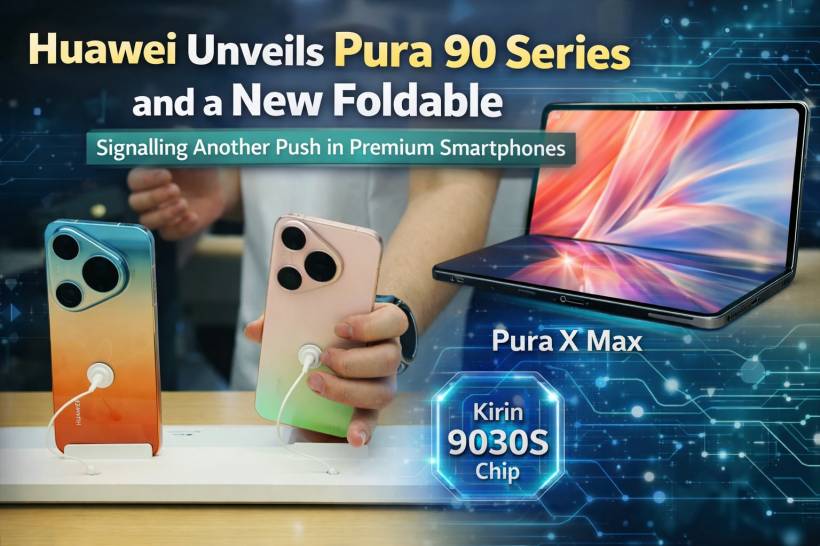
Huawei has introduced its latest flagship phone lineup, the Pura 90 series, alongside a new foldable model called the Pura X Max. The announcement was made during a launch event in Guangzhou, and it shows that the company is continuing to push hard in both the premium smartphone space and the foldable segment.
The new range includes three main models: the standard Pura 90, the Pura 90 Pro, and the Pura 90 Pro Max. On top of that, Huawei also revealed the Pura X Max, which it describes as the industry's first horizontally wide foldable smartphone. That positioning alone suggests Huawei is not just refreshing its product line, but also trying to stand out with a different form factor in an already crowded market.
The Pura 90 Family Focuses on Photography and AI Upgrades
As expected from a flagship launch, Huawei is putting a strong spotlight on camera performance. The top-end Pura 90 Pro Max comes equipped with a 200MP telephoto sensor, which immediately places it in the conversation for users who care about long-range photography and zoom performance.
Huawei is also highlighting a new long-range voice enhancement feature on the device, claiming it can capture audio from as far as 10 metres away. If that performs well in real-world use, it could be useful for recording subjects from a distance, whether during events, outdoor scenes, or content creation situations where getting physically close is not practical.
This suggests Huawei is continuing its strategy of making the camera system do more than just take sharper photos. It wants the phone to feel like a more complete imaging and recording tool, especially for users who rely heavily on their devices for social media, travel, or mobile video work.
Kirin 9030S Takes Centre Stage in the Higher-End Models
The Pura 90 Pro and Pura 90 Pro Max are powered by Huawei's in-house Kirin 9030S chip. That is notable because Huawei has spent years trying to strengthen its own technology stack, and every new chip announcement adds to that bigger story.
According to the company, the Kirin 9030S brings several imaging-related gains:
• AI ISP telephoto video clarity is enhanced by 110%
• Telephoto image stabilisation precision is increased by 30%
Those are impressive claims on paper, especially for users who want better results in zoom photography and video capture. More importantly, it shows Huawei is still leaning heavily into AI-assisted imaging as a key selling point. That has become one of the main battlegrounds in flagship phones, where raw hardware is no longer enough on its own and software tuning plays a major role in the final result.
HarmonyOS 6.1 Continues Huawei's Software Push
All three models in the Pura 90 series ship with HarmonyOS 6.1, which Huawei says brings improvements in visual design, interaction, and privacy.
That part matters because Huawei's smartphone identity today is no longer just about hardware. It is also about building a more self-contained software ecosystem. The more polished and capable HarmonyOS becomes, the more Huawei can position itself as an alternative to the usual Android and iPhone duopoly.
For users already invested in Huawei's ecosystem, software consistency across devices could be a meaningful selling point. For everyone else, the question will likely be whether HarmonyOS now feels mature enough to compete not just in features, but in everyday convenience and app experience.
Pricing Stays Familiar, But Future Increases May Be Coming
Huawei says the pricing for the new series remains unchanged from the previous Pura 80 generation, which is a notable decision given ongoing pressure on component costs.
The starting prices are:
• Pura 90 Pro: 5,499 yuan, roughly RM3,570
• Pura 90 Pro Max: 6,499 yuan, roughly RM4,220
Keeping pricing flat may help the new lineup look more attractive in a premium segment where buyers are already facing rising costs across many brands. At the same time, Huawei executive Yu Chengdong reportedly acknowledged that storage and other key components are becoming more expensive, and that future price hikes cannot be ruled out.
That comment is worth paying attention to. Even if these models launch at stable prices, it hints at how difficult it is becoming for manufacturers to keep flagship devices competitively priced over the long term.
The Pura X Max Brings a Different Foldable Idea
Alongside the main smartphone lineup, Huawei also introduced the Pura X Max, which it says is the first horizontally wide foldable phone currently on the market.
That description suggests Huawei is experimenting with a different foldable shape, possibly aimed at giving users a broader screen experience when unfolded while still maintaining portability. Foldable phones are no longer new, so brands now need something more specific to stand out. In Huawei's case, that seems to be a combination of design identity and alternative usage style.
Whether the Pura X Max becomes a major hit will depend on how practical that wider design feels in daily use. Foldables always look exciting at launch, but long-term appeal usually comes down to comfort, durability, app optimisation, and whether the shape actually improves the experience in a meaningful way.
HarmonyOS Growth Is Becoming Harder to Ignore
Yu also said that the number of devices running HarmonyOS 6 has now surpassed 55 million, with 23 million added in less than six months. That is a sizeable jump, and it suggests Huawei's software ecosystem is still building momentum.
That matters beyond just Huawei's own product announcements. A growing HarmonyOS base means the company has a better chance of strengthening developer support, user retention, and cross-device integration. In other words, the phones are only one part of the story. The bigger picture is Huawei trying to keep expanding its own platform influence.
An earlier IDC forecast also pointed to a 2026 market split where Android, iOS, and HarmonyOS NEXT could account for 70%, 15.3%, and 14.6% of the market respectively. If that projection proves close to reality, Huawei's operating system would no longer be seen as just a niche internal effort, but as a serious ecosystem with growing relevance.
Final Thoughts
Huawei's latest launch feels like more than a routine flagship refresh. The Pura 90 series shows the company is still investing heavily in premium smartphone photography, AI-driven imaging, and its own software ecosystem, while the Pura X Max shows it is still willing to experiment with foldable design.
For consumers, the biggest appeal will probably come down to the combination of strong camera hardware, HarmonyOS improvements, and relatively stable pricing for now. But the longer-term story is just as interesting: Huawei is continuing to build an ecosystem that tries to compete on its own terms, with its own chips, software, and increasingly distinct product direction.











Comments 0