

Malaysia's fast-growing data centre industry has been getting plenty of attention lately, especially in Johor. With major digital infrastructure projects coming in and interest from foreign investors continuing to rise, the conversation is no longer just about server capacity, land size, or proximity to Singapore. Increasingly, it is also about sustainability, resource usage, and how these large developments affect the communities around them.
That is why ZDATA Group's latest milestone stands out.
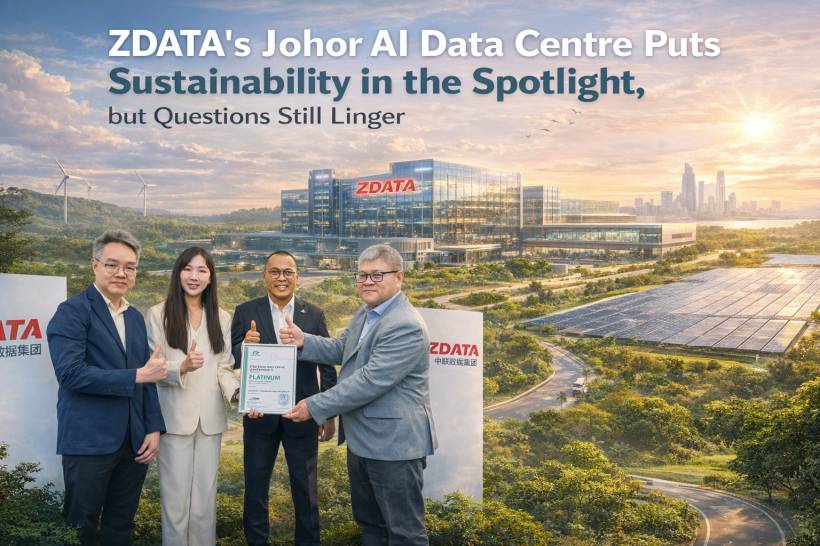
The Chinese digital infrastructure company is preparing to launch what is being described as Malaysia's first hyperscale AI data centre to receive a GreenRE Platinum certification, which is the highest rating under the GreenRE Certification Scheme. The facility, located in Gelang Patah, Johor, carries an estimated investment value of around RM8 billion and is being developed through Computility Technology Sdn Bhd, a wholly owned subsidiary of ZDATA.
At first glance, this looks like a major win for Malaysia's digital economy and green building ambitions. But as with many large-scale infrastructure projects, the full story is more layered than the headline suggests.
A Major AI Data Centre Project in Johor
The Gelang Patah facility is not a small or ordinary development. It is being positioned as a hyperscale AI data centre, which means it is built to support large-scale computing workloads, including the kind of high-performance processing required for artificial intelligence applications.
That matters because AI data centres are far more demanding than conventional facilities. They require significant energy, efficient cooling systems, and long-term infrastructure planning. As demand for AI services grows globally, countries that can host these facilities stand to benefit from new investment, job creation, and stronger digital infrastructure.
According to project representatives, the development will be carried out in phases, with the first facility expected to begin operations by the end of March 2026. This phased approach is common for projects of this size, especially when the goal is to scale capacity over time while aligning with energy supply, water systems, and customer demand.
For Johor, the project adds to the state's rising profile as a major regional hub for data centres. Its location near Singapore continues to be one of its strongest advantages, particularly for companies looking for strategic connectivity while operating outside Singapore's tighter land and infrastructure constraints.
What Makes the GreenRE Platinum Rating So Important
The biggest headline around this project is its GreenRE Platinum certification.
GreenRE is a sustainability certification introduced by REHDA, and a Platinum rating signals that the facility has met the scheme's highest benchmark. In simple terms, this gives the project a strong environmental credential at a time when data centres are often criticised for their heavy use of electricity and water.
This is especially significant because data centres are becoming more central to modern life, yet they also come with growing scrutiny. They power cloud platforms, enterprise systems, AI models, streaming services, and digital communications, but they can also place major strain on utilities if not designed responsibly.
So when a large AI-focused facility earns a top-tier sustainability rating, it sends a message. It suggests that the project is not only being built for scale and performance, but also with environmental efficiency in mind.
In Malaysia's case, this is also symbolically important. The country has been attracting billions in digital infrastructure investments, but sustainability expectations are rising just as quickly. A project like this may become a reference point for how future data centres are planned, certified, and promoted.
Reclaimed Water Is One of the Most Talked-About Features
One of the most notable parts of the Gelang Patah data centre is its cooling strategy.
Instead of depending on domestic potable water, the facility is designed to use reclaimed water sourced from two nearby treatment plants. That makes it one of the more closely watched aspects of the project, especially in a sector where cooling systems can consume large amounts of water.
This approach is important for two reasons.
First, it reduces dependence on treated drinking water, which helps ease pressure on local freshwater resources. In a place like Johor, where long-term water management remains a sensitive issue, that is a meaningful design decision.
Second, it gives the project a more practical sustainability angle rather than just a marketing one. Renewable energy targets and green certifications are often highlighted in announcements, but water sourcing is one of those issues that directly affects public perception because it feels immediate and local.
By using reclaimed water, the developers are clearly trying to address one of the common criticisms aimed at large digital infrastructure projects. It also helps explain why the facility secured the Malaysia Green Data Centre Recycled Water Certification in August 2025.
That said, even a strong sustainability feature like this does not automatically erase broader public concerns. People living near major developments often judge a project not only by what it promises on paper, but by what they experience on the ground.

The Renewable Energy Plan Adds Another Long-Term Layer
Water is only one side of the sustainability story. Energy is the other major one.
The project has also been designed with high energy-efficiency standards in mind, and there are plans to support it with renewable energy in the years ahead. CTDC has already signed a strategic term sheet with BGMC Energy Holdings Sdn Bhd and reNIKOLA Holdings Sdn Bhd for a long-term renewable energy programme tied to the data centre.
Under that arrangement, solar farm assets are expected to be developed to supply power to the facility. The solar component is projected to start operating in 2028, with two sites expected to generate around 630,000 megawatt hours of electricity annually.
That is a major figure, and it shows that the project is not only thinking about current demand, but also about how to support future scale more sustainably.
This is increasingly important because AI infrastructure is power-hungry by nature. Around the world, governments and companies are now trying to balance digital growth with cleaner energy strategies. For Malaysia, projects like this may signal a broader transition where digital expansion and renewable energy planning become more tightly linked.
The Economic Promise Is Hard to Ignore
Beyond its environmental credentials, the project is also being framed as an economic opportunity.
Once fully completed, the facility is expected to create between 400 and 500 jobs, with at least 200 of those roles intended for local talent. In a sector that often brings high-value technical and operational roles, that could be a meaningful boost for Johor's workforce and wider economy.
There is also a broader investment story here. Malaysia is reportedly ZDATA's first investment destination outside China, which makes the project notable not just in terms of scale, but also in terms of confidence. Choosing Malaysia as its first overseas base suggests the company sees long-term potential in the country's digital infrastructure ecosystem.
Political stability and Johor's location near Singapore were cited as key reasons behind the decision. Those factors are not surprising. Johor has increasingly positioned itself as a practical alternative for large data centre developments, particularly when connectivity, logistics, and cross-border business activity are taken into account.
The fact that ZDATA is also evaluating other locations in Malaysia for future expansion suggests this project may be only the beginning.
But This Project Is Not Without Controversy
For all the positive messaging around certification, green design, and economic potential, this data centre project is not entering the spotlight for the first time.
In fact, the same Gelang Patah development drew public criticism earlier in February 2026, when more than 50 residents reportedly gathered near the construction site to protest concerns about dust pollution and possible effects on water supply.
That protest was significant because it highlighted the gap that can sometimes exist between a project's sustainability branding and the lived experience of nearby communities.
Residents claimed that construction activity had seriously worsened air quality in the area. Some said they had to clean dust from their homes every day. Others complained that routine activities, including drying clothes outdoors, had become more difficult because of the conditions around the site. With some homes located less than a kilometre away, the concerns were not abstract. They were immediate and highly personal.
In response, ZDATA Technologies said it was complying with regulatory requirements and working with relevant parties to reduce disruption. The company also noted that parts of the project were already in more advanced stages, where less intensive construction was taking place.
Later, the issue led to a townhall session involving residents, local authorities, and project stakeholders. Complaints were discussed, and mitigation measures such as improved dust control, monitoring of noise levels, and oversight of construction activities were raised.
This part of the story matters because it reminds everyone that sustainability is not only about technical certification. It is also about how responsibly a project is built and how well it manages its impact during the construction phase.
A Green Building Can Still Face a Difficult Public Test
There is an irony at the heart of this story.
On one hand, the Gelang Patah facility is being celebrated as Malaysia's first data centre to achieve the highest GreenRE rating. On the other hand, the very same project has faced criticism from nearby residents who say the development has already disrupted their daily lives.
Both realities can exist at the same time.
A project can be environmentally advanced in design while still causing frustration during construction. It can be energy-efficient on paper and still create local discomfort if mitigation measures are not handled well enough. And that is exactly why public trust matters so much in developments like this.
Certifications are important, but they are only one part of the picture. Communities will also judge a project based on transparency, responsiveness, and whether the people living nearby feel heard when problems arise.
In that sense, the real long-term success of this data centre may depend not only on its technical performance or sustainability features, but also on how effectively its developers manage the relationship with the surrounding community.
What This Means for Malaysia's Data Centre Future
ZDATA's Johor project reflects where Malaysia's digital infrastructure ambitions are heading.
The country wants to attract big-ticket technology investments. It wants to support AI growth. It wants to position Johor as a regional digital hub. And increasingly, it also wants these developments to come with stronger environmental credentials.
That is the broader significance of this project. It is not just another large data centre. It is becoming a test case for how Malaysia balances economic growth, sustainability, infrastructure demand, and community concerns all at once.
If the project succeeds, it could set a new benchmark for future data centres in the country. If it struggles, especially in terms of local impact and public acceptance, it may become a reminder that green branding alone is not enough.
Final Thoughts
ZDATA's RM8 billion AI data centre in Gelang Patah is undeniably a major milestone for Malaysia. The GreenRE Platinum certification, reclaimed water cooling system, renewable energy plans, and job creation potential all point to a project that is trying to position itself as both technologically advanced and environmentally responsible.
But the story does not end there.
The earlier protests in Gelang Patah show that large-scale digital infrastructure projects cannot be judged only by certifications and investor announcements. They also need to be assessed by how they affect the people living nearby, especially during the messy and disruptive construction stage.
In many ways, this project captures the larger challenge facing the data centre industry today. Growth is exciting. Sustainability is necessary. But public trust still has to be earned the hard way.











Comments 0