

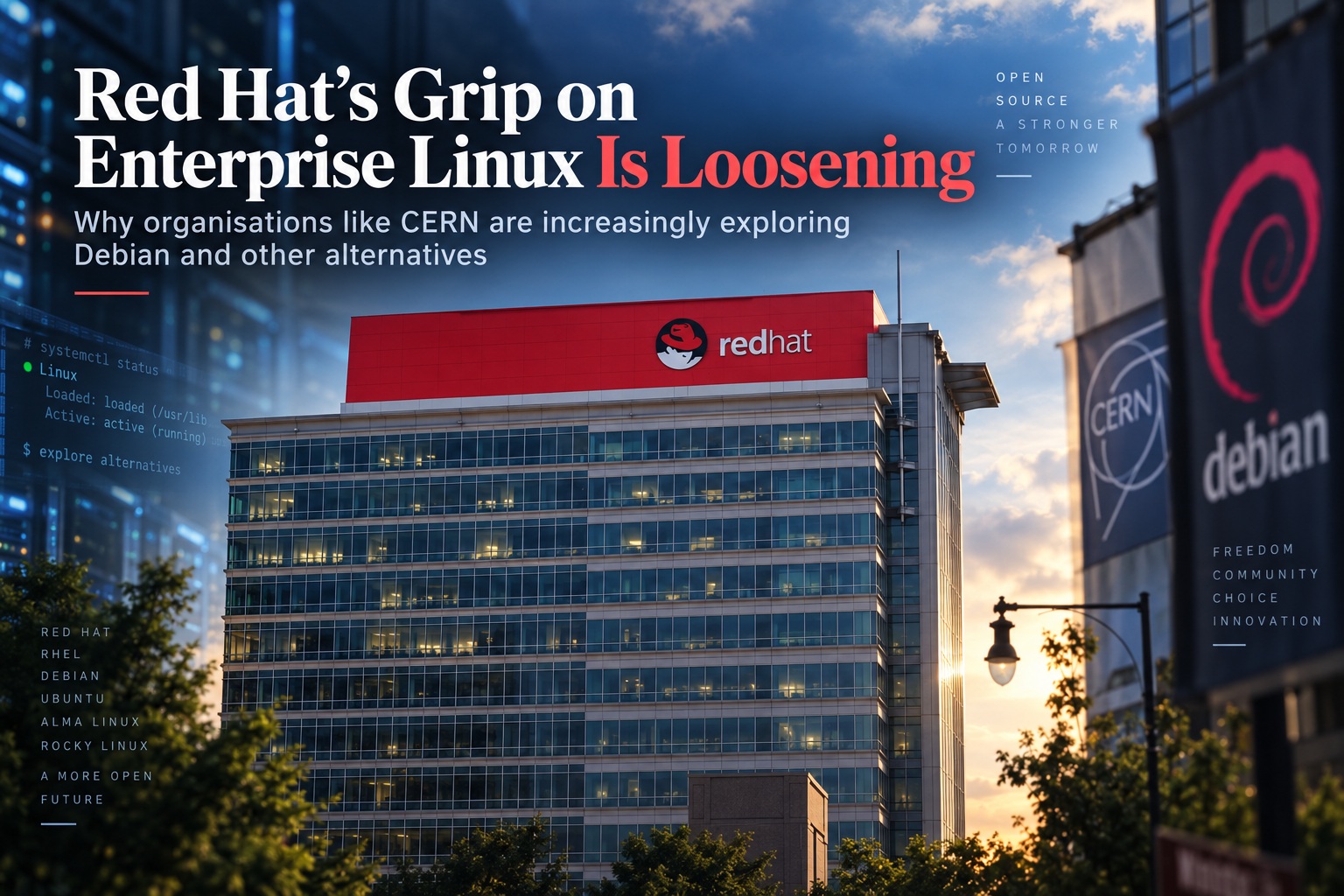
For years, Red Hat Enterprise Linux sat at the centre of professional Linux deployments, especially in organisations where stability, compatibility and long support cycles mattered more than having the newest features. CentOS strengthened that position by giving institutions access to a closely aligned community distribution that could sit beside paid RHEL systems without forcing every machine onto a commercial subscription. That arrangement worked particularly well for large research organisations such as CERN, where thousands of systems could share the same general software foundation while only the most critical deployments required full enterprise support.
That relationship has become much more complicated over the past several years. Changes to CentOS, adjustments to how Red Hat publishes RHEL-related source code, and evolving hardware support have encouraged organisations to reassess whether remaining entirely inside the Red Hat ecosystem still makes operational sense. CERN's decision to begin deploying Debian across more than 2,200 control systems in 2026 is one of the clearest examples that even deeply established enterprise Linux relationships can change when technical and lifecycle requirements no longer align.
Why CentOS Was So Important to the Red Hat Ecosystem
CentOS Linux used to occupy a particularly valuable position. It was closely aligned with Red Hat Enterprise Linux, giving organisations a community-supported option that benefited from much of the same engineering foundation without requiring a paid RHEL subscription on every machine. Companies and institutions could therefore mix commercial RHEL deployments with CentOS while maintaining a high degree of compatibility across their environments.
For organisations such as CERN, that model was extremely attractive. Paid support could be reserved for systems where contractual support and vendor assistance were essential, while less critical machines could run CentOS and remain familiar to administrators already working with RHEL. Standardising around related distributions simplified software deployment, training, maintenance and long-term infrastructure planning.
The arrangement also reduced the risk of fragmentation. If both operating systems behaved similarly, applications developed against one environment could generally be expected to work across the other without requiring entirely separate engineering processes. That consistency was one of the reasons the broader Red Hat ecosystem became such a strong presence in scientific and enterprise computing.
CentOS Stream Changed the Relationship
The first major disruption came when Red Hat announced that the future of the CentOS project would be CentOS Stream. Traditional CentOS Linux had effectively followed RHEL downstream, while CentOS Stream was repositioned upstream as a development branch that sits ahead of future RHEL releases.
That may sound like a relatively technical distinction, but it fundamentally changed what CentOS represented. Institutions that wanted something extremely close to the stable RHEL releases no longer had the same model they had relied upon previously. CentOS Stream instead became a place where development for future RHEL versions could happen before those changes reached the commercial product.
For developers interested in seeing where RHEL was heading, that could be useful. For organisations depending on very long support cycles and predictable enterprise behaviour, however, it created new uncertainty.
CERN Had Already Warned That the New Model Was a Problem
The implications for scientific computing became visible relatively quickly. In 2021, Linux@CERN publicly noted that the shorter CentOS Stream lifecycle was not compatible with several use cases within the worldwide particle physics community. CERN began evaluating alternative scenarios, including community distributions and different licensing arrangements.
This was not a small environment deciding whether to switch Linux distributions on a handful of servers. Research institutions can operate equipment and control systems for many years, often far longer than typical consumer or commercial computing cycles. Replacing an operating system across thousands of specialised systems requires extensive validation because those computers may interact with scientific equipment that cannot simply be upgraded every few years.
CentOS Linux 7 still provided some breathing room until support ended in June 2024, but institutions of CERN's scale need years rather than months to prepare major platform transitions. The CentOS changes therefore forced long-term infrastructure planning to begin much earlier than many organisations had expected.
Red Hat Did Not Disappear From CERN
It is important not to turn CERN's Debian adoption into a story that Red Hat has been completely abandoned. CERN's current distribution guidance still includes RHEL prominently, and the organisation continues to use it where it makes sense. What has changed is the assumption that one ecosystem should automatically cover every deployment.
That distinction matters. Enterprise IT rarely changes overnight, especially when an operating system has been embedded into internal tooling, applications and administrative knowledge for many years. What we are seeing instead is diversification.
Debian can now cover workloads where its characteristics better match CERN's technical needs, while RHEL remains available for systems that benefit from Red Hat's commercial support and enterprise ecosystem. For Red Hat, the concern is therefore not immediate disappearance but the gradual loss of exclusivity within organisations that once had very strong reasons to stay almost entirely within its family of distributions.
The RHEL Source-Code Changes Added More Friction
Another important development followed in 2023 when Red Hat announced that CentOS Stream would become the main public location for RHEL-related source releases. Customers and partners could still obtain RHEL source code through Red Hat's own portals, but the previous public distribution model through the CentOS Git repositories changed.
This had consequences for projects whose goal was to provide highly compatible alternatives to RHEL. AlmaLinux, for example, had been targeting a one-to-one compatible rebuild but later adjusted its strategy because maintaining exact binary reproduction became considerably more difficult under the new source-distribution model.
Instead, AlmaLinux shifted toward maintaining binary compatibility, meaning applications built for RHEL should continue working even if the underlying operating system is no longer an exact reproduction. Rocky Linux and others also criticised Red Hat's direction, arguing that the changes made life harder for downstream rebuilds that had traditionally helped broaden the RHEL ecosystem.
IBM's Acquisition Often Gets Blamed, but the Story Is More Complicated
IBM acquired Red Hat in 2019, and the timing naturally causes people to connect later CentOS and source-code decisions with that acquisition. However, there is no clear public evidence that IBM directly ordered those specific changes. Red Hat has continued to operate with considerable independence, so the decisions should be treated primarily as Red Hat's unless stronger evidence says otherwise.
That does not make the resulting frustration among users any less real. Customers and community members had grown accustomed to a particular relationship between Fedora, CentOS and RHEL, and changing that relationship inevitably affected trust. Enterprise platforms depend heavily on predictability, not only technically but strategically.
When organisations build infrastructure around assumptions expected to last for a decade, even commercially reasonable changes can create substantial downstream costs. The question for customers becomes less about whether the vendor was technically entitled to make a change and more about whether future decisions will remain aligned with their own long-term requirements.
Hardware Support Became the Breaking Point for Some CERN Systems
CERN's latest Debian move appears to be particularly connected to hardware lifecycle rather than ideology. Some scientific control systems continue using hardware that remains perfectly functional for their intended purpose but is no longer supported by newer RHEL releases.
Replacing that equipment simply to satisfy an operating-system requirement can become extraordinarily expensive. Scientific instruments and industrial control systems do not follow the same replacement cycle as ordinary laptops, and hardware that looks ancient by consumer standards may still be reliably performing a very specialised job.
In those situations, moving the operating system can be considerably cheaper than replacing the equipment surrounding it. Debian provides CERN with another long-lived Linux platform capable of supporting systems that may no longer fit Red Hat's assumptions about an appropriate enterprise hardware baseline.
That mismatch is particularly significant because long-term stability has historically been one of RHEL's strongest selling points. If an organisation's definition of "long term" extends considerably beyond Red Hat's supported hardware window, another distribution can suddenly become more attractive.
Why Debian Makes Sense for Long-Lived Infrastructure
Debian has a reputation for conservatism, stability and broad hardware support, which makes it well suited to environments where predictability matters more than rapidly adopting new features. Its enormous package ecosystem and community governance also mean organisations are not dependent on one commercial vendor's product strategy.
That does not make a migration to Debian inexpensive. CERN still needs to validate applications, update deployment systems, retrain processes and ensure that highly specialised scientific environments behave correctly after the switch. Changing the operating system on thousands of control systems is a major engineering project regardless of whether the software itself is free.
The difference is that the migration can preserve otherwise useful hardware rather than forcing the replacement of functioning equipment. Over a large scientific infrastructure, avoiding unnecessary hardware replacement can justify substantial migration effort.
Enterprise Linux Now Has More Credible Choices
The broader lesson is that enterprise Linux no longer automatically means Red Hat. RHEL remains one of the most important enterprise Linux distributions in the world and is deeply embedded across corporate, government and scientific infrastructure. Nothing about CERN's Debian deployment suggests that RHEL is suddenly disappearing.
What has changed is the strength of the alternatives. Ubuntu LTS can now provide extremely long commercial support through Ubuntu Pro, Debian remains a dependable foundation for long-lived systems, and projects such as AlmaLinux and Rocky Linux continue serving organisations that want strong compatibility with the RHEL ecosystem.
These options give IT departments negotiating power they may not have felt they possessed a decade ago. If one distribution changes its lifecycle, hardware requirements or commercial model in ways that no longer suit the organisation, moving elsewhere is difficult but increasingly realistic.
That competition is healthy because long-term enterprise platforms benefit when vendors know customers have credible alternatives.
Ubuntu Has Become a Stronger Enterprise Competitor Too
Ubuntu is another distribution that has gradually become harder to dismiss as merely a developer desktop or cloud-friendly alternative. Canonical's LTS releases provide long support windows, while Ubuntu Pro extends security coverage across a broader package ecosystem for organisations willing to pay for commercial support.
For businesses comparing long-term Linux platforms, that creates a meaningful alternative to RHEL. The exact choice will still depend on application certification, internal expertise, support requirements and workload type, but the decision is no longer as automatic as it once appeared.
Cloud computing has accelerated this shift. Many workloads are now deployed through containers, Kubernetes and infrastructure automation that reduce dependence on the exact Linux distribution underneath. As applications become more portable, changing the underlying operating system becomes less impossible than it was when software was tightly coupled to one vendor's environment.
This gradually weakens ecosystem lock-in even when the distribution itself remains technically strong.
Red Hat Still Has Major Advantages
None of this means Red Hat suddenly lacks compelling reasons for customers to stay. RHEL remains exceptionally well supported across enterprise software, hardware vendors, certification programmes, management platforms and regulated industries. Large organisations frequently value Red Hat not simply for Linux itself but for the support contracts, documentation, security processes and ecosystem surrounding it.
The company also has decades of experience supporting environments where downtime and instability are unacceptable. Many commercial products explicitly certify against RHEL, making it considerably easier for enterprises to obtain support when something goes wrong.
That means alternatives do not automatically win simply because they are cheaper or more open. Moving away from RHEL can introduce migration costs, compatibility testing and additional operational complexity that outweigh subscription savings.
The issue is therefore not whether RHEL remains good. The more interesting question is whether it remains the obvious default for every enterprise Linux deployment.
Long-Term Trust Matters as Much as Technical Quality
Enterprise infrastructure decisions are based on expectations about the future. When an organisation adopts an operating system that may remain in service for ten years, it is implicitly trusting that the vendor's lifecycle, support model and strategic direction will remain reasonably predictable.
Repeated changes can weaken that confidence even when every individual decision has a technical or commercial justification. CentOS Stream, source distribution and hardware-support decisions all become part of a larger conversation about whether an organisation wants its infrastructure strategy tied closely to one vendor's roadmap.
This is particularly important for scientific institutions, governments and industrial organisations where equipment lifespans can be measured in decades. Their requirements may simply be different from those of cloud companies or ordinary commercial enterprises.
Red Hat does not need to satisfy every possible use case, but when its definition of enterprise lifecycle diverges from a major customer's expectations, that customer has more alternatives available today than it once did.
Final Thoughts
CERN's move toward Debian across more than 2,200 control systems should not be interpreted as the collapse of Red Hat Enterprise Linux. RHEL remains deeply established and continues to play an important role within CERN itself. What the move does demonstrate is that even organisations with long-standing ties to the Red Hat ecosystem are willing to diversify when lifecycle, source-access or hardware-support decisions stop matching their operational requirements.
CentOS once made Red Hat's ecosystem uniquely attractive because organisations could combine a commercially supported enterprise platform with a closely aligned community distribution. The move to CentOS Stream changed that relationship, while later source-code policies made exact downstream rebuilds more difficult. None of those decisions destroyed RHEL, but together they gave customers more reasons to evaluate alternatives.
Debian, Ubuntu LTS, AlmaLinux, Rocky Linux and other distributions now provide credible paths for organisations that might previously have considered Red Hat the automatic enterprise choice. That does not mean Red Hat is losing enterprise Linux overnight. It means the market is becoming less dependent on one definition of what enterprise Linux should look like.
For Red Hat, the message from CERN is therefore worth paying attention to. Enterprise customers value stability in more than the operating system itself; they also value stability in the ecosystem, support model and long-term assumptions surrounding it.
The red hat is still very much in the room. It is simply no longer the only hat organisations are willing to wear.











Comments 0