

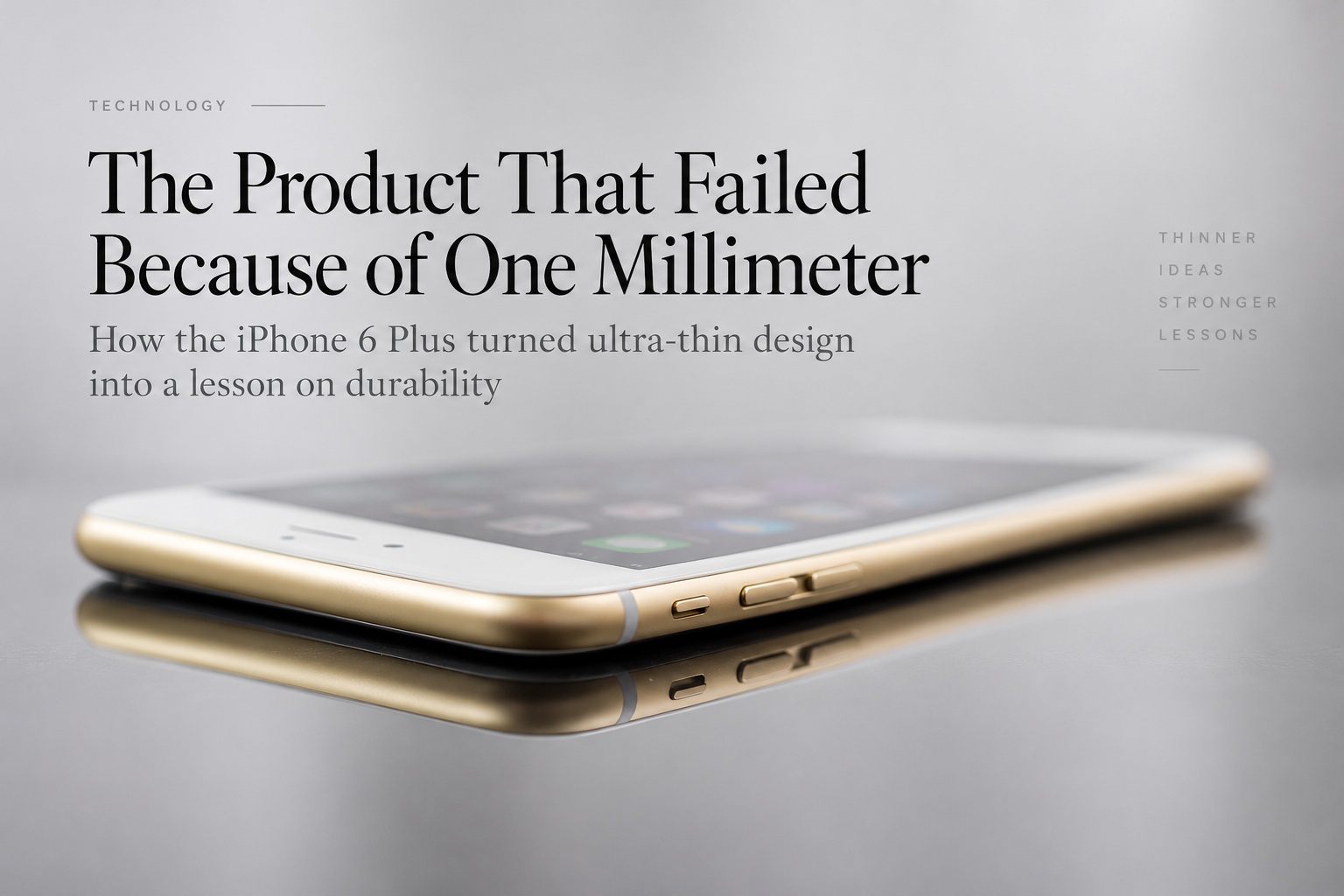
Industrial design is often decided at a scale most people never consciously notice. A millimetre added or removed from a product can change its weight, comfort, strength and even how confidently people use it. The iPhone 6 Plus became one of the clearest examples of this tension when Apple's pursuit of an exceptionally thin smartphone collided with the physical realities of a much larger device. It did not fail commercially, but the controversy surrounding its structural weakness became an enduring lesson in how seemingly minor design decisions can have very visible consequences.
Apple Enters The Large-Screen Smartphone Era
Apple launched the iPhone 6 Plus in September 2014 as its first serious entry into the rapidly growing "phablet" category. Its 5.5-inch display represented a major departure from the smaller iPhones that had defined Apple's smartphone strategy up to that point. Consumers responded enthusiastically, with the iPhone 6 and 6 Plus generation helping Apple ship around 10 million units during the first three days of availability.
The larger screen was not the only major design change. Apple also made the device remarkably thin, with the iPhone 6 Plus measuring just 7.1mm from front to back. The slim aluminium body created an elegant profile, but combining that thinness with a much larger chassis introduced structural challenges that were not as significant on smaller phones.
The Problem Was Not Obvious Until People Started Using It
On a display table, the iPhone 6 Plus looked precisely engineered. Product photography, specifications and showroom demonstrations gave little indication that anything was unusual about its strength. The problem became apparent only when the device entered the much less controlled environment of everyday life.
Within days of release, reports began appearing online from users who claimed their phones had become slightly bent after spending extended periods inside trouser pockets. One MacRumors user known as "hanzoh" described noticing a bend after carrying the phone while driving for around 18 hours. When the device was placed on a flat surface, the distortion became easier to see.
This distinction matters because successful industrial design is not judged solely by how a product performs under ideal conditions. Phones are carried, sat against, squeezed into bags and subjected to repeated small forces throughout the day. A weakness invisible during presentation can become very obvious once those real-world forces begin accumulating.
A Thin Aluminium Chassis Met A Large Surface Area
The structural problem came from the relationship between the phone's dimensions and the design of its aluminium enclosure. A larger smartphone creates greater leverage when force is applied across its body, while reducing thickness leaves less material available to resist that force. Certain portions of the iPhone 6 Plus enclosure were particularly thin, creating areas where deformation could occur more easily.
Cutouts for components such as the volume controls and SIM card interrupted the otherwise continuous aluminium structure. These openings could function as stress concentration points because the surrounding material had less structural support. The area near the volume buttons became especially associated with reports of bending.
None of these design elements was necessarily problematic in isolation. The issue emerged from how they interacted: a large footprint, an exceptionally thin body and strategically weakened areas in the aluminium shell. Industrial design failures often happen this way, not because one decision is obviously wrong, but because several individually reasonable decisions create an unexpected weakness when combined.
Then Bendgate Went Viral
The issue might have remained a relatively small hardware complaint if it had not been demonstrated so dramatically online. YouTube creator Lewis Hilsenteger published a video showing the iPhone 6 Plus being bent using his hands. The demonstration quickly attracted enormous attention, eventually exceeding 13.8 million views, and transformed scattered complaints into an international story.
The controversy soon acquired the inevitable internet nickname: "Bendgate". Memes spread across social media, technology publications ran their own bending tests and the subject even reached mainstream outlets including BBC Radio 4's Today programme. At that point, the problem was no longer simply a question of how many devices had actually bent.
It had become a perception problem. Once consumers see a premium device folding under hand pressure, the image is difficult to forget regardless of how statistically uncommon the failure may be. A structural weakness had effectively become part of the product's public identity.
Apple Said Real-World Bending Was Extremely Rare
Apple responded by stressing that only nine customers had formally contacted the company about bent iPhones at the time. It also said the devices had undergone testing designed to simulate situations such as carrying a phone in a pocket. Phil Schiller, then Apple's head of marketing, described bending during normal use as extremely rare.
That distinction is important when discussing the iPhone 6 Plus fairly. The device did not suddenly bend for every owner, nor was the entire product line rendered unusable. Millions of customers used their phones without experiencing the problem, and the iPhone 6 generation became enormously successful.
But engineering reliability and public confidence are not measured in exactly the same way. A failure can be statistically uncommon while still revealing something meaningful about the margin built into a design. When consumers begin questioning whether an expensive phone can safely remain in a pocket, the perception of durability has already been damaged.
The iPhone 6 Plus Did Not Actually Fail As A Product
Calling the iPhone 6 Plus a commercial failure would be inaccurate. It sold extremely well and helped establish the large-screen form factor that would eventually become standard across Apple's smartphone lineup. In business terms, it was unquestionably successful.
Its more interesting failure was one of design confidence. Apple had produced something beautiful and extremely thin, but that thinness became part of the weakness users were discussing. The controversy exposed how engineering optimisation can go too far when one desirable quality begins compromising another.
This is why Bendgate remains useful as a design case study more than a decade later. It demonstrates that a product can succeed financially while still teaching its manufacturer a significant engineering lesson.
Apple Strengthened The Next Generation
Apple responded to the concerns in subsequent hardware. The iPhone 6s generation adopted stronger 7000-series aluminium, providing greater resistance to deformation. The company also refined its engineering and testing approaches to account for the stresses encountered during real-world use.
The response illustrates one of the most important parts of product development: lessons from the previous generation should influence the next one. A successful company does not necessarily avoid every design weakness, but it should be able to identify what went wrong and adjust accordingly.
In this case, Apple did not have to abandon thin smartphones entirely. It instead improved material strength and structural durability so that the same aesthetic goals could be pursued with a larger safety margin.
Thinness Is A Design Goal, Not The Only Design Goal
Technology companies have spent decades competing over thinner and lighter devices because those qualities are easy to market and immediately noticeable. A thinner laptop looks more advanced, and a thinner phone often feels more elegant when first picked up. But every reduction in material introduces engineering trade-offs involving rigidity, battery capacity, heat management and durability.
The iPhone 6 Plus demonstrates why industrial designers cannot optimise one characteristic indefinitely. A product does not exist only in photographs or technical drawings. It needs to survive the way people actually carry, hold, drop and use it.
That means durability must be treated as part of the user experience rather than as a separate engineering requirement. A phone that feels delicate changes how the owner interacts with it, even if it technically continues functioning.
The Millimetre Matters Because The Context Matters
The real lesson is not that 7.1mm was inherently too thin. Different materials and internal structures can support extremely thin devices successfully. The problem is that dimensions cannot be evaluated independently from materials, geometry and real-world behaviour.
A designer deciding whether to remove another millimetre must therefore ask what that change does everywhere else. Does it reduce rigidity? Does it create more stress around an opening? Does it affect battery capacity or thermal performance? Does the product still survive realistic use with an adequate safety margin?
These are the questions users rarely see. They simply experience the final result as something that feels sturdy, comfortable and trustworthy—or something that does not.
Final Thoughts
The iPhone 6 Plus remains a powerful example of how industrial design is shaped by tiny decisions with very large consequences. Apple's first major large-screen iPhone was commercially successful, beautifully designed and enormously influential, yet its 7.1mm body also exposed a structural weakness that became one of the most memorable hardware controversies of the era.
The lesson from Bendgate is not that designers should avoid thin products or ambitious engineering. It is that every aesthetic decision exists within a physical context. Users may never notice the extra millimetre that makes a device stronger, but they will certainly notice when its absence undermines their confidence. Great design is therefore not about chasing the smallest possible number on a specification sheet; it is about finding the point where beauty, usability and durability remain in balance.











Comments 0