

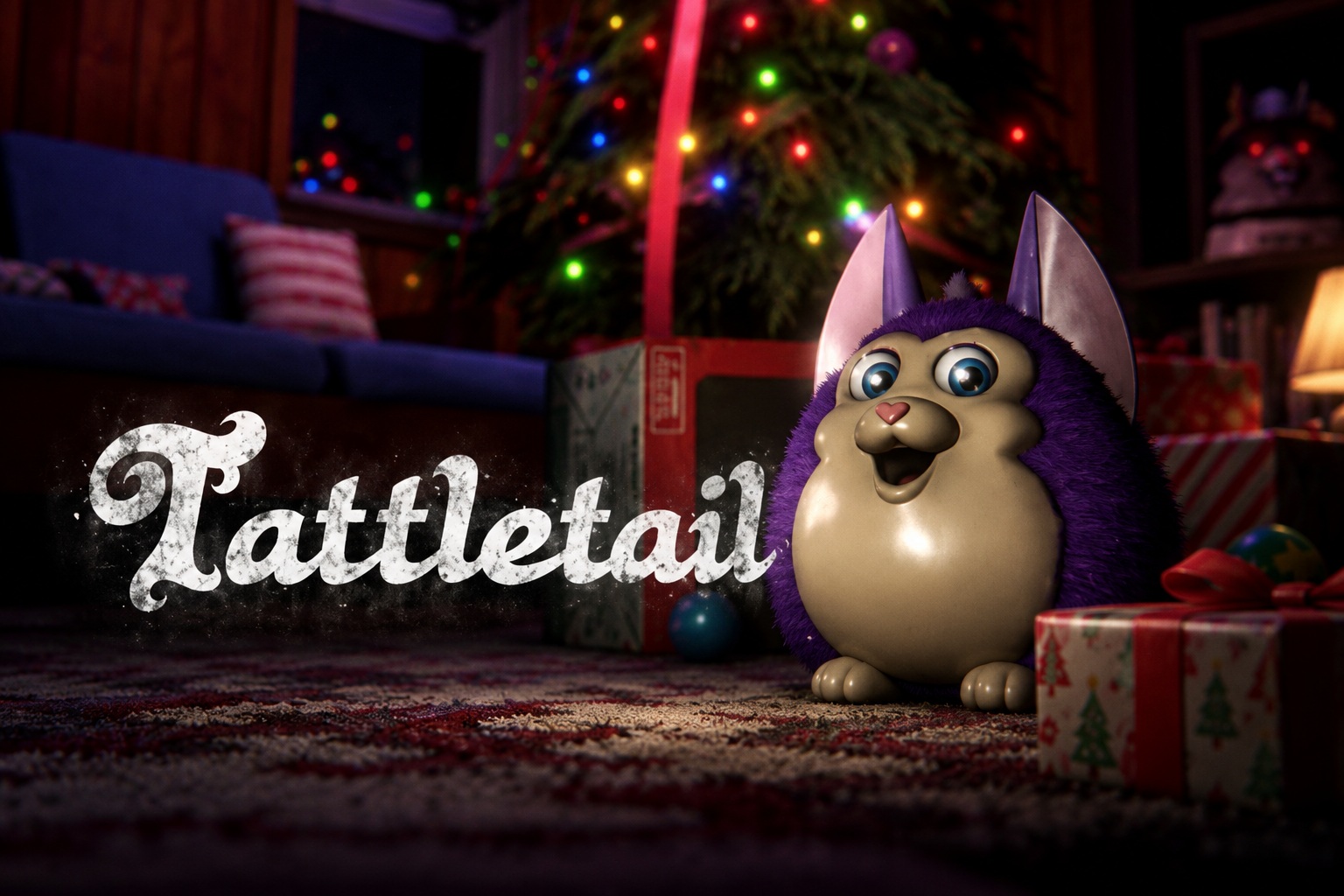
Tattletail takes a familiar childhood temptation—sneaking downstairs to open a Christmas present early—and turns it into a surprisingly effective psychological horror experience. Set during the days leading up to Christmas in 1998, the game begins when a child discovers a brightly colored talking toy hidden in the basement. The creature seems harmless enough at first, demanding food, grooming, and attention while repeating cheerful electronic phrases. Before long, however, every sound the toy makes begins feeling dangerous because something far more threatening is listening.
That threat is Mama Tattletail, a much larger creature connected to the talking toys scattered throughout the house. Mama cannot simply be defeated through combat, and the player has no weapon capable of eliminating her permanently. Instead, survival depends on carefully managing noise, staying aware of the darkness, conserving flashlight power, and reacting quickly whenever Mama approaches. The ordinary family home gradually becomes a hostile environment where hallways, closets, staircases, and the basement feel completely different once the lights go out.
Now playable online through Lemon Web Games, Tattletail brings its unsettling combination of childhood nostalgia, talking electronic toys, nighttime exploration, limited flashlight power, hidden collectibles, and unpredictable encounters with Mama directly into the web browser. Players must complete a sequence of increasingly disturbing tasks while looking after Baby Talking Tattletail and trying not to attract the attention of the creature hunting through the house. The browser-based experience provides a convenient way to revisit one of the more distinctive indie horror games built around late-1990s toy culture. What begins as a mischievous Christmas adventure gradually develops into something much stranger and more unsettling.
Christmas 1998 Creates the Perfect Horror Setting
Tattletail's late-1990s setting is central to its personality. The fictional talking toys feel immediately inspired by the electronic pets and interactive children's products that became extremely popular during that period. Bright plastic shells, oversized eyes, recorded voices, simple electronic responses, and constant demands for attention all feel believable within the era. The developers take that familiar nostalgia and gradually make it uncomfortable.
The house itself reinforces the period. There are no smartphones providing constant light or modern connected security systems that could make the situation easier to understand. Exploration happens through dim rooms, ordinary household objects, and a handheld flashlight. The environment feels recognizable enough to make the supernatural elements more disturbing.
Christmas decorations add another contrast. The player is surrounded by a season normally associated with warmth, family, presents, and excitement, yet the house becomes increasingly threatening every night. Tattletail repeatedly places cheerful imagery beside unsettling events. That contradiction gives the game much of its atmosphere.
Opening the Present Early Starts Everything
The player's problems begin with a simple act of curiosity. A wrapped Christmas present is waiting in the basement several days before Christmas, and the temptation to discover what is inside becomes impossible to resist. Opening it reveals Baby Talking Tattletail, a small interactive creature that immediately begins demanding attention. The mistake seems harmless at first.
Instead of quietly returning the toy to the box, the player becomes responsible for keeping it satisfied. Tattletail becomes hungry, dirty, tired, or low on power, requiring trips through the house to meet its needs. Every task means spending more time awake when the player should be asleep. The house gradually becomes more dangerous with each nighttime excursion.
This setup works because the protagonist effectively creates the problem through an ordinary childhood decision. There is no mysterious invitation to a haunted mansion and no deliberate investigation of something supernatural. The horror begins because someone could not wait until Christmas morning.
Baby Talking Tattletail Is Cute and Extremely Inconvenient
Baby Talking Tattletail looks like the kind of toy a child could easily become obsessed with. It is colorful, expressive, and constantly communicates through short electronic phrases. The toy wants to be played with, fed, groomed, and charged. Meeting those needs becomes a central part of the gameplay.
The problem is that Tattletail is extremely noisy. It talks when excited, complains when something is wrong, and can easily reveal the player's location at the worst possible moment. A harmless toy mechanic therefore becomes a survival problem once Mama enters the house. Keeping Tattletail calm becomes as important as keeping the player safe.
This creates an unusual relationship between the player and the toy. Tattletail is not exactly an enemy, yet carrying it can make survival significantly harder. The player needs the toy for progression while simultaneously wishing it would remain silent. That tension is both funny and frightening.
Feeding Tattletail Becomes a Survival Task
Tattletail's hunger meter gradually decreases and needs to be restored with food. Under ordinary circumstances, feeding a toy would be little more than a playful interaction. In the middle of the night, however, reaching the kitchen can become dangerous. Every trip through the house provides another opportunity for Mama to appear.
The player therefore begins thinking about ordinary rooms strategically. A kitchen is no longer simply part of the home; it is a location that may need to be reached while something dangerous is nearby. Familiar spaces gradually acquire new meaning. The layout becomes increasingly important.
Managing hunger also creates pressure because an unhappy Tattletail becomes noisier. Ignoring the toy is therefore not a reliable survival strategy. Its needs must be handled before they develop into bigger problems.
Grooming Adds Another Reason to Leave Safety
Tattletail can also become dirty and demand grooming. The player needs to carry it to the appropriate location and take care of the problem before continuing. This creates another simple task that becomes stressful entirely because of context. The action itself is harmless, but the journey may not be.
The repeated maintenance tasks contribute to the game's strange rhythm. Players move between moments of almost comedic toy care and sudden fear when the environment changes. Feeding, brushing, and charging would normally belong in a children's game. Tattletail turns them into horror mechanics.
This contrast helps the game remain memorable. The player is not collecting weapons or solving elaborate supernatural machinery. They are desperately trying to keep a needy toy satisfied while avoiding something terrifying.
Charging Tattletail Can Leave You Vulnerable
The toy's battery level provides another resource that needs attention. When power becomes low, Tattletail needs to be taken to its charging station. Reaching that location may require travelling through dark or dangerous areas of the house. The task becomes especially stressful when the player already suspects Mama is nearby.
Charging also reinforces the toy's late-1990s electronic identity. Tattletail behaves like a piece of consumer technology rather than a traditional supernatural creature. Its needs feel almost mechanical. That ordinary design makes the surrounding horror stranger.
Players gradually learn to monitor Tattletail's condition before beginning longer tasks. Allowing several needs to become critical simultaneously creates unnecessary danger. Good preparation can make a difficult night much easier.
Mama Tattletail Is the Real Threat
Baby Tattletail may be annoying, but Mama is genuinely dangerous. Her appearance transforms the game from strange nighttime exploration into survival horror. She is larger, darker, and considerably more threatening than the colorful toys the player has been handling. Encountering her changes the meaning of every sound.
Mama's presence is often communicated through environmental changes, audio cues, and growing tension rather than constant direct pursuit. Players need to pay attention to what the game is telling them. A normal hallway can become terrifying once there is reason to believe she is nearby.
The fact that Mama cannot simply be fought makes encounters particularly stressful. The player is a child inside a house with limited tools. Survival depends on avoidance, awareness, and staying calm.
Mama Hates Noise
Noise is one of the most important survival concepts in Tattletail. Mama is attracted to sound, which makes Baby Tattletail's constant talking a serious liability. The player may be trying to remain quiet while the toy suddenly announces that it needs food or attention. A mechanic that was funny earlier becomes frightening.
This forces players to monitor Tattletail's needs carefully. Keeping the toy satisfied reduces the chance of it becoming unnecessarily loud. Preventative care becomes a survival strategy. The player is effectively managing a mobile noise source.
Other actions can also influence how risky a situation becomes. Players gradually develop an instinct for when to move, when to stop, and when to avoid creating additional sound. Horror emerges from restraint rather than aggression.
The Flashlight Is Essential but Limited
The house becomes extremely dark during nighttime exploration, making the flashlight one of the player's most important tools. It reveals hallways, objects, doors, and potential dangers that would otherwise disappear into darkness. Without it, navigation can become difficult. Yet the flashlight cannot simply be treated as unlimited safety.
Battery management adds another layer of tension. Players need to use light carefully rather than keeping it permanently active without thought. Darkness becomes something that needs to be managed rather than completely eliminated. The player is constantly balancing visibility against available resources.
The flashlight also changes how Mama encounters feel. Seeing something dangerous can be reassuring because the player knows where it is, but illuminating the wrong area at the wrong moment can create panic. Tattletail understands how strongly limited visibility affects horror.
Shaking the Flashlight Creates a Memorable Mechanic
One of the most recognizable interactions involves shaking the flashlight to restore or maintain its usefulness. This physical-style action becomes increasingly stressful when Mama is nearby because any desperate attempt to regain visibility happens under pressure. What feels amusing early in the game can become terrifying later. The same mechanic changes meaning depending on context.
It also reinforces the idea that the player's equipment is unreliable. There is no powerful military flashlight designed for survival. It feels like something a child would actually have available inside a house. The vulnerability suits the protagonist.
The flashlight is therefore more than a basic illumination tool. It contributes directly to the rhythm and tension of exploration. Losing reliable light at the wrong moment can transform a familiar room into something threatening.
Darkness Makes the House Feel Much Larger
During the day, the house would likely feel ordinary and relatively small. At night, darkness changes the player's perception of space. Hallways feel longer, doorways become suspicious, and familiar rooms can suddenly seem isolated from one another. The same floor plan becomes psychologically larger.
This effect is especially strong because the player repeatedly travels through the same locations. Familiarity should theoretically make exploration less frightening, yet nighttime conditions keep changing the emotional experience. Knowing where a room is does not guarantee knowing what might be waiting there.
Tattletail uses repetition effectively. Each return through a familiar hallway carries knowledge from previous encounters. The player remembers where something frightening happened even when the space is currently empty.
Sound Design Is Constantly Working Against You
Tattletail relies heavily on audio to create tension. Baby Tattletail talks, household sounds break the silence, distant noises suggest movement, and Mama's presence can be communicated before the player sees anything. Listening becomes essential. The player often reacts to sound before understanding what caused it.
The toy's cheerful voice is particularly effective because repetition gradually changes its emotional meaning. A phrase that seemed cute during the first night can become stressful once the player associates it with danger. Tattletail turns familiar sounds into warnings.
Silence can become equally uncomfortable. When the house suddenly becomes too quiet, players may begin anticipating something. The game uses both noise and absence of noise to maintain tension.
Each Night Escalates the Situation
The game progresses through several nights leading toward Christmas, and each one becomes stranger than the last. Early objectives focus largely on discovering Tattletail and meeting its needs. Later nights introduce increasingly unsettling tasks, more dangerous encounters, and stronger evidence that something is deeply wrong with the toys. The escalation feels gradual.
This pacing is effective because players have time to become comfortable before the horror intensifies. The first interactions establish the rules and environment. Once those systems feel familiar, the game begins using them in more threatening ways.
The structure also creates anticipation. Finishing one night provides temporary relief, but the player knows another evening is approaching. Returning to sleep never feels like the complete end of the problem.
The Basement Becomes Increasingly Important
The basement begins as the place where the forbidden Christmas present is hidden. Over time, it becomes one of the most significant locations in the game. Returning there repeatedly creates a sense that something important is connected to the toys and their history. The familiar storage area gradually feels much more ominous.
Basements are naturally effective horror environments because they are isolated from the rest of the house. Tattletail takes advantage of that expectation but also connects the location directly to the central mystery. It is not frightening simply because it is dark. Important events actually happen there.
Every trip downstairs therefore carries narrative significance as well as danger. The basement feels increasingly like the center of whatever is happening. Players begin approaching it with much more caution than during the opening minutes.
The Toy Box Becomes More Disturbing Over Time
The box containing Tattletail initially represents excitement. It is a hidden present waiting to be discovered before Christmas. Once the player understands more about the toy, that same object begins feeling suspicious. The emotional meaning changes completely.
This is another example of the game transforming familiar childhood imagery into horror. Wrapped presents, toy packaging, and colorful electronics normally create anticipation and happiness. Tattletail gradually associates them with danger. Nostalgia becomes unsettling.
The game repeatedly uses this technique rather than introducing entirely foreign horror imagery. What should feel safe is what becomes frightening. That reversal gives the experience a strong identity.
Other Tattletails Expand the Mystery
The player eventually encounters additional talking toys, revealing that Baby Tattletail is not an isolated object. The existence of several units raises questions about where they came from, why they were hidden, and what relationship they have with Mama. The story expands beyond one strange Christmas present. Something larger is happening.
These additional toys also create more noise and confusion. One needy Tattletail is already difficult to manage under dangerous conditions. Several talking creatures make quiet movement considerably more complicated. The game's central mechanic scales naturally into greater tension.
The toys also begin behaving less like ordinary commercial products and more like participants in something strange. Their personalities and actions suggest information the player does not yet understand. Curiosity becomes another reason to continue.
The Tattletail Ritual Is One of the Strangest Moments
Later events become increasingly surreal, culminating in sequences involving the toys gathering together and performing strange ritual-like activities. The cheerful electronic creatures suddenly feel connected to something much more unsettling. The visual contrast is intentionally bizarre. A group of colorful toys participating in something ritualistic is difficult to forget.
This is where Tattletail moves beyond a simple killer-toy premise. The game begins introducing imagery that feels dreamlike and difficult to interpret literally. Childhood imagination and supernatural horror start overlapping. The player's home no longer follows ordinary expectations.
The ritual sequences also intensify the mystery surrounding Mama. The relationship between the smaller toys and their larger counterpart becomes more significant. What initially seemed like random hunting begins feeling connected to a broader story.
Mama Cannot Simply Be Attacked
Many horror games eventually give the player weapons or a direct way to fight back. Tattletail largely avoids turning Mama into a conventional combat enemy. The protagonist remains physically vulnerable. Avoidance continues to matter.
This keeps the focus on noise, darkness, and resource management. If Mama could simply be defeated with enough ammunition, Baby Tattletail's talking would become less frightening. The entire design depends on the player wanting to avoid attracting attention. Powerlessness supports the mechanics.
The absence of combat also reinforces the fact that the protagonist is a child. Fighting a terrifying creature directly would feel inconsistent with the story. Hiding and surviving make much more sense.
Collectible Eggs Encourage Exploration
Hidden throughout the house are collectible eggs containing small surprises. These provide a secondary objective for players willing to explore beyond the most direct route. Searching for them can be enjoyable during calmer moments. Under dangerous conditions, however, exploration becomes a much bigger commitment.
The collectibles add replay value because players may finish the main story without discovering everything. Returning later provides another reason to examine corners and rooms that were previously ignored. Familiar areas can contain small secrets.
Collecting also creates tension between curiosity and survival. A player may notice a suspicious location that probably contains something useful but need to decide whether investigating it is worth the risk. The game turns optional exploration into another small decision.
Cassette Tapes Add Background Story
Tapes and recorded material help reveal more about the Tattletail toys and the circumstances surrounding them. Rather than delivering every piece of lore through direct exposition, the game allows curious players to discover fragments of information. This makes the story feel larger than the events occurring during the player's nights at home.
Recorded material is particularly appropriate for the 1998 setting. Physical cassette tapes fit the technology of the period and reinforce the retro atmosphere. The player is uncovering information through objects that belong naturally within the world.
These recordings can also make the toys more disturbing. Learning more about something does not necessarily make it less frightening. Sometimes context makes the situation worse.
The Tattletail Commercial Is Part of the Nostalgia
The fictional toy is presented as though it belonged to a genuine late-1990s product line. Promotional material, toy design, voices, and packaging all contribute to the illusion that Tattletail could have existed alongside real electronic pets of the era. This makes the nostalgia unusually convincing. Players may feel like they remember a product that never actually existed.
That false familiarity strengthens the horror. The more believable the toy feels as a childhood object, the more disturbing its supernatural behavior becomes. The game effectively manufactures nostalgia and then corrupts it.
This marketing-inspired presentation also gives Tattletail a memorable visual identity outside the horror itself. The creatures look exactly like toys that could have appeared in a television commercial. That authenticity makes them easy to recognize.
Tattletail Uses Childhood Fear Extremely Well
Children often imagine something moving in the dark, hiding in closets, or appearing after everyone else has gone to sleep. Tattletail builds directly on those fears. The protagonist is awake alone while the rest of the household remains unavailable. Ordinary rooms become dangerous because there is no adult immediately present to make them safe.
The Christmas setting strengthens that childhood perspective. Sneaking around the house at night before a holiday already carries a sense of forbidden excitement. The game transforms that excitement into anxiety. The player knows they are somewhere they should not be.
This perspective helps distinguish Tattletail from horror games starring adult investigators or soldiers. The protagonist is not looking for danger. They accidentally discover it while behaving like a curious child.
The Parent's Presence Makes the Situation Stranger
The protagonist does not appear to be living alone, yet the nighttime events unfold with surprisingly little adult intervention. This creates an eerie feeling that the child is isolated despite being inside a family home. The player is dealing with something enormous while everyday household life seems to continue around it. The contrast becomes unsettling.
Trying not to wake a parent can also make movement feel more secretive. The player is not supposed to be wandering around at night in the first place. This provides another reason to behave quietly even before Mama becomes the primary concern.
The home therefore contains two layers of rules: ordinary childhood rules and supernatural survival rules. Sneaking out of bed begins as misbehavior and eventually becomes something far more dangerous. The transition happens naturally.
Jump Scares Exist, but Tension Does More of the Work
Tattletail certainly knows how to surprise the player, but its strongest horror often happens before anything actually attacks. Hearing a suspicious sound in the darkness can be more stressful than the eventual encounter. The player knows Mama may be nearby but cannot immediately confirm where. Anticipation creates fear.
The game's task structure contributes strongly to this effect. The player may know they need to cross the basement or reach the kitchen, but the route itself becomes intimidating when Mama could appear. Completing a simple objective becomes stressful before any direct threat occurs.
This means the horror survives even after players understand the basic mechanics. Knowing Mama exists does not remove the tension. It simply makes players more alert to every clue suggesting she is close.
The House Layout Gradually Becomes Familiar
Repeated exploration means players eventually memorize where rooms, hallways, stairs, and important objects are located. This knowledge is useful because it reduces time spent wandering blindly. During dangerous moments, knowing the shortest route can make survival much easier. The house becomes something the player learns.
However, familiarity does not completely remove fear because the game changes the context of those spaces. A comfortable route can become frightening after an unsettling event occurs there. The environment accumulates memories.
This is one reason using one ordinary house works so well. The game does not need dozens of locations. It continually changes how the player feels about the same rooms. Psychological transformation replaces geographical scale.
Noise Management Creates Constant Pressure
The player is repeatedly balancing the need to complete objectives against the danger of attracting Mama. Tattletail may need attention immediately, but providing that attention can create sound or require movement through dangerous areas. Waiting can be equally risky if the toy becomes louder. There is rarely a completely comfortable solution.
This creates a distinctive resource-management problem. Instead of counting bullets or health potions, players are managing how likely their companion is to reveal them. The toy itself becomes the resource that needs maintenance. Horror emerges from caregiving.
The mechanic also makes the relationship with Baby Tattletail unusually complicated. The player is protecting the toy while simultaneously needing protection from the consequences of carrying it. Cooperation and frustration exist together.
Tattletail's Voice Changes Meaning Over Time
Early in the game, Baby Tattletail's recorded phrases can sound amusing. They fit the personality of an overly enthusiastic electronic toy. After several dangerous encounters, the same phrases become warning signs. Hearing Tattletail begin talking at the wrong moment can immediately create panic.
This is an effective example of conditioning through gameplay. The sound itself does not become more threatening, but the player's understanding changes. A cheerful voice becomes associated with danger because of previous consequences.
The game repeatedly uses familiar audio this way. What once felt cute gradually feels stressful. The player's emotional response evolves without the asset needing to change.
Mama's Presence Can Make Players Freeze
One of the strongest responses to Mama is simply stopping. Moving forward may be dangerous, but turning around can feel equally risky. Players listen carefully and wait for some indication that continuing is safe. The game creates moments where doing nothing feels like an active survival decision.
This is quite different from horror based on constant sprinting. Panic movement can actually make the situation worse. Tattletail frequently rewards patience and awareness. Staying calm becomes a mechanical advantage.
These quiet moments can be more frightening than direct pursuit. The player is imagining possibilities that have not happened yet. The darkness becomes filled with potential threats.
The Ending Depends on What the Player Discovers
Tattletail contains more than one way for the story to resolve, with optional discoveries influencing what players learn and how complete the conclusion feels. This gives collectible hunting more significance than simple completion percentage. Exploration can change the player's understanding of what happened. Curiosity becomes narratively valuable.
The main route still provides a complete horror experience, but finding additional material adds context. Players interested in the mystery have a reason to search more carefully. The game rewards attention beyond immediate survival.
This also encourages replaying after the first completion. Knowing the house layout and major threats makes it easier to focus on collectibles or hidden information during another run. Familiarity shifts the objective.
The Game's Short Length Helps Maintain Tension
Tattletail does not attempt to stretch its central premise across an enormous campaign. The sequence of nights is compact enough that the story continues escalating without spending too long repeating the same ideas. New tasks and increasingly strange events arrive regularly. The pacing remains focused.
This works particularly well for horror. Fear can become routine when the same threat is repeated for too many hours. Tattletail keeps Mama dangerous by using her selectively and surrounding encounters with different objectives. The player rarely becomes completely comfortable.
The shorter format also encourages another playthrough. Returning to find missed collectibles or explore alternate outcomes feels manageable. The experience remains memorable rather than exhausting.
The Retro Toy Concept Gives Tattletail a Unique Identity
Killer toys are not new to horror, but Tattletail uses a very specific kind of toy. Baby Tattletail resembles the interactive electronic pets that became cultural phenomena during the late 1990s. That inspiration makes the creature instantly understandable to anyone familiar with the era. Players know what kind of product it is supposed to be.
The game then exaggerates the most annoying qualities of those toys: constant talking, demanding attention, needing food, requiring grooming, and losing battery power. Traits that might irritate a parent become life-threatening when silence matters. The horror grows directly from the product design.
This makes the concept feel unusually coherent. Tattletail is not a random monster disguised as a toy. Its ordinary toy functions are exactly what create the danger.
Nostalgia and Horror Constantly Work Against Each Other
Tattletail wants players to remember the excitement of receiving a new electronic toy while simultaneously making them afraid of it. Bright colors, recorded voices, Christmas presents, and late-1990s aesthetics create nostalgia. Darkness, Mama, distorted audio, strange rituals, and dangerous nighttime tasks undermine that comfort. The two emotions exist simultaneously.
This contrast makes the experience more effective than straightforward darkness from the beginning. Players have something familiar to lose. The safer the childhood imagery feels, the more disturbing it becomes when corrupted.
The game also demonstrates how horror can emerge from nostalgia itself. Old toys can be comforting because they remind us of childhood, but childhood memories also contain exaggerated fears and strange imagination. Tattletail explores both sides.
Why Tattletail Still Stands Out
Tattletail remains memorable because it builds its horror around mechanics directly connected to its central character. Feeding, brushing, charging, and listening to a talking toy are not unrelated mini-games. They determine how noisy Baby Tattletail becomes and therefore how dangerous the situation can get. The narrative and mechanics continually support each other.
Mama is equally effective because she represents the consequence of failing to manage those systems. Players do not fear her only because of appearance. They fear the chain of events that may bring her closer. That makes anticipation extremely powerful.
The late-1990s setting completes the identity. Few horror games capture the specific feeling of sneaking around a family home before Christmas while carrying an irritating electronic toy. Tattletail is difficult to confuse with anything else.
Playing Tattletail Online Today
Through Lemon Web Games, Tattletail can now be played directly in your web browser with no downloads or setup required. Features of the web-based version include:
Players experiencing Tattletail for the first time should pay close attention to Baby Tattletail's needs before beginning longer tasks. Keeping hunger, grooming, and battery levels under control can reduce unnecessary noise at critical moments. Learn the layout of the house early because knowing the fastest route to important locations becomes extremely valuable once Mama begins appearing. Most importantly, listen carefully whenever the environment changes.
Returning players can use their knowledge of the house and nightly objectives to search more thoroughly for collectibles and story details. Familiarity makes basic navigation easier, but Mama can still create tension because the danger is tied heavily to sound and timing. Knowing what might happen does not always make moving through a dark hallway comfortable. The atmosphere remains one of the game's strongest qualities.
Who Should Play Tattletail
Tattletail is particularly suitable for players who enjoy being frightened by familiar environments rather than enormous haunted locations. The game takes an ordinary family home and gradually changes how the player feels about every room inside it. A kitchen, staircase, basement, or hallway can become terrifying purely because of what might be nearby. That transformation is central to the experience.
It should also appeal to players who enjoy horror without traditional weapon-based combat. The player survives primarily through awareness, preparation, noise management, and careful movement. Mama cannot simply be defeated by collecting a stronger weapon. Vulnerability remains important from beginning to end.
Play Tattletail Online Now
Tattletail begins with one small act of Christmas curiosity and turns it into several nights of escalating horror. Baby Talking Tattletail needs to be fed, groomed, charged, and cared for, but every demand creates another reason to leave safety and move through the darkened house. Once Mama begins hunting, the toy's cheerful voice becomes a liability, the flashlight becomes essential, and familiar rooms become places the player would rather avoid. The contrast between cute electronic toys and genuine danger gives the game its distinctive personality.
Through Lemon Web Games, players can experience Tattletail directly in a modern browser and discover why this unusual indie horror game developed such a memorable reputation. Explore the house, manage Baby Tattletail's needs, search for collectibles, uncover hidden recordings, survive encounters with Mama, and piece together the increasingly strange story behind the toys. What initially feels like a nostalgic Christmas adventure quickly becomes something much darker.
Final Thoughts
Tattletail works because almost every part of its horror grows naturally from the toy at the center of the story. Baby Talking Tattletail needs food, grooming, power, and attention just like an exaggerated electronic pet from the late 1990s. Those features would normally be cute or mildly annoying, but in a house where Mama reacts to noise, every complaint becomes potentially dangerous. The game takes ordinary toy functionality and turns it into survival mechanics.
The Christmas 1998 setting makes that transformation even stronger. Wrapped presents, colorful plastic toys, cassette tapes, dark hallways, and the excitement of opening something before Christmas morning create a convincing sense of childhood nostalgia. Mama then corrupts that nostalgia by making the house feel unsafe whenever darkness falls. Familiarity and fear continually collide.
Through Lemon Web Games, Tattletail can now be experienced directly in the browser as a compact psychological horror adventure filled with strange toys, hidden lore, nighttime tasks, and unforgettable encounters with Mama. Its mechanics are straightforward, but the combination of sound management, limited visibility, childhood vulnerability, and retro toy culture gives the experience lasting personality. For players who ever wondered what might happen if a noisy electronic Christmas present refused to stay quiet after everyone went to sleep, Tattletail provides a wonderfully unsettling answer.











Comments 0