

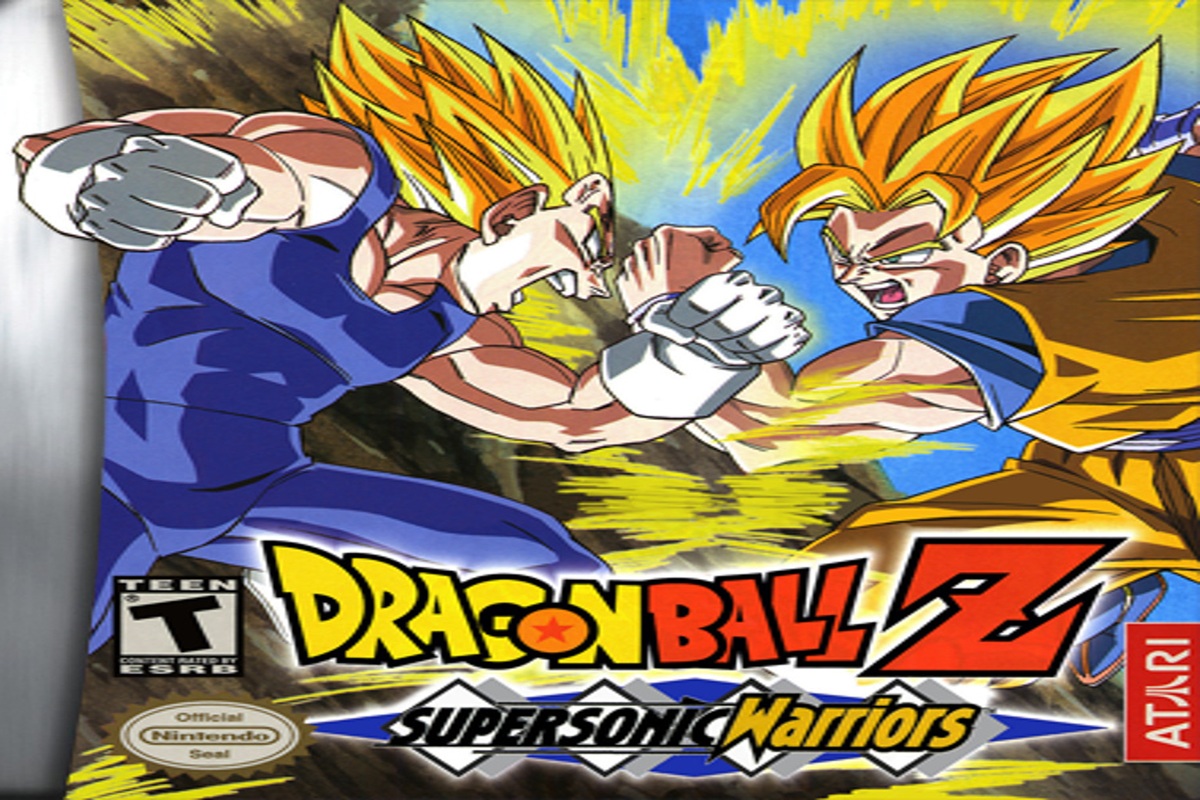
Dragon Ball Z: Supersonic Warriors takes the exaggerated speed, aerial movement, and explosive energy attacks of the anime and turns them into a fast-moving 2D fighting game built specifically around the Dragon Ball style of combat. Released in 2004, the game stands apart from many traditional fighters because characters are not restricted to moving back and forth along the ground. Instead, fighters can fly freely around large arenas, rapidly close the distance between opponents, retreat to charge their ki, and unleash powerful attacks from different positions. The result is a fighting system that feels far closer to the airborne battles of Dragon Ball Z than a conventional side-view tournament fighter.
The game features a strong selection of familiar characters including Goku, Vegeta, Gohan, Piccolo, Krillin, Trunks, Frieza, Cell, Majin Buu, Gotenks, Captain Ginyu, Dr. Gero, and Android 18. Different character levels represent stronger versions or transformations, meaning fighters can change considerably as more content is unlocked. Story Mode covers familiar conflicts from Dragon Ball Z while also introducing alternate character scenarios that explore situations beyond the original storyline. Combined with team battles, unlockable fighters, character upgrades, and several single-player modes, Supersonic Warriors offers considerably more depth than its straightforward controls initially suggest.
Now playable online through Lemon Web Games, Dragon Ball Z: Supersonic Warriors brings its fast-paced Game Boy Advance fighting experience directly into modern web browsers. Players can take control of their favorite Dragon Ball Z fighters, charge their ki, fly across large battlefields, and unleash devastating signature techniques without needing the original handheld console. The browser-based version provides an easy way to revisit one of the more distinctive Dragon Ball fighting games of the early 2000s while preserving its rapid aerial combat and colorful sprite-based presentation. Whether you remember playing it during the Game Boy Advance era or are discovering it for the first time, its unusual approach to 2D fighting remains entertaining today.
A Dragon Ball Fighting Game Built Around Flight
The defining feature of Supersonic Warriors is its emphasis on aerial combat. Traditional 2D fighting games usually keep both characters standing on a horizontal stage, but here players can freely move upward, downward, forward, backward, and diagonally through open battlefields. Fighters can hover almost anywhere in the arena and rapidly dash toward or away from their opponents. This freedom immediately gives battles a different rhythm from conventional fighting games.
The system works particularly well with Dragon Ball Z because aerial movement is such an important part of the anime's battles. Characters frequently disappear across the screen, attack from unexpected directions, and create large distances between themselves before launching powerful energy techniques. Supersonic Warriors recreates that feeling with a surprisingly simple control scheme. Players can quickly retreat to recharge energy before rushing back into close-range combat.
Distance also affects the way fights unfold. Staying close allows players to pressure opponents with punches, kicks, throws, and combinations, while creating space provides opportunities to charge ki and prepare stronger attacks. Because both fighters can rapidly change their position, neither combatant is guaranteed to remain safely at long range. The constant movement helps keep battles aggressive rather than turning them into static exchanges of projectiles.
Simple Controls with More Depth Than Expected
Supersonic Warriors uses straightforward controls designed around the limited buttons of the Game Boy Advance. Weak attacks are fast and useful for beginning combinations, while strong attacks are slower but deliver heavier impact. The same basic controls can produce different attacks depending on whether the player is above, below, beside, or directly approaching an opponent. This allows a relatively small number of buttons to support a surprisingly varied range of techniques.
Blocking also works differently from many traditional fighting games. Defensive actions are closely connected to the attack buttons, meaning players must react at the right moment rather than simply holding a dedicated block button indefinitely. This helps discourage overly defensive play and keeps both fighters actively participating in the battle. Well-timed blocks can also create opportunities to retaliate.
Throws provide another option when fighting at close range, particularly against opponents who rely heavily on defensive play. Players can also chain attacks together and follow an opponent after sending them flying away. Once the basic controls become familiar, combat begins to resemble the rapid exchanges seen throughout Dragon Ball Z. The game remains accessible, but experienced players can learn how positioning, timing, and ki management work together.
Charging Ki and Unleashing Powerful Energy Attacks
No Dragon Ball Z fighting game would feel complete without energy attacks, and Supersonic Warriors places ki management at the center of its combat system. Fighters can stop and charge their energy meter, creating the familiar power-up effect associated with the anime. The obvious disadvantage is that charging leaves the character vulnerable, forcing players to create enough distance before attempting it. Choosing the right moment to recharge becomes an important tactical decision.
Once enough energy has been accumulated, characters can launch different types of ki attacks. Smaller blasts provide quick ranged pressure, while stronger energy attacks can punish an opponent who leaves themselves exposed. The most powerful signature techniques consume considerably more ki but can dramatically change the direction of a battle. Familiar attacks such as the Kamehameha and other character-specific techniques provide some of the game's most visually impressive moments.
Positioning affects these powerful techniques as well. Characters can perform different special attacks depending on whether they are horizontally aligned with an opponent, above them, or below them. This encourages players to think vertically rather than treating the battlefield like an ordinary flat fighting stage. Knowing where to position a fighter before using a signature attack becomes part of mastering each character.
The Battle Gauge Keeps Fights Aggressive
Another distinctive mechanic is the battle gauge positioned near the top of the screen. Rather than functioning as another health meter, it reflects the momentum of the fight. Landing repeated attacks or forcing an opponent to block pushes the gauge toward their side, gradually increasing pressure. If a fighter becomes overwhelmed, the gauge can reach its limit and temporarily leave them vulnerable.
This creates opportunities for dramatic follow-up attacks. A stunned opponent can be struck with additional combinations or powerful techniques before recovering. Heavy attacks can even send fighters crashing away into scenery, recreating the exaggerated knockback frequently seen in Dragon Ball battles. These moments help fights feel more energetic than a simple exchange of punches and energy blasts.
The gauge also discourages players from blocking continuously. Remaining defensive for too long can eventually become dangerous, making movement and counterattacks necessary. Combined with aerial positioning and ki management, the system creates a constant push and pull between offense and defense. It is a relatively simple mechanic, but it contributes significantly to the pace of the game.
A Roster Filled with Familiar Dragon Ball Z Fighters
Supersonic Warriors features thirteen main playable characters drawn from different periods of Dragon Ball Z. Familiar heroes such as Goku, Gohan, Vegeta, Piccolo, Krillin, and Trunks are joined by major villains including Frieza, Cell, Majin Buu, Captain Ginyu, and Dr. Gero. Android 18 and Gotenks provide additional variety, giving the roster a mixture of Saiyans, humans, androids, aliens, and fused warriors. Each fighter has signature attacks and combat characteristics inspired by their appearances in the series.
Characters also have multiple levels that represent stronger versions, transformations, or expanded move sets. Goku progresses through increasingly powerful Super Saiyan forms, while Vegeta can eventually appear as Majin Vegeta. Majin Buu has different forms, and other fighters receive stronger variations or additional techniques as their levels increase. These upgrades provide more than simple cosmetic changes because they can alter abilities and overall effectiveness.
Importantly, these forms are selected as character levels rather than activated freely during combat. Players therefore choose the version of a fighter they want before entering battle. This differs from later Dragon Ball games where transformations frequently happen during a match. The system works well with the game's team-building mechanics because stronger character levels also influence how squads can be assembled.
Building Teams and Switching Fighters Mid-Battle
Several modes allow players to create teams rather than fighting exclusively one-on-one. Teams can contain multiple characters, but their combined strength is limited by a level-based system. Choosing one extremely powerful fighter leaves less room for additional teammates, while selecting lower-level characters can allow a larger team. This creates an interesting balance between individual strength and numerical advantage.
During team battles, players can switch between available fighters while combat is underway. Changing characters allows an injured fighter to leave the battlefield and gives another team member an opportunity to continue the fight. The brief transition can also be used tactically when an opponent is preparing an attack. Learning when to switch becomes particularly important during longer team encounters.
This system encourages experimentation with different character combinations. A team containing several lower-level fighters may offer flexibility, while a smaller group built around a more powerful character can deliver greater individual strength. Because characters have different attacks and movement patterns, choosing fighters that complement one another can make certain battles easier. It gives Supersonic Warriors an additional strategic layer beyond ordinary one-on-one combat.
Story Mode and Alternate Dragon Ball Scenarios
Story Mode is one of the game's strongest features because it does more than simply recreate famous fights from the anime. Players can experience scenarios based around different characters, with battles connected by illustrated story sequences and dialogue. Some routes follow familiar Dragon Ball Z events, while others explore alternate outcomes and "what if" situations that would never occur in the original storyline. This gives fans an additional reason to complete stories for characters they might not normally choose.
Playing from different perspectives also changes which opponents appear and how certain events unfold. A hero's storyline may resemble the familiar Dragon Ball narrative, while a villain's route can take events in an entirely different direction. These alternate scenarios allow the developers to create unusual confrontations without being restricted entirely by established continuity. For longtime fans, seeing these possibilities is one of the more entertaining aspects of the game.
Story progression also helps introduce stronger character levels and additional abilities. As certain stories advance, characters naturally become more powerful in ways that reflect their development within Dragon Ball Z. Completing scenarios rewards players with points that can later be spent on unlockable content. This ties narrative progression directly into the game's broader reward system.
Unlocking Characters, Levels, and Additional Stories
Supersonic Warriors includes a shop system where points earned through gameplay can be exchanged for additional content. Completing battles in Story Mode, Z-Battle, and Challenge Mode provides points that can be used to unlock characters, stronger character levels, and extra story scenarios. This gives players a clear reason to continue playing after completing their first few character routes. Instead of making everything available immediately, the game gradually expands its roster and options.
Unlocking stronger character levels is particularly rewarding because these versions can introduce new forms and techniques. Players who enjoy a particular fighter can continue developing their available versions rather than simply moving to another character. Additional story routes provide further incentive by revealing alternate scenarios and battles. The progression system creates a steady stream of goals without becoming overly complicated.
For players who enjoy completion-focused fighting games, unlocking everything can take considerably longer than simply finishing one story. Different modes reward continued experimentation with the roster, making it worthwhile to learn unfamiliar fighters. Even after the basic combat system becomes familiar, there is usually another character level or scenario waiting to be discovered. This gives the game stronger replay value than a straightforward arcade ladder.
Z-Battle, Challenge, and Free Battle Modes
Story Mode may provide the narrative foundation, but Supersonic Warriors includes several other ways to fight. Z-Battle places the selected character against a sequence of opponents and provides a ranking based on performance. This mode focuses more directly on combat skill without the longer narrative sequences found in Story Mode. It is useful for players who simply want a series of battles with increasing pressure.
Challenge Mode places greater emphasis on team construction. Players assemble a squad and confront predetermined enemy teams, making character selection and team strength important before the battle even begins. Because stronger fighters consume more of the available team level allowance, players need to decide whether raw power or additional teammates will provide the better advantage. Completing these challenges can also provide substantial rewards.
Free Battle allows players to create matches with fewer restrictions and experiment with different characters. Training Mode offers an environment for practicing attacks, movement, ki techniques, and character-specific abilities without the pressure of normal competition. The original release also supported multiplayer through a Game Boy Advance link connection, allowing two players to battle directly. Together, these modes give players several alternatives to repeatedly replaying Story Mode.
Signature Techniques Make Characters Feel Different
At first glance, several fighters can appear mechanically similar because everyone shares the same basic movement and attack controls. The differences become much clearer once players begin experimenting with signature techniques. Each character has powerful special attacks based on abilities associated with them in Dragon Ball Z. Their effectiveness can change depending on positioning, distance, and the amount of available ki.
Goku naturally relies on familiar energy techniques, while Vegeta brings his own aggressive arsenal into battle. Gotenks uses attacks that reflect the fused character's unusual personality, and Captain Ginyu has abilities connected to his famous Body Change technique. Villains such as Cell, Frieza, and Majin Buu likewise bring recognizable attacks into their move sets. These details help characters feel connected to their anime counterparts even when the underlying control structure remains consistent.
Learning these differences becomes particularly valuable in team battles. A character who excels at long-range pressure may complement another fighter who performs better when constantly attacking at close range. Some techniques are easier to land from particular positions, encouraging players to adjust their movement before committing to an attack. This makes character knowledge increasingly important as the difficulty rises.
Large Arenas and Dynamic Camera Movement
The battlefields in Supersonic Warriors are significantly larger than what can be seen on the Game Boy Advance screen at any one moment. When fighters move far away from each other, the camera automatically zooms outward to keep both combatants visible. As the distance closes, the view moves in again so players can clearly see close-range attacks. This dynamic scaling helps support the game's unusually large aerial arenas.
The system also reinforces the sensation of speed and distance. A fighter can be launched far away, recover, and then rapidly dash back across the battlefield. Energy attacks can travel considerable distances, encouraging players to pay attention even when the opponent appears far away. These large spaces would not work nearly as well without the camera adjusting dynamically.
Backgrounds represent environments inspired by the Dragon Ball universe, including rocky landscapes and locations reminiscent of famous battles. The environments are generally less detailed than the character sprites, partly because they must remain readable while the camera changes scale. Nevertheless, the combination of large stages and unrestricted flight is central to the game's identity. It allows Supersonic Warriors to capture a style of combat that more conventional 2D fighters cannot easily reproduce.
Colorful Sprite Animation and Dragon Ball Presentation
Visually, Supersonic Warriors makes effective use of large two-dimensional character sprites. Fighters are easily recognizable through their hairstyles, clothing, transformations, and signature poses. Punches, kicks, energy attacks, and knockback animations communicate the speed and impact expected from a Dragon Ball game. Considering the limited screen size of the original hardware, the presentation remains impressively energetic.
Powerful attacks receive bright visual effects that make them stand out from ordinary strikes. Large beams and energy projectiles can dominate the screen, while heavy attacks send opponents flying across the battlefield. Character portraits and story scenes further reinforce the anime presentation between fights. The overall visual style successfully translates Dragon Ball Z into a compact handheld format without attempting unrealistic graphical complexity.
The game also includes voice clips during certain attacks, adding additional personality to major techniques. Audio naturally remains limited compared with console Dragon Ball games, but the combination of effects and recognizable attack calls adds excitement during combat. Music keeps battles moving at an energetic pace even if it is not the primary attraction. The visual presentation remains the game's stronger achievement, particularly during fast aerial exchanges.
Difficulty and Learning the Flow of Combat
Supersonic Warriors is relatively easy to understand but can become challenging when opponents begin taking advantage of the same mechanics available to the player. Charging ki carelessly can result in an immediate attack, while constantly blocking can eventually create problems through the battle gauge. Players must learn when to attack, retreat, recharge, defend, and reposition. Simply pressing attack buttons continuously becomes less effective against stronger opponents.
Aerial movement is probably the most important skill for newcomers to learn. Instead of thinking purely about left and right movement, players need to become comfortable approaching from different directions and changing altitude during a fight. This makes it easier to avoid incoming energy attacks while also creating opportunities for position-dependent special moves. Once this freedom becomes natural, combat begins to feel much faster and more fluid.
Team battles introduce another layer because players must manage multiple fighters rather than a single health bar. Switching at the right moment can protect a weakened character or disrupt an opponent's attack sequence. Players who understand how their chosen fighters work together will generally perform better than those who simply select the strongest characters available. These systems give the game enough depth to reward practice without requiring the complex command inputs of more technical fighting games.
Why Supersonic Warriors Remains Enjoyable
The biggest reason Supersonic Warriors still works is that its core mechanics were designed specifically around Dragon Ball rather than simply placing Dragon Ball characters inside a conventional fighting template. Free aerial movement, ki charging, large-scale energy attacks, rapid dashes, knockback, and dramatic momentum shifts all reflect the style of combat seen in the anime. Even though the controls are relatively simple, the way those mechanics interact creates battles that feel appropriately fast and chaotic. That sense of authenticity remains appealing even after many newer Dragon Ball games have appeared.
The alternate stories also give the game personality beyond its fighting system. Fans can see familiar characters placed into unusual situations and experience events from perspectives rarely explored in other adaptations. Unlocking additional scenarios encourages players to experiment with characters they might otherwise ignore. This makes progression feel connected to both gameplay and Dragon Ball fan service.
Its handheld origins also give it a certain charm. The game delivers large airborne battles, team mechanics, animated sprites, and multiple story routes within the technical limitations of the Game Boy Advance. Rather than attempting to imitate a console game directly, it builds a combat system that works around those limitations. That focused design is one reason Supersonic Warriors remains worth revisiting.
Playing Dragon Ball Z: Supersonic Warriors Online Today
Through Lemon Web Games, Dragon Ball Z: Supersonic Warriors can now be played directly in your web browser with no downloads or setup required. Features of the web-based version include:
The browser-based version provides a convenient way to revisit a Dragon Ball fighting game that approached the series differently from many later titles. Battles are quick to begin, making it suitable for short sessions, while Story Mode and unlockable content provide enough progression for players who want something more substantial. The straightforward controls also make returning to the game relatively easy even after many years. Once aerial movement and ki management become familiar again, the combat quickly regains its distinctive rhythm.
For new players, Supersonic Warriors offers an interesting look at how developers translated Dragon Ball's airborne battles onto handheld hardware. Its mechanics are simpler than those of modern Dragon Ball fighters, but the focus on positioning, momentum, and energy management gives the battles their own identity. The ability to explore alternate character stories also gives fans additional motivation to continue beyond their favorite fighter. It remains a compact but surprisingly complete Dragon Ball fighting experience.
Who Should Play Dragon Ball Z: Supersonic Warriors
Supersonic Warriors is particularly suitable for players who want a Dragon Ball fighting game that captures the movement of the anime without requiring complicated command inputs. Flying freely around the battlefield, rapidly closing distance, and launching energy attacks from different angles creates a sense of speed that traditional ground-based fighters cannot easily reproduce. The controls are simple enough for newcomers to understand while still providing room for players to improve their timing and positioning. This makes it accessible without making every battle feel identical.
Longtime Dragon Ball fans may find the character stories equally appealing. Alternate scenarios provide unexpected outcomes and give villains or supporting characters opportunities to take center stage. Completing these routes while unlocking additional character levels adds a meaningful sense of progression to the fighting. Players who enjoy experimenting with different characters will find plenty of reasons to continue exploring the roster.
Play Dragon Ball Z: Supersonic Warriors Online Now
Dragon Ball Z: Supersonic Warriors remains an entertaining fighting game because it focuses on the qualities that make Dragon Ball battles exciting. Combat is fast, characters can fly freely, powerful attacks fill the screen, and opponents can be sent crashing across large environments. Ki management and the battle gauge provide additional strategy without overwhelming the straightforward control scheme. Team battles and character levels add another dimension for players who want more than simple one-on-one matches.
Through Lemon Web Games, players can experience these battles directly in a modern web browser without needing the original Game Boy Advance hardware. Returning fans can rediscover their favorite characters and alternate story routes, while newcomers can experience one of the more unusual Dragon Ball fighters of its era. The game's compact structure makes it easy to begin playing, but unlocking additional content provides reasons to stay with it. For anyone interested in retro anime fighting games, Supersonic Warriors remains a strong example of how much action could be packed into a handheld title.
Final Thoughts
Dragon Ball Z: Supersonic Warriors succeeds because it does not simply imitate a traditional fighting game and replace the characters with Dragon Ball heroes and villains. Its free-flight movement, vertically influenced special attacks, ki charging, momentum system, and dramatic knockback were all designed around the exaggerated combat style of Dragon Ball Z. These mechanics give fights a sense of speed and movement that feels appropriate to the source material. Even after newer Dragon Ball games have introduced far more advanced graphics and larger rosters, the fundamental combat concept remains enjoyable.
The game's progression systems also provide more longevity than might be expected from a handheld fighter. Story scenarios, alternate outcomes, unlockable character levels, team battles, Z-Battle, and Challenge Mode encourage players to experiment beyond their initial favorite character. Different forms and techniques gradually expand the available options, while team construction introduces useful strategic decisions. This combination of accessible combat and unlockable content makes Supersonic Warriors particularly easy to revisit.
More than two decades after its original release, Dragon Ball Z: Supersonic Warriors remains a memorable example of a licensed fighting game built around the strengths of its source material. Its colorful sprite artwork, rapid aerial exchanges, recognizable characters, and explosive special attacks capture much of the excitement associated with classic Dragon Ball Z. Through Lemon Web Games, players can once again take these battles into the sky, charge their ki, unleash signature attacks, and explore alternate versions of familiar stories directly in their browsers. For Dragon Ball fans and retro fighting game enthusiasts, it remains an energetic handheld classic worth experiencing.











Comments 0