

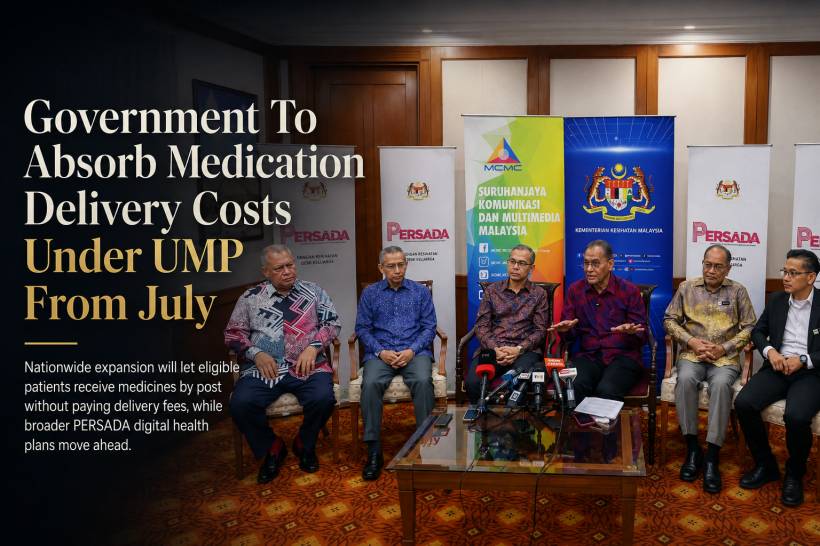
The government is preparing to expand its Ubat Melalui Pos programme nationwide, while also absorbing the delivery costs for patients who depend on the service. The move is expected to make it easier for patients to receive their regular medication without having to repeatedly travel to hospitals or clinics.
Ubat Melalui Pos, or UMP, is not a new programme. It has been around for more than a decade and was introduced to help patients receive prescribed medicines through postal delivery. For many patients, especially those with long-term conditions, this can reduce the need for frequent visits to healthcare facilities just to collect medication.
With the latest expansion, the government wants to make the service more accessible while removing the delivery cost barrier for eligible patients.
A Collaboration Between MOH, MCMC And Pos Malaysia
Communications Minister Datuk Fahmi Fadzil said the initiative will involve cooperation between the Ministry of Health and the Malaysian Communications and Multimedia Commission.
Under the arrangement, the Ministry of Health will be responsible for determining which patients are eligible for the UMP service. Pos Malaysia will then handle the actual delivery of medicines to patients, while MCMC will help facilitate the arrangement.
This setup makes sense because medicine delivery does not only involve healthcare management. It also requires reliable logistics, proper coordination, and a delivery network that can reach patients across different parts of the country, including rural and semi-urban areas.
Government Funding To Ease Patient Burden
According to Fahmi, the initiative will be funded using federal government allocations. The estimated annual cost is around RM5.69 million.
He said the move is expected to benefit about 80,000 patients every month. For these patients, having medicine delivered directly to them can save time, reduce transport costs, and make follow-up treatment more convenient.
This is especially important for patients who need regular medication for chronic conditions. Some may be elderly, have mobility difficulties, live far from healthcare facilities, or depend on family members to bring them to hospitals and clinics. By covering delivery charges, the government is reducing one more obstacle in their healthcare journey.
Fahmi also expressed hope that the initiative can begin sometime in July, preferably at the start of the month, and be implemented across all states.
Why Medicine Delivery Matters
While medicine delivery may sound like a simple service, it can have a meaningful impact on public healthcare access. In many cases, patients do not need to see a doctor every time they collect repeat medication. However, they may still need to travel, queue, and spend time at healthcare facilities just to pick up their prescriptions.
By improving access to postal medicine delivery, the government can help reduce crowding at hospitals and clinics. It can also allow pharmacy counters and healthcare staff to focus more on patients who need in-person assistance.
For patients, the benefits are more direct:
• Less travel to healthcare facilities
• Lower transport and parking costs
• Shorter waiting time
• Better convenience for elderly or mobility-limited patients
• Easier access for those living far from hospitals or clinics
For a public healthcare system that is often under heavy demand, even small improvements in medication collection can help reduce pressure on facilities.
PERSADA Initiative Signed Alongside The UMP Expansion
The announcement also comes alongside another major healthcare digitalisation effort known as PERSADA, which stands for National Digital Health Ecosystem and Connectivity Catalyst.
Fahmi signed the memorandum of understanding between the Ministry of Health and MCMC and also witnessed the signing for the PERSADA initiative on 15 June 2026.
PERSADA is being developed as a nationwide cloud-based clinical management system initiative. The project is valued at RM650 million and is intended to modernise healthcare operations, improve doctor-patient care, and support the growth of telehealth services in Malaysia.
In simple terms, PERSADA is part of the government's broader plan to move public healthcare away from older manual and paper-based systems, and towards a more connected digital healthcare ecosystem.
Moving Beyond Paper-Based Healthcare Records
Health Minister Datuk Dr Dzulkefly Ahmad described the initiative as a possible turning point for Malaysia's healthcare system, saying it could mark the end of manual records and legacy paper-based systems.
This is a major ambition because many healthcare facilities still depend heavily on physical documents, manual workflows, or disconnected systems. These older processes can slow down patient registration, consultation, record retrieval, referrals, and follow-up care.
A cloud-based clinical management system could help healthcare workers access patient information more efficiently, reduce duplication, and improve coordination between facilities.
Of course, the success of such a system will depend on proper implementation, training, connectivity, cybersecurity, and system reliability. Healthcare digitalisation is not just about introducing software; it also requires careful change management across hospitals and clinics.
Telehealth Expansion Through MyVAS And NADI
PERSADA will also support the expansion of telehealth services through integration with the Malaysia Virtual Health Assistant System, known as MyVAS, and the National Information Dissemination Centre, or NADI.
This is particularly important for rural communities, where access to healthcare facilities may be more limited. Telehealth can help bridge some of that gap by allowing patients to receive guidance, follow-up support, or basic consultation services remotely where appropriate.
While telehealth cannot replace all physical consultations, it can be useful for selected cases such as follow-up checks, health education, basic monitoring, and patient navigation.
Combined with medicine delivery through UMP, these digital health efforts suggest that the government is trying to make healthcare less dependent on physical visits whenever possible.
Targeting Faster Treatment And Higher Capacity
Under PERSADA, the Ministry of Health is targeting 81% of patients to receive treatment within one hour. This is an ambitious target, especially for busy public healthcare facilities where waiting times can be a common concern.
Dzulkefly also said that a piloted cloud-based clinical management system could allow healthcare facilities nationwide to handle an additional capacity of between 75,000 and 300,000 patients per hour.
If successfully implemented, this could improve patient flow, reduce delays, and support more efficient use of healthcare resources. However, the real impact will only become clearer once the system is deployed more widely and used in day-to-day healthcare operations.
Two-Phase Rollout By 2028
The government plans to implement the PERSADA project in two phases by 2028. The rollout is expected to cover 150 government hospitals and 2,488 public healthcare facilities nationwide.
Phase one of the project is estimated to cost RM74 million. Funding will be channelled and managed by MCMC through the Universal Service Provision Fund.
The scale of the rollout shows that PERSADA is not a small digital pilot. It is intended to become a major national healthcare infrastructure project, with the potential to affect hospitals, clinics, healthcare workers, and patients across the country.
A Step Towards More Convenient Public Healthcare
Taken together, the UMP delivery cost absorption and the PERSADA digital health initiative point towards a wider shift in Malaysia's public healthcare approach. The government is not only trying to improve treatment inside hospitals and clinics, but also looking at how services can reach patients more efficiently outside those facilities.
For patients, the most immediate benefit will likely come from the government absorbing medicine delivery costs under UMP. For those who rely on regular medication, this can make healthcare access more convenient and less costly.
Meanwhile, PERSADA represents the longer-term effort to modernise the healthcare system through digital records, better connectivity, telehealth integration, and improved patient management.
If both initiatives are implemented well, they could help reduce unnecessary hospital visits, improve patient convenience, and make public healthcare services more responsive to the needs of Malaysians.











Comments 0