

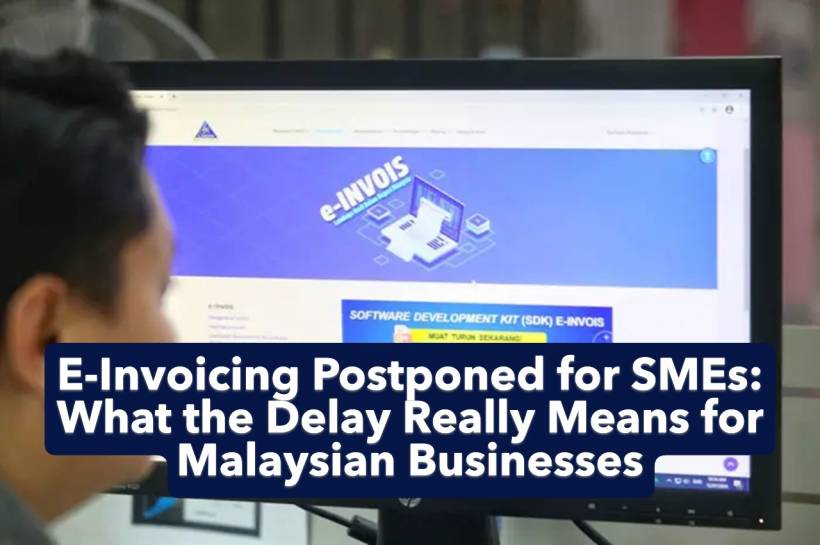
The Malaysian government has announced a significant reprieve for small and medium enterprises (SMEs that fall within the RM1 million to RM5 million annual sales bracket. The mandatory rollout of e-invoicing, initially scheduled to take effect on 1 January, has now been postponed, offering businesses more breathing room to prepare for the transition.
The announcement was made by Prime Minister Anwar Ibrahim, who acknowledged that many companies were struggling with the cost and complexity of implementing e-invoicing systems within the original timeline.
Why the Government Hit Pause on E-Invoicing
E-invoicing is a key pillar of Malaysia's broader tax digitalisation strategy, aimed at improving compliance, transparency, and efficiency. However, for many SMEs, especially those still relying on manual or semi-digital accounting processes, the cost of compliance has proven to be a major hurdle.
According to Anwar, feedback from the business community highlighted that software upgrades, system integration, staff training, and ongoing maintenance would impose a heavy financial burden. As a result, the government agreed to extend the transition period for another year, with no penalties imposed during this extended window.
This delay is not a rollback of policy, but rather a recalibration to ensure SMEs are not pushed into rushed or unsustainable implementations.
Extended Support for Retail and Building Materials Sectors
In addition to the postponement, the government also expanded access to consolidated e-invoicing facilities, particularly benefiting businesses in the retail and building materials sectors. These industries often deal with high transaction volumes and thin margins, making compliance costs even more sensitive.
The move signals a more pragmatic, sector-aware approach, rather than a one-size-fits-all enforcement model.
Rental Services Tax Reduced to Ease Cost Pressures
Beyond e-invoicing, the government introduced relief measures on service taxes, particularly for rental services. The sales and services tax (SST) on rentals, which had previously been raised from zero to eight percent, will now be reduced to six percent.
This adjustment comes at a significant fiscal cost, with Anwar stating that the government is foregoing nearly RM500 million in revenue. However, the Cabinet recognised that the earlier increase had placed pressure on both landlords and tenants, especially small businesses operating from rented premises.
Crucially, micro, small, and medium enterprises with annual sales below RM1.5 million will be fully exempted from service tax on rental services.
Stamp Duty and Income Tax Updates
The government also announced an extension of the voluntary stamp duty disclosure programme, which will now run for an additional six months, from 1 January to 30 June. This provides individuals and businesses more time to regularise past stamp duty matters without facing penalties.
On income tax refunds, Anwar revealed that RM22.5 billion has already been returned to taxpayers. The Inland Revenue Board, Lembaga Hasil Dalam Negeri, successfully cleared 3.5 million backlogged refund cases last year. Outstanding refunds for the 2023 assessment year are expected to be resolved by the first quarter of this year, while 2024 cases are targeted for completion by year-end.
Adjustments to Tax Exemptions in Agriculture
During a special Cabinet meeting held prior to the Prime Minister's Department monthly assembly in Putrajaya, the government also agreed to limit certain tax exemptions for registered manufacturers of animal feed, fertiliser, and insecticides.
The intent behind this move is to better manage production costs across the agricultural supply chain, ultimately helping to stabilise prices of agricultural goods for consumers.
What SMEs Should Do During the Grace Period
While the postponement offers welcome relief, it should not be seen as a reason to delay preparation indefinitely. SMEs now have a valuable window to evaluate suitable e-invoicing solutions, budget realistically, and train internal teams at a manageable pace.
When e-invoicing does become mandatory, businesses that have used this transition period wisely will be better positioned to comply smoothly, avoid last-minute costs, and integrate digital invoicing into their daily operations with minimal disruption.
For now, the government's message is clear: digital transformation remains the destination, but SMEs will be given the time and flexibility needed to get there sustainably.











Comments 0