

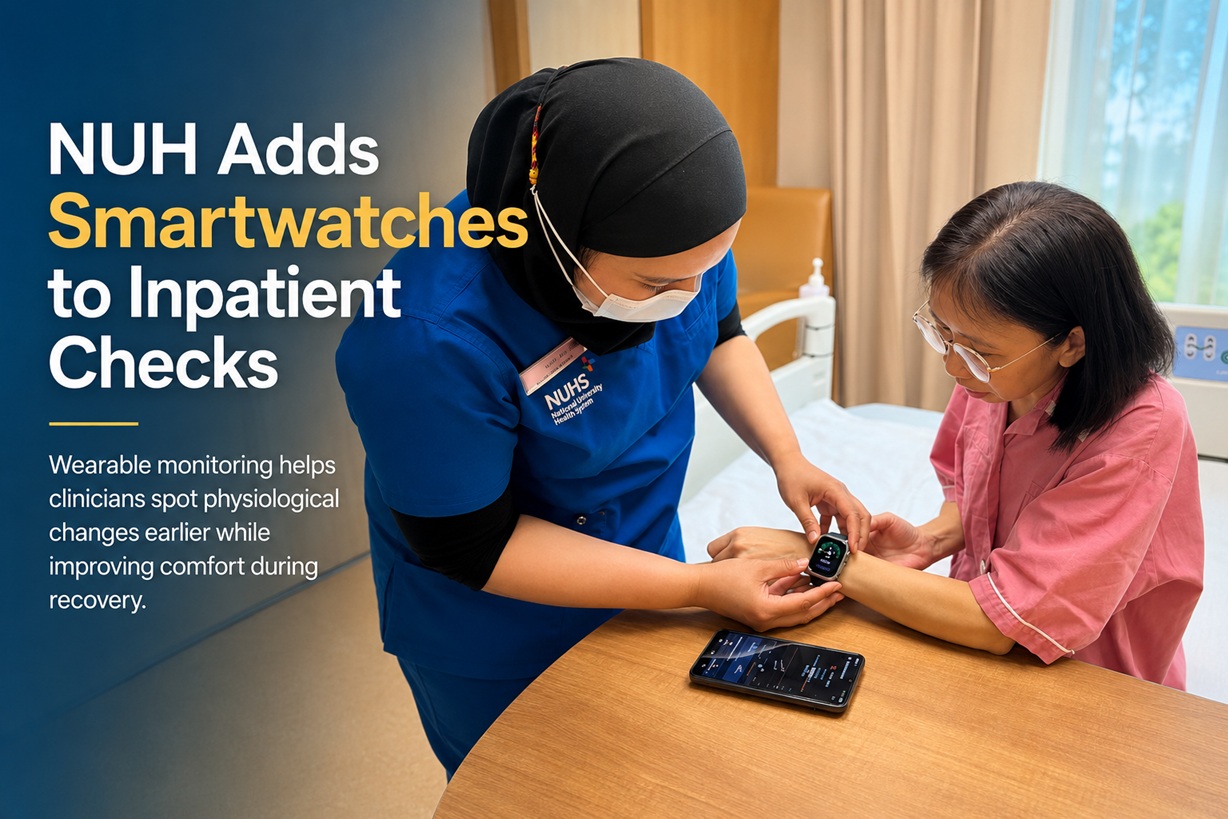
Smartwatches are commonly associated with tracking daily steps, exercise routines and sleep patterns. At Singapore's National University Hospital, however, the same type of wearable technology is being explored for a much more important purpose: helping clinical teams detect early changes in hospitalised patients.
NUH has begun using medical-grade smartwatches to continuously monitor selected inpatients' vital signs after a recent pilot demonstrated that the devices could identify abnormal physiological changes as much as two hours earlier than routine bedside observations.
The initiative represents more than simply introducing another digital gadget into the ward. It reflects a wider shift towards continuous, less intrusive patient monitoring while giving nurses and doctors earlier visibility of possible deterioration.
Testing Smartwatches in a Real Hospital Environment
The month-long pilot was completed in June and involved post-operative patients recovering in a short-stay surgical ward.
It was led by the NUH Department of Surgery in collaboration with a multidisciplinary team from the Yong Loo Lin School of Medicine at the National University of Singapore.
During the pilot, suitable patients wore a commercially available smartwatch that had received approval from Singapore's Health Sciences Authority. The device continuously measured three important indicators:
The readings were transmitted to a smartphone application monitored by the nursing team. Nurses could then review the information alongside their scheduled hourly or four-hourly bedside assessments.
This meant the smartwatch did not replace existing nursing observations. Instead, it provided an additional stream of information between scheduled checks.
Earlier Visibility of Patient Deterioration
One of the most significant findings from the pilot was the ability of the wearable device to identify abnormal readings up to two hours earlier than routine nursing observations.
In a hospital environment, two hours can be clinically meaningful. A patient's blood pressure, oxygen level or pulse rate may begin changing before they display obvious symptoms or before the next scheduled bedside assessment takes place.
By detecting those changes sooner, the system can prompt nurses to assess the patient, verify the reading and begin the hospital's established escalation process when necessary.
NUH reported that abnormal readings identified by the devices resulted in timely clinical reviews, while no critical clinical events were missed throughout the pilot.
The outcome suggests that continuous wearable monitoring may serve as a useful early-warning layer, particularly for patients recovering from surgery.
A Support Tool, Not an Automated Doctor
Despite the potential benefits, NUH has been careful to position the smartwatch as a clinical decision-support tool rather than an autonomous monitoring system.
Any unusual reading detected by the wearable was verified using standard hospital bedside equipment before further action was taken. Clinical decisions continued to follow existing hospital protocols and remained the responsibility of trained healthcare professionals.
This distinction is important because wearable devices can occasionally produce inaccurate readings due to movement, poor skin contact, device positioning or other technical factors.
A sudden abnormal result does not necessarily mean that a patient is deteriorating. It signals that the patient may require closer assessment.
The technology therefore strengthens clinical awareness, but it does not replace the judgment, experience or physical assessment performed by nurses and doctors.
Making Recovery More Comfortable for Patients
Traditional continuous monitoring equipment often involves cables, sensors and bedside machines. While necessary for critically ill or high-risk patients, these attachments can restrict movement and make it more difficult for recovering patients to walk around comfortably.
A smartwatch provides a less intrusive alternative for carefully selected patients.
With fewer wires and attachments, patients may be able to move around the ward more freely, rest with fewer disturbances and begin mobilising earlier after surgery.
Early mobilisation is an important part of many post-operative recovery programmes. It may help patients gradually regain strength and independence while reducing some of the risks associated with remaining in bed for extended periods.
The wearable devices may also reduce unnecessary overnight disruptions. Instead of repeatedly waking a stable patient solely to obtain certain measurements, nurses may already have access to continuously updated readings.
However, bedside checks would still be performed when clinically required.
Reducing the Administrative Burden on Nurses
Vital-sign monitoring is one of the most frequently performed nursing activities in a hospital. Although each observation may only take a few minutes, the workload quickly adds up across an entire ward.
A nurse may need to measure and document multiple vital signs for many patients several times during a shift. The process involves approaching the patient, preparing the equipment, taking the readings, confirming the results and entering the information into the hospital system.
NUH estimates that integrating wearable monitoring into clinical workflows could reduce the time needed for a routine observation from approximately two minutes to around 40 seconds per patient.
The actual time saved would depend on several factors, including patient condition, observation frequency, ward size and clinical workflow.
Even relatively small savings per patient could become meaningful when multiplied across dozens of patients and repeated observations.
More importantly, the objective is not simply to make nurses work faster. It is to reduce repetitive administrative tasks so that nurses can spend more time on direct patient care, education, communication and clinical assessment.
Connecting the Smartwatch to the Electronic Medical Record
A major part of NUH's future plan is to integrate smartwatch readings directly into its Epic electronic medical record system.
At present, wearable data may still need to be reviewed through a separate application. Direct integration would allow verified observations to be recorded automatically in the patient's clinical record.
This could reduce duplicate documentation, improve the availability of real-time information and provide doctors and nurses with a clearer view of patient trends.
Instead of looking only at individual readings taken several hours apart, clinical teams may eventually be able to examine how a patient's vital signs have changed continuously over time.
For example, one slightly abnormal pulse-rate reading may not appear significant on its own. A gradual increase over several hours, however, could indicate that the patient requires further assessment.
Successful integration will still require careful controls. Hospitals must ensure that data is accurately linked to the correct patient, securely transmitted, properly validated and presented in a way that does not overwhelm clinical staff with unnecessary alerts.
Avoiding Alert Fatigue
Continuous monitoring creates more data, but more data does not automatically lead to better care.
If a wearable system generates too many alerts, nurses may begin receiving notifications for minor fluctuations, temporary movement-related errors or readings that are not clinically important.
This can contribute to alert fatigue, where healthcare workers become overwhelmed by frequent alarms and may find it harder to distinguish urgent warnings from low-priority notifications.
For wearable monitoring to succeed, alert thresholds must be carefully designed according to patient condition, clinical risk and ward requirements.
The system should highlight meaningful changes without creating unnecessary interruptions. This will require ongoing evaluation, feedback from frontline staff and refinement of the monitoring rules.
A Gradual Expansion Rather Than Immediate Hospital-Wide Adoption
Following the pilot, NUH plans to progressively provide smartwatches to as many as 10% of suitable inpatients over the next year.
The hospital is taking a selective approach rather than introducing the devices across every ward and patient group at once.
Patients will continue to be assessed based on:
Not every hospitalised patient will be appropriate for smartwatch monitoring. Patients in intensive care, those with highly unstable conditions or individuals requiring specialised monitoring equipment may still need conventional systems.
NUH will continue studying which specialties, patient groups and care environments are most likely to benefit before considering wider adoption.
Could Smartwatches Eventually Replace Manual Observations?
For now, NUH does not view wearable monitoring as a direct replacement for scheduled bedside assessments.
Manual observations provide more than numerical readings. During a bedside check, a nurse can observe the patient's breathing, skin colour, alertness, pain level, mobility and overall appearance.
A smartwatch cannot fully capture these important clinical signs or the concerns a patient may express during a face-to-face interaction.
Future studies may show that observation workflows can be redesigned for carefully selected, clinically stable patients. However, any major change to the current standard of care would require further validation, regulatory consideration, governance review and evidence that the technology remains accurate and reliable in everyday hospital use.
The most realistic future model is likely to combine continuous wearable monitoring with professional bedside assessment rather than choosing one over the other.
Part of NUH's Wider Digital Health Strategy
The smartwatch initiative forms part of NUH's broader efforts to use digital technology and artificial intelligence to improve care delivery, hospital efficiency and patient experience.
The hospital has introduced digital systems designed to predict bed availability and has also explored AI tools capable of analysing lumbar spinal stenosis within seconds.
In April, NUH launched an innovation hub intended to serve as an incubator and testing environment for AI and digital health solutions. The goal is to validate promising technologies in real clinical environments before they are expanded across the healthcare system.
Earlier in January, the hospital also opened the National University Centre for Digestive Health, where AI-supported systems are being used to assist in screening and diagnosing digestive conditions.
Together, these projects show how digital transformation in healthcare is gradually moving beyond administrative systems and into direct patient care.
Technology That Gives Clinicians More Time and Better Visibility
The strongest potential benefit of smartwatch monitoring is not the device itself. It is the ability to give healthcare workers earlier information while reducing some of the repetitive work involved in collecting and documenting observations.
Continuous monitoring may help clinicians recognise changes sooner, support more comfortable patient recovery and provide a clearer picture of how a patient's condition develops between scheduled assessments.
At the same time, successful adoption will depend on more than purchasing wearable devices. Hospitals will need reliable system integration, cybersecurity protections, clinical governance, staff training, effective alert management and clear procedures for responding to abnormal results.
Final Thoughts
NUH's smartwatch pilot demonstrates how familiar consumer-style technology can be adapted for serious clinical use when supported by proper validation and hospital protocols.
The initiative is not about replacing nurses with devices or allowing algorithms to make independent treatment decisions. It is about giving healthcare professionals additional visibility into their patients' recovery and helping them respond earlier when something begins to change.
As the programme expands, its true value will be measured not only by how much time it saves, but by whether it improves patient safety, reduces unnecessary disruptions and allows nurses to dedicate more attention to the human side of care.
For suitable patients, a small device worn on the wrist could eventually become an important part of a much larger hospital monitoring ecosystem.











Comments 0