

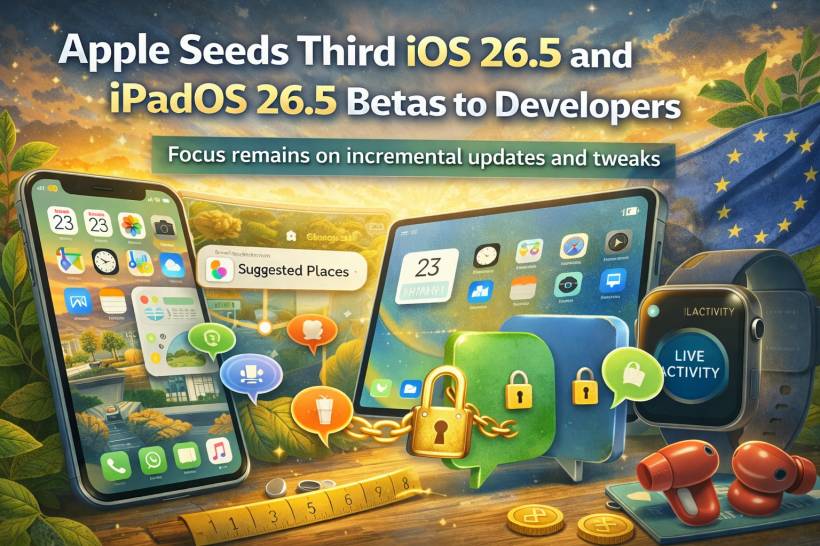
Apple has released the third developer beta of iOS 26.5 and iPadOS 26.5, continuing its usual test cycle ahead of a wider public release. The new beta arrives just a week after the second one, which suggests Apple is still moving at a steady pace with refinements and behind-the-scenes adjustments rather than introducing a major surprise at this stage.
For developers already enrolled in Apple's testing programme, the update can be downloaded directly through the Settings app by heading into the General section and selecting Software Update. That part is routine, but the more interesting question is what this beta actually changes — and so far, the answer seems to be that Apple is focusing more on polishing than on headline-grabbing additions.
No New Siri Breakthrough Yet
One thing that stands out is what is still missing. iOS 26.5 and iPadOS 26.5 do not appear to include the new Siri capabilities many people have been waiting for. That absence is quite telling.
At this point, it increasingly looks like Apple may be saving bigger Siri-related upgrades for iOS 27 instead of squeezing them into this mid-cycle release. If that turns out to be the case, then iOS 26.5 may end up being remembered more as a maintenance and transition update rather than a major intelligence-focused step forward.
That may disappoint users hoping for a more obvious Siri overhaul, especially with AI-related expectations continuing to grow across the tech industry. But it is also very much in line with Apple's habit of holding back features until they are ready for a cleaner and more controlled rollout.
Apple Maps Continues to Evolve
While Siri remains quiet for now, Apple does appear to be making some smaller but still notable adjustments in Maps. One of the features being tested is Suggested Places, which is designed to recommend nearby locations based on trends and recent searches.
That may sound like a relatively modest addition, but it points to Apple trying to make Maps feel more proactive and context-aware. Instead of simply reacting to what a user types in, the app could start nudging them toward places that are relevant to where they are and what others are looking for nearby.
There is also another detail worth watching: Apple is reportedly continuing groundwork related to ads in the Maps app. That does not necessarily mean users will suddenly start seeing a flood of advertising immediately, but it does suggest Apple is still exploring ways to monetise Maps more directly. If that eventually expands, it could become a bigger conversation later, especially around how ads are presented in a navigation and discovery app that many people expect to feel clean and utility-focused.
RCS Encryption Is Still Being Tested
Another important area is messaging security. Apple is continuing to test end-to-end encryption for RCS conversations between iPhone and Android users. That is a meaningful development because it touches one of the long-running gaps in cross-platform messaging.
Apple had already included this feature in the iOS 26.4 beta before removing it prior to public release, so seeing it continue in testing suggests the company has not dropped the idea. It may simply need more work before Apple feels comfortable shipping it broadly.
If Apple does eventually bring end-to-end encryption to RCS messaging in a stable public release, that would be a significant quality-of-life and privacy improvement for users who regularly communicate across iPhone and Android. It would not erase all the differences between platforms, but it would help make mixed-device conversations feel more secure and modern.
More Support for Third-Party Wearables in the EU
There is also an interesting development for users in the European Union. Apple is testing several features for third-party wearables, including proximity pairing, notification forwarding, and Live Activities.
That may not sound dramatic at first glance, but it could be quite important. These are the kinds of conveniences that help make Apple's own ecosystem feel especially seamless. Bringing similar functionality to third-party earbuds and smartwatches would narrow that gap and potentially give users more freedom in choosing hardware outside Apple's own product range.
In practical terms, this could mean non-Apple wearables behaving more like AirPods or an Apple Watch in certain day-to-day scenarios. For EU users especially, this reflects the broader push toward greater interoperability and a less closed ecosystem.
A Beta Cycle That Feels More Incremental Than Transformational
Taken as a whole, the third beta of iOS 26.5 and iPadOS 26.5 feels like a release centred more on refinement than reinvention. That is not necessarily a bad thing. Not every update needs to be packed with flashy new features. Sometimes the more important work happens in the quieter releases, where Apple tests future direction, improves compatibility, and lays groundwork for what comes next.
That seems to be the pattern here. Apple Maps is becoming more recommendation-driven, RCS encryption remains in progress, and third-party wearable support is slowly expanding in certain regions. None of those are the kind of dramatic features that dominate headlines on their own, but together they show where Apple's priorities may be heading.
Final Thoughts
The third iOS 26.5 and iPadOS 26.5 developer betas suggest Apple is still in fine-tuning mode, with a mix of privacy testing, ecosystem adjustments, and gradual Maps improvements shaping this release cycle. The lack of new Siri upgrades will probably be the biggest point of disappointment for some users, especially those expecting Apple to move faster on smarter assistant features.
Still, this beta is not without substance. Continued RCS encryption testing and broader wearable functionality in the EU hint at more meaningful long-term changes, even if they are arriving quietly. For now, iOS 26.5 looks less like a major leap and more like Apple carefully setting the stage for what comes next.











Comments 0