

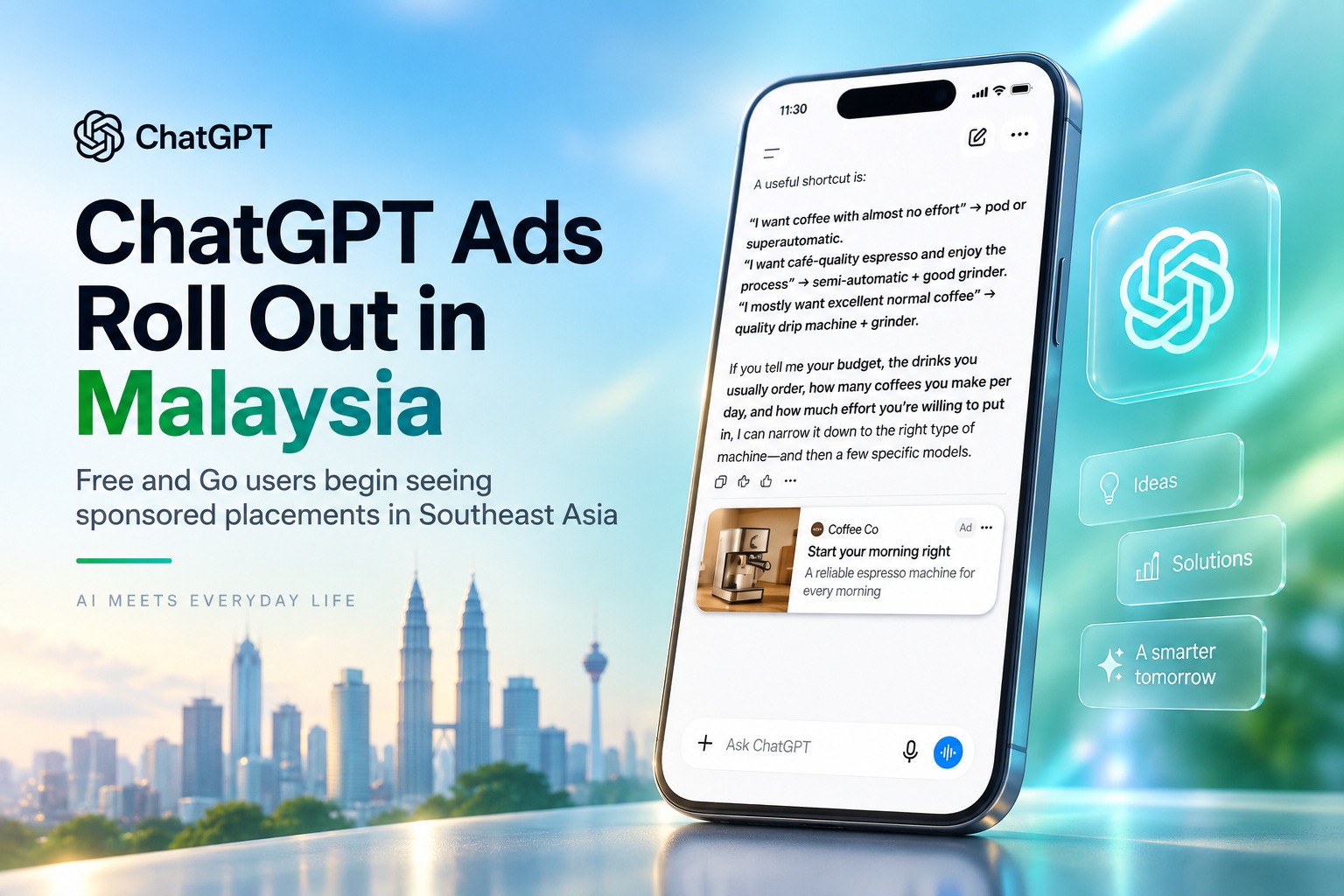
Advertising is officially becoming part of the ChatGPT experience for more users in Southeast Asia, with OpenAI beginning its latest regional expansion of ChatGPT Ads to markets including Malaysia. The rollout follows earlier testing in the United States and subsequent expansion into other international markets, bringing OpenAI's advertising model to a much wider audience.
The change primarily affects people using ChatGPT Free and ChatGPT Go, OpenAI's lower-cost subscription tier. Users on higher-tier plans such as Plus, Pro, Business and Enterprise will continue using ChatGPT without advertisements. OpenAI's current advertising policy also states that ads may appear on Free and Go, while Plus, Pro, Business, Enterprise and Edu accounts do not receive them.
The important distinction is that OpenAI says advertisements are being introduced as a separate layer around ChatGPT rather than being inserted into or used to influence the answers generated by the AI.
Free and Go Users Are the Main Audience for Ads
OpenAI's advertising strategy is focused on maintaining lower-cost access to ChatGPT while helping fund the significant infrastructure required to operate the service. Free users naturally pay nothing for access, while ChatGPT Go is positioned as a more affordable paid tier with higher usage allowances than Free.
Those are the two plans where advertisements may appear. Users who prefer a conventional paid, ad-free experience can move to Plus or Pro, while organisations using Business, Enterprise or Edu accounts remain outside the advertising experience. OpenAI also currently offers Free users in supported advertising regions an optional ads-free Free experience in exchange for lower usage limits and reduced access to some features.
OpenAI describes advertising as one way of supporting broader access to ChatGPT without requiring everyone to subscribe to a more expensive plan. The company first announced its intention to experiment with advertising earlier in 2026 before gradually expanding those tests internationally.
Ads Will Be Clearly Separated From ChatGPT Answers
One of the biggest questions surrounding advertisements inside an AI assistant is whether commercial interests could affect what the model says. OpenAI says that will not happen.
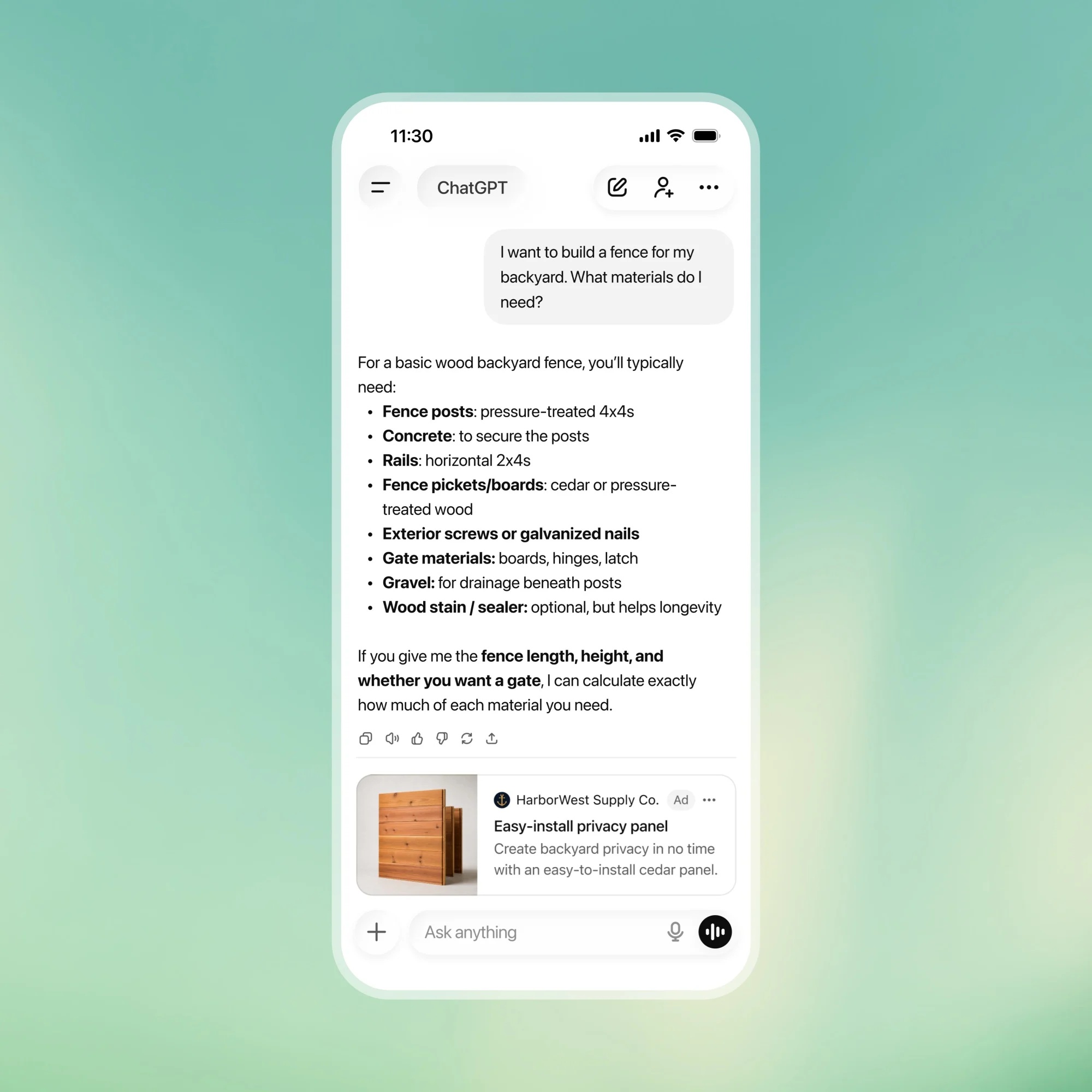
Advertisements are designed to appear separately from ChatGPT's generated response and will be clearly labelled as sponsored content. A user may therefore see an answer to their question followed by a relevant advertising card, but the advertisement is not supposed to become part of the actual answer.
This distinction is particularly important because people use ChatGPT for everything from casual questions and product research to education and professional work. If paid placements were allowed to influence generated answers, users could have difficulty determining whether a recommendation reflected the model's reasoning or an advertiser's commercial relationship.
OpenAI says the two remain separate: answers are generated independently, while advertisements are displayed as distinct paid placements.
Advertising Will Focus on What the User Is Trying to Do
Rather than simply showing generic banner advertisements, OpenAI says its approach will attempt to understand the goal behind the current conversation and surface advertising that may be relevant to it.
Imagine asking ChatGPT to help plan a holiday in Bali. The assistant could still provide the itinerary, travel suggestions or planning information normally, but an advertisement shown beneath the response might feature a hotel, restaurant or travel-related service connected to that destination.
This creates a different advertising environment from conventional websites. Search advertising generally reacts to a short search query, while ChatGPT may have a much richer understanding of what someone is currently trying to accomplish because the request can contain several paragraphs of context.
That potentially makes advertising more useful, but it also means OpenAI needs particularly strong boundaries around privacy and how conversation context is handled.
Advertisers Will Not Receive Users' Conversations
OpenAI says users' conversations will remain private from advertisers. Advertisers do not receive access to chats, chat history, memory or personal conversation details. The company instead shares aggregated advertising performance information such as impressions and clicks.
That separation is significant because a conversation with an AI assistant can contain considerably more personal context than a typical web search. People may discuss work problems, personal plans, finances, relationships or other subjects they would not necessarily enter into a conventional search engine.
The advertising system therefore needs to distinguish between using contextual signals to decide whether an advertisement may be useful and exposing the conversation itself to the company paying for the advertisement. OpenAI says advertisers do not receive that underlying conversation data.
The company has also stated that user data is not sold to advertisers.
Ads Will Not Be Shown to Users Under 18
The advertising rollout is also subject to age restrictions. OpenAI says accounts identified as belonging to people under 18 years old will not be shown advertisements.
This provides an additional separation between the general ChatGPT experience and its commercial layer. It also means advertising eligibility is not determined exclusively by subscription type. Someone can be on Free or Go and still not receive advertisements if the account falls under the age restriction.
OpenAI has also said that advertising content is subject to its own policies, with restrictions around sensitive, inappropriate or potentially harmful categories. Regional launches additionally need to comply with local advertising and consumer-protection regulations.
Free and Go Do Not Necessarily Mean Different Ad Frequency
According to OpenAI's explanation during the Malaysian rollout, being on Go rather than Free does not automatically determine how frequently advertisements appear. Instead, advertising frequency may depend on factors including how often someone uses ChatGPT and whether an appropriate advertisement is available for the conversation.
OpenAI describes its initial approach as relatively conservative rather than attempting to fill every conversation with sponsored placements. That matters because the usability of ChatGPT depends heavily on maintaining a relatively uncluttered interface.
An advertisement appearing occasionally beneath a relevant answer is very different from encountering sponsored content after every message. The success of the model will therefore depend not only on which advertisements appear but on how frequently users encounter them.
For OpenAI, there is a clear balancing act: advertising needs enough visibility to become commercially meaningful without changing ChatGPT into an experience dominated by commercial interruptions.
ChatGPT Go Occupies an Interesting Position
The inclusion of ChatGPT Go is particularly interesting because it is already a paid subscription. Go provides higher limits and expanded access compared with Free while remaining considerably cheaper than higher-tier subscriptions. OpenAI describes it as a low-cost plan aimed at giving users broader access to popular ChatGPT features.
That means Go effectively sits between fully free, ad-supported access and the higher-priced ad-free subscriptions. Users receive more capacity than Free but may still encounter sponsored content.
This is not unusual across digital services. Streaming platforms increasingly offer cheaper subscription tiers that still include advertisements, giving customers the choice between lower monthly costs and an uninterrupted experience.
ChatGPT appears to be moving toward a similar structure, although advertisements inside an AI conversation require different design and privacy considerations from ads shown during films or music playback.
A Relevant Ad Could Be More Useful Than a Random Banner
Contextual relevance is likely to determine whether users find ChatGPT advertising tolerable or irritating. Traditional display advertising often feels disconnected from what someone is currently doing, which makes it easier to ignore.
ChatGPT potentially has an opportunity to make sponsored placements more situational. Someone researching a camera could see a retailer promotion, while someone planning a restaurant visit might see a relevant dining offer. The commercial content becomes connected to an active task rather than simply occupying screen space.
However, the line between useful and intrusive will need careful management. If every product-related question immediately generates an advertisement, users may begin to feel that ordinary conversations have been transformed into shopping opportunities.
OpenAI's challenge is therefore not simply delivering relevant advertising. It is deciding when an advertisement actually adds value and when the better user experience is to show nothing.
Users Will Still Have Control Over Ads
OpenAI's advertising controls allow users to interact with individual sponsored placements rather than simply accepting everything shown. Current controls include options to hide advertisements, report inappropriate or misleading ads, and view information explaining why a particular sponsored item appeared.
Users can also bring a specific advertisement into a ChatGPT conversation through the "Ask ChatGPT" option if they want help understanding or evaluating what is being advertised. By default, the assistant does not automatically see advertisements displayed separately in the interface.
For people on the Free plan who strongly dislike advertising, OpenAI's current setup also provides an ads-free Free option in supported regions, although choosing it reduces message limits and removes access to some features. Alternatively, upgrading to Plus or Pro provides an ad-free experience without those reduced Free-tier limits.
Malaysia Becomes Part of OpenAI's Expanding Ads Market
The Southeast Asian rollout marks another significant expansion for OpenAI's advertising business. ChatGPT's enormous user base makes it an obvious potential advertising platform, particularly because many conversations involve commercial intent such as travel planning, shopping research, product comparisons and service recommendations.
For advertisers, ChatGPT creates an opportunity different from conventional search engines and social networks. Instead of targeting users primarily through keywords, feeds or browsing history, an advertiser may be able to appear when someone is actively working through a relevant task.
With the Malaysian launch, advertisers can participate through OpenAI's advertising operations as well as agency groups including dentsu, Havas Media, Omnicom Media, Publicis Groupe and WPP. Eligible businesses can also use OpenAI's advertising management tools as access expands.
This could eventually make ChatGPT another important channel alongside search, social media and online video for Malaysian advertisers.
The Separation Between Answers and Ads Will Be Crucial
The long-term success of ChatGPT advertising will probably depend less on whether ads exist and more on whether users continue trusting the distinction between what ChatGPT says and what somebody paid to show.
That separation needs to remain visually obvious and technically meaningful. An advertisement may appear because it is relevant to a conversation, but the advertiser should not be able to purchase a favourable answer from the assistant itself.
OpenAI's published advertising principles emphasise exactly this distinction. Ads are separate paid placements, and their presence does not represent an endorsement of the advertiser, product or service by OpenAI.
For an AI assistant, that boundary is arguably even more important than it is for a conventional search engine because generated responses often feel conversational and authoritative. Maintaining trust requires users to understand exactly when they are reading an AI-generated response and when they are looking at sponsored material.
Final Thoughts
The arrival of ChatGPT Ads in Malaysia marks a meaningful change in how many people will experience the service. Free and Go users may now encounter clearly labelled sponsored content beneath ChatGPT responses, while Plus, Pro, Business, Enterprise and Edu accounts remain ad-free under OpenAI's current policy.
OpenAI is attempting to make the advertising model less intrusive by focusing on relevance, limiting ads to eligible adult users and keeping commercial placements separate from generated answers. Conversations also remain private from advertisers, which is particularly important given how personal and detailed interactions with AI assistants can become.
The bigger question will be how users respond once advertisements become part of everyday conversations. Relevant recommendations could occasionally be useful, especially for tasks involving travel, shopping or services. Too many advertisements, however, could quickly undermine the simplicity that makes conversational AI appealing in the first place.
For OpenAI, the challenge is therefore bigger than simply building another advertising platform. It needs to prove that ads can help fund wider access to ChatGPT without changing the trust users place in the answers themselves.











Comments 0