

A new community-developed modification is claiming to unlock previously limited Tensor Core performance on older NVIDIA GeForce RTX 20, 30 and 40 Series graphics cards. The project, known as gpu_unlock, removes compute restrictions that reportedly reduce the speed of certain FP16, BF16 and TF32 workloads when using FP32 accumulation.
The modification is aimed specifically at artificial intelligence and general compute workloads rather than gaming. According to the modders, removing the limiter can allow supported GeForce cards to perform Tensor Core operations at rates much closer to NVIDIA's professional RTX A-series hardware using similar silicon.
The Mod Targets Tensor Core Compute Limits
The developer behind gpu_unlock says NVIDIA ships GeForce cards with Tensor Core throughput limited for several mathematical formats commonly used by AI workloads. These include FP16, BF16 and TF32 calculations with FP32 accumulation, which are heavily used during AI training and unquantized inference.
According to the modder, professional NVIDIA cards based on similar GPU silicon can operate these workloads at a higher rate. The project therefore attempts to remove that limitation before NVIDIA's standard graphics driver loads.
Importantly, the modification does not require users to flash a custom VBIOS or permanently patch the NVIDIA driver.
The Unlock Happens Before The NVIDIA Driver Loads
One of the more interesting aspects of gpu_unlock is how it operates. Rather than replacing NVIDIA's driver with a custom version, the modification applies the change during system startup before the stock driver is loaded.
This means users do not necessarily need to repeat the modification every time NVIDIA releases a new graphics driver. The original driver can remain intact while the Tensor Core restriction is removed separately during boot.
That approach could make the modification easier to maintain compared with projects that depend heavily on patched drivers or modified firmware.
RTX 30 Series Currently Has The Best Support
Although the project lists RTX 20, RTX 30 and RTX 40 Series graphics cards as potential targets, the developer says the modification is currently most stable on RTX 30 Series GPUs.
Support for RTX 20 and RTX 40 Series hardware remains experimental. That means users with those cards may encounter instability or unexpected behaviour that has not yet been fully resolved.
The current state of development therefore makes Ampere-based RTX 30 Series cards the safest target for anyone interested in experimenting with the unlock.
Laptop GPUs Are Supported Too
The project is not limited to desktop graphics cards. Certain NVIDIA laptop GPUs can also benefit from the modification.
For the RTX 30 Series, the currently supported mobile hardware appears to include the RTX 3070 Laptop GPU and RTX 3080 Laptop GPU. Laptop support is particularly interesting because mobile GPUs often operate under stricter power and thermal limitations than their desktop counterparts.
Even so, the Tensor Core unlock does not remove the normal power-management systems built into the GPU.
This Does Not Increase Gaming Performance
Anyone hoping this modification will turn an older RTX graphics card into a faster gaming GPU will probably be disappointed. The unlock specifically affects Tensor Core compute behaviour and does not increase traditional gaming resources.
It does not add CUDA cores, increase VRAM capacity or improve memory bandwidth. Rasterisation performance and normal graphics workloads should therefore remain essentially unchanged.
The main beneficiaries are users running AI inference, AI training and other workloads that heavily depend on Tensor Core mathematics.
AI Performance Can Increase Dramatically
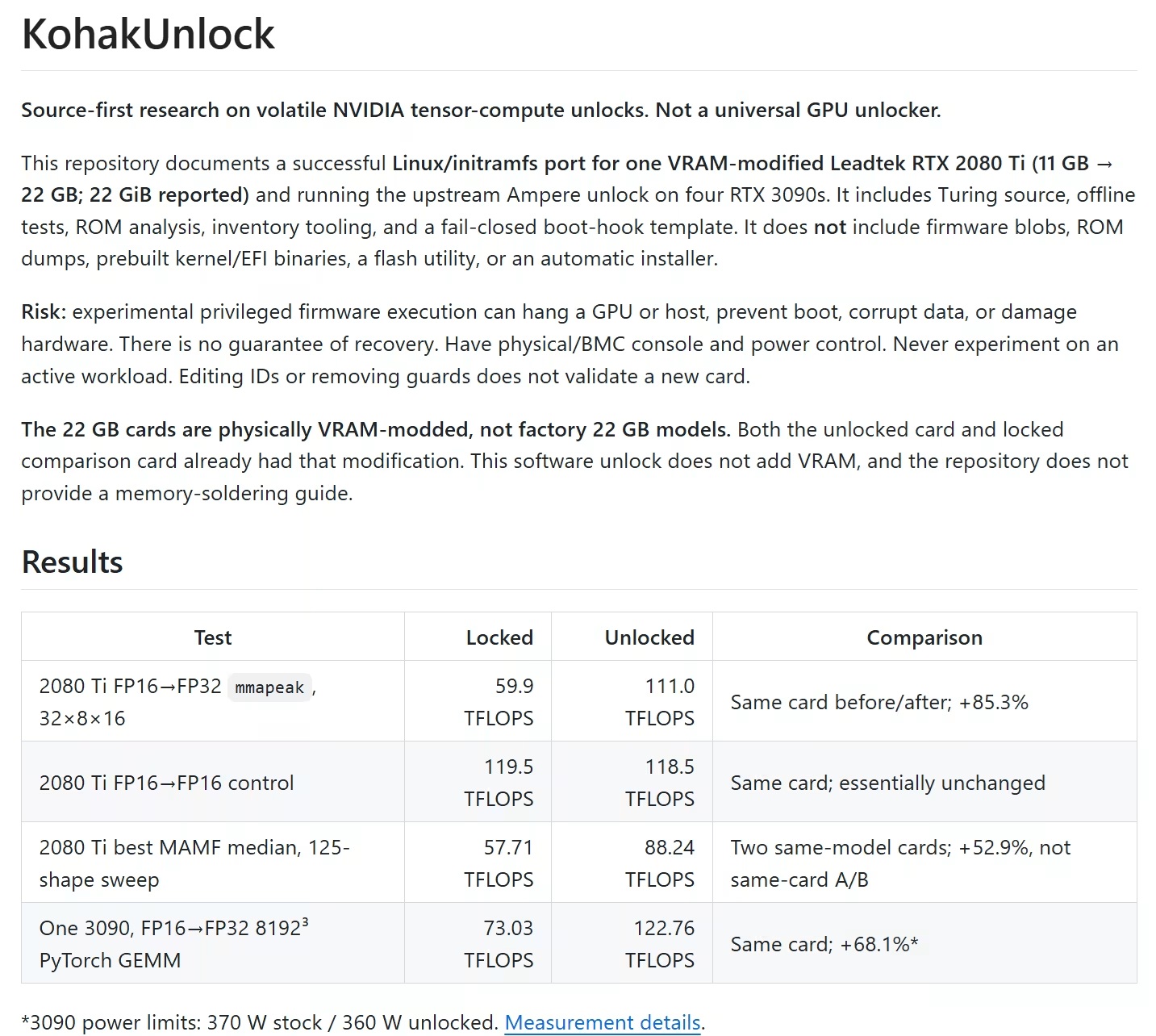
The most impressive part of the project is the reported improvement in BF16 performance. According to benchmark figures provided by the modders, some GPUs gain more than 80% additional Tensor Core throughput after applying the unlock.
The RTX 4090 reportedly shows the largest improvement, effectively doubling its peak BF16 compute rate. Several RTX 30 Series cards also see gains approaching 80%.
These improvements could make older GeForce hardware considerably more attractive for local AI workloads.
RTX 3060 Nearly Doubles BF16 Throughput
The RTX 3060 12GB reportedly improves from around 27 TFLOPS to 51 TFLOPS in BF16 workloads. That represents an increase of approximately 87%.
This is particularly interesting because the 12GB RTX 3060 has already become popular among budget-conscious AI users thanks to its relatively large VRAM capacity. Increasing Tensor Core throughput without changing the memory configuration could make the card even more useful for local model workloads.
The card remains limited by its existing memory bandwidth and compute architecture, but the additional Tensor performance could significantly improve certain operations.
RTX 3060 Ti Gains Around 82%
The RTX 3060 Ti reportedly moves from approximately 37 TFLOPS to 68 TFLOPS, representing an improvement of around 82%.
Unlike the 12GB RTX 3060, the 3060 Ti generally offers stronger raw compute performance but less VRAM. That means it may perform well on AI workloads that fit comfortably within available memory.
The Tensor Core unlock does not solve memory-capacity limitations, but it can allow the GPU to process supported mathematics considerably faster.
RTX 3070 Reaches Around 72 TFLOPS
The RTX 3070 reportedly increases from roughly 40 TFLOPS to 72 TFLOPS, giving it an improvement of about 81%.
That is a substantial increase for a GPU that is now several generations old. For users who already own the card, gpu_unlock could potentially provide additional value without requiring a hardware upgrade.
Again, the benefit depends heavily on whether the workload actually uses the Tensor Core formats affected by the modification.
RTX 3080 Also Sees A Large Improvement
The RTX 3080 10GB reportedly improves from approximately 65 TFLOPS to 113 TFLOPS, an increase of about 73%.
The RTX 3080 still offers strong raw GPU performance, but its 10GB of VRAM can become a limiting factor with larger AI models. The unlock therefore makes the compute side considerably stronger without changing the card's memory limitations.
For workloads that fit within 10GB, however, the additional Tensor performance could be very useful.
RTX 3090 Gains Around 65%
The RTX 3090 reportedly moves from around 75 TFLOPS to 125 TFLOPS, representing a gain of roughly 65%.
The RTX 3090 is already widely used for local AI workloads because of its 24GB VRAM capacity. That combination of large memory and significantly improved Tensor throughput could make the card even more attractive for users running larger models.
For AI enthusiasts, used RTX 3090 cards could potentially become even more valuable if the unlock continues proving reliable.
RTX 3090 Ti Reaches 157 TFLOPS
The RTX 3090 Ti, running at its 450W configuration, reportedly increases from around 88 TFLOPS to 157 TFLOPS. That represents an improvement of approximately 80%.
The card already consumes a considerable amount of power, so users should still pay close attention to cooling and power supply requirements. The modification does not remove the card's normal thermal and electrical safeguards.
Its main benefit is allowing the existing Tensor hardware to operate at a higher rate for supported workloads.
RTX 4070 Ti Reportedly Gains 84%
The RTX 4070 Ti is listed as improving from approximately 81 TFLOPS to 150 TFLOPS, representing an increase of around 84%.
RTX 40 Series support remains experimental, so these figures should be viewed with more caution than results from supported RTX 30 Series hardware. Stability and compatibility may still vary significantly depending on the specific system.
Still, the potential gain demonstrates how much Tensor throughput may currently remain restricted on certain GeForce configurations.
RTX 4080 Nearly Doubles BF16 Performance
The RTX 4080 reportedly jumps from around 104 TFLOPS to 193 TFLOPS, representing an increase of roughly 87%.
That pushes the card into significantly stronger AI-compute territory without changing its hardware. The RTX 4080's larger memory capacity compared with lower-tier cards also makes it more practical for heavier workloads.
However, users should remember that experimental support means this configuration may not yet be suitable for production environments.
RTX 4090 Reportedly Reaches 329 TFLOPS
The biggest reported gain comes from the RTX 4090, which increases from approximately 165 TFLOPS to 329 TFLOPS. That represents a theoretical 100% improvement at peak MMA rate.
The RTX 4090 is already one of the fastest consumer GPUs for local AI work, so doubling this particular Tensor workload performance would be substantial. It could push the card even closer to professional accelerators in specific mathematical workloads.
That said, the improvement applies specifically to the Tensor Core operations affected by the limiter rather than overall GPU performance.
The Mod Does Not Increase Memory Bandwidth
One important limitation is that removing the Tensor Core cap does nothing to increase the speed at which data moves in and out of VRAM.
Memory bandwidth remains exactly the same as before. For workloads already limited by memory throughput rather than Tensor compute, the real-world performance improvement may therefore be much smaller than the headline TFLOPS figures suggest.
AI workloads vary significantly in how much they depend on compute versus memory bandwidth, so the benefit will not be identical across every model or application.
VRAM Capacity Does Not Change Either
The modification also cannot increase the amount of memory physically installed on the card. An RTX 3070 remains limited by its existing VRAM even if Tensor throughput rises dramatically.
This is important because many modern AI models are constrained more by memory capacity than pure compute performance. A GPU may technically process Tensor operations extremely quickly but still be unable to load a large model entirely into memory.
For local AI users, VRAM remains one of the most important considerations when choosing hardware.
CUDA Core Performance Remains Unchanged
Traditional CUDA performance is not being unlocked either. The number of CUDA cores remains fixed, and conventional FP32 workloads that do not depend on the affected Tensor Core modes should see no meaningful change.
That further reinforces how specialised this project is. gpu_unlock is not an overclocking tool or general-purpose performance modification.
Its purpose is specifically to remove what the developers believe is a software-enforced Tensor Core throughput restriction.
The Modder Says Hardware Safeguards Remain Active
One obvious concern is whether allowing Tensor Cores to run at higher throughput could damage the GPU. The developer argues that this should not happen because NVIDIA's existing power management, temperature limits and throttling behaviour remain operational.
If the GPU reaches its thermal or electrical limits, the normal protection mechanisms should still reduce performance accordingly. The modification is not described as bypassing voltage, temperature or power protections.
That makes the project very different from extreme hardware modifications that deliberately disable safety limits.
Higher Compute Performance Can Still Increase Power Usage
Even if the safeguards remain intact, running Tensor workloads more quickly could still result in higher sustained utilisation. That may increase power consumption and heat output compared with workloads running under the original cap.
Users experimenting with the modification should therefore ensure their cooling system is adequate. Laptop users in particular may encounter tighter thermal constraints because mobile cooling systems have much less headroom.
A successful unlock does not guarantee that every system can sustain the maximum theoretical performance continuously.
Professional GPUs May Use Similar Silicon At Higher Rates
The project is based partly on the observation that NVIDIA's professional RTX products can provide higher Tensor throughput despite using hardware related to consumer GeForce GPUs.
The modders argue that the lower performance on GeForce cards is therefore not purely a silicon limitation but a product segmentation decision enforced through software.
Product segmentation is common throughout the semiconductor industry. Manufacturers may use very similar physical chips across several product tiers while enabling different features or performance levels depending on the market.
gpu_unlock attempts to remove one of those distinctions.
NVIDIA Has Long Segmented Consumer And Professional Hardware
Professional graphics cards generally offer more than just faster compute. They can include certified drivers, additional memory, ECC support, enterprise management features and professional application validation.
The Tensor Core limiter therefore represents only one difference between GeForce and professional hardware. Removing it does not transform a consumer card into a full professional accelerator.
Still, for users interested specifically in AI compute performance, the difference can be significant.
Older RTX Cards Could Become More Useful For Local AI
One interesting consequence is that older Ampere hardware may gain renewed value. GPUs such as the RTX 3060, RTX 3090 and RTX 3090 Ti are increasingly available on the used market as gamers upgrade to newer generations.
For local AI enthusiasts, these cards can already offer good value, particularly models with larger amounts of VRAM. Unlocking additional Tensor performance could make them even more competitive.
The RTX 3090 is especially interesting because its 24GB of memory remains extremely useful for local model inference and experimentation.
This Could Appeal To Home AI Enthusiasts
Local AI has grown rapidly as users run language models, image generators and other machine-learning workloads directly on their own computers.
One major advantage is privacy because prompts and data do not necessarily need to leave the machine. Local execution also avoids recurring API costs and can continue working without an internet connection.
Hardware performance remains one of the biggest limitations. Any modification capable of significantly increasing AI compute on existing GPUs will therefore attract considerable interest.
AI Training Could Benefit More Than Gaming Ever Would
The formats affected by gpu_unlock are particularly relevant to AI workloads. FP16 and BF16 are widely used during training because they reduce memory and compute requirements compared with full FP32 operations.
TF32 is also used heavily on NVIDIA hardware for accelerating matrix operations while maintaining useful numerical precision.
These are exactly the types of calculations Tensor Cores were designed to perform. Allowing them to run at full throughput can therefore produce much larger improvements in machine learning than in conventional graphics workloads.
Inference Performance Will Depend On Model Format
The actual inference gains will also depend on how a model is stored and executed. Many local AI models use quantisation such as INT8, INT4 or other reduced-precision formats to lower memory requirements.
The mod specifically targets FP16, BF16 and TF32 workloads with FP32 accumulation. Highly quantised models may therefore receive much less benefit than unquantized or higher-precision inference.
Users should not assume that every AI application will suddenly run twice as fast.
Benchmark Gains Need Real-World Validation
The reported TFLOPS improvements are impressive, but synthetic compute figures do not always translate directly into equivalent application performance.
A workload may be constrained by VRAM capacity, memory bandwidth, CPU performance, storage, software efficiency or kernel implementation. Tensor throughput is only one part of the complete pipeline.
Real-world testing across language models, image generation, training frameworks and scientific applications will therefore be necessary to determine how useful the unlock actually is.
RTX 40 Series Support Remains Experimental
Users with Ada Lovelace cards such as the RTX 4070 Ti, RTX 4080 and RTX 4090 should pay particular attention to the project's experimental status.
Reported benchmark improvements do not necessarily mean every system will operate reliably. Driver changes, firmware differences and GPU revisions could all affect compatibility.
Anyone attempting the modification on valuable hardware should therefore understand that community-developed software comes without the same guarantees as an official NVIDIA feature.
RTX 20 Series Is Experimental Too
The older Turing-based RTX 20 Series is also listed as experimental. These cards introduced Tensor Cores to the consumer GeForce lineup, but their implementation differs from later Ampere and Ada architectures.
That could make the unlock more complicated or less reliable.
Still, if support improves, users with older RTX 20 Series cards could potentially gain additional AI capability from hardware that might otherwise be considered increasingly outdated.
No VBIOS Flash Makes The Experiment Less Intrusive
One reassuring part of the project is that users do not need to modify the graphics card's VBIOS.
VBIOS flashing carries obvious risks because a failed or incompatible flash can potentially leave the GPU unable to initialise normally. Recovering from that situation may require another graphics card, specialised tools or physical access to the firmware chip.
A boot-time software modification is generally much easier to reverse.
Stock NVIDIA Drivers Can Still Be Used
The project also avoids requiring permanently patched NVIDIA drivers. This is valuable because NVIDIA releases new drivers frequently, particularly when new games, CUDA versions or security fixes arrive.
Driver-based modifications often break whenever a new version appears, forcing users to wait for another patched build.
Applying the unlock before the stock driver loads could potentially make the project much more resilient to ordinary driver updates.
NVIDIA Could Still Block The Technique Later
Of course, there is no guarantee the modification will continue working indefinitely. NVIDIA could change how future drivers, firmware or GPUs initialise Tensor Core capabilities.
If the restriction exists intentionally as part of GeForce product segmentation, NVIDIA may eventually decide to close whatever mechanism gpu_unlock is using.
Community hardware modifications frequently become a cat-and-mouse game between users and manufacturers.
For now, the project demonstrates that the limitation can apparently be bypassed on at least some existing cards.
The Mod Raises Questions About Artificial Product Limits
The project also reignites the long-running debate around software-enforced hardware segmentation.
If two products use similar silicon but one runs a capability at half speed purely because of a configuration restriction, enthusiasts naturally question whether the limitation is technically necessary.
From the manufacturer's perspective, segmentation allows different products to target different markets and price points.
From the consumer perspective, however, discovering unused performance inside hardware they already purchased can be frustrating.
Professional Cards Still Offer Advantages Beyond Tensor Speed
Even with the unlock, professional NVIDIA cards retain numerous benefits. They may offer much larger memory capacities, ECC memory protection, enterprise support and certified drivers for professional applications.
Data-centre and workstation models may also be designed for continuous operation under sustained workloads.
gpu_unlock therefore does not make a GeForce card equivalent to an enterprise accelerator.
It simply narrows the performance gap in certain Tensor Core workloads.
Final Thoughts
The gpu_unlock project is one of the more interesting NVIDIA community modifications to appear recently because it targets performance specifically relevant to modern AI computing. By removing a reported Tensor Core limiter, the developers claim that older GeForce RTX 20, 30 and 40 Series cards can run FP16, BF16 and TF32 operations with FP32 accumulation at substantially higher rates.
The most mature support currently appears to be on the RTX 30 Series, while RTX 20 and RTX 40 Series support remains experimental. Laptop variants are supported in some cases as well, including selected RTX 3070 and RTX 3080 mobile GPUs.
Reported BF16 improvements range from around 65% on the RTX 3090 to approximately 87% on cards such as the RTX 3060 and RTX 4080. The RTX 4090 reportedly reaches around 329 TFLOPS, effectively doubling its peak MMA rate from the original configuration.
None of this improves gaming performance, CUDA core count, memory bandwidth or VRAM capacity. The benefits are specifically aimed at AI training, higher-precision inference and other Tensor-heavy compute workloads.
The modder also says NVIDIA's normal power management, thermal throttling and hardware safeguards remain active, reducing concern that the unlock directly removes protection mechanisms.
If the project continues maturing, the most interesting outcome may not involve the newest GPUs at all. Older cards such as the RTX 3090 could become even more attractive for local AI because they combine large amounts of VRAM with significantly higher unlocked Tensor throughput.
For gamers, gpu_unlock changes almost nothing. For AI enthusiasts trying to squeeze more compute from hardware they already own, however, it could potentially unlock an entirely different class of performance.











Comments 0