

The NVIDIA GeForce RTX 5090 has become one of the most valuable consumer graphics cards on the market, and its usefulness now extends far beyond conventional PC gaming. The enormous amount of compute performance and memory bandwidth provided by NVIDIA's flagship Blackwell GPU has made it highly attractive for artificial intelligence workloads, helping push already limited supplies into increasingly expensive territory.
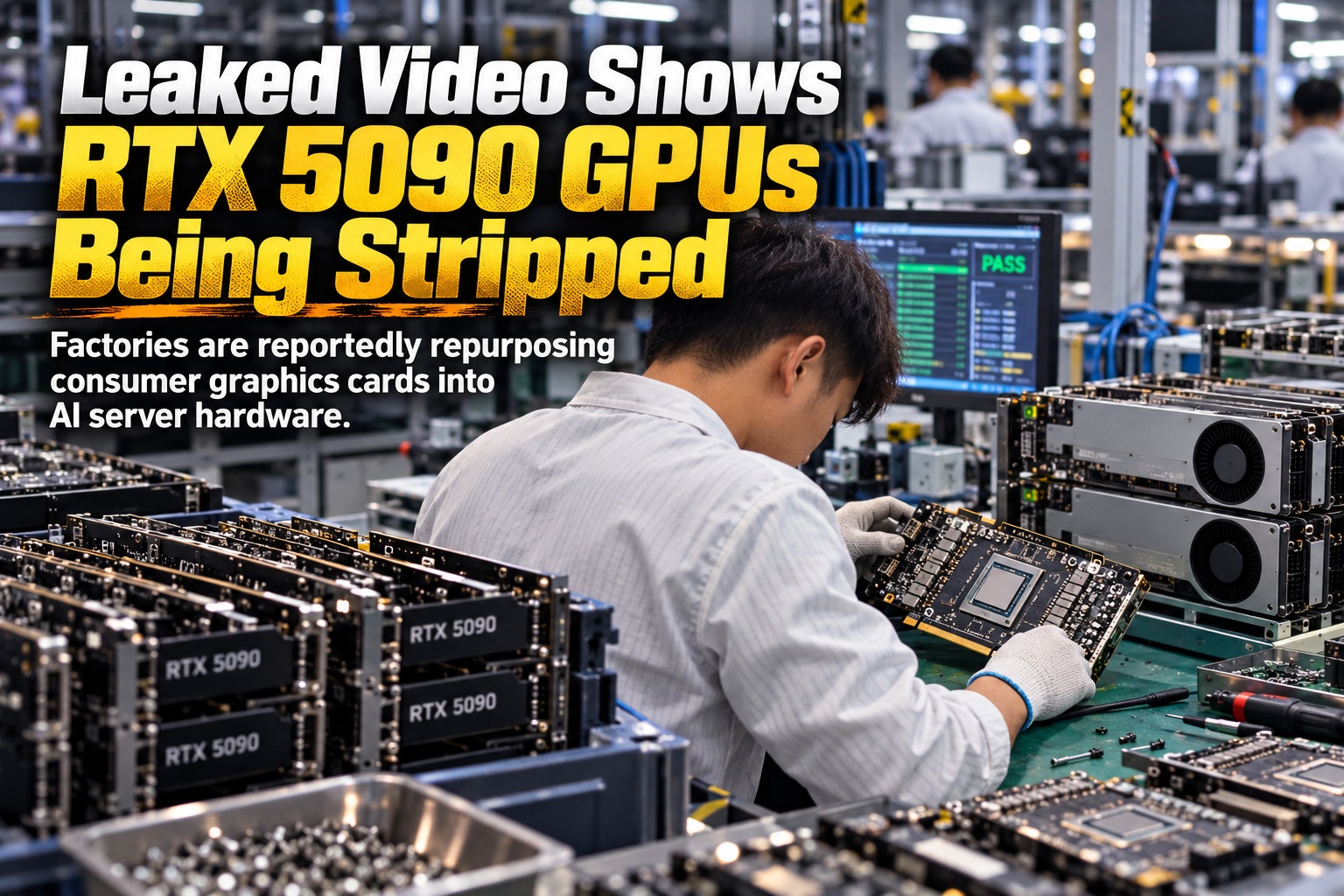
A recently leaked video from China now appears to show another reason why gamers may be struggling to find reasonably priced RTX 5090 cards. Rather than using the graphics cards in their original form, specialised operations are reportedly purchasing complete retail RTX 5090s, removing their valuable GB202 GPU dies and GDDR7 memory chips, and transplanting those components onto custom boards designed for AI servers.
Retail RTX 5090 Cards Are Being Dismantled
The footage was circulated by HKEPC through X, although the original source of the video was reportedly removed afterwards. That has naturally attracted additional attention, as the recording appears to provide a rare look inside an operation that was probably never intended for widespread public viewing.
In the video, technicians can be seen dismantling RTX 5090 graphics cards and carefully removing their most valuable components. The GB202 processor and accompanying GDDR7 memory modules are desoldered from the original consumer graphics-card PCB before being transferred onto purpose-built replacement boards.
Those newly assembled cards use more compact cooling systems that appear much better suited to densely populated server environments than the enormous triple-slot and four-slot coolers commonly found on gaming RTX 5090s.
The GB202 GPU Is The Main Prize
At the centre of every RTX 5090 is NVIDIA's GB202 Blackwell GPU, which is what makes these cards so valuable for both gaming and compute-heavy workloads. While NVIDIA markets the RTX 5090 primarily as an enthusiast GeForce graphics card, the underlying hardware is capable of considerably more than rendering games.
AI workloads can take advantage of the GPU's enormous parallel-processing capability, Tensor hardware and large memory configuration. This makes the RTX 5090 attractive to researchers, developers and companies that need powerful local GPU computing but either cannot obtain or do not want to pay for much more expensive professional accelerators.
For businesses assembling AI servers, purchasing consumer graphics cards simply to extract their chips can therefore make economic sense, even if the practice looks completely absurd from a gamer's perspective.
GDDR7 Memory Is Just As Valuable
The factories are apparently not removing only the GB202 processor. The RTX 5090's GDDR7 memory chips are also being desoldered and reused on the custom PCBs.
That is important because high-speed graphics memory has become increasingly valuable as demand from AI workloads grows. Running large AI models requires substantial memory capacity and bandwidth, meaning the RTX 5090's memory subsystem can be nearly as important as the GPU itself.
Reusing both the GPU die and its original GDDR7 modules allows these operations to effectively reconstruct the heart of an RTX 5090 on hardware designed specifically around server deployment.
The Components Are Transplanted Onto Custom PCBs
Once the GPU and memory have been removed, technicians reportedly install them onto custom-designed printed circuit boards. These replacement boards appear significantly different from the gaming-oriented PCBs originally supplied by NVIDIA's board partners.
The finished cards are fitted with dual-slot blower-style coolers, providing another strong indication that the hardware is destined for server racks. Blower cooling is generally less desirable in gaming PCs because it can be louder, but it works well in dense rack environments where airflow needs to move predictably from one end of the system to the other.
A compact dual-slot design also allows substantially more GPUs to be installed inside a server chassis than would be possible with enormous consumer coolers.
Gaming Cards Become AI Accelerators
What emerges at the other end of the production line is therefore not really an RTX 5090 gaming card anymore. The silicon remains the same, but the surrounding hardware has been redesigned around an entirely different purpose.
These converted cards can be installed densely inside GPU servers where appearance, RGB lighting and low acoustic noise are irrelevant. Cooling efficiency, physical density and sustained compute performance become much more important.
From an AI operator's perspective, this makes perfect sense. From the perspective of somebody trying to buy an RTX 5090 for gaming, however, watching perfectly functional premium graphics cards being dismantled may be painful.
This Is Apparently A Proper Production Operation
Perhaps the most surprising part of the footage is the apparent scale and organisation of the process. The cards do not appear to be modified by a few hobbyists working at a small repair bench. Instead, the operation resembles a structured production line.
Several stages can reportedly be identified, including procurement, unpacking, dismantling, desoldering, component transplantation, testing, validation and eventual repackaging. Each stage appears dedicated to converting commercially available gaming graphics cards into something more appropriate for AI infrastructure.
That suggests there is enough financial incentive behind the process to justify industrialising it.
The Procurement Stage May Frustrate Gamers The Most
For consumers, perhaps the most frustrating part is how the factories reportedly obtain their hardware. They are not limiting purchases to one particular RTX 5090 model or simply buying lower-end cards that happen to be available.
According to the report, RTX 5090 cards from multiple manufacturers are being purchased, including models from Asus, Gigabyte and MSI. Even premium versions from the highest tiers of each manufacturer's lineup can reportedly end up on the dismantling line.
That means expensive enthusiast models carrying elaborate cooling systems and premium PCBs may ultimately have their core components removed just like the cheaper versions.
Even Founders Edition Cards Are Reportedly Being Used
NVIDIA's own GeForce RTX 5090 Founders Edition is reportedly not spared from the process either. These cards are already difficult to obtain in many markets and are often highly sought after by collectors and enthusiasts because of their distinctive NVIDIA-designed hardware.
From the point of view of the repurposing operation, however, the branding does not matter much. The important assets are the GB202 GPU and GDDR7 memory.
Once those components are removed, the elaborate original cooler and PCB have little relevance to the intended AI server application.
Premium Coolers Essentially Become Waste
This is one of the more wasteful-looking aspects of the process. Manufacturers invest heavily in engineering custom coolers, power delivery systems and premium PCBs for flagship graphics cards, only for much of that work to become irrelevant once the silicon is harvested.
An Asus ROG, MSI SUPRIM or Gigabyte AORUS model may command a significant premium partly because of its cooling system and board design. But if the GPU and memory are immediately removed and installed elsewhere, most of that premium hardware provides no practical benefit.
In effect, the AI operation may be paying for an entire finished consumer product simply because that is the easiest available route to obtaining the desired silicon.
Why Not Simply Buy GB202 Chips Directly?
This naturally raises the question of why these companies do not simply purchase GB202 GPUs and GDDR7 modules directly rather than dismantling completed graphics cards. The obvious explanation is availability.
NVIDIA tightly controls how its processors are distributed, and bare high-end GPU packages are not necessarily available to every company that wants them. Consumer graphics cards, on the other hand, can be purchased through distributors, retailers and other channels.
If the value generated by deploying the GPU for AI exceeds the cost of buying and dismantling the card, the process can still be commercially worthwhile.
That is a rather strange situation, but the economics of AI hardware have created plenty of unusual market behaviour already.
RTX 5090 Has Become Much More Than A Gaming GPU
The situation demonstrates how difficult it has become to categorise flagship consumer GPUs purely as gaming hardware. The RTX 5090 may carry the GeForce name, but its architecture makes it useful across a much wider range of workloads.
Content creation, 3D rendering, scientific computing and local AI inference can all benefit from the same hardware. For some users, gaming may actually be one of the least financially valuable things the GPU can do.
That creates competition between ordinary PC enthusiasts and commercial operators who can potentially generate revenue using the hardware.
When businesses can earn money from each GPU, they can justify paying substantially higher prices than most gamers.
AI Demand Is Distorting The Consumer GPU Market
This is not the first time non-gaming demand has affected graphics-card availability. Cryptocurrency mining previously created enormous GPU shortages as miners purchased consumer graphics cards in bulk.
AI is creating a somewhat similar situation, although the underlying economics are different. Instead of calculating cryptocurrency hashes, powerful GPUs are now being used to train, fine-tune and run artificial intelligence models.
The important similarity is that commercial demand competes directly against gaming demand for the same physical hardware.
When that happens, retail pricing tends to move in only one direction.
The RTX 5090 Is Already Extremely Expensive In Malaysia
The RTX 5090 was never intended to be an affordable graphics card, but Malaysian pricing has reached extraordinary levels. Cards are currently reported to sell for an average of around RM28,000, depending on the manufacturer and model.
At that price, the GPU alone can cost more than an entire premium gaming computer. Buyers could build an exceptionally powerful system around an RTX 5080 or another high-end card while spending considerably less overall.
The RTX 5090 therefore sits in an unusual position where it remains a consumer-branded product while increasingly carrying workstation-like pricing.
The Original MSRP Feels Very Far Away
NVIDIA originally introduced the RTX 5090 at an MSRP of US$1,999, positioning it as an ultra-premium enthusiast graphics card. That price was already substantial, but current market conditions make MSRP cards extremely difficult to find in many regions.
Supply constraints, enormous demand and the value of Blackwell hardware for AI have helped push actual prices far above that original figure. Premium board-partner models carry additional markups on top of an already inflated market.
For Malaysian buyers seeing cards around RM28,000, NVIDIA's launch pricing now feels almost theoretical.
Scarcity Creates Opportunity For Resellers And Commercial Buyers
Whenever a product becomes difficult to obtain, opportunists naturally enter the market. Limited supply encourages resellers to purchase cards early and list them again at significantly higher prices.
AI operators add another layer because they are not necessarily buying cards for resale. They may be purchasing them because the underlying GPU can generate commercial value once placed into a server.
This means gamers are competing simultaneously against other enthusiasts, scalpers, professional users and AI infrastructure operators.
That combination makes price normalisation much more difficult.
Converted RTX 5090s Are Better Suited To Server Racks
The custom blower-style design seen in the leaked footage also highlights why retail RTX 5090 cards are poorly suited to dense AI servers in their original form. Modern flagship gaming cards are enormous, with some occupying three or four expansion slots.
A server filled with those cards would waste substantial space and create difficult airflow conditions. Converting the silicon into a dual-slot blower design allows far more GPUs to fit inside the same physical rack space.
For large AI deployments, density matters enormously. Each additional GPU that can fit into a server or rack increases the available compute capacity without requiring another complete system.
Cooling Requirements Are Very Different In Servers
Gaming PC cooling generally prioritises low noise while maintaining acceptable temperatures. Large axial fans and oversized heatsinks work extremely well for that purpose.
Server environments operate differently. Noise is largely irrelevant because the hardware runs inside dedicated data centres where powerful fans are already commonplace.
What matters is predictable airflow and the ability to remove heat from multiple GPUs installed closely together. Blower-style coolers push hot air in a controlled direction, making them much better suited to dense server configurations.
The converted design therefore makes considerably more sense for AI infrastructure despite appearing less sophisticated than premium gaming coolers.
There Are Plenty Of Unanswered Questions
The leaked video also leaves several questions unanswered. It is unclear exactly how many RTX 5090 cards are being processed, who ultimately purchases the converted boards or how widespread this practice has become across the industry.
There is also no indication that NVIDIA or its official board partners are directly involved in the conversion process. The footage appears instead to show third-party operations buying complete cards and repurposing their components independently.
Without more information, it would be difficult to determine how much this particular practice contributes to global RTX 5090 shortages. Still, the existence of organised conversion operations demonstrates the commercial demand surrounding the GPU.
Warranty And Support Become Irrelevant After Conversion
Once an RTX 5090 has been dismantled and its GPU transplanted onto a custom board, any conventional consumer warranty effectively becomes irrelevant. The resulting hardware is no longer the graphics card originally sold by the manufacturer.
For businesses operating these converted GPUs, that may simply be part of the calculation. They may have their own technicians, spare components and validation procedures rather than relying on ordinary retail support.
Again, this highlights how differently commercial AI operators view the product compared with consumers. A gamer expects a complete supported graphics card, while the factory primarily values the silicon contained inside it.
The Video Highlights The Value Of NVIDIA's Blackwell Silicon
Perhaps the biggest takeaway is just how valuable NVIDIA's Blackwell hardware has become. Companies are reportedly willing to buy expensive finished graphics cards, dismantle them, discard much of the original hardware and rebuild them solely to access the GB202 processor and its accompanying memory.
That would make little sense if the silicon were easily available or financially unimportant.
The fact that an industrial process can apparently exist around harvesting RTX 5090 components speaks volumes about current AI demand.
NVIDIA's most powerful consumer GPU has effectively become a commodity for an entirely different market.
Gamers Are No Longer The Only Important GeForce Customers
Historically, GeForce hardware was primarily associated with gaming enthusiasts. Professional users had Quadro, Tesla and later RTX professional products designed specifically for their workloads.
The boundaries have become much less clear as consumer GPUs gained enormous general-purpose compute capabilities. A modern GeForce card can run workloads that once required extremely specialised hardware.
This is excellent for developers and creators because powerful compute becomes more accessible. Unfortunately, it also means gamers are no longer the only customers interested in buying these products.
The stronger AI demand becomes, the more pressure that puts on the traditional consumer market.
The RTX 5090 Is Almost A Luxury Product At This Point
At around RM28,000, the RTX 5090 is already approaching the territory of specialised professional equipment rather than ordinary enthusiast hardware. That makes the image of factories tearing apart these cards even more surreal.
For many gamers, purchasing one would represent a major investment and perhaps the centrepiece of a dream PC. Inside an AI conversion facility, the same card may simply be another source of reusable silicon moving through a production line.
That contrast perfectly illustrates how dramatically the GPU market has changed.
Final Thoughts
The leaked footage reportedly showing Chinese factories dismantling NVIDIA GeForce RTX 5090 cards provides a fascinating and somewhat painful look at the economics surrounding modern AI hardware. Complete graphics cards from multiple manufacturers are apparently being purchased, stripped of their GB202 GPU dies and GDDR7 memory, and rebuilt on custom dual-slot PCBs intended for dense AI server installations.
What makes the footage particularly striking is how organised the operation appears to be. Procurement, dismantling, desoldering, transplantation, validation and repackaging all seem to form part of a structured production process rather than an experimental workshop.
For gamers, this adds another possible source of pressure on RTX 5090 availability at a time when the card already sells for around RM28,000 on average in Malaysia. Every card converted into an AI accelerator is potentially one fewer flagship GPU available to somebody building a gaming PC.
But the bigger story is what this says about NVIDIA's Blackwell silicon. When businesses are willing to buy an entire premium graphics card simply to harvest the GPU and memory hidden underneath its enormous cooler, the RTX 5090 has clearly become far more than just the fastest gaming card.
For the AI industry, it is valuable compute hardware. For gamers trying to buy one anywhere near MSRP, it increasingly feels like gold.











Comments 0