

Chinese AI company Z.ai has introduced GLM-5.2, a new open-source model aimed at developers who need AI to do more than answer short coding questions. The model is designed for longer, more involved engineering workflows: reading through large repositories, keeping track of documentation, working with terminal output, debugging across multiple files, and handling tasks that may take many steps to complete.
GLM-5.2 is released under the MIT licence, which gives developers broad freedom to experiment with it, adapt it, and run it on their own infrastructure. Its other headline feature is a one million-token context window, placing it firmly in the growing category of models built for long-context coding agents.
Designed for Bigger Software Tasks
Most developers have already used AI for tasks such as writing a function, explaining an error, or generating a quick code snippet. But real software work is rarely that simple.
A meaningful coding task may involve inspecting multiple files, understanding project documentation, reviewing previous changes, running commands, checking test results, and revisiting earlier decisions. The more context an AI model can retain, the less often it needs to be reintroduced to the project from scratch.
That is the main idea behind GLM-5.2's one million-token context window.
Z.ai is positioning the model for project-scale work rather than short prompt-and-response interactions. In theory, that means the model can process more of a codebase, retain a longer task history, and work through extended engineering sessions without losing as much context along the way.
For coding agents, this matters because they often need to combine several types of information at once. They may read source code, inspect documentation, review command-line output, analyse test failures, and generate patches as part of the same workflow.
A Focus on Long-Horizon Coding Agents
GLM-5.2 follows the company's earlier GLM-5.1 release, which was also aimed at AI-assisted software engineering. Z.ai says the new version improves performance on longer coding-agent tasks and gives users more control over how much reasoning effort the model applies.
The release includes High and Max thinking-effort modes. These are intended to let developers choose between a faster response for straightforward work and more compute-intensive processing for complex tasks.
For example, a developer may not need maximum reasoning power to rename variables or produce a small utility function. But a larger debugging session involving unfamiliar code, performance bottlenecks, or multiple failing tests may benefit from a slower and more deliberate approach.
This type of control is becoming more common in advanced AI models, especially those designed for technical work. The trade-off is usually simple: more reasoning may produce better results on difficult tasks, but it can also take longer and cost more to run.
How GLM-5.2 Performed in Z.ai's Benchmarks
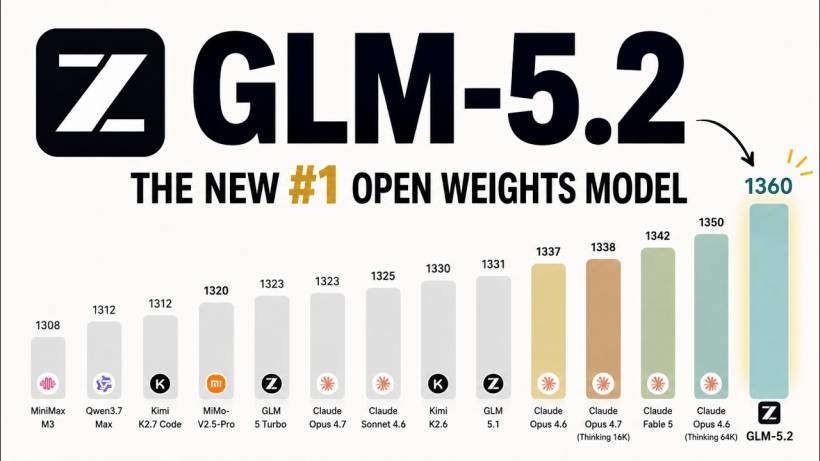
Z.ai has published benchmark comparisons showing GLM-5.2 improving on GLM-5.1 across several coding-related evaluations.
On SWE-bench Pro, which evaluates how well models can resolve real-world software issues, Z.ai lists GLM-5.2 with a score of 62.1, compared with 58.4 for GLM-5.1.
The larger reported jump came from Terminal-Bench 2.1, a benchmark focused on command-line software engineering tasks. Z.ai says GLM-5.2 achieved 81.0, up from 62.0 for its previous model. The company also listed a best reported harness result of 82.7.
These results suggest that Z.ai is placing particular emphasis on workflows where a model has to interact with tools, inspect terminal output, and complete more practical engineering tasks rather than simply generate code from a written instruction.
However, benchmark scores should always be treated carefully. They can be useful indicators, but they do not automatically reflect how well a model will perform in every real development environment. Results can vary depending on the framework, prompt setup, repository size, tools, hardware, and type of problem being solved.
Z.ai's own comparison also places GLM-5.2 below Claude Opus 4.8 on Terminal-Bench 2.1, although the gap appears relatively narrow based on the figures it published.
Why Long Context Can Be Expensive
Giving an AI model access to a very large context window sounds useful, but it also creates a technical challenge: processing long histories can become increasingly expensive.
A coding agent working across a large repository may need to repeatedly look at source files, package documentation, error logs, terminal output, previous tool calls, and test results. Over time, that accumulated context can consume significant compute resources.
Z.ai says GLM-5.2 includes architectural changes designed to reduce that cost.
One of the company's highlighted techniques is called IndexShare. According to Z.ai, it allows the same indexer to be reused across groups of sparse-attention layers, reducing the amount of computation needed during very long-context workloads.
The company claims this can reduce per-token FLOPs by 2.9 times at a one million-token context length.
GLM-5.2 also includes changes to its multi-token prediction layer. Z.ai says this improves speculative decoding efficiency, with acceptance length increasing by up to 20%.
For developers, the technical details matter less than the practical goal: making long coding-agent workflows more realistic to run without costs rising too quickly as the conversation or project history grows.
Developers Can Run It on Their Own Infrastructure
One of GLM-5.2's biggest attractions is that it is open source.
According to its documentation, the model can be run through several popular tools and frameworks, including Transformers, vLLM, SGLang, Docker Model Runner, and KTransformers. Z.ai also lists support for deployment on Ascend NPU hardware through platforms such as vLLM-Ascend, xLLM, and SGLang.
That gives developers more deployment flexibility than they would have with a closed, API-only model.
Self-hosting can be particularly useful for organisations that want tighter control over data, internal source code, security policies, or deployment environments. It may also appeal to teams working with sensitive repositories that they do not want to send to an external hosted service.
Of course, self-hosting comes with responsibilities as well. Companies need suitable hardware, infrastructure expertise, monitoring, access controls, and a plan for updates and performance tuning.
Early Interest Is Growing, but Real-World Testing Matters More
GLM-5.2 has already attracted attention from developers and technology executives online. Some early users have praised its coding performance and suggested that it could be useful for daily engineering work.
That is encouraging for an open model, especially in a market where developers often have to choose between powerful closed systems and more flexible self-hosted alternatives.
Still, early impressions are only one part of the picture.
The real test for GLM-5.2 will be how consistently it performs in production-style coding workflows. Can it reliably understand a large existing codebase? Can it avoid breaking unrelated parts of a project? Can it use tools effectively, interpret test results correctly, and recover when an initial approach fails?
Those are the questions that matter most when AI moves beyond autocomplete and becomes a more active coding assistant.
Final Thoughts
GLM-5.2 is Z.ai's attempt to build a more capable open model for long-running coding-agent work.
Its one million-token context window, configurable reasoning effort, self-hosting options, and reported benchmark gains over GLM-5.1 make it an interesting release for developers experimenting with AI-assisted engineering.
The model's published results are promising, especially for command-line and tool-based tasks. But as with every new AI coding model, independent testing will determine whether those gains translate into reliable everyday use.
For teams that want an open-source alternative focused on larger repositories, longer task histories, and agent-style coding workflows, GLM-5.2 is likely to be one worth watching.











Comments 0