

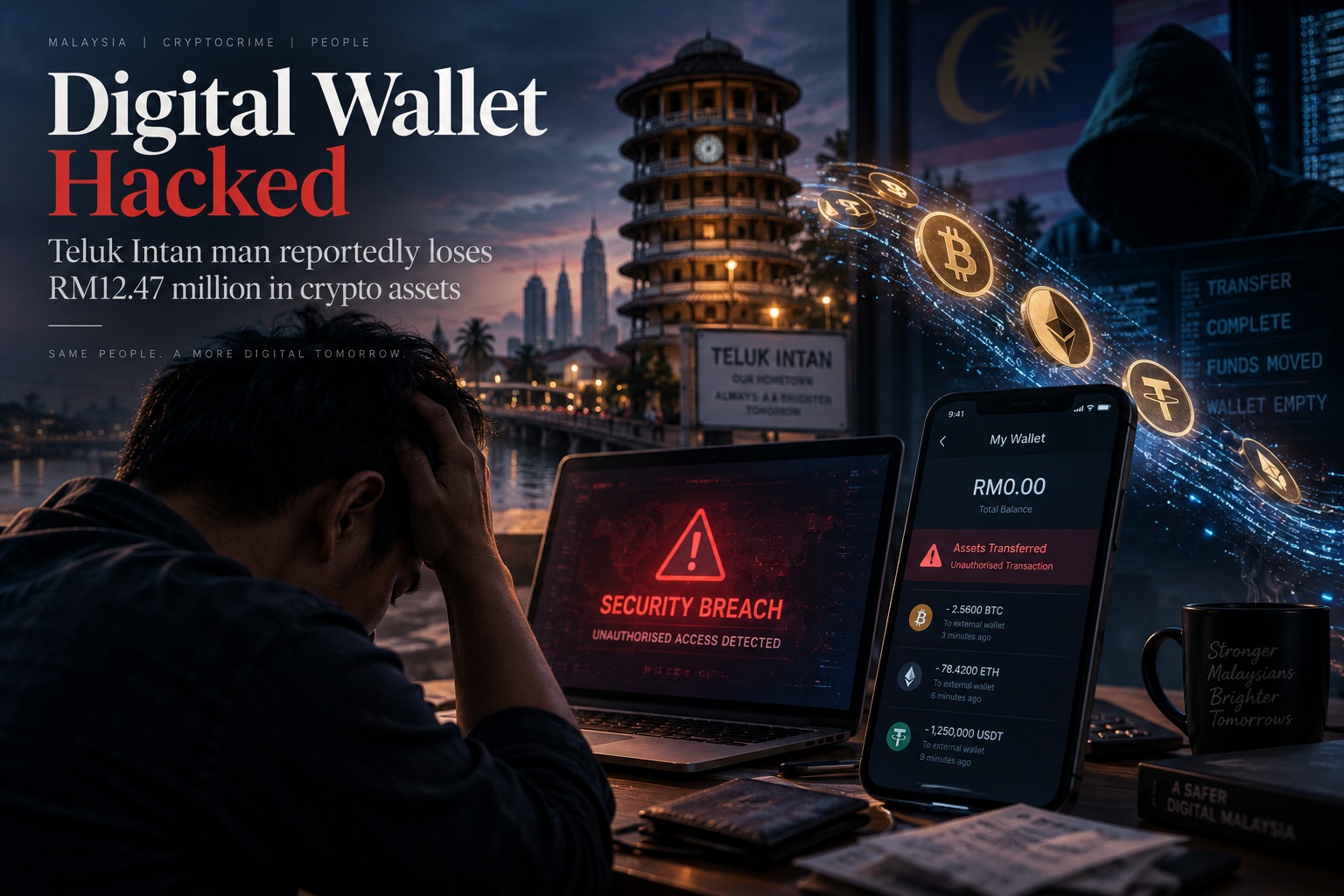
A 39-year-old man from Teluk Intan has reportedly lost around RM12.47 million worth of cryptocurrency after his digital wallet was allegedly compromised. The victim discovered that a large amount of his crypto assets had been transferred out of the wallet without his knowledge or authorisation on Friday, 9 October 2026, at approximately 1pm.
Perak police are now investigating the incident and attempting to trace the movement of the stolen assets across the blockchain. The case highlights the significant financial risks associated with cryptocurrency wallets, where compromised credentials can potentially allow attackers to move digital assets quickly and permanently.
Victim Discovered An Unauthorised Crypto Transfer
According to Perak police chief Comm Datuk Mohd Alwi Zainal Abidin, the victim noticed that his cryptocurrency had been transferred from his wallet without permission. The transaction involved a blockchain network, meaning investigators will need to follow the movement of the assets across publicly recorded blockchain transactions.
Unlike conventional banking transactions, cryptocurrency transfers can move through multiple wallet addresses extremely quickly. Although blockchain transactions are generally visible, identifying the real individuals controlling those wallet addresses can be considerably more difficult.
The reported RM12.47 million loss makes the incident particularly significant and underlines how valuable digital wallets can become attractive targets for cybercriminals.
Bukit Aman Crypto Unit Assisting The Investigation
Police are working with the Bukit Aman Commercial Crime Investigation Department's cryptocurrency unit to trace the transaction flow and identify the parties involved. Blockchain analysis can potentially reveal how stolen funds move between wallets, exchanges and other cryptocurrency services.
Investigators may examine the destination addresses, transaction patterns and whether the assets eventually reach platforms where identity verification is required. If cryptocurrency is transferred through regulated exchanges, authorities may have additional avenues for identifying account holders.
However, attackers may also attempt to complicate tracing by moving assets through several wallets or different blockchain services.
Case Being Investigated Under Section 420
The incident is being investigated under Section 420 of the Penal Code for cheating. If convicted under the provision, offenders can face imprisonment of up to 10 years, whipping and a fine.
Although the initial suspicion involves a hacked digital wallet, investigators will still need to determine exactly how access was obtained. Crypto theft can happen through several different methods, including phishing, malware, stolen credentials or compromised devices.
Understanding the original attack method will be important because it can help determine whether the victim's wallet itself was technically compromised or whether attackers obtained the credentials required to control it.
Seed Phrases And Private Keys Are Extremely Sensitive
Police are reminding cryptocurrency users never to reveal their seed phrases, private keys or passwords to anyone. These credentials effectively control access to digital assets and should be treated with the same level of protection as the assets themselves.
A seed phrase is particularly important because it can allow someone to reconstruct a cryptocurrency wallet on another device. If an attacker obtains that phrase, changing a password on the original device may not be enough to stop them from accessing the wallet.
Private keys serve a similar purpose by proving ownership and allowing transactions to be authorised. Anyone who obtains them may be able to transfer assets without needing further approval from the legitimate owner.
Phishing Remains A Major Threat
Police have also warned users to be cautious about suspicious links. Phishing attacks remain one of the most common ways criminals attempt to steal wallet credentials.
A fraudulent website may look almost identical to a legitimate crypto exchange or wallet service and ask users to sign in, enter a recovery phrase or reconnect their wallet. Once that information is submitted, attackers can immediately use it to access the victim's assets.
The danger is that cryptocurrency transactions are generally difficult to reverse once they have been confirmed on the blockchain. Preventing the theft in the first place is therefore much more important than relying on recovery afterwards.
Malware Can Target Crypto Wallets Too
Digital wallet users should also be aware that phishing is not the only danger. Malware running on a computer or smartphone can potentially steal passwords, monitor clipboard activity or search for wallet-related files.
Some malicious software specifically targets cryptocurrency users by replacing copied wallet addresses. A user may copy the correct destination address, but malware silently substitutes the attacker's address before the transaction is confirmed.
Other malware can search browsers, password managers and local application folders for saved credentials. Keeping devices patched and avoiding untrusted software is therefore an important part of protecting digital assets.
Review Wallet Activity Regularly
Police advise cryptocurrency holders to check their wallet transaction history and connected applications every day. Regular monitoring can help users detect suspicious activity quickly instead of discovering it days or weeks later.
Many wallets and exchanges also support security notifications for logins, withdrawals or changes to account settings. Enabling these alerts can give users another opportunity to react before additional assets are moved.
Users should also periodically review which applications or smart contracts have permission to interact with their wallets. Old or unnecessary approvals should be removed where possible.
Connected Apps Can Introduce Additional Risk
Modern cryptocurrency wallets frequently connect to decentralised applications, exchanges and other Web3 services. While this makes the ecosystem more convenient, each connection can potentially increase exposure.
A malicious or compromised decentralised application may request permissions that allow it to move certain tokens. Users who approve transactions without carefully reviewing them may unknowingly grant more access than intended.
For wallets holding substantial assets, separating everyday transactions from long-term holdings can reduce risk. A wallet used regularly for online services does not necessarily need access to an entire cryptocurrency portfolio.
Stop Using A Device If Compromise Is Suspected
If a smartphone or computer is suspected of being compromised, police advise users to stop using the device immediately. Continuing to log in, change passwords or access wallets from the same compromised device could allow malware to capture the new credentials as well.
The safer approach is to isolate the device and use another trusted system to contact the relevant wallet or exchange provider through official channels. Users should also preserve available evidence rather than immediately wiping the compromised device.
Logs, screenshots, transaction IDs, wallet addresses and suspicious messages may all be useful during an investigation.
Keep Blockchain Transaction Evidence
One advantage investigators have with cryptocurrency is that blockchain transactions generally leave a permanent public record. Victims should therefore retain transaction hashes and wallet addresses connected with any unauthorised transfers.
This information can help authorities trace where assets were sent and whether they were subsequently moved again. While it does not automatically reveal the identity of the attacker, it provides an evidence trail that does not disappear in the same way as some traditional cybercrime data.
Users should also record the approximate time they noticed the incident and any suspicious activity that occurred beforehand.
Contact Providers Through Official Channels Only
Victims should contact their wallet provider, exchange or related platform using verified contact details. Searching online for emergency support numbers can sometimes lead to another scam, as criminals frequently advertise fake customer-service channels.
The safest approach is to use contact information provided inside the official application or on the organisation's verified website. Users should never provide recovery phrases or private keys to someone claiming to be customer support.
A legitimate wallet provider should not require a user to disclose those credentials in order to investigate a compromised account.
Large Crypto Holdings Require Stronger Security
The reported RM12.47 million loss also highlights the importance of using stronger protection when storing high-value cryptocurrency holdings. Keeping large amounts in a single internet-connected wallet creates a significant concentration of risk.
Users with substantial assets may consider separating holdings across different wallets and using hardware-based or offline storage for funds that do not need to be accessed regularly. This reduces the amount exposed if one wallet or device is compromised.
Additional protections such as multi-signature wallets can also require more than one authorisation before funds can be moved, making a single stolen credential less useful to an attacker.
Crypto Security Requires More Than A Strong Password
A strong password remains important, but cryptocurrency security extends much further. Users need to protect devices, recovery phrases, private keys, browser sessions and connected applications at the same time.
Where available, multi-factor authentication should be enabled on exchanges and other custodial services. Passwords should also be unique and not reused across email, financial and cryptocurrency accounts.
The email account associated with a crypto service deserves particular protection because password reset messages and security notifications may be delivered there.
Final Thoughts
The reported RM12.47 million cryptocurrency theft in Teluk Intan is a stark reminder of how quickly digital assets can disappear once attackers gain control of a wallet or its credentials. Police are now working with specialised cryptocurrency investigators to trace the blockchain transactions and identify those responsible.
For crypto users, prevention remains the strongest protection. Seed phrases, private keys and passwords should never be shared, suspicious links should be avoided and wallet activity should be monitored regularly. Anyone who suspects that a device or wallet has been compromised should stop using the affected device, preserve available evidence, contact the platform through official channels and lodge a police report as quickly as possible.











Comments 0