

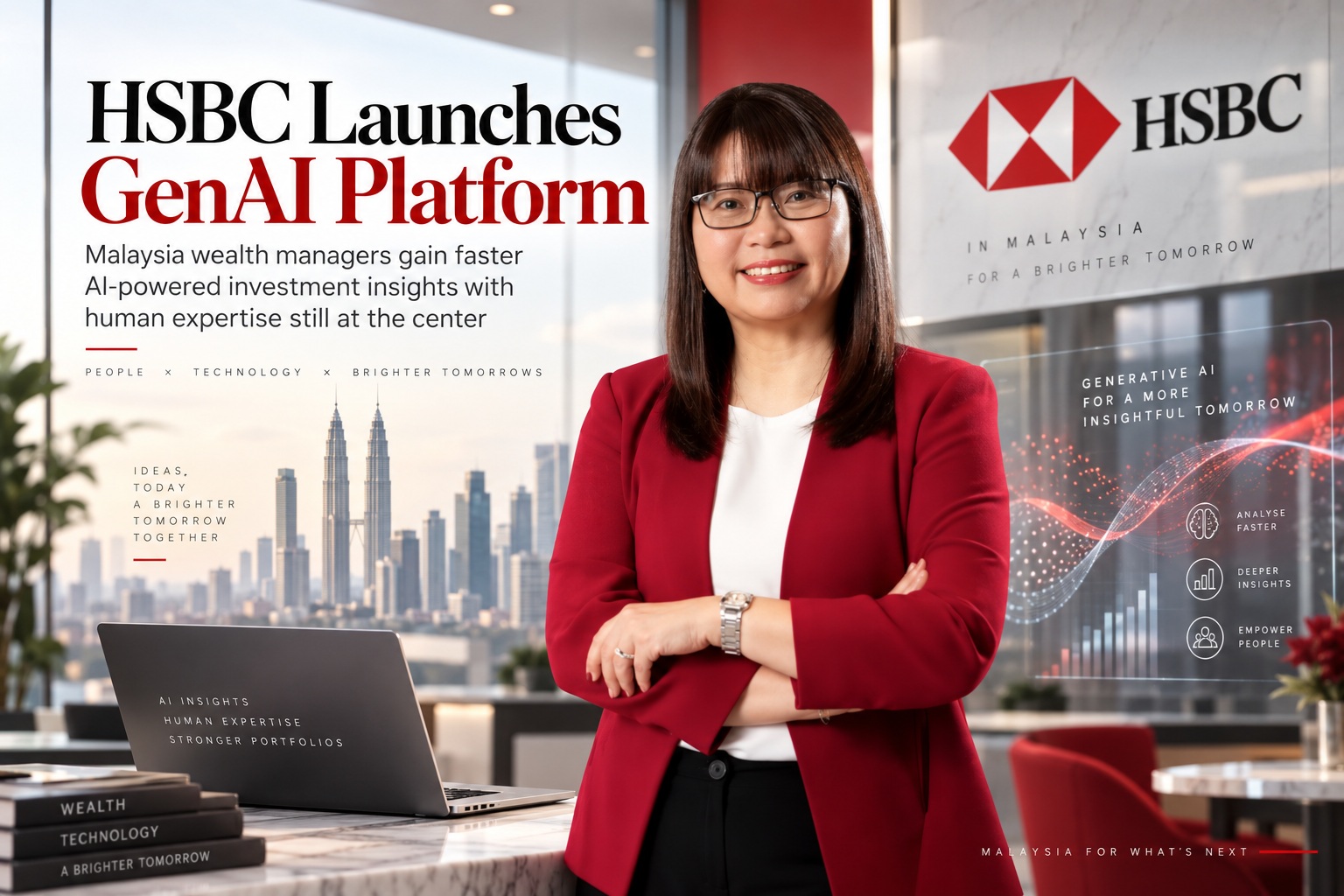
Artificial intelligence is becoming a much bigger part of how Malaysians research and think about their money, but most investors still do not want technology making financial decisions on its own. HSBC Malaysia is responding to that shift by launching Wealth Intelligence, a new generative AI platform designed to help its relationship managers analyse investment information, summarise market developments, and prepare more relevant conversations with clients.
The move follows an HSBC-commissioned survey conducted by Ipsos involving around 10,000 affluent and high-net-worth individuals across 10 markets. Malaysia stood out as one of the strongest adopters of AI for financial purposes, with 85% of respondents saying they already use AI for finance, putting the country level with mainland China and only slightly behind India at 86%. Even with such high adoption, however, the research shows that investors still place considerable value on human judgement and professional reassurance.
Malaysian Investors Are Already Comfortable Using AI
AI is no longer something affluent investors are simply curious about. According to the survey, it is already being used by a large majority of Malaysian respondents for financial and investment-related tasks. That level of adoption suggests tools such as AI assistants, automated research platforms, portfolio-analysis services, and generative AI are becoming part of ordinary investment behaviour rather than remaining niche technology.
The pattern is particularly strong among younger investors. Millennials recorded the highest adoption rate at 89%, followed by Gen Z at 86% and Generation X at 85%. Even Baby Boomers showed substantial usage at 78%, indicating that interest in AI-assisted finance is not limited entirely to younger generations.
What differs more is how people are using the technology. Among Gen Z respondents, 61% use AI to analyse portfolio performance while 57% use it to generate new investment ideas. For Millennials, both activities were cited by 53% of respondents, suggesting younger investors increasingly see AI as a practical research and decision-support tool rather than simply a source of general financial information.
Human Advice Still Carries More Weight
Despite the strong enthusiasm for AI, Malaysian investors have not abandoned traditional financial advice. Financial institutions and professional advisors remain the leading source of investment ideas for 65% of respondents, showing that credibility and established expertise still matter even when digital tools are widely available.
Human advisors also continue to influence final financial decisions more strongly than AI alone. The survey found that 85% of respondents look to advisors for reassurance, while 76% rely on their strategic expertise. This suggests investors may be comfortable using AI to gather information, compare possibilities, or generate ideas, but many still want a human professional involved when those ideas turn into actual financial decisions.
That balance is reflected in the fact that 58% of Malaysian respondents prefer a hybrid approach, combining AI capabilities with human advice. The result points toward a future where technology supports wealth managers rather than replaces them, particularly when clients need interpretation, context, and confidence rather than another stream of raw information.
Investors Still Want Humans to Catch AI Mistakes
One of the more interesting findings is how investors view the weaknesses of AI-generated financial information. Around 31% of respondents rely on financial professionals to identify errors in AI-generated data, while another 31% value the ability of advisors to interpret complicated information in a personalised way. A further 30% specifically look to human judgement to validate AI-generated conclusions.
Those numbers highlight an important limitation of financial AI. A system may process large amounts of information rapidly, but speed does not automatically guarantee that the result is complete, accurate, or appropriate for a particular investor. Financial markets are affected by changing economic conditions, risk tolerance, personal goals, tax circumstances, and countless other factors that cannot always be reduced to a generic generated response.
HSBC Malaysia appears to be positioning its new platform around that distinction. The technology is intended to make relationship managers faster and better informed, while the relationship manager remains responsible for turning that information into a meaningful conversation with the client.
Wealth Intelligence Is Built for Relationship Managers, Not Customers
HSBC's new Wealth Intelligence platform is designed specifically for internal use by its relationship managers in Malaysia. The system uses generative AI to analyse material from HSBC's Chief Investment Office, market commentary, and information relating to unit trust funds, helping staff quickly surface relevant information when discussing investments with clients.
The platform is not intended to independently recommend investments to customers. HSBC has made clear that Wealth Intelligence does not itself provide investment advice or direct recommendations, which keeps the relationship manager firmly in the decision-support process. Instead, the system is meant to reduce the time spent manually searching through reports, market updates, and investment data.
That distinction is important in wealth management, where context matters enormously. Two clients may ask the same question about a particular market but have completely different investment objectives, time horizons, liquidity needs, or attitudes toward risk. AI can organise the information, but the advisor still needs to understand the person sitting across the table.
Speed From AI, Trust From Human Relationships
Linda Yip, Country Head of International Wealth and Premier Banking at HSBC Malaysia, described the strategy as a combination of technological speed and human trust. Her point reflects the broader message of the survey: investors are increasingly comfortable using AI, but they do not necessarily want the financial relationship itself to become fully automated.
This hybrid model makes sense because wealth management has always involved more than presenting market data. Advisors regularly need to explain uncertainty, challenge assumptions, discuss risk, and help clients understand how changing market conditions relate to their long-term goals. These are areas where interpersonal understanding and judgement remain valuable even when sophisticated analytics are available.
AI can make those conversations more informed by processing information before the meeting even begins. A relationship manager who can rapidly summarise market commentary, compare relevant investment data, and identify emerging themes may have more time to focus on explaining what those findings mean for the individual client.
AI Is Changing How Investors Feel About Risk
The survey also suggests that AI is affecting investor psychology, not just the way people gather information. Around 57% of Malaysian respondents said AI makes them feel more in control of their investments, compared with 21% who said it makes them feel less in control. Greater access to information, rapid analysis, and easier portfolio monitoring may be contributing to that increased sense of confidence.
AI also appears to influence willingness to take risk. 54% said using AI makes them more willing to take calculated risks, while only 25% said it makes them more cautious. That does not necessarily mean investors are becoming reckless, but it does suggest that more information can make people feel better prepared to act.
This is another reason human oversight remains important. Greater confidence is helpful when it comes from better understanding, but confidence can become dangerous if investors assume AI-generated analysis is always correct. A professional advisor can help distinguish between genuinely improved insight and overconfidence driven by polished but potentially incomplete information.
Younger Investors Are Driving the Shift
The generational breakdown provides a useful indication of where wealth management is heading. Millennials and Gen Z are already accustomed to using digital tools across almost every part of their lives, so it is unsurprising that they are also using AI more aggressively for portfolio analysis and idea generation. For these customers, waiting for a scheduled meeting to access investment information may increasingly feel outdated.
That does not mean younger investors want to remove advisors from the process. The survey's preference for a hybrid model suggests many simply expect financial professionals to work with better technology. An advisor supported by real-time AI analysis may feel more relevant than one relying entirely on traditional research methods.
For banks, this changes the competitive landscape. The question is no longer simply whether a financial institution offers digital banking or an investment portal. Increasingly, clients may judge institutions by how intelligently they combine technology with personalised service.
The Bigger Opportunity Is Better Client Conversations
The most useful application of Wealth Intelligence may ultimately be relatively simple: giving relationship managers more time to talk to clients instead of searching for information. Wealth professionals often work across large volumes of market commentary, fund information, research, and client documentation. Generative AI can compress some of that preparation by quickly extracting relevant information from approved internal sources.
This does not remove the need for expertise. In fact, faster access to information can make professional judgement even more important because the advisor still needs to decide which information matters, whether it is relevant to the client, and how it should be communicated. AI can accelerate the research process, but it cannot automatically understand every nuance of a person's financial priorities.
Used properly, the technology could therefore make wealth management feel more human rather than less. The advisor spends less time gathering material and more time discussing what it actually means.
Financial AI Still Needs Strong Oversight
The banking sector has particular reasons to be cautious about generative AI. Investment information can influence significant financial decisions, and inaccurate summaries or misunderstood market data can have real consequences. Any internal AI system therefore needs clear controls over the information it uses, how generated content is reviewed, and where responsibility ultimately sits.
HSBC's approach of keeping Wealth Intelligence as an internal tool for relationship managers provides an additional layer of human review before information reaches a client. The system supports the professional rather than speaking directly to customers as an autonomous financial advisor. That structure may become increasingly common as banks experiment with generative AI while maintaining established regulatory and advisory responsibilities.
The quality of the source material also matters. AI tools are far more useful when they operate on trusted internal research than when they simply generate answers from broad, uncontrolled information. By grounding the platform in HSBC's own investment research and market commentary, the bank can keep the system closer to information its advisors are already expected to use.
Final Thoughts
HSBC Malaysia's launch of Wealth Intelligence reflects a wider change in how financial services are approaching artificial intelligence. Affluent Malaysian investors are already using AI heavily, with the country recording one of the highest adoption rates in the survey, but most still want professional judgement alongside that technology.
That combination may define the next stage of wealth management. AI can process data quickly, identify relevant information, and help advisors prepare more efficiently, while human professionals provide context, reassurance, strategy, and the ability to question what the technology produces.
The survey also suggests that investors themselves understand this distinction. They are willing to use AI for portfolio analysis and new investment ideas, yet many still rely on advisors to identify mistakes, interpret complex information, and validate conclusions. That is less a competition between humans and AI than a division of strengths.
For HSBC, Wealth Intelligence is therefore not about replacing the relationship manager with a chatbot. It is about giving the relationship manager better tools. As AI becomes more deeply integrated into financial services, the institutions that use it most effectively may be those that preserve the part clients still value most: the confidence that comes from having a knowledgeable human involved when the decision really matters.











Comments 0