

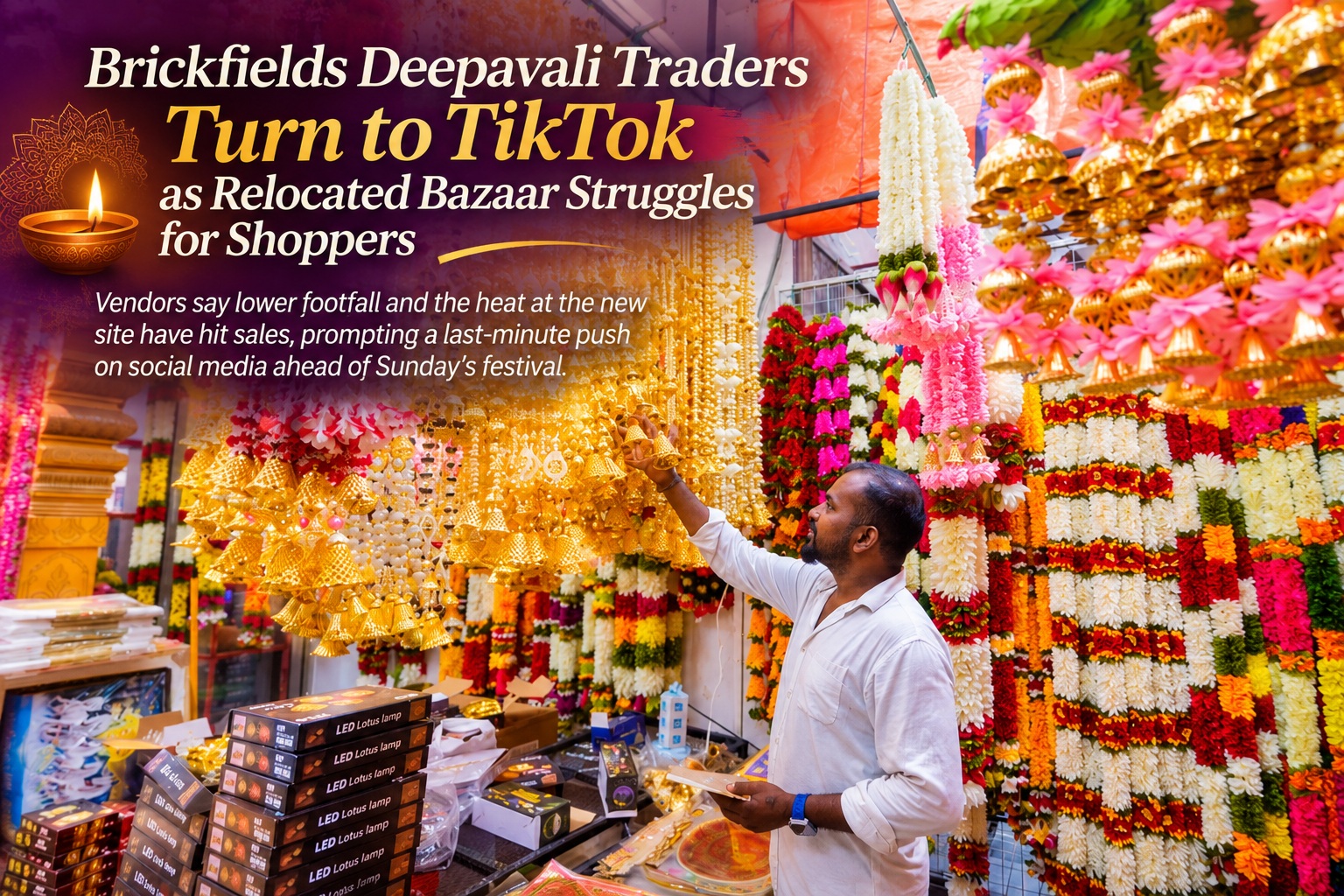
With Deepavali just days away, traders at the Brickfields Deepavali bazaar are making a final attempt to rescue what has been an unusually difficult festive season. After weeks of disappointing sales at the newly relocated bazaar, several vendors have turned to TikTok livestreams and viral videos in the hope of attracting shoppers who may not even realise the market is operating at its current location. For traders who normally depend heavily on the final weekend before Deepavali, social media has unexpectedly become one of the most important tools keeping their businesses visible.
The atmosphere is very different from previous years, when festive stalls were spread along Brickfields' main roads and naturally benefited from the constant flow of office workers, tourists and people passing through the neighbourhood. This year, traders say the relocation has removed much of that spontaneous foot traffic, leaving some long-time vendors struggling to recover even a fraction of what they normally earn during the festive period.
A Very Different Deepavali Bazaar This Year
Brickfields has long been associated with Deepavali shopping, particularly in the weeks leading up to the festival. Shoppers traditionally visit the area looking for Indian clothing, accessories, decorations, food and other festive necessities, while traders depend on the increased crowds to generate some of their strongest sales of the year.
The layout of this year's bazaar, however, is noticeably different. Instead of having stalls positioned along prominent stretches of Brickfields where pedestrians naturally encounter them, vendors have been moved into a more concentrated bazaar area. Traders say the new arrangement may be more organised, but it has also reduced visibility considerably.
Traders Miss Their Old Main-Road Locations
For many vendors, the biggest complaint is simple: people used to see them without needing to deliberately search for the bazaar. Long-time trader Gunaseelan Subramaniam, who has operated at the Brickfields Deepavali bazaar for 25 years, said his previous location attracted much stronger crowds throughout the day.
Office workers would pass through during breakfast and lunch breaks, while tourists exploring Brickfields would often stop to browse. Gunaseelan also remembers attracting a strong number of Malay customers in previous years, illustrating how the bazaar had become more than simply a shopping destination for the Indian community.
This year, he says many people do not even realise where the bazaar has moved.
Visibility Has Become One Of The Biggest Problems
Location can make an enormous difference for temporary markets because much of their business comes from impulse visits. Someone walking past a colourful row of Deepavali stalls may decide to stop even if shopping was not part of their original plan.
Once stalls are moved away from the busiest pedestrian routes, that spontaneous discovery disappears. Customers now need to know that the bazaar exists and make a deliberate decision to visit it, which places much more pressure on advertising and social media promotion.
For smaller traders without large marketing budgets, that can become a serious disadvantage.
Gunaseelan Says Sales Have Fallen Sharply
Gunaseelan said the contrast with previous years has been particularly painful during the crucial period immediately before Deepavali. The final weekend before the celebration would traditionally be one of the strongest periods for traders as families make last-minute purchases.
This time, he said his earnings over three days barely reached RM1,000. For a seasonal trader who has already invested in stock, transportation and stall preparation, such weak revenue creates serious concern about whether the business can recover its costs before the bazaar closes.
With Deepavali approaching rapidly, there is very little time left for sales to improve.
TikTok Has Become A Last-Minute Lifeline
Faced with poor foot traffic, Gunaseelan began livestreaming on TikTok to promote both his stall and the wider bazaar. Instead of waiting for shoppers to discover the market physically, he started bringing the bazaar directly onto their phone screens.
The strategy appears to have helped. Some customers reportedly told him that they regularly passed through the surrounding area but had no idea the Deepavali bazaar was operating there until TikTok videos began circulating.
For Gunaseelan, social media has become less of an optional marketing channel and more of a survival tool during the final stretch of the festive season.
Viral Videos Are Doing What Street Visibility Used To Do
In previous years, the main road effectively served as free advertising. Thousands of people moving through Brickfields would see the stalls simply by being in the area.
Now TikTok is beginning to perform part of that role digitally. A short livestream or video showing colourful clothing, festive decorations and the bazaar atmosphere can reach thousands of potential shoppers without them physically passing the location.
It is an interesting example of how social media can compensate, at least partially, when traditional retail visibility disappears.
Traders Are Personally Promoting The Bazaar
The situation also highlights how much responsibility for promotion has shifted towards individual vendors. Rather than relying solely on official publicity, traders are recording videos, speaking directly to viewers and asking people to support the bazaar.
This creates a much more personal form of marketing. Potential customers can see the faces behind the stalls, view the available clothing and ask questions directly through livestream comments.
For traders racing against time to clear festive inventory, that direct connection can make a meaningful difference.
Heat Inside The Bazaar Is Another Major Complaint
Location is not the only issue affecting customer comfort. Viswalingam Karuppiah, 61, who sells traditional clothing imported directly from India, said the heat inside the bazaar tents is discouraging families from spending time browsing.
Only a limited number of air coolers have reportedly been installed along the corridors, and traders say they are not sufficient to cool the area effectively. During Malaysia's hot and humid weather, enclosed or semi-enclosed tented spaces can quickly become uncomfortable, particularly when large crowds gather.
The problem becomes especially important for clothing vendors because customers generally need time to browse, compare materials and try garments before making a decision.
Clothing Shopping Requires Time
Buying traditional festive wear is very different from purchasing something quickly from a convenience store. Customers may want to feel the fabric, compare colours, find the correct size and see how an outfit looks before spending money.
That process naturally takes time. If the shopping environment becomes uncomfortable after only several minutes, customers may leave before making a purchase.
For traders selling kurtas, sarees, lenghas and other traditional clothing, creating an environment where customers are comfortable enough to browse can directly affect sales.
Even Evening Shopping Can Feel Too Warm
Night-time shopping usually offers some relief from Malaysia's daytime heat, but Viswalingam said conditions inside the bazaar remain uncomfortable even after sunset. That makes it more difficult for families who might otherwise visit after work or dinner.
Festive bazaars normally benefit from customers spending considerable time wandering between stalls, comparing products and returning to vendors they liked earlier. If shoppers simply want to leave quickly because of the temperature, those opportunities disappear.
Comfort therefore becomes more than an inconvenience; it becomes part of the commercial environment.
Traders Appreciate The Lower Rental
Despite their frustrations, vendors have acknowledged efforts by Kuala Lumpur City Hall (DBKL) to reduce some of their operating costs. Traders were charged only RM400 per lot, while sturdier tents were also provided.
For small festive businesses, lower rental helps reduce the amount they need to earn before becoming profitable. The improved tent structures also offer better protection from weather compared with more basic temporary setups.
However, traders argue that lower rent provides limited comfort when customer traffic remains too weak to generate enough sales.
Cheap Rent Cannot Replace Customers
A stall costing RM400 is affordable only when enough customers actually visit it. Traders still need to pay for inventory, transport, workers and other expenses before calculating whether the month-long bazaar was worthwhile.
If sales decline dramatically compared with previous years, even heavily reduced rental may not prevent losses. This is particularly difficult for seasonal vendors because Deepavali clothing and merchandise may become harder to sell once the festival ends.
Every unsold item therefore represents capital that remains tied up after the most important selling period has passed.
Viswalingam Has Also Turned To TikTok
Like Gunaseelan, Viswalingam has started using TikTok to attract shoppers before Deepavali arrives. The platform gives him an opportunity to show his collection directly to viewers and remind them that the Brickfields bazaar is still operating.
For older traders who built their businesses long before social media existed, the shift is particularly striking. What once depended almost entirely on location and word of mouth now increasingly relies on algorithms, livestreams and viral videos.
The change demonstrates how quickly traditional retail is adapting when circumstances force vendors to experiment.
Social Media Can Reach Customers Beyond Brickfields
TikTok also gives traders access to people who may not normally pass through Brickfields at all. Someone living elsewhere in the Klang Valley can discover a video, see an outfit they like and decide to visit specifically for that product.
This potentially expands the bazaar's reach beyond its physical neighbourhood. However, social media promotion works best when videos actually reach the right audience, making results less predictable than simply being positioned along a busy road.
For desperate traders, however, even a small increase in visitors is valuable.
Another Trader Says She Has Earned Only A Fraction Of Last Year's Sales
The experience of Sunita Gill, a trader from Ipoh selling kurtis and lenghas, paints an equally difficult picture. A full-time homemaker, Sunita returned to Brickfields hoping to repeat the strong results she achieved at the previous year's bazaar.
Instead, much of her merchandise has remained on the racks since the market opened around a month ago. She estimated that her current earnings amount to only around 10% of what she made last year.
For someone who travelled from another state and invested specifically for the festive market, that kind of decline can be devastating.
Her Previous Location Generated Regular Lunch Crowds
Sunita previously traded opposite RHB Bank, where she said lunchtime alone could produce sales of two or three dresses. Office workers and other pedestrians naturally passed the stall, providing regular opportunities throughout the day rather than concentrating business entirely around weekends.
That steady flow appears to have disappeared after the relocation. The contrast reinforces the traders' argument that their old positions gave them much greater exposure.
A location does not necessarily need huge crowds at every moment if it consistently provides smaller waves of potential customers throughout the day.
She May Not Return Next Year
Sunita has been participating in the Brickfields Deepavali bazaar since 2022, but this year's experience has made her reconsider whether returning is worthwhile. Unless vendors are moved back towards their previous locations, she said she would probably look for a different bazaar next year.
That decision would represent a loss not only for the individual trader but potentially for the bazaar itself. Long-running festive markets depend on returning vendors because they create familiarity and give customers reasons to come back every year.
If poor sales persuade experienced traders to leave, rebuilding the bazaar's reputation could become harder.
Relocation Can Change More Than Foot Traffic
Moving a bazaar may appear to be a relatively straightforward logistical decision, but retail environments depend heavily on human behaviour. People develop habits around where they walk, shop, eat and park, and those patterns can take years to establish.
A bazaar that previously benefited from those patterns may struggle immediately after relocation even if the new site is technically nearby. Customers need time to learn the new location, while traders need stronger promotion to replace visibility they previously received automatically.
Temporary festive markets have even less time to adapt because they exist for only a few weeks.
Deepavali Shopping Is Also About Atmosphere
Festive bazaars are not purely transactional spaces. People visit them partly for the atmosphere: lights, colours, music, food and crowds all contribute to the experience of preparing for Deepavali.
When stalls are visible along prominent streets, that atmosphere becomes part of the neighbourhood itself. Pedestrians encounter the festival even when they were not originally shopping.
Moving the market into a more isolated area can weaken that sense of discovery, which may help explain why traders feel the previous setup attracted a broader mixture of customers.
Non-Indian Customers Were Part Of The Market Too
Gunaseelan's comments about attracting Malay customers in earlier years are significant because they show the bazaar appealed beyond the community celebrating Deepavali directly. Festive markets can attract people interested in clothing, food or simply experiencing another Malaysian cultural celebration.
Tourists represent another important group, particularly in Brickfields because of its identity as Little India and its proximity to Kuala Lumpur Sentral. A visible street bazaar can naturally become part of the tourist experience.
Reducing visibility may therefore affect several customer groups simultaneously.
Brickfields Has A Natural Advantage For Festive Retail
Brickfields is one of Kuala Lumpur's most recognisable Indian cultural districts, making it a natural destination for Deepavali shopping. Its restaurants, textile stores, jewellery businesses and other retailers already attract significant activity throughout the year.
A temporary bazaar can benefit from that existing ecosystem when it is positioned where normal Brickfields visitors can easily encounter it. The traders' concerns suggest this year's arrangement may not be taking full advantage of that natural foot traffic.
Better signage and promotion could help, but physical positioning remains difficult to replicate completely.
TikTok Is Changing How Small Traders Market Themselves
The experience also reflects a much broader change across Malaysian small businesses. Social media platforms that were once used mainly for entertainment are increasingly becoming critical sales and discovery channels.
A vendor no longer needs a large advertising budget to reach thousands of potential customers. A well-timed TikTok video can spread rapidly, while livestreaming allows sellers to interact with customers in real time.
For seasonal markets facing weak traffic, these tools can become especially valuable because traders need results quickly.
Livestreaming Creates Urgency
Deepavali provides a natural deadline that works well with livestream marketing. Traders can remind viewers that only a few days remain before the festival, show what stock is still available and encourage people to visit before items sell out.
The interaction is also much more immediate than conventional advertising. Viewers can ask about sizes, prices or colours while the trader is standing directly beside the merchandise.
That personal interaction may persuade someone to visit the stall who otherwise would never have known the bazaar existed.
Digital Visibility Cannot Completely Replace Physical Footfall
TikTok may help, but traders cannot rely entirely on social media to compensate for poor physical visibility. Not every potential customer uses the platform, and even viral videos do not guarantee that viewers will actually travel to Brickfields.
Traditional retail still benefits enormously from people simply walking past and deciding to browse. This is particularly true for clothing because customers often want to touch materials and try items before purchasing.
The strongest strategy may therefore combine digital promotion with a location that naturally attracts people.
The Final Weekend Is Crucial
With Deepavali falling on November 8, traders are entering the most important remaining period of the bazaar. Festive shopping often intensifies immediately before the celebration as families complete last-minute purchases for clothing, gifts and household preparations.
Vendors who have endured weeks of weak sales are therefore hoping the final rush can recover at least part of their investment. TikTok videos and livestreams are being used aggressively because there are now only days rather than weeks remaining to change the outcome.
For some traders, the final weekend may determine whether this year's bazaar finishes with a small profit or a substantial loss.
Deepavali Falling On A Sunday Could Encourage Weekend Shopping
The festival taking place on Sunday may provide traders with one final opportunity because many shoppers will have Saturday available for last-minute preparations. Families who have postponed buying clothing may finally visit bazaars once work and school obligations are finished.
Whether Brickfields receives that surge will depend partly on how effectively people learn about the relocated market. Traders are clearly hoping TikTok can spread that message quickly enough to make a difference.
The next few days could therefore be significantly busier than the previous weeks.
The Relocation Will Likely Be Reviewed After The Festival
Given the complaints surrounding foot traffic, heat and sales, this year's arrangement will likely provide useful lessons for future Deepavali bazaars. Authorities will need to balance traffic management, pedestrian safety and trader requirements when deciding how the event should be organised.
The lower rental and stronger tents demonstrate attempts to improve conditions, but traders clearly believe location and customer comfort need greater attention. Collecting sales and visitor feedback after Deepavali could help determine whether adjustments are required next year.
The strongest festive markets usually succeed because both shoppers and traders find them convenient.
Better Signage Could Be A Simple Improvement
If future bazaars remain in the new location, stronger signage around Brickfields could help compensate for reduced visibility. Directional banners at major pedestrian routes, train exits and busy intersections could make visitors aware that the bazaar exists and show them exactly where to find it.
Digital maps and social media promotion could complement those signs. A visitor arriving at KL Sentral should ideally encounter clear information pointing towards the festive market before leaving the area.
Awareness is difficult to build when people can walk nearby without knowing the bazaar is operating.
Cooling Needs To Be Considered Too
Improving ventilation and cooling could also encourage visitors to remain longer. Additional air coolers, fans and better airflow through the tent layout may help reduce discomfort, particularly during crowded evening periods.
Shoppers who feel comfortable are naturally more likely to browse several stalls instead of leaving quickly. For clothing traders, longer browsing time creates more opportunities to explain materials, recommend sizes and complete sales.
Environmental comfort therefore deserves to be considered part of the commercial design of the bazaar.
The Traders' Experience Shows Why Location Still Matters
Digital marketing receives enormous attention today, but the Brickfields situation demonstrates that physical location remains incredibly important for traditional retail. TikTok can generate awareness, but it is currently being used to compensate for something traders previously received naturally: visibility.
The strongest retail environments combine both. Good physical positioning attracts spontaneous customers, while digital promotion brings people who deliberately seek out the destination.
Removing either one makes the other work much harder.
Final Thoughts
Brickfields Deepavali bazaar traders are entering the final days before the festival hoping TikTok can rescue what has been an unusually difficult selling season. Vendors say the relocation away from their familiar main-road positions has dramatically reduced foot traffic, with some customers apparently unaware that the bazaar is operating at all.
Long-time trader Gunaseelan Subramaniam says the final weekend before Deepavali would normally produce some of his strongest sales, yet he barely earned RM1,000 over three days during the previous weekend. Viswalingam Karuppiah has highlighted uncomfortable heat inside the tents as another factor discouraging families from browsing, while Sunita Gill says her earnings are only around 10% of what she achieved last year.
The traders acknowledge DBKL's effort to keep rental at RM400 per lot and provide sturdy tents, but affordability means little when customer numbers are too low. Several vendors have therefore turned to TikTok livestreams and viral videos to tell Malaysians that the Brickfields Deepavali bazaar is still there and urgently needs support.
For some, the strategy is already bringing customers who admit they had no idea where the market had moved. TikTok may not completely replace the foot traffic Brickfields traders once enjoyed along the main roads, but with Deepavali only days away, it has become their best hope of turning a disappointing month into one final festive rush.











Comments 0