

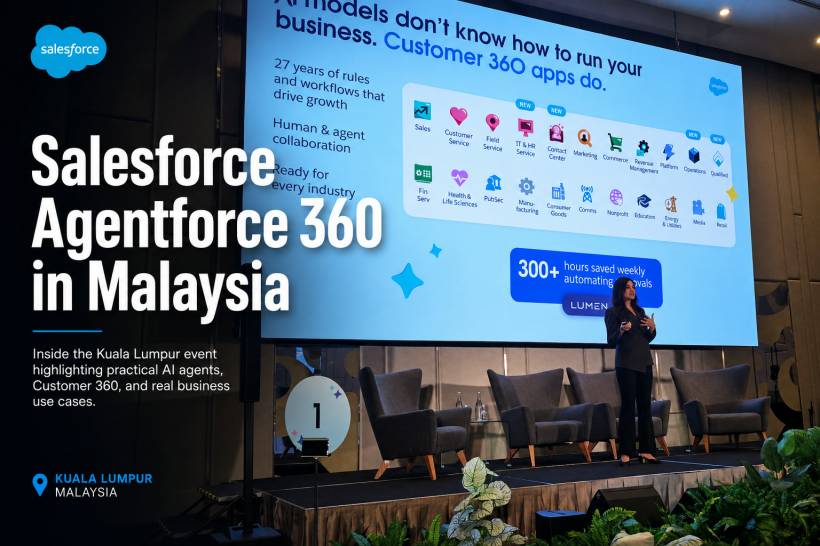
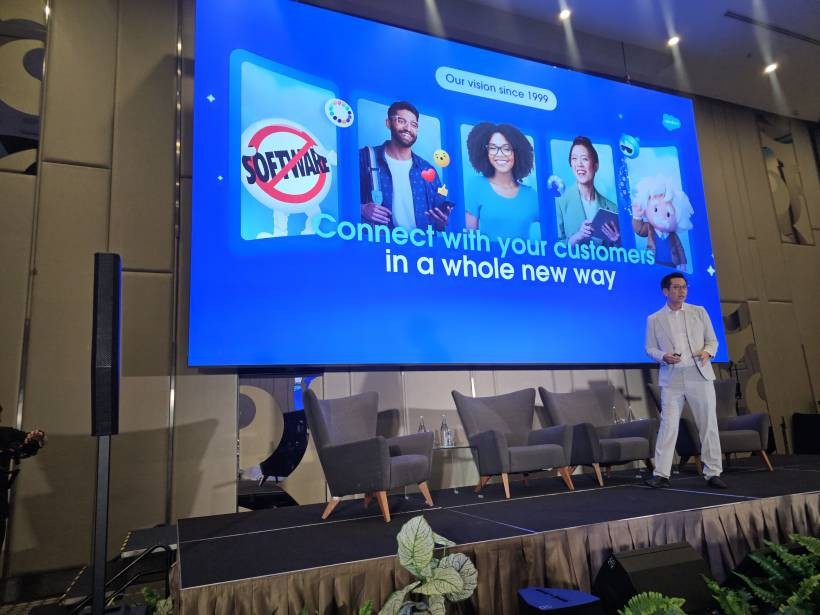
Yesterday, I attended Salesforce's Grow Your Business: Drive Success with Agentforce event at Meridian Hotel in Kuala Lumpur, where the conversation was less about AI hype and more about a question many business leaders are now asking: how can AI actually help a company run better every day?
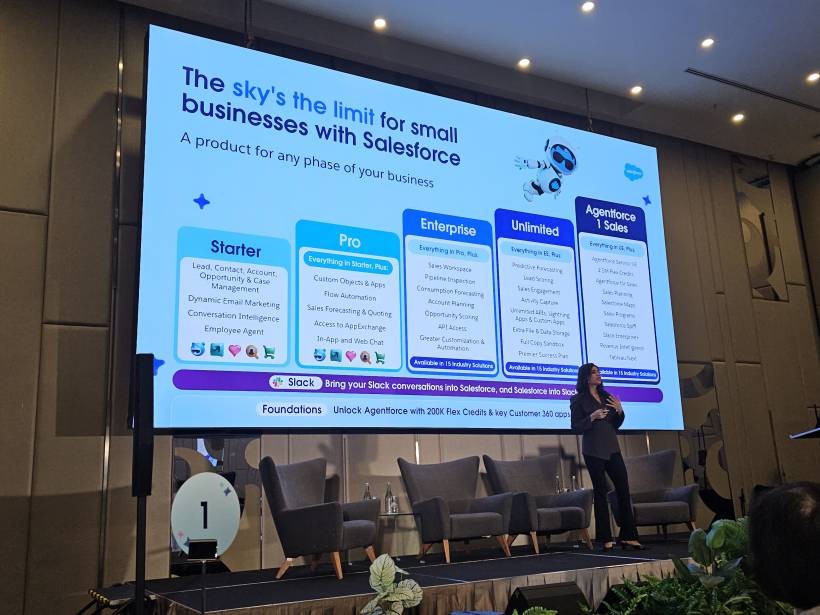
The event was designed for small and medium-sized businesses, with sessions covering the Agentic Enterprise, a live Agentforce 360 demonstration, local customer stories, expert consultations, and networking. Salesforce positioned the event around helping organisations operate more efficiently, improve customer engagement, and find realistic ways to introduce AI agents into business operations.
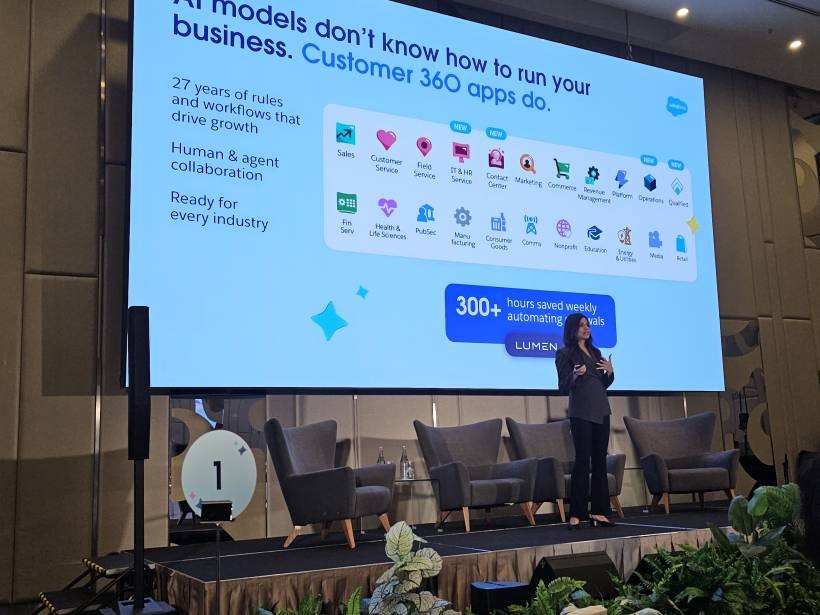
One slide captured the main message particularly well: "AI models don't know how to run your business. Customer 360 apps do."
That is an important distinction.
AI models can write, summarise, answer questions, and generate ideas. But an organisation's real work is usually buried in CRM records, service tickets, sales pipelines, field-service workflows, customer histories, internal approvals, product information, policies, and years of operational rules. Without access to that context, even a capable AI assistant can only offer generic answers.
Agentforce 360 is Salesforce's attempt to bridge that gap.
Rather than treating AI as a separate chatbot sitting beside the business, Agentforce 360 brings together employees, AI agents, customer data, business applications, and workflows on a single platform. Salesforce describes it as a portfolio that combines Customer 360, Data 360, and the underlying platform used to build, manage, govern, and scale AI agents.
More Than a Chatbot
The biggest takeaway from the event was that Agentforce is not meant to be another "ask anything" AI tool.
A conventional chatbot may help answer a simple question such as, "What are your opening hours?" An AI agent, on the other hand, is designed to take a more meaningful role in a defined business process.
For example, an agent could potentially identify a customer, check an order status, review recent service cases, suggest the next action, create a follow-up task, and hand the conversation to a human employee when approval or judgement is required.
That only works when the agent has access to trusted information and well-defined permissions. Salesforce's Agentforce platform is designed to use existing workflows, integrations, and data sources so agents can act across business channels rather than simply generate text.
This is why the phrase "human and agent collaboration" appeared repeatedly during the presentation. The goal is not necessarily to remove people from the process. It is to reduce repetitive admin work, shorten response times, and help employees focus on situations that genuinely need human attention.
The Role of Customer 360 and Data 360
Agentforce 360 becomes easier to understand when broken into three practical layers.
Customer 360 is where many familiar business functions sit, including sales, customer service, marketing, commerce, field service, IT, operations, and industry-specific workflows.
Data 360 acts as the context layer. It is designed to connect fragmented information from CRM systems, websites, internal platforms, external applications, and legacy databases into a more unified customer view. This is crucial because an AI agent is only as useful as the data and business context available to it.
Then there is the underlying Agentforce platform, where organisations can build agents, define their actions, apply controls, set permissions, and establish governance. Salesforce has also highlighted capabilities such as conversational agent building, hybrid reasoning, voice functions, and semantic context for more accurate responses.
In simple terms, the model provides intelligence, but the platform gives that intelligence context, boundaries, and a job to do.
What This Could Look Like for Malaysian Businesses
For Malaysian organisations, the most realistic Agentforce use cases are likely to begin with high-volume, repetitive customer and employee interactions.
A retail or e-commerce business could use an agent to assist with product questions, order tracking, returns, loyalty queries, delivery updates, and simple after-sales support. Instead of customers waiting for a human agent to search across multiple systems, the AI agent could retrieve relevant information and resolve straightforward requests faster.
For businesses with sales teams, an agent could help summarise leads, identify customers who may need follow-up, prepare account briefs before meetings, create CRM updates, and remind teams about opportunities that have not moved forward.
For distributors, manufacturers, maintenance providers, and facilities businesses, Agentforce could support field-service coordination. This may include checking service history, arranging appointments, identifying warranty details, recommending the right technician, or preparing work-order summaries before a staff member arrives on site.
The slide shown during the event referenced a case involving more than 300 hours saved weekly through automating renewals. Whether a business is in telecommunications, SaaS, insurance, education, or professional services, renewals are a strong example of work that can involve repetitive checking, reminders, customer outreach, documentation, and escalation.
Potential Use Cases in Healthcare and Service Industries
Healthcare is another area where agentic AI can assist, although the boundaries must be especially clear.
An AI agent could help handle appointment enquiries, guide patients through registration steps, provide pre-visit reminders, surface insurance-document requirements, route non-clinical enquiries, and reduce administrative workload for front-desk or call-centre teams.
However, patient diagnosis, clinical recommendations, medication advice, and emergency triage should remain under qualified human oversight. In healthcare, the right use of AI is often not replacing clinical judgement, but improving the processes around it.
The same principle applies to banks, insurers, telecommunications providers, and government-linked services. AI agents may be useful for customer support, form completion, status checks, document collection, and internal knowledge search, but high-impact decisions should have strong rules, review processes, and escalation paths.
Malaysia's Data Privacy and Governance Reality
The enthusiasm around AI should always be balanced with governance.
Businesses using customer information need to consider Malaysia's Personal Data Protection Act 2010, which regulates personal-data processing in commercial transactions.
Malaysia's Personal Data Protection Department has also issued guidance on automated decision-making and profiling. The guidance emphasises engaging the Data Protection Officer early and carrying out a Data Protection Impact Assessment when introducing systems that process personal data through automated decision-making approaches.
This means organisations should not rush into connecting every customer database to an AI agent simply because the technology is available.
Before deployment, businesses should be clear about what data the agent can access, what actions it is allowed to perform, when it must escalate to a human employee, how conversations are logged, and how errors can be corrected.
Start Small, Then Scale With Confidence
One of the most practical messages for Malaysian SMEs is that AI transformation does not need to begin with a massive, expensive project.
A better starting point may be one business process that is repetitive, measurable, and frustrating for both employees and customers.
That could be handling common WhatsApp or website enquiries, assigning support tickets, preparing sales follow-ups, managing renewal reminders, helping staff find internal policies, or summarising customer interactions after a call.
The best first use case is usually not the most impressive one. It is the one that saves time, reduces avoidable mistakes, and produces a visible improvement for customers or employees.
Once the organisation has clearer data, stronger workflows, and confidence in its governance model, it can expand Agentforce into more complex areas.
Final Thoughts
The Salesforce event made a convincing case that the future of business AI is not simply about asking a chatbot better questions.
It is about giving AI agents a structured role inside the organisation, supported by customer data, established workflows, proper permissions, and human oversight.
For Malaysian businesses, Agentforce 360 could become particularly valuable in customer service, sales operations, field service, marketing, commerce, and internal support. But success will depend less on how advanced the AI sounds and more on whether the organisation has clean data, clear processes, and responsible controls in place.
The companies that benefit most may not be those that automate everything first. They may be the ones that identify where people are spending too much time on repetitive work, then use AI agents carefully to make that work faster, smarter, and more useful.











Comments 0