

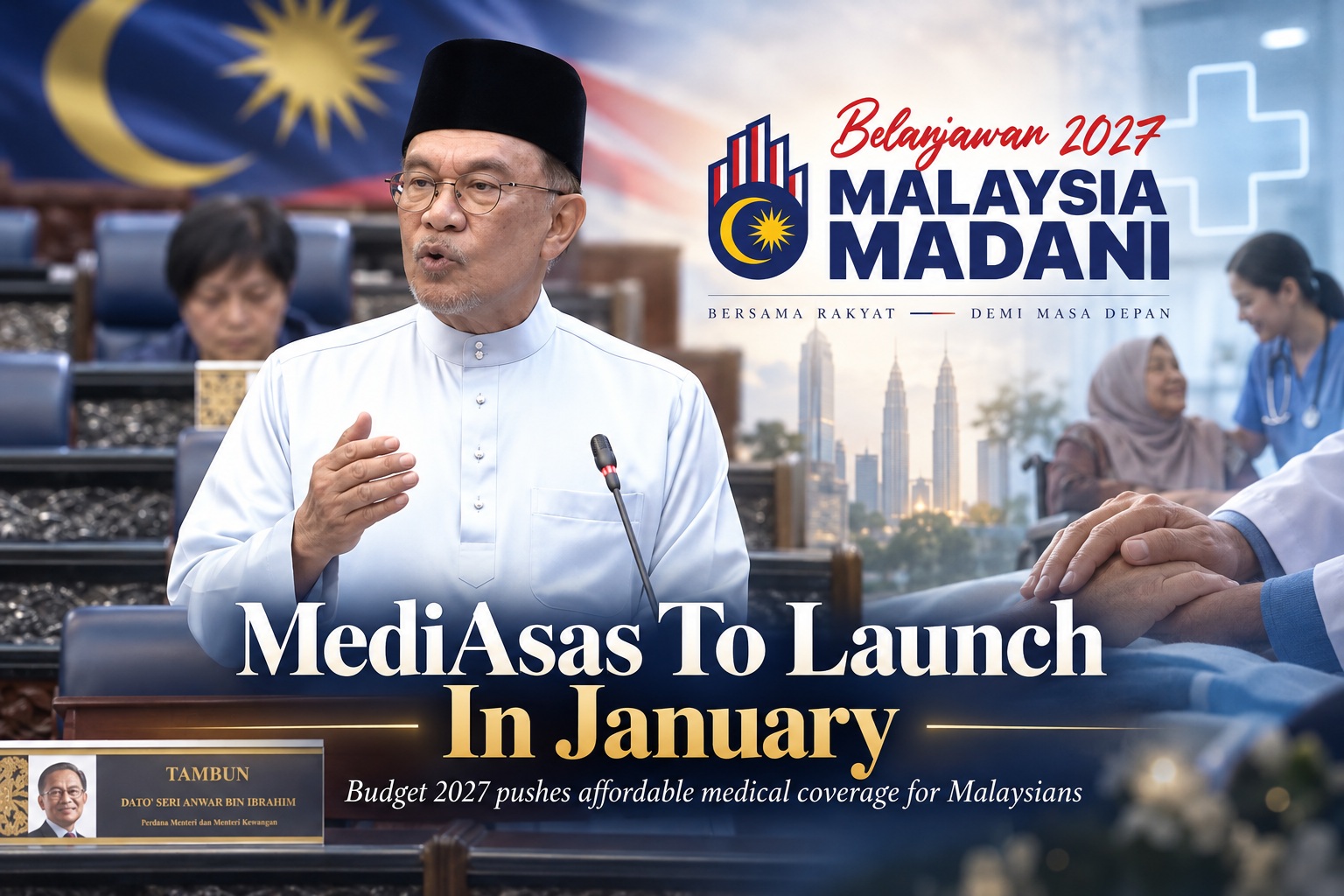
The Malaysian government will roll out its affordable MediAsas medical insurance and takaful plan nationwide in January 2027, Prime Minister Datuk Seri Anwar Ibrahim announced during the tabling of Budget 2027. The initiative is intended to make private medical coverage more affordable while also introducing measures to improve transparency around healthcare costs. Eligible small and medium enterprises, or SMEs, will also receive support to help cover employee premiums.
MediAsas was first introduced as a basic Medical and Health Insurance/Takaful, or MHIT, initiative designed to provide more sustainable medical protection. A pilot programme has already been running in the Klang Valley since the end of July and is scheduled to continue until October 2026. The trial involves six insurance and takaful providers together with selected private hospitals.
EPF Members Can Use Akaun Sejahtera For Premiums
One of the more notable measures announced under Budget 2027 is that EPF members below the age of 55 will be allowed to use savings from their Akaun Sejahtera to pay MediAsas premiums. This gives contributors another option for financing medical coverage without relying entirely on monthly disposable income. The move is intended to make participation more accessible, particularly for individuals who may otherwise find regular insurance premiums difficult to manage.
Allowing Akaun Sejahtera funds to be used for medical protection also expands the role of EPF savings in supporting longer-term personal wellbeing. However, individuals will still need to consider how premium payments affect their remaining retirement-related savings. The option is designed to provide flexibility rather than make EPF withdrawals compulsory.
Government To Subsidise SME Employee Premiums
The government is also introducing a first-year premium subsidy for eligible SMEs. Companies with fewer than 75 employees will receive RM200 per worker towards MediAsas premiums, with the subsidy capped at 50 employees per company. The measure is expected to benefit as many as 200,000 SME workers.
This could help smaller employers offer basic medical coverage without carrying the full cost during the first year. For businesses operating with tighter margins, the subsidy lowers the initial barrier to introducing employee protection. It may also encourage more SMEs to include medical coverage as part of their staff benefits.
Two MediAsas Plans Will Be Offered
MediAsas is expected to be available as a standalone insurance or takaful product with two options: MediAsas Teras and MediAsas Fleksi. The plan is designed to cover individuals up to the age of 85, giving it a relatively broad age range compared with many conventional medical products. This could make it relevant not only to working-age adults but also to older Malaysians seeking basic private medical protection.
Indicative monthly premiums previously ranged from around RM60 to RM550 for individuals enrolling up to age 70. These figures were only preliminary, with final pricing expected to be confirmed before the nationwide launch. Actual premiums may therefore vary depending on the final product structure and the applicant's age.
Pilot Programme Runs Until October 2026
The Klang Valley pilot is an important step before MediAsas moves to a national rollout. By involving multiple insurance and takaful providers as well as selected private hospitals, the government can assess how the plan performs across different parts of the healthcare and insurance ecosystem. This period allows issues involving pricing, coverage, administration and claims processes to be identified before wider implementation.
The pilot also gives policymakers an opportunity to see whether the product meets its objective of providing affordable and sustainable medical protection. Feedback from participating providers and hospitals could influence how the final nationwide version is structured. More detailed terms are therefore likely to become clearer as the January 2027 launch approaches.
Private Hospital Bills To Become Easier To Understand
Budget 2027 also includes measures aimed at improving transparency in private healthcare. Starting in 2027, private hospitals will adopt standardised fee categories when presenting bills to patients. The intention is to make charges easier to understand and compare, especially when patients receive multiple items covering procedures, facilities, professional fees and other services.
Clearer billing categories could help patients better understand what they are being charged for and reduce confusion surrounding treatment costs. This is particularly important as private healthcare expenses become a bigger consideration for households and insurers. Greater transparency may also support more informed decisions when comparing treatment options.
"One Individual, One Record" Medical Records To Expand
The government also plans to expand electronic medical records based on the principle of "one individual, one record". The aim is to improve transparency and continuity across private healthcare services by making patient information more consistently available. A more unified record system could reduce duplication and help healthcare providers understand a patient's previous treatment history more easily.
In the longer term, this could improve coordination between facilities and reduce the risk of fragmented medical information. However, the effectiveness of such a system will depend on how securely information is shared and how consistently healthcare providers adopt the standard. Patient privacy and data protection will therefore remain important considerations as implementation expands.
e-CKAPS To Move Private Healthcare Licensing Online
The government is also developing the e-CKAPS portal to digitise the licensing process for private healthcare facilities. From 2027, licensing is expected to be conducted fully online, reducing the need for manual paperwork and physical processing. Anwar said the move could cut processing times by as much as 65%.
The change is intended to improve administrative efficiency for private healthcare operators while making the licensing process more streamlined. Faster processing could help facilities complete renewals and applications more efficiently, provided the digital system is implemented smoothly. This forms part of the broader effort to modernise how Malaysia manages private healthcare services.
Final Thoughts
The nationwide launch of MediAsas in January 2027 represents a significant expansion of Malaysia's efforts to make basic private medical coverage more accessible. With support for EPF payments, first-year SME subsidies and two planned product options, the scheme is designed to reduce some of the financial barriers that prevent individuals and smaller employers from obtaining medical protection.
At the same time, Budget 2027 is addressing broader issues within private healthcare through standardised billing, expanded electronic medical records and fully digital facility licensing. The real impact will depend on final MediAsas pricing, coverage details and how effectively these wider reforms are implemented, but the overall direction is towards making private healthcare costs clearer, more manageable and easier to access.











Comments 0