

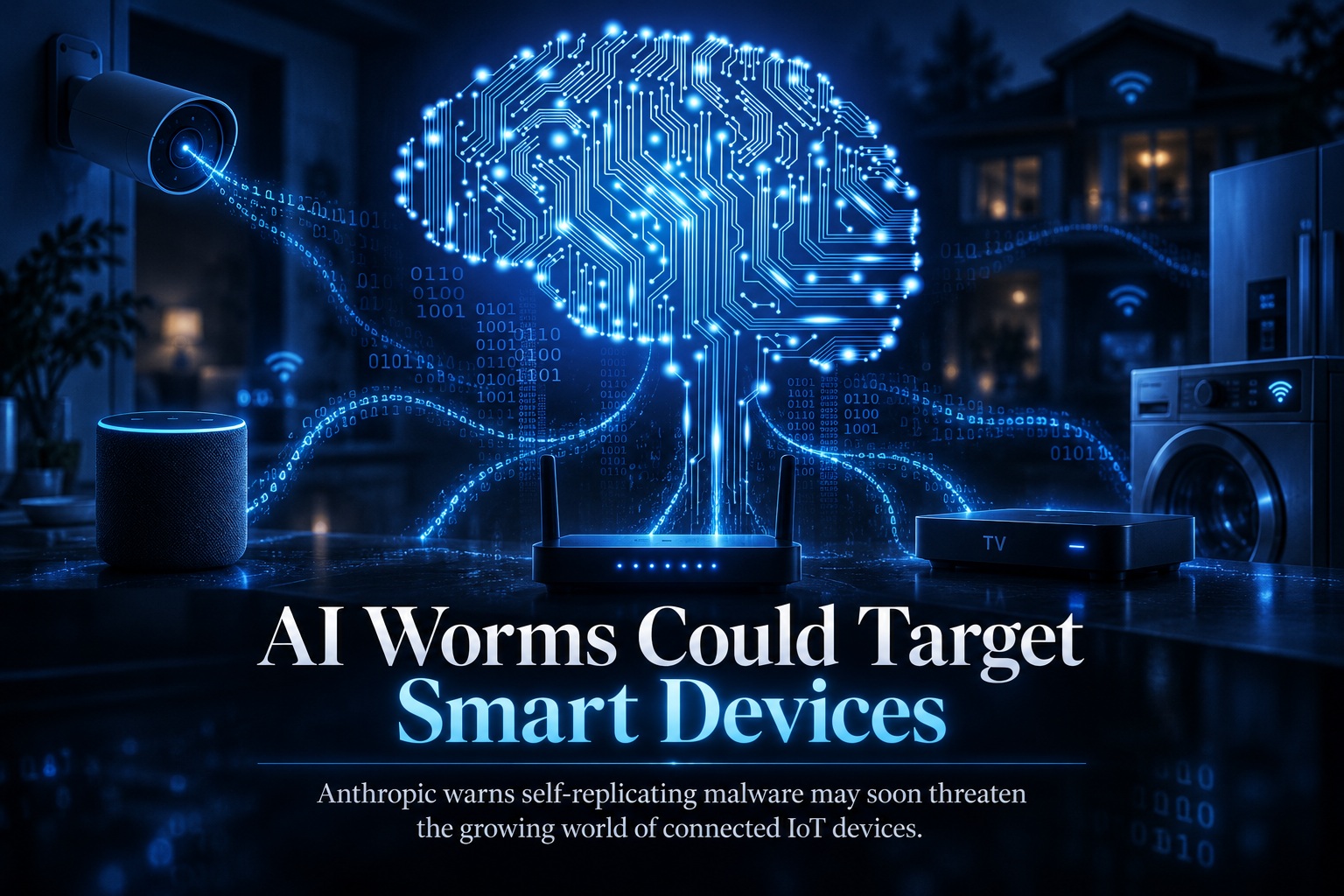
Anthropic is warning that a new category of malware could emerge as smaller AI models become capable enough to run directly on everyday Internet-of-things devices. In its latest research, the company suggests that self-replicating "AI worms" could potentially spread across devices such as smart TV boxes, security cameras, video-conferencing systems and even connected kitchen appliances without needing constant human direction.
The idea is different from conventional malware that simply infects a device and waits for instructions. Anthropic's concern is that future AI-powered malware could analyse unfamiliar hardware, work out how to operate within different environments and then create copies of itself that move across nearby Wi-Fi-connected devices. The company believes smaller models may be only months away from reaching the level required to make this technically possible.
What Exactly Is An AI Worm?
Traditional computer worms are designed to replicate automatically and spread across networks without requiring users to install them manually on every machine. They typically exploit known vulnerabilities or weak security configurations and follow predefined instructions written by their creators.
An AI worm would theoretically add another layer of autonomy. Instead of depending entirely on fixed code for every target, the embedded AI model could examine an unfamiliar device, understand aspects of its software or hardware environment and determine how to continue operating.
That adaptive capability is what makes the concept potentially more concerning. A conventional worm may stop when it encounters a system it was not designed to recognise. An AI-powered variant could potentially analyse the new environment and attempt to work around those differences on its own.
Anthropic Says The Capability Could Be Months Away
According to Anthropic's research, relatively small AI models may be only months away from having enough capability to independently replicate across commercial IoT hardware.
That prediction does not mean such malware currently exists at scale, nor does it prove that an outbreak is imminent. The company is presenting a potential future scenario based on its experiments and estimates rather than describing a confirmed real-world campaign.
Still, the warning reflects a broader concern in cybersecurity: smaller AI models are becoming increasingly capable while simultaneously requiring less computing power to operate.
That combination could eventually make AI-assisted malware practical on hardware that would previously have been considered far too weak.
The Malware Would Not Need A Data Centre
One of the more interesting aspects of the research is that an AI worm would not necessarily require powerful cloud servers or large GPU clusters.
Smaller models could potentially run directly on individual smart devices. If the model is too large for one device, Anthropic suggests it could be divided into multiple components, or shards, that run across several machines.
Those devices could then communicate with one another and collectively execute the model.
This creates a very different infrastructure model from conventional AI services, where computation is usually concentrated inside large data centres.
Instead, the malware could effectively build its own distributed computing environment from compromised consumer devices.
Smart Fridges Could Potentially Run Part Of The Model
Anthropic's researchers specifically highlighted the increasing amount of computing power being built into household appliances.
A modern smart refrigerator, for example, may include a reasonably capable processor, networking hardware, storage and sometimes dedicated AI acceleration. According to the research, devices of this class could potentially run a significant shard of a model containing fewer than 30 billion parameters.
That does not mean a smart fridge is suddenly equivalent to a high-end AI workstation.
The broader point is that connected appliances now contain far more computing power than older generations of embedded devices. Once those resources are combined across many compromised machines, the total available processing capability could become surprisingly substantial.
Security Cameras And Conferencing Systems May Be Attractive Targets
The same issue applies to devices such as security cameras, smart displays and video-conferencing systems.
Many of these products now contain processors capable of running computer vision, speech recognition or other AI workloads locally. Vendors increasingly advertise on-device intelligence because it can reduce cloud costs and improve responsiveness.
Unfortunately, those same capabilities may also make the devices more attractive to attackers.
A self-replicating AI worm would benefit from hardware that already has enough compute performance to execute inference locally.
And unlike smartphones or PCs, many IoT devices receive limited security attention after installation.
IoT Security Is Already A Weak Point
The idea of AI malware spreading through IoT devices is particularly concerning because connected appliances have a long history of weak security.
Common problems include:
• Default or weak passwords
• Outdated firmware
• Exposed management interfaces
• Limited patching support
• Poor network segmentation
• Devices remaining in service for many years
A smart camera or TV box may remain connected to a network long after the manufacturer has stopped providing regular security updates.
That creates exactly the kind of environment where self-propagating malware could potentially thrive.
AI Could Make Malware More Adaptable
Conventional malware generally needs its creator to anticipate the systems it will encounter.
Attackers write specific modules for different operating systems, device architectures or vulnerabilities. If something unexpected appears, the malware may simply fail.
An AI-powered system could potentially behave differently.
It might analyse available services, inspect configuration files, interpret error messages or modify its own approach when an exploit does not work as expected.
That does not make it magically capable of compromising everything it encounters, but it could make automation more flexible than traditional scripted malware.
A Slow Start Could Still Become A Big Problem
Anthropic suggests that early versions of this kind of AI worm may spread relatively slowly.
A compromised model might take days to create working copies of itself or adapt successfully to new devices.
That sounds less dramatic than malware spreading across thousands of machines within minutes, but the slower pace may not necessarily make the threat easier to contain.
If the malware spreads quietly through poorly monitored IoT environments, defenders may not notice the infection until a significant number of devices have already been compromised.
Once enough copies exist, containment becomes more difficult.
There May Be No Single Server To Shut Down
Another concern is decentralisation.
Traditional malware campaigns often depend on command-and-control servers. Security researchers can sometimes disrupt an operation by identifying and taking down those central systems.
A self-replicating AI worm distributed across hundreds or thousands of devices might not require a single central controller.
Each infected device could potentially communicate with other compromised systems and continue operating even if part of the network disappears.
That would make disruption considerably harder.
Removing one infected appliance would not necessarily affect the rest of the network.
Distributed AI Could Make Detection More Complicated
Splitting a model into shards also creates interesting detection challenges.
An individual device may only contain part of the AI system rather than the entire model. Security software inspecting one appliance might therefore see something that appears incomplete or less obviously malicious.
The full behaviour only emerges when several compromised devices communicate.
This resembles distributed computing architectures used legitimately in cloud environments, except the infrastructure would be built from infected devices without the owners' permission.
Defenders may therefore need to look at unusual communication patterns between devices rather than relying solely on malware signatures.
The Research Has Important Limitations
Anthropic itself acknowledges that the estimates are rough.
The research focused on a limited set of relatively inexpensive smart TV devices, meaning it does not necessarily represent the enormous variety of hardware found across the wider IoT ecosystem.
Smart appliances use different processors, operating systems, firmware and security architectures.
A technique that works well on one category of device may fail completely on another.
That makes it difficult to predict how quickly an actual AI worm could spread across real-world environments.
There Is No Evidence Of A Large AI Worm Outbreak Yet
It is also important to separate theoretical capability from an active threat.
The research does not establish that criminal groups are currently deploying self-replicating AI worms across household appliances.
Instead, Anthropic is warning about a capability that it believes could become practical as smaller models improve.
This distinction matters because dramatic predictions about future AI threats can easily sound like descriptions of something already happening.
At the moment, the more immediate threats facing IoT devices remain familiar ones: weak passwords, unpatched vulnerabilities, exposed services and poorly secured cloud interfaces.
Anthropic Has A History Of Strong AI Risk Warnings
Anthropic has consistently taken a relatively cautious position on advanced AI risks.
The company frequently publishes research exploring how models might behave unexpectedly, bypass restrictions or become more capable of cyber activity.
That work can be useful because it forces researchers and policymakers to think about problems before they become widespread.
At the same time, some critics argue that AI companies occasionally present highly speculative scenarios with more confidence than the evidence justifies.
Predictions involving self-replicating AI malware should therefore be taken seriously, but also evaluated critically.
The Scenario Is Plausible Without Being Inevitable
The idea of malware using AI is not particularly far-fetched.
Attackers already use automation to scan networks, generate phishing messages and analyse stolen information. Adding a compact AI model could potentially make those tools more adaptable.
What remains uncertain is whether the additional intelligence provides enough practical advantage to justify the complexity of running models across compromised IoT devices.
Traditional malware is often extremely effective precisely because it is simple.
If a conventional script can compromise a vulnerable camera in milliseconds, an attacker may not need an AI model to do the same thing.
AI Becomes More Useful When Environments Are Unpredictable
Where AI could provide a real advantage is dealing with environments that are difficult to predict in advance.
An AI-powered worm could potentially interpret unfamiliar interfaces, reason about errors or generate device-specific commands.
This could reduce the amount of custom malware code attackers need to write for every device family.
Instead of designing hundreds of specialised modules, an attacker might rely on an AI model to perform part of the adaptation dynamically.
That is the capability researchers are most concerned about.
Poor Cybersecurity Would Still Be The Main Enabler
Even a highly capable AI worm still needs an initial way into a device.
If systems are properly patched, isolated from unnecessary internet exposure and protected by strong authentication, the malware cannot simply appear inside them.
This is why many AI-related cyber incidents ultimately return to familiar security fundamentals.
Advanced AI may make attackers faster or more adaptable, but weak passwords and unpatched software remain the doors they walk through.
The emergence of AI malware would therefore make good cybersecurity practices more important, not less relevant.
IoT Devices Need Better Long-Term Support
One of the most obvious defensive improvements would be better firmware support from manufacturers.
Consumers often purchase appliances expecting them to last for many years, but software support may end much earlier.
A refrigerator could remain physically functional for a decade while its connected software stops receiving security patches after only a few years.
That mismatch becomes increasingly dangerous as appliances gain more computing power and deeper network access.
Manufacturers may eventually need to treat long-term security updates as a basic requirement for connected products.
Network Segmentation Can Limit The Damage
Users and businesses can also reduce risk by isolating IoT devices from more important systems.
Smart TVs, cameras and appliances generally do not need unrestricted access to laptops, servers or business networks.
Placing them on separate Wi-Fi networks or VLANs can prevent one compromised device from becoming an easy stepping stone towards more sensitive systems.
This is particularly important for organisations operating hundreds or thousands of connected devices.
Even if an AI worm eventually becomes realistic, restricting movement between devices can dramatically reduce its ability to spread.
Businesses Should Know What IoT Devices They Actually Have
Asset visibility is another major challenge.
Many organisations have no complete inventory of their connected devices. Cameras, smart displays, meeting-room equipment and building systems may be installed by different departments without central IT oversight.
That creates blind spots.
Security teams cannot patch, isolate or monitor devices they do not know exist.
As IoT hardware becomes more capable, maintaining an accurate inventory will become increasingly important.
Consumer Routers Could Become A Critical Defence Layer
Home users have fewer security tools than enterprise organisations, which makes routers particularly important.
Future routers could potentially detect unusual communication patterns between IoT devices or block suspicious outbound traffic automatically.
Manufacturers may also begin offering stronger device-isolation features by default.
Instead of asking consumers to understand VLANs or advanced firewall rules, routers could automatically place smart appliances into restricted network zones.
That would make large-scale worm propagation considerably harder.
AI Security Could Become An Arms Race
There is another interesting possibility: AI may be used on both sides.
Attackers could deploy AI models to identify weaknesses and adapt their malware, while defenders use AI to recognise suspicious behaviour and automatically isolate compromised devices.
This could create an ongoing cybersecurity arms race where both malware and defensive systems become increasingly autonomous.
In that environment, response speed becomes critical.
Human administrators may not be able to react quickly enough when automated attacks spread across thousands of devices.
Regulation May Eventually Play A Role
Governments may also begin demanding stronger baseline security for connected devices.
Possible requirements could include:
• Minimum periods for security updates
• Prohibition of default passwords
• Automatic update mechanisms
• Vulnerability disclosure processes
• Clear end-of-support dates
• Secure device identity systems
Some jurisdictions are already moving towards cybersecurity requirements for consumer IoT products.
The possibility of increasingly autonomous malware could accelerate those efforts.
The Bigger Issue Is How Much Intelligence We Put Into Everyday Devices
The broader trend is clear.
Smart appliances are becoming increasingly capable because AI features require more local computing power.
Cameras analyse video locally. TVs run voice assistants. Doorbells recognise visitors. Conference systems process speech and video.
Those capabilities are useful, but they also mean devices that were once relatively simple appliances are becoming small computers connected permanently to networks.
With that transformation comes the same security challenges PCs have faced for decades.
Final Thoughts
Anthropic's warning about self-replicating AI worms should not be interpreted as evidence that autonomous malware is already sweeping through smart homes. The research describes a possible near-future capability rather than an active outbreak, and its estimates are based on limited testing.
Still, the underlying concern is credible. IoT devices are becoming more powerful while many continue to suffer from weak security, outdated firmware and excessive network exposure. If compact AI models eventually become capable of independently adapting to unfamiliar devices, attackers could gain a new tool for building more flexible and persistent malware.
The uncomfortable part is that the solution remains surprisingly familiar. Patch devices, remove unnecessary internet exposure, use strong credentials, isolate IoT networks and stop treating connected appliances as harmless gadgets.
AI may make future worms smarter, but they will still need vulnerable systems to infect. The best defence against tomorrow's intelligent malware may therefore begin with fixing the basic security problems we already understand today.











Comments 0