

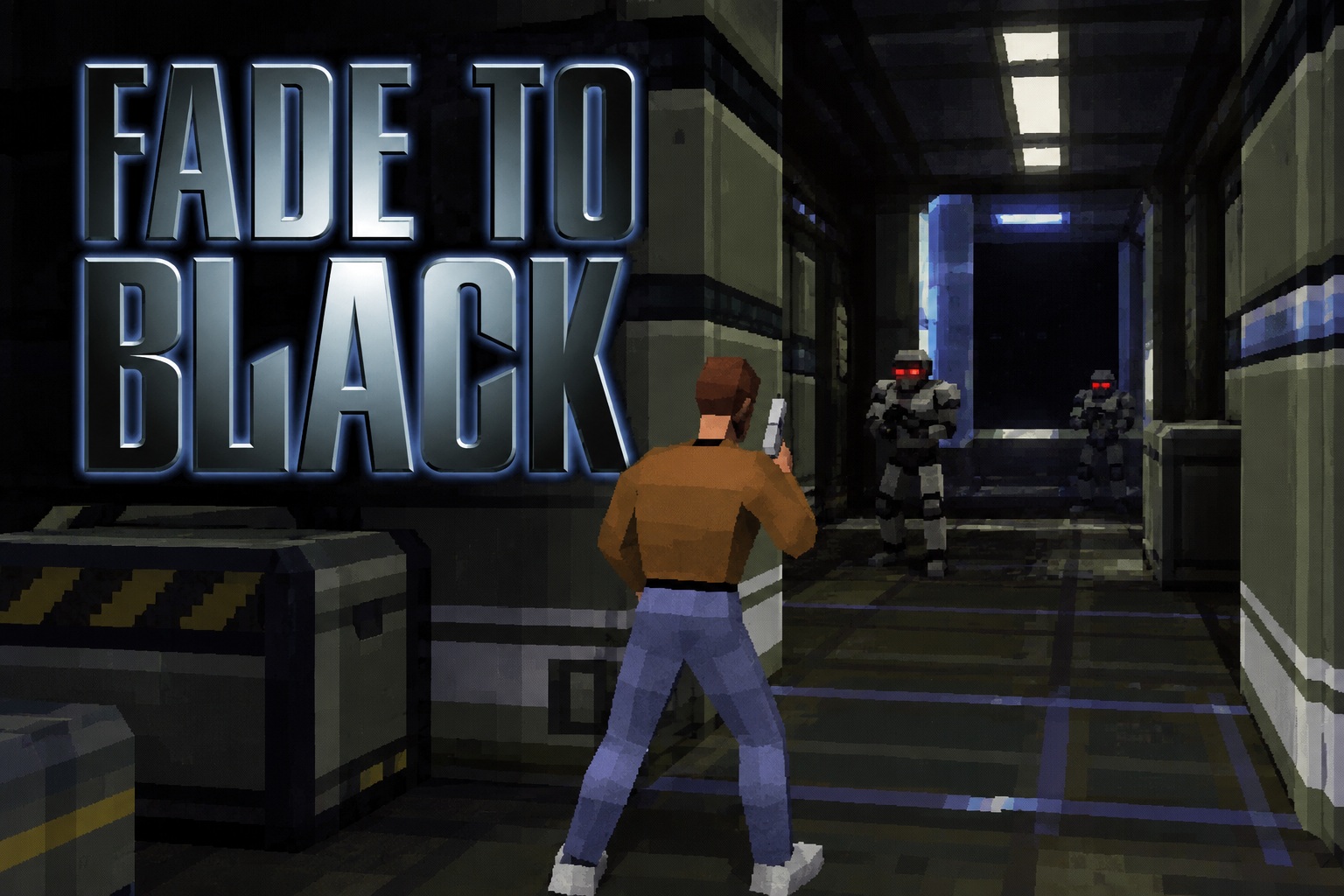
Fade to Black is a 1995 science-fiction action-adventure developed by Delphine Software and published by Electronic Arts, continuing the story of Conrad B. Hart after the events of Flashback: The Quest for Identity. Instead of returning safely to normal life, Conrad awakens from cryogenic sleep to discover that his old enemies, the Morphs, have captured him. He begins the game imprisoned inside a hostile facility and must escape before becoming involved in an even larger conflict threatening humanity. What follows is a journey through prisons, laboratories, alien installations, underground complexes, and other dangerous locations filled with Morph soldiers, strange creatures, traps, puzzles, and security systems.
The biggest change from Flashback is immediately obvious: Fade to Black abandons the cinematic 2D side-scrolling presentation of its predecessor and moves into a fully polygonal 3D world. Conrad is viewed from behind while computer-controlled cameras change perspective depending on his location, giving the game a cinematic style reminiscent of other early 3D adventures of the period. Exploration, combat, switches, scanners, environmental hazards, and puzzles all take place inside these three-dimensional environments. For players who experienced Flashback first, the transition feels dramatic, but many familiar ideas remain underneath the new technology.
Now playable online through Lemon Web Games, Fade to Black brings Conrad's fully 3D adventure, third-person gun combat, environmental puzzles, Morph enemies, exploration, and science-fiction story directly into the web browser. Players must escape captivity, search unfamiliar installations, manage weapons and ammunition, activate machinery, investigate rooms, and gradually uncover the larger threat surrounding the Morph invasion. The controls and camera system reflect the experimental nature of early 3D game design, making careful movement and positioning especially important. For fans of Flashback or players interested in the evolution of cinematic action games, Fade to Black remains a fascinating example of developers pushing DOS hardware into a new three-dimensional era.
The Story Continues After Flashback
Fade to Black directly continues Conrad B. Hart's battle against the Morphs. At the end of Flashback, Conrad appeared to have survived the immediate alien threat, but his problems were far from over. While travelling in cryogenic suspension, events changed dramatically around him.
When Conrad finally awakens, he is already a prisoner. The Morphs have returned, humanity is once again in danger, and escape becomes the first priority. Rather than spending time slowly introducing the threat, the game begins with Conrad already surrounded by enemies.
This immediate connection gives longtime players a reason to care about the situation from the opening minutes. Conrad is not discovering the Morphs for the first time. He understands how dangerous they are, and the player quickly realizes that their influence has grown substantially since Flashback.
Conrad B. Hart Returns as the Main Character
Conrad remains the central protagonist, although his abilities are adapted to the new 3D environment. He can move through corridors and rooms, crouch, aim weapons, fire at enemies, interact with objects, and investigate the installations around him.
Unlike Flashback, however, Fade to Black does not offer the same extensive platforming movement. Conrad cannot freely climb ledges or jump across gaps in the way players might expect from the earlier game. The focus has shifted much more strongly toward exploration, shooting, and puzzle solving.
This change gives Fade to Black a slower and more deliberate rhythm. Players spend more time checking corners, positioning Conrad before opening doors, and determining what a control panel or security device actually does before continuing.
The Morphs Remain the Primary Threat
The Morphs are once again Conrad's most dangerous enemies. Their ability to disguise themselves and manipulate appearances gives them an unsettling presence throughout the game.
Some encounters are straightforward firefights, while others create uncertainty about who or what can be trusted. The science-fiction setting allows enemies to appear in different forms and inhabit a wide variety of environments.
Because Conrad is often fighting inside enclosed rooms and corridors, even a small number of Morph enemies can become dangerous. Limited space makes positioning important, especially when several attackers begin firing simultaneously.
The Ancients Expand the Flashback Universe
Fade to Black introduces the mysterious Ancients, adding a new dimension to the conflict established in Flashback. Conrad must gradually learn more about them and earn their trust while attempting to understand the larger struggle surrounding the Morph invasion.
Their presence makes the story feel broader than a simple escape mission. What begins inside a prison eventually becomes connected to ancient technology, powerful artifacts, and events extending beyond Conrad's personal survival.
The mysterious Pyramid also plays an important role in this expanded mythology. These elements move the sequel into a larger science-fiction narrative and give the adventure more scope than simply defeating another group of Morph soldiers.
A Major Transition From 2D to Fully Polygonal 3D
Fade to Black represented an ambitious technical change for Delphine Software. Flashback had become famous for its beautifully animated 2D characters and cinematic side-view environments, but the sequel was constructed entirely from polygons.
Characters, rooms, corridors, machinery, and objects are presented in 3D. Players can move around spaces rather than travelling only left and right, fundamentally changing how exploration works.
For 1995, this was a significant shift. Developers across the industry were experimenting with how games should control and present themselves in 3D, and Fade to Black is a clear product of that transitional period.
The Camera Creates a Cinematic Perspective
The game usually follows Conrad from behind, but the camera can change position according to the area he enters. Some rooms provide broader views, while narrow corridors naturally create tighter perspectives.
These automatic camera changes allow environments to be presented dramatically. Entering a new section can reveal machinery, enemies, or architecture from an angle chosen specifically for the scene.
The system can require adjustment because the perspective occasionally changes while the player is moving. Understanding how Conrad responds after those transitions is part of mastering the game. It reflects an era before modern third-person camera conventions had become standardized.
Combat Focuses on Careful Positioning
Fade to Black contains plenty of shooting, but combat generally works best when approached cautiously. Running directly into a room can expose Conrad to several enemies before the player understands where attacks are coming from.
Using doorways, walls, corners, and available cover helps reduce the number of enemies that can attack at once. Crouching can also help Conrad respond to incoming fire and make certain encounters easier to control.
The slower movement means preparation matters. Entering a dangerous area with the weapon already ready can be much safer than reacting only after enemies begin shooting.
Different Weapons Provide Tactical Options
Conrad gains access to multiple weapons during the adventure rather than relying on a single firearm throughout the game. These include conventional energy-based and projectile weapons as well as specialized equipment useful in particular situations.
Different ammunition types and weapon upgrades give combat additional variety. Stronger equipment becomes especially valuable against tougher Morph soldiers and dangerous creatures encountered later in the game.
Players therefore need to pay attention to supplies rather than firing carelessly at every opportunity. Entering a difficult area without enough ammunition can make an already challenging encounter significantly harder.
Explosive Mines Can Be Used Strategically
Mines provide another way to deal with enemies without confronting them directly. They can be placed in areas where approaching enemies are likely to trigger them, allowing Conrad to prepare an ambush.
This is particularly useful when the environment creates narrow routes or predictable approaches. Instead of trading fire in an exposed position, the player can use the layout itself as part of the strategy.
The system adds variety to combat and reinforces the importance of equipment management. A mine saved earlier may become extremely useful when facing a more dangerous group later.
The Reconnaissance Droid Adds Another Tool
Fade to Black also provides a remote reconnaissance droid that can help Conrad investigate hazardous areas. Using it allows the player to gather information without immediately exposing Conrad himself.
This becomes valuable when approaching unfamiliar rooms or dangerous mechanisms. Knowing what lies ahead can prevent unnecessary damage or reveal how a puzzle is structured.
The droid contributes to the game's science-fiction atmosphere while also supporting its slower, more methodical style. Information can be just as useful as additional firepower.
Scanners Help Conrad Understand His Environment
Information devices and scanners appear throughout the adventure, helping Conrad identify objects, systems, and clues. These tools encourage players to investigate areas instead of treating every room purely as another combat arena.
A strange machine may contain information required to proceed, while another device may reveal details about the surrounding installation. Exploring carefully often prevents later confusion.
This reinforces the adventure side of Fade to Black. Although gunfire is frequent, the game expects players to observe and understand their surroundings rather than simply eliminating everything and moving forward.
Environmental Puzzles Interrupt the Gunfights
Progress frequently requires more than defeating enemies. Conrad encounters locked doors, security mechanisms, switches, computer terminals, traps, and other environmental problems that need to be solved before the next section opens.
Some puzzles involve finding the correct controls, while others depend on understanding how different devices interact. Exploring every accessible room is often necessary because the solution may not be located beside the obstacle itself.
These sections slow the pace and encourage investigation. The combination of combat and puzzles keeps Fade to Black from becoming a straightforward third-person shooter.
Security Systems Can Be Just as Dangerous as Enemies
Hostile installations contain more than armed guards. Automated security devices, traps, locked areas, and environmental hazards can injure or kill Conrad if approached carelessly.
The player therefore needs to pay attention even after nearby enemies have been eliminated. A quiet corridor is not automatically a safe corridor.
This adds tension to exploration. Moving slowly and checking the surroundings can prevent a sudden death caused by something that was never an ordinary combat encounter.
The Game Uses Thirteen Major Levels
Fade to Black is structured across thirteen major levels with numerous connected areas and sub-sections. Each environment gradually moves Conrad deeper into the story while introducing different enemies, puzzles, and technological settings.
The adventure spans more than the opening prison complex. Conrad eventually travels through laboratories, alien structures, space-based installations, and other environments linked to the wider conflict.
This variety keeps the campaign from feeling like one enormous corridor. Although many areas share the industrial science-fiction aesthetic, their objectives and hazards continue changing.
New Alcatraz Sets the Tone
The opening prison area immediately establishes how different Fade to Black feels from Flashback. Conrad awakens inside confinement and must begin exploring the surrounding facility while avoiding or eliminating guards.
The narrow corridors teach the player how the camera, aiming, crouching, and interaction systems work. Doors, terminals, hazards, and weapons are introduced naturally as part of the escape.
Starting in captivity also gives the game an immediate sense of vulnerability. Conrad does not begin as an unstoppable hero. He needs to gather equipment and create opportunities before he can properly fight back.
Exploration Rewards Thorough Players
Many locations contain supplies, information, ammunition, health items, or useful equipment that can easily be missed by players rushing directly toward the next objective.
Checking side rooms therefore becomes worthwhile. A small detour may provide the ammunition or medical support needed to survive a later battle.
The game's environments are relatively compact compared with modern 3D worlds, but they still encourage curiosity. Players who investigate thoroughly generally enter difficult sections better prepared.
Health Management Matters
Conrad cannot absorb unlimited punishment. Firefights and traps gradually reduce his health, making medical or energy restoration resources valuable.
Avoiding unnecessary damage is therefore just as important as finding healing supplies. A careless encounter early in a level can create problems much later if the player fails to recover.
This encourages cautious combat. Taking time to position Conrad safely can preserve far more health than charging into a room and attempting to overpower everything through firepower alone.
Saving Progress Is Important
Fade to Black can be unforgiving, particularly when traps, enemies, or environmental hazards appear unexpectedly. Saving progress regularly prevents a single mistake from erasing a large amount of exploration.
Players learning an unfamiliar area should especially consider preserving progress before entering suspicious rooms or activating unknown mechanisms. Experimentation becomes less frustrating when failure does not require repeating an entire section.
This approach also suits the puzzle-heavy structure. Players can test different solutions without permanently committing themselves to a dangerous mistake.
The Sound Design Builds a Dark Atmosphere
Fade to Black uses music, voice work, weapon sounds, alarms, machinery, and environmental effects to reinforce its science-fiction setting. The audio presentation is considerably more elaborate than what many earlier DOS games could provide.
Dialogue helps establish character relationships and expands the story beyond text alone. Music shifts with the action and environment, supporting both exploration and combat.
The result is a darker and more cinematic atmosphere than Flashback. Conrad's journey feels less like a colourful science-fiction adventure and more like survival inside hostile technological environments.
Full-Motion Sequences Strengthen the Cinematic Style
Computer-generated sequences appear between important events, continuing Delphine Software's interest in cinematic presentation. These scenes provide transitions that would have been difficult to communicate entirely through normal gameplay.
For a 1995 DOS title, the combination of polygonal gameplay, voice acting, scripted cameras, and rendered sequences was ambitious. The game clearly wanted to present itself as more than a conventional action title.
This emphasis on presentation connects Fade to Black directly with Delphine's earlier work. The technology changed dramatically, but the studio's interest in cinematic storytelling remained.
The Controls Reflect Early 3D Design
Modern players may need some time to adjust to Fade to Black because its controls were designed before third-person movement conventions became widely standardized. Turning, aiming, crouching, and navigating around objects can feel more deliberate than in later action games.
The fixed and semi-automatic camera system also affects movement. A direction that feels natural from one angle may require adjustment when the perspective changes.
Once understood, the controls become easier to manage, but patience is important. The game is best approached as a mid-1990s 3D adventure rather than judged entirely by modern shooter standards.
Fade to Black Was Ambitious for DOS Hardware
Running fully polygonal environments, character models, dynamic camera positions, digital audio, and cinematic sequences on mid-1990s PCs required considerably more hardware than traditional DOS adventures.
Fade to Black was designed for comparatively powerful systems of its era, including 486-class processors and CD-ROM drives. The additional processing power allowed Delphine to create environments that would have been impossible using Flashback's original technology.
This technical ambition makes the game historically interesting. It arrived during the brief period when DOS was still important while fully 3D gaming was rapidly becoming the industry's future.
Its Relationship With Flashback Remains Fascinating
Fade to Black is unmistakably connected to Flashback through Conrad, the Morphs, the broader storyline, and Delphine Software's cinematic approach. Mechanically, however, the two games are dramatically different.
Flashback emphasizes precise platforming, climbing, running, jumping, and cinematic 2D animation. Fade to Black replaces most of those systems with three-dimensional exploration, gun combat, puzzles, and environmental interaction.
This makes the sequel particularly interesting even for players who prefer the original. Rather than creating a straightforward continuation using the same technology, Delphine attempted to reinvent the series around the emerging possibilities of 3D.
Playing Fade to Black Online Today
Through Lemon Web Games, Fade to Black can now be played directly in your web browser with no downloads or setup required. Features of the web-based version include:
New players should approach combat carefully rather than treating Fade to Black like a fast modern third-person shooter. Check rooms before moving deeply into them, use available cover, and conserve ammunition whenever weaker enemies can be handled efficiently.
It is equally important to investigate the environment. Terminals, scanners, switches, side rooms, and unusual devices often contain the information or resources required to progress. Taking time to understand a location usually makes both the puzzles and the combat much easier.
Who Should Play Fade to Black
Fade to Black is especially worthwhile for players interested in how game design changed during the transition from 2D to 3D. Many modern conventions did not yet exist, so Delphine had to experiment with cameras, controls, aiming, exploration, and environmental interaction.
It should also appeal to Flashback fans willing to accept a very different style of sequel. Conrad and the Morphs remain familiar, but the way players interact with the world has been completely transformed.
Play Fade to Black Online Now
Fade to Black takes Conrad B. Hart out of the beautifully animated 2D world of Flashback and places him inside a dark, fully polygonal science-fiction adventure. Escape from Morph captivity, search hostile installations, collect weapons and equipment, solve environmental puzzles, avoid traps, investigate mysterious technology, and uncover the role of the Ancients in the expanding conflict.
Through Lemon Web Games, players can experience this ambitious 1995 DOS adventure directly in a modern browser. Its early 3D controls and camera system may require adjustment, but they are also part of what makes the game such an interesting snapshot of a rapidly changing period in PC gaming.
Final Thoughts
Fade to Black is fascinating because it represents both a continuation and a reinvention. The characters, Morph threat, science-fiction setting, and cinematic ambitions clearly connect it to Flashback, yet almost every major gameplay system has been rebuilt around three-dimensional technology. Delphine Software was not simply producing another side-scrolling sequel; it was attempting to imagine how Conrad's adventures might work in the emerging world of polygonal gaming.
The result combines third-person shooting, exploration, puzzles, security systems, equipment management, fixed-camera presentation, and cinematic storytelling into an experience that feels unmistakably rooted in 1995. Some of its design can feel unfamiliar by modern standards, but that is precisely what makes it interesting. Players are experiencing developers discovering solutions to problems that later games would spend years refining.
Through Lemon Web Games, Fade to Black can now be revisited directly in the browser as an important piece of DOS and early 3D history. Its dark atmosphere, ambitious technology, expanding Flashback storyline, and mixture of action and adventure still give it a distinctive identity. For anyone interested in Conrad B. Hart, Delphine Software, or the moment when PC games began moving decisively from 2D worlds into full 3D environments, Fade to Black remains well worth exploring.











Comments 0