

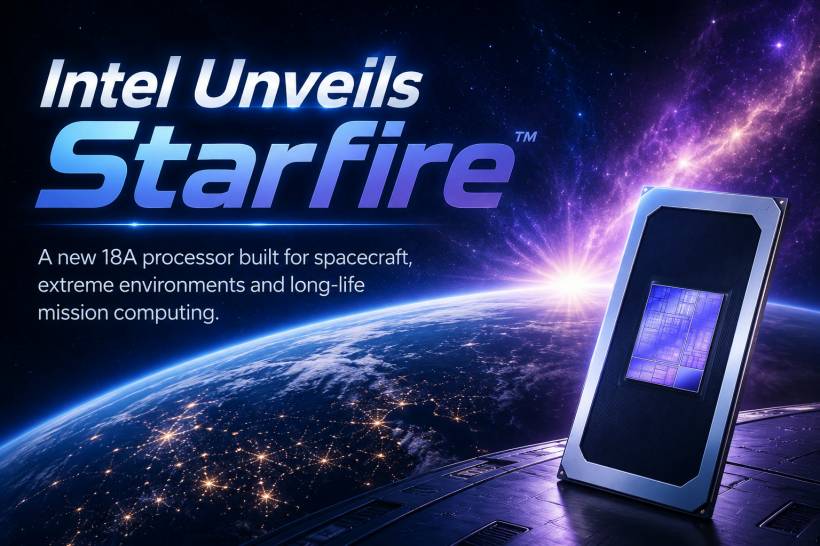
Intel is taking its processor ambitions far beyond laptops, desktops and data centres with the introduction of Starfire, a new chip platform designed specifically for spacecraft and other systems operating in exceptionally harsh conditions.
Unlike a conventional consumer processor, Starfire is being developed around the requirements of long-duration missions where reliability, compact size, low weight and resistance to extreme temperatures matter far more than achieving the highest possible benchmark score.
The processor also shows how Intel intends to apply its latest 18A manufacturing technology beyond mainstream computing, bringing modern CPU, graphics and AI capabilities into an area traditionally dominated by highly specialised aerospace hardware.
A Processor Designed for Life Beyond Earth
Computers used in spacecraft must operate under conditions that would be completely unsuitable for an ordinary laptop or desktop processor.
A space-qualified system may need to withstand dramatic temperature changes, limited electrical power, difficult maintenance conditions and years of continuous operation. Once a spacecraft is deployed, replacing a failed processor is usually impossible.
Starfire is therefore being designed around what Intel describes as space-grade survivability. Its relatively compact size and low weight could also be valuable for spacecraft designers, since every component added to a launch vehicle contributes to overall mass, power consumption and thermal management requirements.
The processor is not necessarily intended only for deep-space missions. Similar hardware could potentially be used in satellites, orbital platforms, scientific instruments and other specialised systems operating in demanding environments.
Built Using Intel's 18A Manufacturing Process
Starfire is based on Intel's 18A process technology.
The same manufacturing generation is also being used across newer Intel product families, including Panther Lake and Wildcat Lake processors, as well as the Arc G3 Extreme graphics platform intended for gaming handhelds.
Using 18A gives Intel an opportunity to bring newer-generation performance and power-efficiency improvements into aerospace computing rather than relying entirely on older chip designs.
That said, space processors are evaluated differently from consumer products. A newer manufacturing process may improve efficiency and transistor density, but mission operators will also be concerned with long-term reliability, environmental tolerance and predictable operation over many years.
Two Versions Target Different Power Requirements
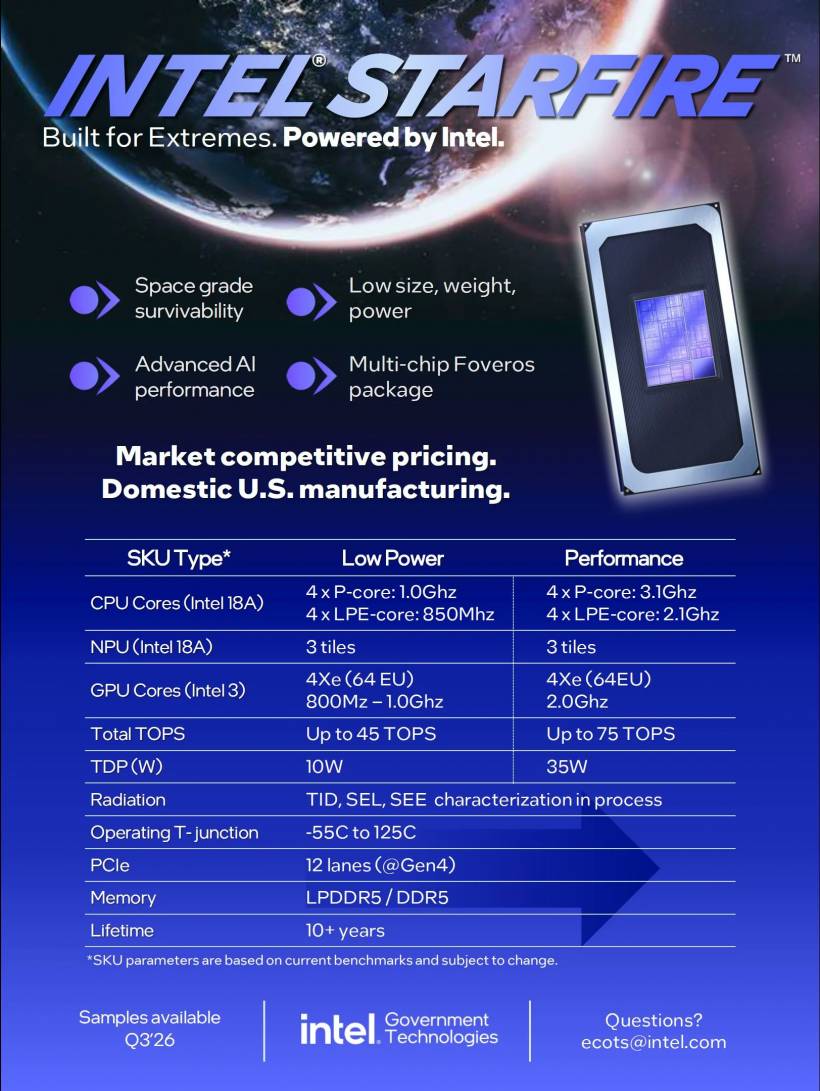
Intel is preparing Starfire in two main configurations: a Low Power model and a Performance model.
Both variants use an eight-core CPU layout consisting of four Performance cores and four Low-Power Efficient cores. The fundamental core arrangement is therefore the same, but the operating speeds and power limits differ considerably.
The Low Power version runs its Performance cores at 1GHz, while the Low-Power Efficient cores operate at 850MHz.
The Performance model raises those speeds significantly, with its Performance cores reaching 3.1GHz and its Low-Power Efficient cores running at 2.1GHz.
This gives spacecraft designers a choice between a processor optimised for restricted power budgets and another intended for systems requiring considerably more computing capability.
Low Power Starfire Focuses on Efficiency
The Low Power Starfire operates with a thermal design power of just 10W.
That is particularly important for smaller spacecraft or satellites where available electricity may be limited and excess heat can be difficult to remove.
Cooling in space is not as straightforward as attaching a conventional fan to a processor. Heat must be carefully transferred through the spacecraft's structure and radiated away, making lower-power components valuable for compact designs.
Despite its relatively modest power target, the Low Power model is rated for up to 45 trillion operations per second across its available computing engines.
This could make it suitable for tasks such as onboard data processing, system monitoring, image analysis and basic autonomous decision-making without requiring every piece of information to be transmitted back to Earth first.
Performance Model Raises Compute Capability to 75 TOPS
The Performance version increases the processor's thermal design power to 35W.
In return, it offers much faster CPU and graphics frequencies, along with peak processing capability of up to 75 TOPS.
That additional performance could support more demanding workloads, including advanced sensor processing, real-time imaging, navigation calculations or AI-assisted mission operations.
The higher power requirement means it will not be suitable for every spacecraft. However, larger satellites and platforms with stronger power-generation and thermal-management systems may benefit from the extra computing capacity.
The availability of two models suggests that Intel is not treating Starfire as a single-purpose chip. Instead, the company appears to be targeting a broader range of aerospace systems with different size, power and performance constraints.
Integrated Graphics and AI Processing
Both Starfire variants include four Xe graphics cores, equivalent to 64 execution units.
The Low Power version operates its graphics hardware between 800MHz and 1GHz, while the Performance model can reach 2GHz.
Integrated graphics may be useful for more than displaying visual interfaces. In spacecraft, GPU resources can assist with parallel workloads such as image processing, terrain analysis, scientific data processing and computer-vision tasks.
Both processors also share the same neural processing unit, which contains three tiles.
The inclusion of an NPU reflects the growing importance of onboard artificial intelligence. Spacecraft often have limited communication bandwidth and may experience significant delays when sending information to Earth.
Local AI processing could allow a system to identify important images, detect unusual behaviour or prioritise data before transmitting it.
For example, a satellite collecting large volumes of imagery could analyse the data onboard and send only the most relevant results, reducing bandwidth consumption and response time.
Support for Modern Memory and Expansion
Starfire supports both LPDDR5 and DDR5 memory.
LPDDR5 may be useful in systems where power efficiency and compact packaging are priorities, while DDR5 could provide greater flexibility for higher-performance platforms.
The processors also include 12 PCIe 4.0 lanes.
These lanes can provide high-speed connections to storage, networking hardware, sensors, accelerators and other specialised spacecraft components.
Modern expansion support could make Starfire easier to integrate into more capable computing platforms, although any connected components would also need to satisfy the environmental and reliability requirements of the mission.
Built to Operate Across Extreme Temperatures
One of Starfire's most important differences from consumer processors is its planned operating junction temperature range.
Intel says the chip is designed to operate between -55°C and 125°C.
That is far wider than the temperature range expected of a typical notebook or desktop processor and reflects the severe conditions that aerospace and industrial systems may encounter.
Temperature tolerance does not remove the need for careful spacecraft design, but it gives engineers more flexibility when building systems for environments where thermal conditions can change dramatically.
It may also make Starfire relevant for certain Earth-based applications that operate in remote, high-altitude or industrial environments where conventional electronics may be unsuitable.
A Product Designed to Remain Available for More Than a Decade
Intel is planning a product lifetime exceeding ten years for Starfire.
Long-term availability is particularly important in aerospace because spacecraft development can take many years. Engineers may select a processor early in the design process, long before the final system is launched.
If the component disappears from production too quickly, the entire project may need to be redesigned, retested or recertified.
A longer product lifecycle can also make it easier to support multiple missions using the same computing platform. Organisations can maintain compatible hardware, software and development tools instead of starting from the beginning with every new spacecraft.
This is a very different model from the consumer processor market, where product families may be replaced within a relatively short period.
Manufactured Entirely in the United States
Intel says Starfire will be manufactured entirely in the United States.
Domestic manufacturing may be strategically important for aerospace and government customers that have strict supply-chain, security or procurement requirements.
For sensitive systems, organisations may want greater visibility into where processors are manufactured and how the supply chain is managed.
The decision also aligns with Intel's wider effort to expand advanced semiconductor manufacturing within the US, particularly around strategically important technologies.
Why Modern Spacecraft Need More Onboard Computing
Spacecraft are becoming more capable and increasingly autonomous.
Modern satellites may carry high-resolution cameras, environmental sensors, communication systems and scientific instruments that generate enormous amounts of data.
Sending all of that raw information back to Earth is not always practical. Communication links have limited capacity, and distant missions may experience long delays.
More powerful onboard processors allow spacecraft to make certain decisions independently. They can filter data, detect anomalies, adjust operations and respond to changing conditions without waiting for constant instructions from ground control.
This does not mean spacecraft will operate without human oversight. Instead, processors such as Starfire could help systems handle routine analysis and immediate responses while mission teams focus on higher-level decisions.
Modern Performance Must Still Meet Space Reliability Standards
Starfire's specifications are impressive for a specialised processor, but performance alone will not determine its success.
Space systems face risks such as radiation exposure, long-term component degradation and limited opportunities for repair.
Aerospace customers will therefore examine how the processor performs under mission-specific conditions, how errors are detected and corrected, and how the platform behaves after years of operation.
Intel's experience with advanced manufacturing gives it a strong technical foundation, but Starfire will still need to prove that modern computing capabilities can be delivered with the reliability expected of aerospace hardware.
Final Thoughts
Intel Starfire represents an unusual but potentially important expansion beyond the company's familiar consumer and enterprise processor markets.
By combining an eight-core hybrid CPU, Xe graphics, dedicated AI hardware, modern memory support and PCIe 4.0 connectivity, Intel is bringing features associated with current-generation computing into a platform designed for spacecraft.
The two configurations give engineers a choice between a highly efficient 10W model and a faster 35W version capable of reaching 75 TOPS. Its wide operating-temperature range and planned availability beyond ten years further separate it from ordinary consumer silicon.
The real test will be how Starfire performs in the demanding world of aerospace qualification and long-duration missions. Nevertheless, the platform shows that the future of Intel's 18A technology may extend much further than PCs—potentially all the way into orbit and beyond.











Comments 0