

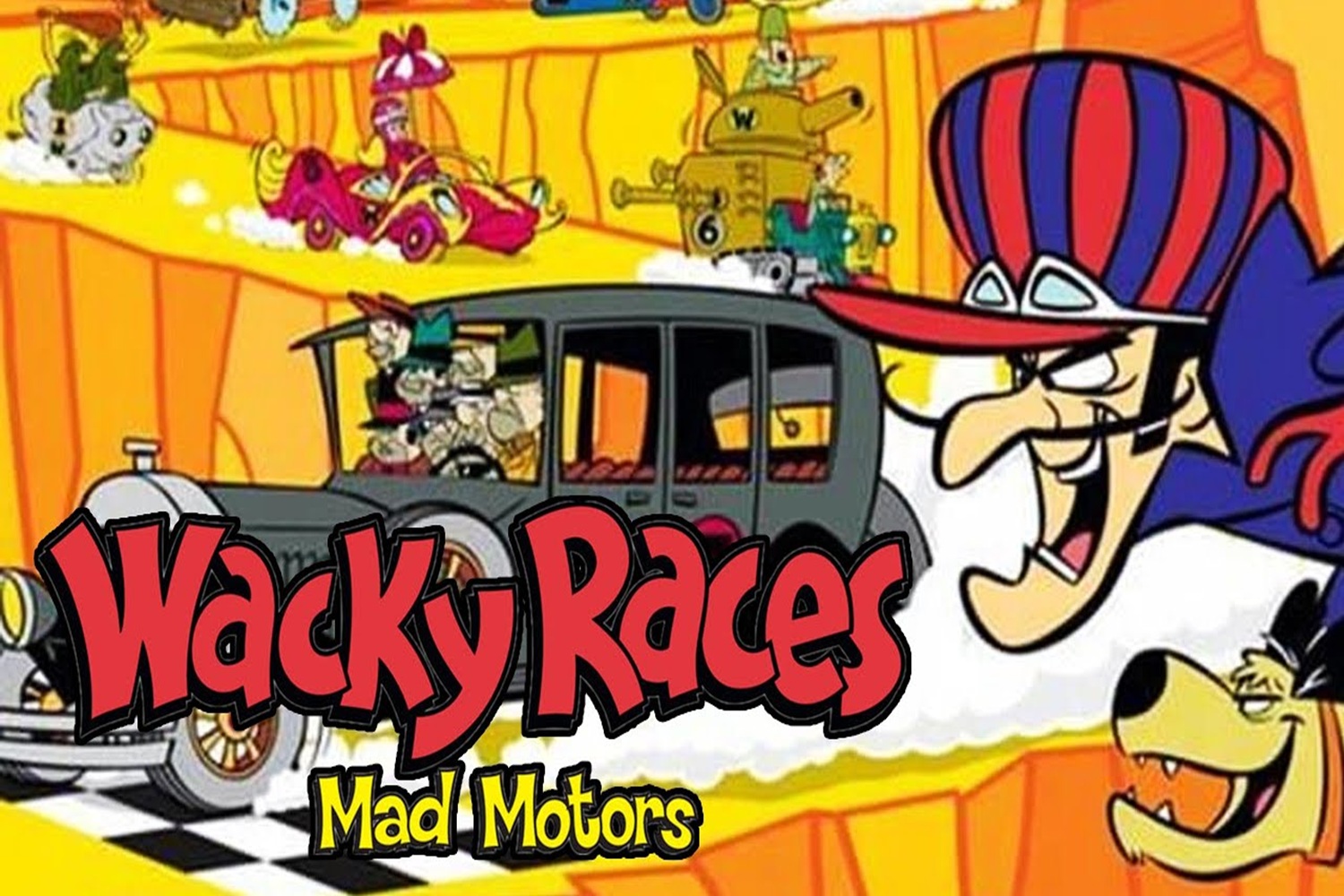
Wacky Races: Mad Motors brings the eccentric vehicles and characters of Hanna-Barbera's classic Wacky Races cartoon into a colorful arcade racing game built around speed, collectibles, vehicle progression, and increasingly demanding circuits. Released in 2007, the game features the familiar competitors from the original animated series, including Dick Dastardly and Muttley, Penelope Pitstop, Professor Pat Pending, Peter Perfect, the Slag Brothers, the Ant Hill Mob, and several other wonderfully strange racers. Rather than attempting realistic motorsport, Mad Motors embraces exaggerated vehicles and cartoon-inspired environments while asking players to qualify through a sequence of races and unlock more of the roster. It is a straightforward racing experience, but its connection to one of television's most recognizable cartoon competitions gives it plenty of nostalgic personality.
The central campaign gradually introduces new tracks and characters while requiring players to pay attention to more than simply reaching the finish line first. Collectible tokens are placed around the circuits, meaning progression often depends on navigating the course carefully while still maintaining enough speed to remain competitive. Boost pickups provide extra bursts of acceleration, while other progression items contribute toward unlocking or improving what becomes available. This creates an unusual mixture of racing and collection where learning where important items appear can be just as useful as mastering a difficult corner.
Now playable online through Lemon Web Games, Wacky Races: Mad Motors brings its cartoon racing adventure directly into modern web browsers without requiring the original console. Players can work through the campaign, collect the tokens scattered around each circuit, unlock additional racers, improve their progress, and eventually take control of famous vehicles such as the Mean Machine, Compact Pussycat, Convert-a-Car, Bouldermobile, and Turbo Terrific. The browser-based version provides an easy way to revisit a lesser-known Wacky Races game from the late 2000s and experience its simplified arcade racing structure. For fans of Hanna-Barbera, retro licensed games, and unusual cartoon vehicles, Mad Motors remains an interesting piece of Wacky Races gaming history.
The Wacky Racers Return to the Starting Grid
The biggest attraction is naturally the cast itself. Wacky Races was built around the idea that every competitor looked as though they belonged in a completely different cartoon, and Mad Motors brings that eclectic lineup into one racing game. The Slag Brothers drive the stone-age Bouldermobile, while Professor Pat Pending controls the inventive Convert-a-Car. Penelope Pitstop arrives in the glamorous Compact Pussycat, while Peter Perfect races the fragile-looking Turbo Terrific.
The Ant Hill Mob brings the Bulletproof Bomb, Rufus Ruffcut and Sawtooth drive the wood-covered Buzzwagon, and Lazy Luke and Blubber Bear appear in the Arkansas Chugabug. Sergeant Blast and Private Meekly bring military styling through their Army Surplus Special, while the Gruesome Twosome naturally arrive in the Creepy Coupe. Red Max drives the aircraft-inspired Crimson Haybailer. Few racing games can offer a garage with this much visual variety.
And then there is Dick Dastardly and Muttley in the Mean Machine. The duo remain the most recognizable characters associated with Wacky Races, remembered for spending more time trying to sabotage everyone else than simply winning honestly. Unlocking the Mean Machine gives fans the opportunity to take control of the cartoon's legendary troublemakers rather than merely watching their schemes fail from the sidelines.
Eleven Famous Vehicles Give the Game Its Identity
Mad Motors eventually gives players access to all eleven vehicles associated with the classic Wacky Races lineup. This full roster is important because the strange machines are arguably just as memorable as the characters driving them. Each vehicle immediately communicates the personality of its owner, whether through the enormous stone wheels of the Bouldermobile or the pink styling of Penelope's Compact Pussycat. Even before a race begins, the starting grid looks completely unlike an ordinary motorsport event.
The visual designs remain recognizable despite the relatively simple presentation. Fans familiar with the original cartoon can identify the vehicles almost immediately from their silhouettes. This authenticity gives the game much of its nostalgic appeal. Mad Motors may offer a straightforward racing system, but driving the actual Wacky Races machines makes that simplicity more entertaining.
The unlock structure also prevents the entire garage from being handed to players immediately. Additional racers become available as progress is made through the campaign, providing another objective beyond simply completing the circuits. Seeing another famous vehicle added to the selection creates a useful sense of advancement. Eventually building the full roster becomes one of the main reasons to continue.
Campaign Progression Requires More Than Winning
Mad Motors takes an unusual approach to progression because finishing in first place is not always the only thing that matters. Important tokens are scattered around the circuits, and collecting the required Wacky Tokens is tied directly to qualifying for subsequent races. A strong finishing position can therefore become meaningless if the player ignored too many collectibles along the way. The game effectively asks players to race and collect simultaneously.
This creates a different strategy from a conventional arcade racer. The fastest racing line may bypass a token positioned slightly away from the ideal route, forcing the player to decide whether to sacrifice speed temporarily. Missing one can create an even bigger problem because turning around to retrieve it allows rival vehicles to escape. Learning the token locations therefore becomes part of mastering each race.
The system can make progression demanding, but it also gives the circuits additional objectives. Players gradually learn not only where to brake or accelerate but where each important collectible appears. A successful run involves combining both pieces of knowledge. Familiarity becomes extremely valuable.
Wacky Tokens Become Essential Collectibles
Wacky Tokens are among the most important objects encountered during campaign races. Rather than functioning merely as optional score bonuses, they contribute directly toward qualification. Players need to remain alert while driving because a token can appear near the side of the track or around an awkward bend. Speed alone is not enough.
The requirement changes how repeat attempts feel. During the first run, a player may concentrate heavily on understanding the course and overlook a collectible. The next attempt can then be planned around remembering exactly where it appeared. After several runs, the locations become part of the player's mental map of the circuit.
This collectible emphasis can be frustrating when a nearly perfect race is invalidated by one missed token, but it also gives Mad Motors a structure distinct from conventional lap racing. The game continuously asks players to look beyond the opponents immediately ahead. Track awareness includes both driving lines and collectible placement.
Wrench and Dastardly Tokens Add More Progression Goals
Other token types provide additional reasons to explore each circuit thoroughly. Wrench-themed collectibles contribute toward vehicle progression, while Dastardly-related tokens are associated with the broader unlock structure. These objects encourage players to deviate from the most obvious route and interact with more of each track. Collecting everything becomes a separate challenge from simply qualifying.
The combination of several collectible types can make a race feel surprisingly busy. Players need to keep an eye on rivals, upcoming corners, and objects positioned around the course simultaneously. A collectible located on an awkward line may require a carefully planned approach. Poor positioning can quickly result in losing both the token and several racing places.
For completion-focused players, these systems provide a reason to return even after a track has technically been cleared. A previous run may have opened the next race while still leaving something behind. Replaying with a different objective can produce another layer of progression. The circuits become more than one-use events.
Boost Pickups Provide the Main On-Track Power-Up
Unlike some earlier Wacky Races games that gave characters a broader collection of offensive and defensive gadgets, Mad Motors takes a much simpler approach to power-ups. The most important active pickup is a speed boost, allowing the player's vehicle to gain extra acceleration for a short period. Using it effectively can help recover from a mistake or create an overtaking opportunity. Timing matters because a boost used immediately before a tight corner may provide very little benefit.
Longer straights are naturally ideal opportunities. Players can activate the boost while the vehicle is already aligned and convert the extra speed directly into progress. It can also be useful immediately after a collision or spin, where acceleration back toward racing speed becomes especially important. Saving a boost for the right moment is generally more effective than using it immediately.
The simplified system makes Mad Motors more focused on track navigation than weapon combat. Players expecting missiles, traps, and character-specific attacks may find the design more restrained than other cartoon racers. Instead, most of the challenge comes from maintaining speed, collecting tokens, and avoiding costly collisions.
Twelve Campaign Races Create the Main Journey
The main campaign is built around a sequence of twelve races that gradually introduce different circuits and unlock additional racers. Early events provide an opportunity to learn the handling and collectible system before later courses demand more accurate steering. Progress through the campaign opens more of the game's content. Completing the full sequence becomes the primary single-player objective.
Track names embrace the same exaggerated humor as the cartoon, with races such as Dastardly Desert Dash, Rockaway to the Rockies, Speedway in the Sandy Sun, and Wacky Rocky Ridges. Later events move between warmer rocky environments and much colder snowy courses. The changing scenery provides visual variety even though the underlying racing structure remains consistent.
The campaign is relatively compact compared with large modern racing games, but that works with its straightforward design. Players can focus on clearing each event, collecting the required tokens, and unlocking the remaining vehicles. Replaying individual races for cleaner results extends the experience beyond the initial completion. It feels closer to a traditional arcade campaign than a sprawling racing career.
Desert Tracks Emphasize Open-Road Racing
Several circuits take place across dry desert environments filled with dusty roads, rocky scenery, and wide open landscapes. These courses fit the cross-country spirit associated with Wacky Races particularly well. The vehicles look appropriately absurd travelling through environments that seem barely suitable for ordinary cars. The cartoon premise makes almost any location believable.
Longer open sections provide opportunities to use boosts effectively. However, the wide appearance of the environment can be misleading because the actual racing line remains defined. Cutting too aggressively or colliding with roadside scenery can erase the advantage gained from extra speed. Players need to remain focused even when the course appears forgiving.
Desert environments also make collectibles relatively easy to spot from a distance. This gives players additional time to decide how they should adjust their line. Once the locations are memorized, experienced players can plan token collection without losing as much momentum. Early desert races become useful practice for the more restrictive tracks later.
Mountain Roads Demand Better Control
Rocky and mountainous environments create tighter racing conditions where steering becomes increasingly important. Corners can arrive quickly, and collisions become far more expensive when there is little space to recover. These courses reward players who have already become comfortable with the handling. Holding the accelerator without considering the next turn becomes increasingly risky.
The combination of corners and collectible tokens makes these environments especially demanding. A token positioned near the outside of a bend may require a very different line from the one normally used for maximum speed. Players need to collect it without losing control. One poor adjustment can allow several opponents to pass.
Repeating these tracks gradually becomes easier as the layout becomes familiar. Players begin anticipating where the road changes direction and where important tokens are positioned. What initially appears chaotic eventually becomes predictable. Course knowledge remains the most powerful advantage.
Snow and Ice Change the Atmosphere
Later races introduce snow-covered environments that provide a strong visual contrast with the desert and rocky courses encountered earlier. Bright white scenery, frozen surfaces, and colder landscapes make the final portion of the campaign feel noticeably different. The Wacky Races vehicles appear especially amusing when driving through environments that were clearly never considered during their construction. The contrast fits the cartoon spirit perfectly.
Slippery-looking roads also reinforce the importance of controlled steering. Even when the underlying handling remains accessible, the visual environment encourages players to approach corners with additional caution. Narrow winter roads can become especially dangerous when several racers arrive at the same place simultaneously. Contact quickly becomes a major problem.
Snowy stages appear near the later portion of the progression and help give the campaign a sense of travel. The adventure feels as though the racers are moving through very different regions rather than circling one local championship. That world-tour atmosphere connects nicely with the original animated concept.
Collisions Can Completely Change a Race
Contact with rival vehicles is one of the most dangerous parts of Mad Motors. A collision can disrupt the car's direction and cost significant time while the player attempts to recover. This becomes particularly painful during close races where opponents remain tightly grouped. One bad impact can turn a leading position into a much weaker one almost instantly.
The safest strategy is often to avoid unnecessary physical battles. Attempting to force through a crowded opening may produce more harm than waiting for a cleaner overtaking opportunity. This becomes especially important when the player is also trying to line up with collectible tokens. Stability can be more valuable than momentary aggression.
Learning to recover quickly is another useful skill. As soon as the car begins losing direction, players need to correct without oversteering into another problem. Boosts can help regain speed once the vehicle is aligned again. A fast recovery can save a race that initially appeared lost.
The AI Keeps Pressure on the Player
Computer-controlled racers provide constant competition throughout the campaign. Opponents can remain relatively close, making it difficult for the player to relax even after reaching first place. A mistake near the end can therefore be costly. The field continues applying pressure until the finish.
Falling significantly behind can be difficult to overcome, particularly on tracks where missed collectibles already require extra movement. This makes clean driving during the opening portions important. Players benefit from avoiding unnecessary collisions and maintaining steady progress rather than relying on a dramatic late comeback. Consistency matters.
The challenge can occasionally feel demanding because token collection itself already forces compromises in racing lines. Players are essentially competing against the course and the opponents at the same time. Learning the layout gradually reduces that pressure. Once collectibles can be gathered efficiently, more attention can be directed toward racing.
Time Trial Mode Focuses on Pure Driving
Time Trial provides an alternative to the campaign's collectible-heavy progression. Instead of concentrating on rival racers and campaign objectives, players can focus more directly on navigating the circuit efficiently. This makes it useful for learning track layouts and improving driving performance. Familiarity gained here can later translate into stronger campaign attempts.
Without the same level of traffic pressure, players have more room to experiment with corners and boost timing. A section that feels chaotic during a crowded race can be studied more calmly. This makes Time Trial useful as both a separate mode and a form of practice. Players can identify where they are losing time.
The mode also provides a straightforward performance challenge. Improving a previous result becomes its own objective even after the campaign has been completed. Players who enjoy racing against their own best runs may spend additional time refining each course. It offers a cleaner form of competition.
Checkpoint Races Add Another Racing Variation
Checkpoint-based challenges provide another alternative to the standard campaign. Instead of treating the entire race purely as a competition for finishing position, these events emphasize reaching specific points along the route efficiently. Maintaining speed between checkpoints becomes the primary concern. Mistakes can quickly create pressure as the next target approaches.
These races reward strong knowledge of the track. Players who already know where sharp corners and obstacles appear can prepare earlier and preserve more momentum. A newcomer may lose time simply reacting to each section as it appears. Experience makes a noticeable difference.
The mode helps extend the game's relatively small selection of circuits by changing the objective. The same road can feel different when the focus shifts from racing opponents toward maintaining a consistent pace through timed sections. This provides additional content without requiring entirely separate environments. It is a simple but useful variation.
Unlocking Racers Provides the Main Long-Term Reward
One of the strongest reasons to continue through Mad Motors is the gradual expansion of the playable roster. Only a portion of the famous Wacky Racers is available immediately, with additional vehicles unlocked through campaign progression. This creates a clear reward for completing difficult races and gathering the required collectibles. Every unlocked character makes the selection screen more interesting.
The later additions include several of the cartoon's most recognizable vehicles. The Compact Pussycat, Convert-a-Car, Creepy Coupe, Crimson Haybailer, Mean Machine, and Turbo Terrific become available as progress continues. Building toward these famous machines gives the campaign a nostalgic motivation beyond simply reaching another finish line. Fans naturally want access to the entire cast.
Unlocking Dick Dastardly and Muttley's Mean Machine is particularly appropriate as a later reward. The pair are arguably the faces of the franchise, and gaining control of their infamous car feels like reaching an important milestone. The game understands that character recognition is one of its strongest assets. Roster progression takes advantage of that.
Dick Dastardly and Muttley Remain the Stars
Few cartoon villains are as closely associated with failure as Dick Dastardly. His constant attempts to cheat in the original Wacky Races usually created more problems for himself than for anyone else. Muttley's unmistakable snickering made those failures even more entertaining. Together, they became far more recognizable than many of the racers who actually won events.
Mad Motors gives players the unusual opportunity to control the Mean Machine and perhaps finally help Dastardly win through legitimate driving. The experience naturally cannot recreate every elaborate sabotage plan from the cartoon, but simply seeing the purple number 00 vehicle on the track provides strong nostalgia. It immediately communicates the identity of the series.
Muttley's presence is equally important visually even without extensive character dialogue. The duo belongs together, and the Mean Machine would feel incomplete without both of them. For fans who grew up watching the cartoon, unlocking them may be the main objective of the entire campaign.
Penelope Pitstop Brings the Compact Pussycat Back
Penelope Pitstop is another instantly recognizable member of the roster. Her bright pink Compact Pussycat looks completely different from the heavy military vehicle driven by Sergeant Blast or the prehistoric Bouldermobile. The extravagant design captures the exaggerated character-based approach of the original cartoon. It is impossible to mistake for an ordinary racing machine.
Penelope became popular enough to appear in her own animated adventures, making her an especially important part of the wider Hanna-Barbera universe. Her inclusion gives fans another strong reason to work through the unlock progression. The Compact Pussycat remains one of the most visually distinctive cars available.
Driving the vehicle also reinforces how little Wacky Races cares about believable automotive engineering. The cars are extensions of the personalities controlling them. Style matters at least as much as mechanical logic. Mad Motors preserves that quality through its roster.
Professor Pat Pending Drives the Convert-a-Car
Professor Pat Pending's Convert-a-Car represents the inventive side of the Wacky Races lineup. In the cartoon, the vehicle could transform into whatever form seemed useful for the current situation. Mad Motors naturally simplifies that extreme versatility within its racing mechanics, but the distinctive design remains recognizable. Professor Pat Pending still looks perfectly suited to the strange competition.
The character represents how varied the original lineup was. One racer relies on prehistoric stone, another uses glamorous styling, and Professor Pat Pending arrives with a machine built around impossible invention. Placing all of them on the same starting grid is inherently funny. The game benefits from simply recreating that contrast.
Unlocking the Convert-a-Car adds another famous machine to the collection. Even when vehicle handling is relatively straightforward, changing the visual character of the race can keep repeated circuits interesting. Fans may naturally choose racers based more on personality than performance statistics. That suits Wacky Races perfectly.
The Presentation Leans on Cartoon Recognition
Visually, Mad Motors uses bright colors and simplified three-dimensional environments intended to reflect the lighthearted source material. The vehicle models are the most important part of the presentation because they need to remain recognizable despite the technical limitations of the game. Fortunately, the famous silhouettes translate reasonably well. The starting grid immediately looks like Wacky Races.
Environmental detail is relatively modest compared with larger racing games from the same period. The emphasis remains on clear tracks and recognizable scenery rather than dense background activity. This keeps navigation straightforward, particularly when players are also searching for tokens. The presentation prioritizes readability over spectacle.
The absence of extensive dialogue means much of the cartoon personality needs to come from the vehicles themselves. Fans familiar with the characters can supply much of that context automatically. Newcomers may simply see an eccentric selection of cars. Either way, the roster remains the game's strongest visual element.
A Late-Era Racing Curiosity
Mad Motors arrived relatively late in the life of its original console generation, releasing in 2007 when the industry was already moving toward newer hardware. This gives it an unusual position in gaming history. It is a licensed cartoon racer from a period when developers were still releasing lower-budget games for a huge established audience. The result feels very different from the major racing productions appearing elsewhere at the time.
Its modest scope reflects that background. The campaign is relatively short, the power-up system is simple, and the tracks prioritize straightforward arcade racing over technical complexity. Players approaching it as a huge kart racer may find the design limited. As a small Wacky Races adaptation, however, it has a more specific nostalgic appeal.
That makes the game particularly interesting today. It represents a type of licensed release that appeared frequently during the 2000s but has become less common. Familiar cartoon characters were often enough to support compact games built around simple mechanics. Mad Motors is very much a product of that era.
Why Wacky Races Works Naturally as a Racing Game
The original cartoon already provides almost everything needed for a video game concept. Eleven competitors race unusual vehicles across ridiculous locations while Dick Dastardly attempts to interfere with everyone around him. There is no need to invent an excuse for racing because competition is already the entire premise. A video game simply allows the viewer to take control.
The unusual vehicles provide natural character selection. The world-tour format supports changing environments, while Dastardly and Muttley provide familiar personalities around which to build progression. Collectibles and boosts add game-specific objectives without completely abandoning the original concept. The adaptation almost designs itself.
Mad Motors may simplify several of the cartoon's sabotage ideas, but the basic fantasy remains intact. Players choose one of the famous machines and try to reach the finish ahead of the others. For fans, that alone has considerable nostalgic value. The source material remains an excellent fit for arcade racing.
Playing Wacky Races: Mad Motors Online Today
Through Lemon Web Games, Wacky Races: Mad Motors can now be played directly in your web browser with no downloads or setup required. Features of the web-based version include:
Playing Mad Motors through a browser provides a convenient way to experience this lesser-known Wacky Races adaptation without relying on aging original hardware. The controls are straightforward enough to begin racing quickly, while the collectible requirements give players an additional objective beyond simply overtaking the field. Repeated attempts become easier once token locations and difficult corners are memorized. The campaign naturally rewards familiarity.
For returning players, the browser-based version offers an opportunity to revisit the famous vehicles and gradually rebuild the complete roster. Newcomers can experience a compact arcade racer centered around one of Hanna-Barbera's most memorable cartoon concepts. It may be simpler than more elaborate kart racers, but the character selection gives it an identity that ordinary racing games cannot replicate. Sometimes the attraction is simply seeing which ridiculous machine will cross the finish line first.
Who Should Play Wacky Races: Mad Motors
Mad Motors is particularly suitable for players who enjoy nostalgic licensed games and do not require complicated racing simulation. Steering, boosting, collecting, and learning the tracks form the main gameplay loop, making the game easy to understand from the opening race. The collectible requirements add enough additional pressure to prevent every event from becoming purely about speed. Players who enjoy memorizing circuits should gradually find qualification easier.
Wacky Races fans naturally have the most to appreciate because the complete roster eventually becomes available. Unlocking another famous vehicle can be more rewarding than simply improving a lap time. The cars carry decades of cartoon history and remain instantly recognizable. That character connection is the main reason Mad Motors continues to be interesting.
Play Wacky Races: Mad Motors Online Now
Wacky Races: Mad Motors offers a straightforward arcade racing experience built around one of animation's most unusual collections of drivers and machines. Players work through twelve races, gather important tokens, use speed boosts, learn increasingly demanding tracks, and gradually unlock more of the famous Wacky Races roster. The racing itself remains accessible, but collecting everything required for progression introduces an additional challenge. Missing one important item can make track knowledge just as valuable as pure speed.
Through Lemon Web Games, players can take the Bouldermobile, Compact Pussycat, Convert-a-Car, Mean Machine, Turbo Terrific, and the rest of the Wacky Races lineup back onto the track directly through a modern browser. Returning fans can work toward unlocking their favorite vehicle, while newcomers can discover just how strange Hanna-Barbera's fictional motorsport championship really was. The game is compact, colorful, and unmistakably tied to the cartoon that inspired it. For players seeking uncomplicated retro racing with plenty of character, Mad Motors offers an unusual trip back to the starting grid.
Final Thoughts
Wacky Races: Mad Motors is best approached as a small, straightforward arcade racer built around the charm of its famous license. The roster is unquestionably the main attraction, bringing together Dick Dastardly and Muttley, Penelope Pitstop, Professor Pat Pending, the Slag Brothers, Red Max, Peter Perfect, the Ant Hill Mob, and the rest of the original competition. Their bizarre vehicles immediately give the game a personality that ordinary racing machines could never match. Seeing all eleven eventually assembled in one game remains the strongest reward for progressing through the campaign.
Its racing structure adds an unusual collectible requirement that separates it from a completely conventional kart racer. Wacky Tokens force players to learn more than the fastest route, while additional collectibles and vehicle progression provide reasons to examine the circuits carefully. Time Trials and checkpoint challenges offer alternatives when players want to concentrate more directly on driving. The mechanics are relatively simple, but they are easy to understand and suit short sessions.
For Wacky Races fans in particular, the game remains an interesting late-era licensed release that preserves the most important part of the cartoon: an absurd lineup of competitors racing equally absurd machines across ridiculous locations. Through Lemon Web Games, players can revisit Mad Motors directly in their browser, unlock the full roster, gather every important token, and perhaps finally give Dick Dastardly the victory he spent so many episodes trying to achieve.











Comments 0