

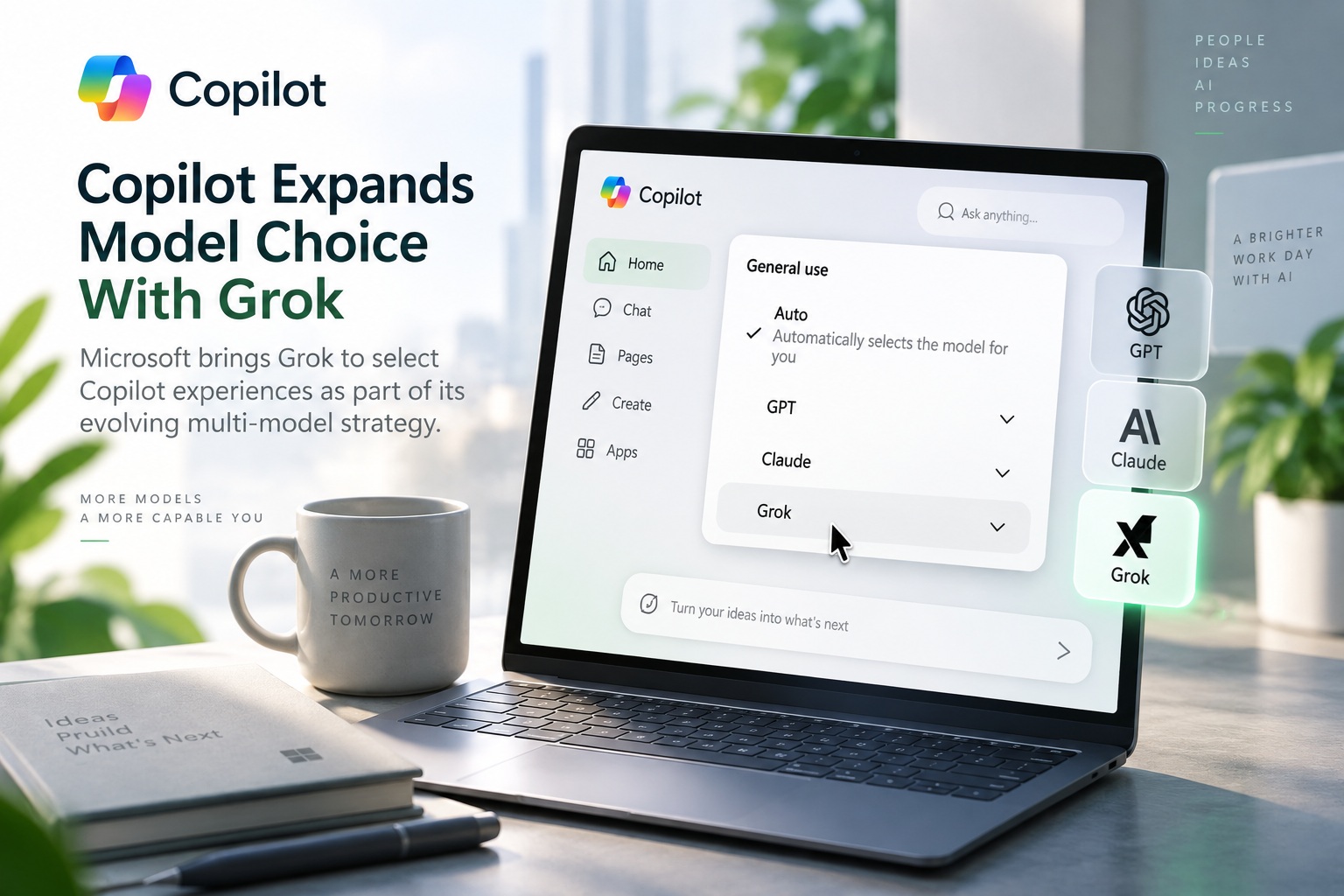
Microsoft is continuing to broaden the range of artificial intelligence models available through Copilot, this time bringing Grok models from SpaceXAI into selected Microsoft 365 experiences. The move forms part of Microsoft's wider multi-model strategy, which is designed to give businesses greater flexibility when choosing the AI technology they want to use while still working within the familiar Copilot environment.
Rather than making Grok immediately available to every Copilot customer, Microsoft is taking a controlled approach to the rollout. Access is beginning through the Microsoft Frontier Program and will initially focus on Word, Excel and PowerPoint, allowing the company to study how customers use Grok across common workplace scenarios before deciding how widely to expand support.
Copilot Is Becoming More Than a Single-Model AI Assistant
One of the more interesting developments around Copilot is Microsoft's increasingly visible move toward model choice. Instead of building the entire Copilot experience around one AI model family, Microsoft is creating an environment where different models can potentially be selected depending on the task, organisation or business requirement.
That approach could become increasingly important as AI models develop different strengths. One model may perform particularly well at reasoning, another could be better suited to writing, while another may offer advantages in coding, analysis or certain specialist workflows. Giving users access to several options allows Copilot to evolve into more of an AI platform rather than simply a front end for a single underlying model.
The addition of Grok fits directly into that strategy. Microsoft says it wants to bring leading AI innovations into Copilot while tuning the experience around workplace productivity and business requirements.
Grok Is Coming to Word, Excel and PowerPoint First
The initial rollout will make Grok available through the Microsoft Frontier Program, beginning with several of the company's most widely used productivity applications. Eligible customers will be able to access the model within:
Starting with these applications gives Microsoft an opportunity to observe how Grok performs across a broad range of everyday productivity tasks. In Word, that might involve drafting, rewriting or analysing documents, while Excel provides opportunities for working with data, formulas and business information. PowerPoint, meanwhile, introduces another set of scenarios involving presentations, summaries and content development.
Microsoft describes this stage as a focused release rather than a full deployment. Customer feedback, usage behaviour and the overall suitability of the model will help determine whether Grok eventually becomes available across additional areas of Copilot.
Businesses Must Explicitly Enable SpaceXAI Models
One important aspect of the rollout is that Grok will not simply appear automatically within corporate Copilot environments. Microsoft has introduced a dedicated administrative setting for SpaceXAI models, and that setting is disabled by default.
Organisations that want employees to access Grok must therefore choose to enable it first. This gives IT administrators control over whether data is processed by SpaceXAI-backed models and prevents the introduction of an additional AI provider without organisational approval.
That distinction matters particularly for enterprise environments. Businesses may have internal requirements governing data processing, external AI providers, compliance obligations or approved subprocessors. By keeping Grok opt-in at the administrative level, Microsoft is giving organisations an opportunity to review those considerations before allowing employees to use the model.
It also means that simply being eligible for the Frontier Program does not necessarily guarantee immediate access. An organisation's administrator must first permit the use of SpaceXAI models within supported Copilot experiences.
SpaceXAI Has Been Added as a Microsoft Subprocessor
Supporting Grok inside Copilot also requires Microsoft to formally account for SpaceXAI within its data-processing framework. The company has therefore added SpaceXAI to its Online Services Subprocessor List.
In enterprise software, subprocessors are third-party organisations that may process customer information as part of delivering a service. Listing them provides customers with greater visibility into which external companies may be involved when particular services or capabilities are used.
For organisations operating under strict privacy, security or regulatory requirements, this information is especially important. IT and compliance teams need to understand not only which AI model employees are using, but also which company may process information when that model is selected.
Microsoft says administrators will retain transparency and control over data processed through SpaceXAI models in supported Copilot experiences. The separate administrative switch reinforces that approach by ensuring organisations have to actively approve access.
Why Administrative Control Matters for Enterprise AI
Consumer AI services can usually be adopted by an individual with little more than an account and a login. Enterprise environments are very different. Introducing another AI provider can involve reviews covering information security, contractual obligations, data residency, privacy policies and internal governance.
A company may be perfectly comfortable allowing employees to use one model for general drafting while applying stricter controls to another provider when sensitive business information is involved. Larger organisations may also maintain formal lists of approved vendors or require security assessments before new services can interact with internal data.
This is one reason Microsoft's model-selection strategy needs to provide more than just a drop-down menu containing different AI names. The surrounding administrative and governance controls become just as important as the models themselves.
By disabling SpaceXAI access by default, Microsoft is effectively putting that decision in the hands of each organisation rather than assuming that every business wants every available model.
The Preview Has Some Regional Restrictions
Grok availability during the initial preview will not be global. Microsoft says Frontier customers located in the European Union, European Free Trade Association and the United Kingdom will not have access to Grok during this stage of the rollout.
Microsoft has not positioned the preview as the final availability map, however. The current release is intended to collect feedback and evaluate the model before potentially expanding it into additional Copilot environments.
Regional restrictions during previews are relatively common for enterprise technology, particularly where AI services may need to account for different regulatory, privacy and data-processing requirements. Whether Grok eventually reaches Frontier customers in those markets will depend on how Microsoft develops the integration after the initial testing period.
Customer Behaviour Will Help Decide What Happens Next
Microsoft is treating the Grok rollout as an opportunity to learn rather than simply adding another permanent model option immediately. The company says it will evaluate customer feedback, usage patterns and overall product fit before making decisions about broader availability.
That means Microsoft will likely be interested in more than how frequently people select Grok. It will also need to understand which tasks customers choose it for, whether it delivers useful results inside productivity applications and whether businesses see enough value in the additional model choice to enable it across their organisations.
The findings could influence where Grok appears next. If the model proves particularly useful for certain workflows, Microsoft could potentially extend support to more Copilot surfaces or integrate model selection more deeply into productivity scenarios.
This also gives Microsoft flexibility if customer demand turns out to be limited. A multi-model platform does not necessarily mean every model must appear everywhere; different AI systems could eventually be offered selectively depending on the application and use case.
Microsoft Is Betting on a Multi-Model Future
The larger story here may be Microsoft's continued movement toward a multi-model AI ecosystem. As generative AI matures, businesses are becoming more aware that there may not be one universally superior model for every task.
The competitive advantage could therefore shift from simply having access to the "best" model toward having an intelligent platform capable of supporting several leading models while maintaining consistent security, governance and productivity features.
For Microsoft, Copilot is well positioned to act as that layer because it is already integrated deeply across Microsoft 365. Employees could potentially work with different models without leaving Word, Excel, PowerPoint or other familiar applications, while organisations continue applying central administrative policies around them.
That approach could also reduce the pressure on businesses to choose one AI vendor exclusively. Instead, companies may eventually select models based on the workload while relying on Copilot to provide a consistent user experience.
Safety Reviews Still Apply Before Models Reach Customers
Microsoft says third-party models are not simply connected to Copilot and immediately released. Before they become available to customers, models undergo testing, safety validation and Responsible AI reviews.
That process is particularly important because adding external models introduces differences in behaviour, capabilities and potential risks. A model that performs strongly in one environment may behave differently when integrated into productivity tools containing business information.
Microsoft therefore needs to evaluate both what a model can do and how it behaves inside the Copilot ecosystem. Safety testing can include identifying problematic outputs, examining model limitations and determining whether additional safeguards are necessary before customers are given access.
These reviews also help maintain some consistency across the Copilot experience even when the underlying AI provider changes.
Model Choice Could Eventually Become a Major Copilot Feature
For users, the most visible benefit of Microsoft's strategy is choice. Instead of being restricted to whatever model happens to power Copilot at a particular moment, customers could increasingly select the AI that works best for the task they are performing.
That could be particularly useful for advanced users who understand the differences between AI models. A user preparing a complicated analysis may prefer one model, while someone working on a presentation or rewriting a lengthy document may find another performs better.
There is also the possibility that model selection eventually becomes more automated. Rather than expecting every employee to understand which model is best, future AI platforms could potentially route particular tasks to appropriate models behind the scenes. Microsoft has not announced such functionality as part of this Grok preview, but a growing collection of supported models makes that type of approach increasingly conceivable.
For now, however, the focus remains on controlled access and collecting real-world feedback.
Enterprise AI Is Becoming About Governance as Much as Intelligence
The Grok announcement also highlights how enterprise AI is evolving beyond a simple competition over which company has the smartest model. Businesses increasingly care about how models are deployed, where information is processed and how administrators can control access.
A powerful AI tool may have little value to a large organisation if its security, privacy or governance requirements cannot be satisfied. Conversely, providing administrators with clear controls can make organisations more comfortable experimenting with new models.
Microsoft's decision to require explicit enablement for SpaceXAI reflects that reality. It allows Copilot to expand technically without forcing every organisation to adopt the same AI providers.
As more models become available, administrative tools for controlling them may become an increasingly important part of the Copilot platform itself.
Final Thoughts
The addition of Grok to Microsoft Copilot represents more than another AI model appearing inside Word, Excel and PowerPoint. It reinforces Microsoft's broader strategy of turning Copilot into a multi-model productivity platform where businesses can gain access to different AI technologies without abandoning the Microsoft 365 environment they already use.
Microsoft is also taking a relatively cautious approach to the introduction. SpaceXAI has been added as a subprocessor, administrators must deliberately enable access, and availability is initially limited to eligible Frontier customers while Microsoft evaluates feedback and usage.
For businesses, this combination of choice and control may prove particularly important. Organisations increasingly want access to the latest AI capabilities, but they also need visibility into how their information is handled and which external providers are involved.
The Grok preview therefore provides an interesting glimpse at where enterprise AI may be heading. Instead of businesses choosing one model and building everything around it, the future may involve several competing AI systems working within the same productivity platform—with organisations deciding which ones best fit their users, workloads and governance requirements.











Comments 0