

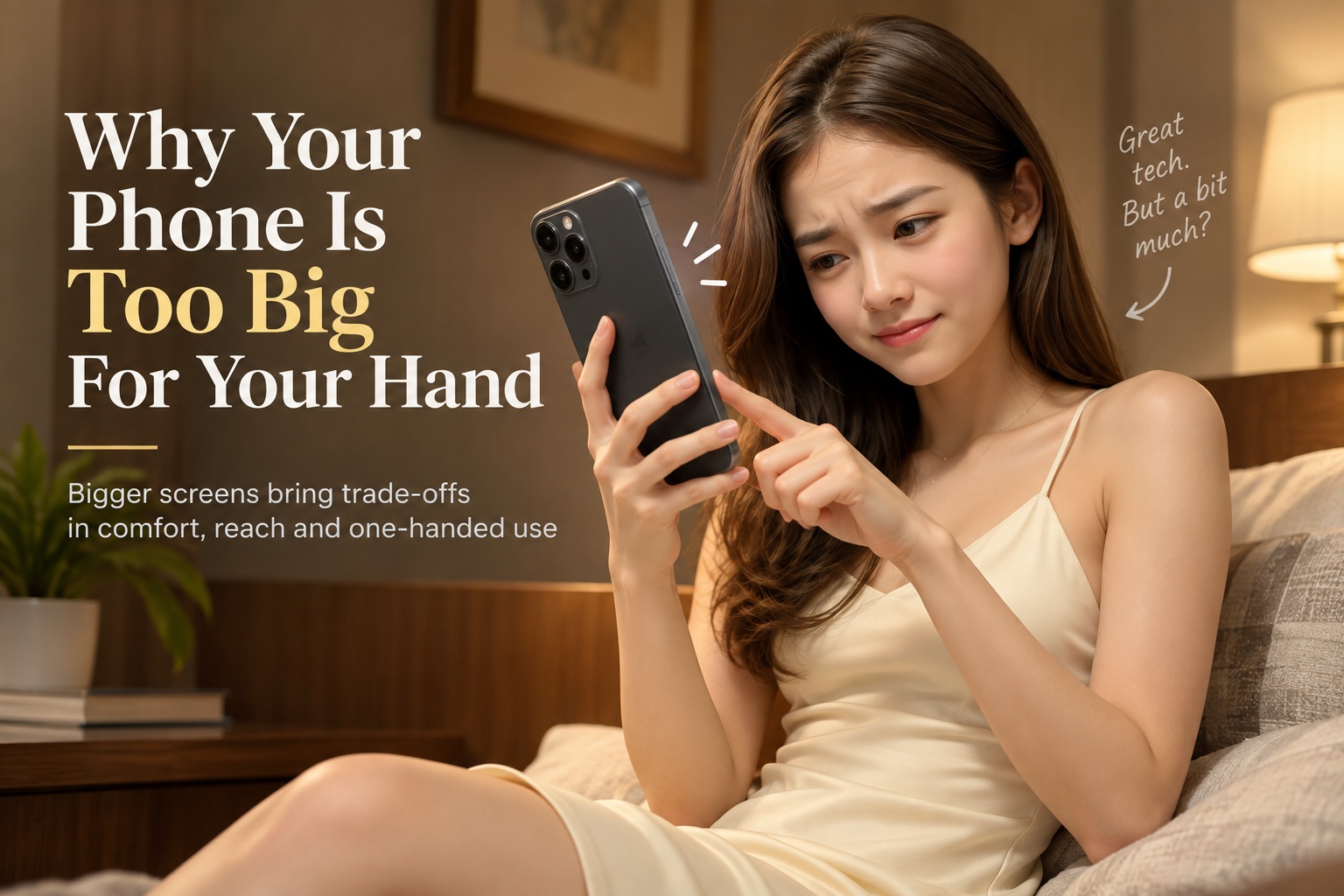
Modern smartphones are incredible pieces of technology. A single device can replace a computer, camera, television, music player, navigation system and even an entire bookshelf, all packed into a thin slab of glass and metal. Yet despite how advanced smartphones have become, many of them suffer from a surprisingly simple problem: they are becoming too large to use comfortably. Screens have continued growing, but the size and reach of our hands have stayed exactly the same.
Our Hands Haven't Grown With Our Phones
Smartphones have steadily increased in size over the years, largely because the way we use them has changed. Mobile video, social media, gaming and internet browsing all benefit from larger displays, while a bigger chassis also gives manufacturers more room for larger batteries and other hardware. Larger devices can also be positioned as premium products, giving brands another reason to keep pushing screen dimensions upward.
The problem is that human hands have not evolved alongside this trend. Average hand breadth is roughly 3.5 inches for men and around 3.1 inches for women, while average thumb length is approximately 2.74 inches and 2.49 inches respectively. Once a phone becomes wider than the natural reach of your thumb, simple one-handed interaction starts becoming increasingly awkward. Instead of comfortably reaching across the display, users find themselves stretching, repositioning the phone or simply giving up and using both hands.
When One-Handed Use Becomes A Struggle
You can usually tell when a smartphone is too large because everyday tasks start requiring physical adjustments. Reaching buttons or icons on the opposite side of the display can place additional strain on the thumb and wrist, particularly when the phone is being held in one hand. This often leads to what could be described as a constant "grip shuffle", where the device has to be moved up and down in the palm just to reach different areas of the screen.
That movement is not only inconvenient but can also make the phone feel less secure. Stretching a thumb towards the upper corner of a large display often means loosening your grip, increasing the risk of dropping the device. Eventually, what was originally intended to be a portable handheld computer effectively becomes a two-handed device for anything more complicated than a quick swipe or tap.
Why Compact Phones Feel So Different
Anyone who has used a genuinely compact smartphone will probably understand how different the experience can feel. Devices such as the iPhone 13 Mini and Samsung Galaxy S10e demonstrated how comfortable a smaller handset could be when its dimensions matched the natural reach of the hand. They were easy to grip, easy to carry in a pocket and could be operated almost entirely with one hand.
There is a particular sense of convenience when the phone feels like an extension of your hand rather than something you constantly have to reposition. Interestingly, manufacturers have spent years competing to make smartphones thinner, but reducing thickness does not necessarily solve the ergonomic problem. For comfortable one-handed use, width and height often matter considerably more than shaving another millimetre from the phone's thickness.
Maybe Phones Need To Be Shorter, Not Thinner
The smartphone industry's obsession with thin devices sometimes overlooks the dimensions that actually determine how comfortably a phone can be held. A very thin smartphone can still be extremely tall and wide, leaving users with exactly the same reach problems. In some situations, making the phone excessively thin can even make it harder to hold securely because there is less surface area for the fingers to grip.
A slightly thicker but shorter and narrower phone could therefore be more comfortable for many users. It may also provide additional internal room for battery capacity without forcing the device to become even taller. Instead of continually chasing record-breaking thinness, manufacturers could arguably gain more from focusing on ergonomics and realistic one-handed usability.
Compact Phones Used To Mean Compromising On Features
One reason smaller smartphones struggled commercially was that manufacturers often treated them as budget devices rather than genuine flagships. Consumers who wanted a compact phone frequently had to accept weaker processors, poorer cameras, smaller storage capacities or other compromises compared with the larger premium models. This created the impression that choosing a smaller phone also meant settling for inferior hardware.
That approach has gradually started changing. Manufacturers including Google, vivo and OnePlus have experimented with smaller flagship-style devices that retain high-end performance and premium features. Phones such as the Pixel 10 Pro and OnePlus 13s demonstrate that compact dimensions do not necessarily have to mean entry-level specifications.
Is 6.3 Inches The New Sweet Spot?
For many users, a display of around 6.3 inches may represent a practical middle ground. It provides considerably more screen space than the compact smartphones of several years ago while remaining easier to hold than the increasingly common 6.7-inch and larger flagship models. Depending on the bezels and overall aspect ratio, this size can still offer reasonably comfortable one-handed operation.
The key is that screen size alone does not tell the entire story. Two phones with identical display sizes can feel completely different depending on their width, height, bezels and aspect ratio. A relatively narrow 6.3-inch handset can therefore feel much easier to manage than a wider phone with only a slightly larger screen.
The Bigger Screen Trade-Off
There are legitimate reasons why large smartphones have become so popular. Watching videos, playing games, editing documents and multitasking are generally more enjoyable on a larger display. More screen space makes content easier to see, provides room for larger keyboards and creates a more immersive experience for entertainment.
Those benefits come with obvious compromises. Larger phones are less comfortable in pockets, harder to operate with one hand and can become tiring to hold for extended periods. Smaller devices may sacrifice some battery capacity and provide slightly tighter keyboards, but for many everyday activities such as messaging, browsing, navigation and social media, the actual difference in capability can be surprisingly small.
Comfort Is Becoming A Feature Again
For years, smartphone design has largely followed the idea that bigger screens automatically represent progress. However, there is growing recognition that usability is not simply about how much display area a manufacturer can fit into a device. A phone that feels comfortable every time you pick it up can provide a better overall experience than one with an enormous display that constantly requires two hands.
This does not mean the industry needs to return entirely to tiny smartphones. Instead, offering a wider range of genuinely premium sizes would allow consumers to choose based on comfort rather than specifications alone. A compact flagship should not need to be treated as a lesser version of the larger model.
Final Thoughts
The problem with oversized smartphones is ultimately less about technology and more about ergonomics. Screens, batteries and processing power have continued improving, but the human hand remains the same size it has always been. Once a smartphone becomes too wide or too tall for comfortable thumb reach, using it begins to involve stretching, shifting and compromises that should not really be necessary for a device designed to live in your hand.
Large phones will always have advantages for gaming, video and productivity, and there will continue to be users who prefer them. But compact phones offer something equally valuable: comfort, portability and effortless one-handed use. Wanting a smaller smartphone is not simply nostalgia for older devices; sometimes, the best phone is simply the one that actually fits your hand.











Comments 0