

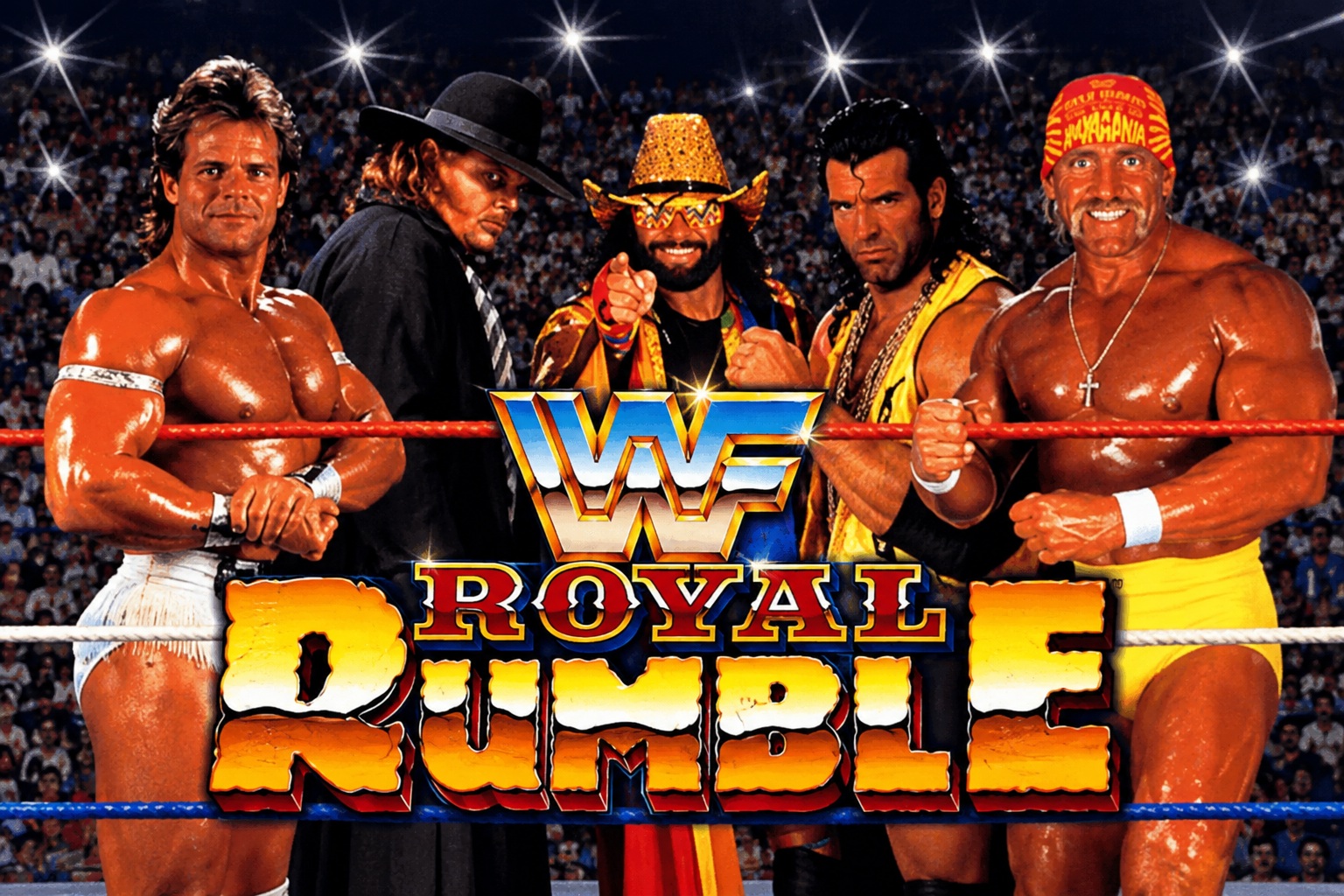
WWF Royal Rumble captures a very specific moment in early-1990s professional wrestling, when larger-than-life characters such as Bret Hart, The Undertaker, Randy Savage, Shawn Michaels, Razor Ramon, Yokozuna, Ric Flair, and Mr. Perfect were filling television screens and arenas around the world. Released in 1993, the game built on the foundation of WWF Super WrestleMania while expanding the move set, introducing individual finishing moves, adding more match types, and most importantly bringing the Royal Rumble concept into a home wrestling game. The action is deliberately arcade-like, with punches, kicks, grapples, running attacks, top-rope moves, illegal tactics, and steel chairs all contributing to matches that can quickly become chaotic. It may look simple compared with modern wrestling simulations, but beneath that simplicity is a competitive system built around wearing opponents down and winning crucial grapples.
The Super Nintendo edition features twelve wrestlers representing some of the biggest WWF personalities of the period: Bret "Hitman" Hart, The Undertaker, "Macho Man" Randy Savage, Shawn Michaels, Razor Ramon, Crush, Tatanka, Mr. Perfect, Ric Flair, Yokozuna, Ted DiBiase, and "The Narcissist" Lex Luger. Each wrestler shares the same basic controls but receives an individual finishing move, giving the roster additional personality once players understand how those techniques are triggered. Match types range from traditional one-on-one contests to tag team and three-on-three matches, while Tournament modes provide longer championship challenges. The headline attraction, however, is naturally the Royal Rumble itself, where the ring gradually fills with wrestlers until only one remains.
Now playable online through Lemon Web Games, WWF Royal Rumble brings this classic arcade-style wrestling experience directly into modern web browsers without requiring the original console. Players can choose from the twelve-man roster, compete for championships, fight alongside tag partners, use ringside chairs, execute signature finishers, or attempt to survive against the entire roster in the Royal Rumble match. The straightforward controls make the game easy to start, while its grappling system and elimination mechanics still require timing and persistence to master. For wrestling fans who remember the WWF of the early 1990s, the roster alone provides an immediate dose of nostalgia.
A Snapshot of WWF in 1993
One of the strongest attractions of WWF Royal Rumble is how clearly its roster represents the transition happening in the company during 1993. Bret Hart had emerged as one of the leading singles stars, Shawn Michaels was developing rapidly as a major competitor, Yokozuna had become an imposing new force, and The Undertaker was already one of the company's most distinctive attractions. At the same time, established stars such as Randy Savage, Ric Flair, Mr. Perfect, and Ted DiBiase were still important parts of the wrestling landscape. Looking at the character-select screen today feels almost like opening a time capsule from that era.
The game also reflects how wrestling games were beginning to place greater emphasis on individual wrestler identity. Earlier titles often gave large parts of the roster nearly identical move sets, relying primarily on appearance to distinguish them. WWF Royal Rumble still shares many standard grappling techniques across its characters, but signature finishing moves provide each superstar with something recognizable. Executing the Sharpshooter as Bret Hart or the Tombstone as The Undertaker adds far more personality than simply changing sprite colors.
The roster is especially interesting because the Super Nintendo and Sega Genesis releases were not identical. Seven wrestlers appear in both versions, while five characters differ depending on the system. The Super Nintendo edition specifically includes Ric Flair, Mr. Perfect, Ted DiBiase, Yokozuna, and Tatanka, making it distinct from the alternative roster found on Genesis. For players revisiting the game today, that difference is worth remembering because memories of the two versions can easily become mixed together.
Bret Hart Brings the Sharpshooter
Bret "Hitman" Hart was one of WWF's most prominent wrestlers during this period and naturally stands among the most recognizable choices in the game. His signature Sharpshooter can be applied when a weakened opponent is lying on the mat, giving players an immediately recognizable finishing move. The animation is simplified by modern standards, but seeing Bret lock in his famous submission remains a satisfying reward after wearing an opponent down. It reinforces the connection between the game and the wrestler's television persona.
Bret works particularly well for players who enjoy keeping matches controlled rather than relying entirely on wild brawling. Standard grapples, suplexes, slams, and running attacks provide enough variety to soften an opponent before attempting the finisher. Because signature moves generally require the opponent's stamina to be severely depleted, players cannot simply perform them at the beginning of a match. The finisher becomes the conclusion to the punishment that came before it.
For fans of the era, Bret's inclusion also captures an important moment in his rise toward becoming one of the defining wrestlers of the 1990s. The game arrived during a period when WWF was moving away from relying solely on enormous heavyweight characters. Bret represented a more technical style, and the Sharpshooter gives his in-game character an appropriately distinctive ending to a match.
The Undertaker Delivers the Tombstone
The Undertaker is almost impossible to mistake for anyone else in the roster. His dark attire, towering appearance, and supernatural wrestling persona immediately distinguish him from the colorful competitors surrounding him. His signature Tombstone Piledriver is executed from a grapple once the opponent has been sufficiently weakened. Even with the limited sprite animation of the era, the move remains one of the most satisfying finishers in the game.
The Undertaker's presence also demonstrates how important character presentation already was becoming in wrestling games. Players did not simply choose wrestlers based on statistics; they chose favorites because of personalities they knew from television. Taking control of The Undertaker and finishing someone with the Tombstone provided a small version of the fantasy seen on WWF programming. The game relies heavily on that recognition.
His size and visual presence are particularly entertaining during Royal Rumble matches, where the ring can become crowded with several competitors at once. Seeing The Undertaker surrounded by wrestlers while attempting to eliminate them over the top rope feels appropriate to the character. The multi-man format allows larger personalities to stand out even more strongly.
Randy Savage Takes to the Top Rope
"Macho Man" Randy Savage brings one of the most recognizable aerial finishing moves in wrestling history: the Flying Elbow Smash. Unlike grapple-based finishers, Savage's signature attack requires the opponent to be lying down while he climbs the turnbuckle. The player then launches from the corner toward the fallen opponent. Successfully landing it creates one of the game's most visually satisfying match endings.
The setup also introduces additional risk. Climbing the turnbuckle takes time, and an opponent who recovers can disrupt the attempt. Players therefore need to ensure enough damage has been inflicted before committing to the move. This makes the Flying Elbow feel mechanically different from a simple grapple finisher.
Savage is also a perfect representation of the game's colorful era. His flamboyant personality, energetic wrestling style, and instantly recognizable appearance fit naturally within the exaggerated visual presentation. For fans who grew up watching him compete, taking control of Macho Man remains one of the easiest ways to immediately connect with the game.
Shawn Michaels Represents a Star on the Rise
Shawn Michaels appears at a much earlier stage of his career than many modern wrestling fans may expect. His in-game finishing move is a back suplex rather than the Sweet Chin Music that would later become inseparable from his identity. That detail alone helps place WWF Royal Rumble firmly within its 1993 setting. Players are controlling the version of Michaels that existed before many of his most famous later accomplishments.
His inclusion gives the roster another faster, more athletic personality alongside wrestlers such as Bret Hart and Randy Savage. Standard running attacks and grappling techniques suit the more active style associated with younger competitors. The shared controls mean his mechanical differences are not enormous, but the finishing move and presentation still provide identity. For wrestling historians, that snapshot of early Shawn Michaels is particularly interesting.
This is part of what makes old wrestling games entertaining beyond the gameplay itself. Rosters preserve performers at specific points in their careers, including names, costumes, finishing moves, and personas that may later change dramatically. WWF Royal Rumble captures Michaels during a period when his eventual status as one of wrestling's biggest stars was still developing.
Razor Ramon and the Razor's Edge
Razor Ramon brings another instantly recognizable finishing move through the Razor's Edge. After reducing an opponent's stamina sufficiently, players can execute the move from a grapple and finish the match in appropriately dramatic fashion. Razor's look and attitude make him one of the most visually distinctive wrestlers in the roster. Even simplified pixel artwork communicates the character effectively.
His presence also reflects how strong WWF's character-driven presentation had become by the early 1990s. Razor Ramon was not simply another wrestler with different tights; the entire persona was constructed around attitude, gestures, entrance style, and distinctive offense. A home game could only reproduce part of that presentation, but the finisher was enough to give players something immediately recognizable. The Razor's Edge remains the centerpiece of using him.
Razor can also be particularly enjoyable during Brawl matches, where the restrictions of standard wrestling are removed. The character's aggressive personality fits naturally with choking, eye raking, ringside fighting, and steel-chair attacks. The game may not reproduce the full theatrical presentation of television, but it provides enough mechanics for players to create their own version of a heated match.
Yokozuna Brings Heavyweight Power
Yokozuna represents the heavyweight extreme of the Super Nintendo roster and uses the Banzai Drop as his signature finisher. The move is performed near the turnbuckle when the opponent is down, recreating one of the most devastating attacks associated with the character. Its setup differs from standard grapple finishers, giving players another reason to learn character-specific conditions. Landing the move provides an appropriately dramatic ending.
The sprite proportions do not reproduce his real-world size perfectly, but the character is still immediately recognizable through costume and presentation. Wrestling games of this era had limited ability to represent huge differences in body type, yet Yokozuna's inclusion was too important to ignore. He was one of WWF's most prominent characters during 1993. His place in the roster helps anchor the game firmly within that moment.
Yokozuna is especially appropriate for Royal Rumble mode because the real-world event itself was closely associated with his rise during this period. Attempting to throw opponents over the top rope while controlling one of the company's largest stars creates a natural fantasy. The gameplay may not simulate real weight differences in detail, but the character still feels right for the format.
Ric Flair and Mr. Perfect Strengthen the SNES Roster
Ric Flair is one of the notable wrestlers specifically included in the Super Nintendo version. His finishing move is the Figure-Four Leglock, applied to a weakened opponent lying on the mat. Like Bret Hart's Sharpshooter, it gives the roster another submission-style finishing move rather than relying entirely on slams and aerial attacks. Flair's inclusion is historically interesting because he had already departed WWF by the time many players encountered the game.
Mr. Perfect provides another strong roster addition with the Perfectplex. The move is triggered from a grapple once the opponent's stamina has reached the necessary condition. It is a fitting signature technique and one of the more recognizable finishers represented in the game. Together, Flair and Perfect make the Super Nintendo lineup particularly appealing to fans of technical wrestling personalities from the period.
Their presence also highlights how quickly professional wrestling rosters can change compared with game development schedules. By the time a wrestling title reaches store shelves, television lineups may already have shifted. That creates fascinating snapshots where characters coexist inside a game even if their real-world timelines barely overlap. Retro wrestling games often become historical documents almost by accident.
Ted DiBiase, Tatanka, Crush, and Lex Luger Complete the Lineup
Ted DiBiase uses the Million Dollar Dream as his signature finisher, applying the hold from behind a sufficiently weakened opponent. His wealthy villain persona was already well established, and his presence gives the game another major character from the preceding WWF era. The finisher differentiates him from wrestlers who rely on slams or top-rope attacks. DiBiase remains an excellent choice for players who enjoy the classic heel personalities of the time.
Tatanka's Reverse Slam requires a different setup, involving an opponent running toward the player. Crush uses the Cranium Crunch from behind a groggy opponent, again creating another distinctive finishing condition. "The Narcissist" Lex Luger uses his Running Forearm, reflecting the version of the character that existed before his later All-American presentation became prominent. These details provide additional historical flavor throughout the roster.
Because standard moves are shared heavily between characters, these finishing conditions become important sources of variety. Players need to remember whether their wrestler's signature move begins from a grapple, a grounded opponent, the turnbuckle, or another setup. Learning the entire roster therefore involves more than simply selecting another sprite. Each wrestler has a specific moment where their most recognizable move becomes available.
The Grappling Meter Creates a Tug-of-War Battle
Grappling is at the center of WWF Royal Rumble's wrestling system. When wrestlers lock up, players rapidly press the appropriate input to gain control, with an on-screen meter indicating which competitor is winning the struggle. Securing the advantage allows the player to execute moves such as bodyslams, vertical suplexes, backbreakers, atomic drops, headbutts, or Irish whips. This creates a physical button-mashing contest that fits the arcade-like design.
The system becomes more difficult as stamina decreases because a weakened wrestler is naturally easier to control. Early in a match, grapples can become competitive struggles where either player may gain the advantage. Later, one wrestler can begin dominating once enough damage has accumulated. This provides a simple but readable representation of momentum.
Against another human player, the tug-of-war mechanic becomes especially entertaining because both participants know exactly what is happening. A grapple is no longer simply an animation triggered by one successful button press; it becomes a brief competition inside the match itself. The approach is primitive compared with modern wrestling systems, but it creates immediate tension.
Punches, Kicks, Running Attacks, and Top-Rope Moves
Not every encounter needs to begin with a grapple. Wrestlers can use standing punches and kicks to gradually reduce stamina and interrupt opponents. Running attacks such as dropkicks and clotheslines provide more aggressive options, while an opponent rebounding from the ropes can be met with techniques such as the hip toss. These moves create enough variety to keep ordinary exchanges active.
Grounded opponents can be attacked with knee drops, elbow drops, stomps, and body splashes. Players can also climb the turnbuckles and launch aerial attacks when an opponent remains down long enough. These options encourage players to keep attacking rather than simply waiting for another grapple. Wrestling becomes a mixture of striking, positioning, and timing.
The controls remain relatively straightforward, which is appropriate for an arcade-oriented game from 1993. There are no complicated analog-stick grappling systems or enormous move lists to memorize. Players can become functional very quickly. Mastery comes from knowing when each move is useful rather than remembering dozens of combinations.
Signature Finishers Give Every Wrestler a Big Moment
Signature finishing moves were a major improvement over earlier wrestling games where characters could feel mechanically interchangeable. In WWF Royal Rumble, each wrestler has an individual finishing technique activated only after specific conditions are met. The opponent generally needs to be badly weakened before the move becomes available. This gives matches a natural climax.
The different setups encourage players to understand their chosen wrestler. Bret Hart and Ric Flair need grounded opponents for their submission finishers, while Randy Savage heads to the top rope for the Flying Elbow. Razor Ramon, Mr. Perfect, and The Undertaker can finish opponents from grapples, while other characters require running or rear-position situations. Knowing the correct condition prevents frustrating attempts when the move is not ready.
Finishers also give the game tremendous nostalgic appeal. Wrestling fans naturally want to recreate the techniques they remember from television. Successfully landing a Tombstone, Sharpshooter, Perfectplex, Razor's Edge, or Banzai Drop provides a stronger connection to the real personalities represented on screen. The animation may be simple, but the fantasy works.
One-on-One Matches Provide the Traditional Experience
One-on-One mode is the most straightforward wrestling option. Two competitors enter the ring and attempt to win under the selected rules. In a standard One Fall match, victory comes through a pinfall or count-out, while a referee monitors the contest. This provides the closest approximation of an ordinary televised wrestling match.
Tournament mode extends the concept by asking one player to battle through the roster in pursuit of the championship. This provides a more substantial single-player challenge than repeatedly selecting exhibition matches. Each victory moves the wrestler another step toward the title. Completing the tournament with multiple characters can provide considerable replay value.
Standard matches also provide the best environment for practicing signature finishers. With fewer characters creating chaos, players can concentrate on lowering the opponent's stamina and setting up the correct finishing position. Learning a wrestler here makes moving into more chaotic modes much easier. It functions almost like the game's training environment despite having no dedicated practice mode.
Brawl Mode Removes the Referee's Restrictions
Brawl mode changes the rules considerably. There is no referee enforcing traditional restrictions, meaning illegal moves such as choking and eye raking can be used freely. The match is not won through a standard pinfall; instead, the objective is to completely drain the opponent's stamina. This immediately creates a rougher style of wrestling.
Fighting outside the ring becomes much more attractive because there is no count-out forcing competitors back inside. Players can use the harder ringside surface, throw opponents toward barriers, and make use of steel chairs. The match becomes closer to a fight than a conventional wrestling contest. For players who enjoy the less restrained side of wrestling, this is one of the most entertaining modes.
Brawl mode also demonstrates how relatively small rule changes can make the same controls feel different. Moves that would be risky or illegal in One Fall suddenly become central strategies. The absence of a referee removes the need to disguise cheating. Players can simply concentrate on inflicting damage.
Steel Chairs Add Classic Ringside Chaos
Steel chairs can be found outside the ring and used as weapons against opponents. Picking one up turns a normal wrestling match into something considerably less sporting. A successful chair attack can inflict substantial damage, making the journey outside worthwhile when the opportunity appears. It is one of the game's clearest links to the more chaotic side of professional wrestling.
Using weapons in standard matches carries greater risk because the referee can enforce the rules. Players can sometimes take advantage of situations where the referee has been temporarily knocked down, creating the classic wrestling scenario where illegal behavior occurs while the official cannot see it. This adds a small amount of strategic mischief. Waiting for the correct moment can be far safer than cheating openly.
The visual impact is simple, but the concept remains immediately satisfying. Retro wrestling games did not always include extensive environmental interaction, so being able to leave the ring and grab a chair added significant personality. It made matches feel less confined.
Tag Team Matches Add Partnership Strategy
Tag Team mode places two wrestlers on each side while only one active competitor from each team is normally inside the ring. Players can tag their partner when the current wrestler becomes damaged, allowing the fresh teammate to enter. Managing stamina becomes more important because remaining in the ring too long can put the entire team at a disadvantage. A well-timed tag can completely change momentum.
Partners standing on the apron can also interfere when opponents move too close, giving positioning near the ropes additional importance. This creates situations where dragging the fight toward a friendly corner provides an advantage. Conversely, being trapped near the opposing team can become dangerous. The ring itself becomes tactically divided.
Tournament variations allow players to pursue the Tag Team Championship rather than the singles title. Two human players can also cooperate on the same team in supported configurations, making the mode especially enjoyable with a friend. For a 1993 wrestling game, the amount of multiplayer flexibility is impressive.
Triple Tag Team Makes Matches Even Busier
Triple Tag Team expands the concept to teams of three wrestlers. Only one partner appears on the apron at a time, but players can switch which outside wrestler is available before making the tag. This adds another small decision regarding who should enter next. Building a three-wrestler team also lets players combine several favorite superstars.
The mode supports both One Fall and Brawl rule variations, producing very different experiences. A standard match still revolves around pinfalls and legal tags, while Brawl removes many restrictions and emphasizes stamina depletion. With six wrestlers involved overall, the match feels significantly larger than a normal one-on-one contest. The roster begins to feel like a genuine collection rather than individual characters.
Triple Tag also provides another reason to experiment with the full lineup. Players who normally choose only Bret Hart or The Undertaker can include other wrestlers as partners. This naturally exposes more finishing moves and character combinations. The mode broadens replay value without requiring new mechanics.
Royal Rumble Mode Is the Main Attraction
The Royal Rumble match is naturally the feature that gives the game its name. The match begins with two wrestlers, with additional competitors entering over time until as many as six can occupy the ring simultaneously. As wrestlers are eliminated, new entrants continue arriving until all twelve members of the roster have participated. The last wrestler remaining wins.
Elimination works differently from ordinary matches because pinfalls do not matter. Wrestlers need to be thrown over the top rope and out of the ring. A heavily weakened opponent is much easier to eliminate, so damaging rivals before attempting to remove them becomes important. Certain running situations or top-rope attacks can also produce quicker eliminations.
The changing number of opponents creates constant unpredictability. A player may be comfortably controlling one rival only for another wrestler to enter and immediately attack from behind. Alliances do not exist in any formal sense, so everyone can become a threat. Surviving requires awareness of the entire ring.
Six Wrestlers in the Ring Creates Wonderful Chaos
Having up to six wrestlers active simultaneously was a major spectacle for a home wrestling game of this era. The relatively small ring suddenly becomes crowded with characters grappling, running, falling, and attempting eliminations. It can become difficult to focus on one opponent without another interfering. That confusion is part of the attraction.
Players need to be careful near the ropes because an otherwise manageable situation can quickly become an elimination attempt. Remaining toward the center of the ring can provide additional safety, but it also places the player closer to more opponents. There is no completely safe position. The mode constantly forces movement.
The chaos also makes Royal Rumble particularly entertaining in multiplayer. Human players can become temporary rivals while computer-controlled wrestlers interfere unpredictably. A carefully planned elimination can fail because someone else becomes involved. The mode captures the disorder of the real Royal Rumble surprisingly well despite the technical limitations.
Winning Requires More Than Simply Attacking Everyone
Aggression is useful, but survival matters more than eliminating every opponent personally. Charging into every nearby wrestler can quickly drain stamina and leave the player vulnerable when another entrant arrives. Sometimes allowing computer-controlled opponents to fight each other is the smarter strategy. Preserving strength becomes increasingly important during a long run.
Worn-down wrestlers are easier to throw from the ring, so opportunistic eliminations can be extremely effective. A player can allow two opponents to damage each other before moving in at the right moment. This creates a simple form of strategy beyond button mashing. Patience can sometimes produce better results than constant offense.
End-of-match rankings also record performance information such as time spent in the ring and opponents eliminated. This provides additional motivation beyond simply surviving to the end. Skilled players can attempt to dominate the match rather than merely hiding from trouble. Royal Rumble mode supports both approaches.
The SNES Roster Is Different from the Genesis Version
Players who remember WWF Royal Rumble from another console may notice that the lineup does not perfectly match their memory. Seven wrestlers are shared between the Super Nintendo and Genesis editions: Bret Hart, The Undertaker, Shawn Michaels, Razor Ramon, Randy Savage, Crush, and Lex Luger. The remaining five differ. This was an unusual but memorable characteristic of the game.
The Super Nintendo version includes Ric Flair, Mr. Perfect, Ted DiBiase, Yokozuna, and Tatanka. The Genesis version instead features a different group of wrestlers, including several major personalities absent from the Nintendo roster. This means neither edition provides the complete WWF lineup of the period. Each effectively represents an alternate version of the same game.
For retro wrestling enthusiasts, the difference creates another reason to remember the individual releases separately. The underlying mechanics are extremely similar, but roster preference can strongly influence which version a player remembers most fondly. In wrestling games, character selection often matters as much as technical differences.
Pixel Graphics Capture the Personalities Clearly
WWF Royal Rumble uses colorful wrestler sprites designed to make each competitor recognizable within the limits of 16-bit hardware. Costumes, hair, body shape, and color schemes provide the main visual distinctions. The proportions are not always realistic, especially when comparing wrestlers of dramatically different real-world sizes, but character identity generally remains clear. The roster looks appropriately colorful inside the ring.
Animations cover grappling, running, top-rope moves, finishers, weapons, pins, and ringside fighting. Signature moves receive enough unique animation to communicate what is happening even when the sequence is simplified. Watching The Undertaker perform the Tombstone or Bret Hart apply the Sharpshooter remains immediately understandable. The game prioritizes recognizability over realism.
Character-select music and presentation further reinforce individual personalities. Wrestling games of this period could not reproduce full televised entrances with video and commentary, so small audio and visual details carried more weight. For players familiar with WWF television, imagination filled in the rest. The game provided just enough representation to trigger that connection.
Arcade Simplicity Makes the Game Easy to Revisit
Modern wrestling games can involve enormous move lists, analog grappling systems, reversals, stamina management, positioning mechanics, and complex control combinations. WWF Royal Rumble belongs to a much simpler era. Punch, kick, run, grapple, climb, pin, and execute the correct finisher once the opponent has been weakened. The controls can be relearned quickly even after years away.
That simplicity is particularly effective in multiplayer. A friend does not need to study several pages of controls before becoming competitive. Within a few matches, both players understand the basic rhythm of striking and winning grapples. The game can therefore become entertaining almost immediately.
The trade-off is naturally reduced mechanical depth compared with later wrestling games. Many wrestlers share substantial portions of the same move set, and match simulation is relatively basic. However, the directness gives the game its own retro appeal. It feels more like an arcade wrestling competition than a detailed wrestling simulator.
Why WWF Royal Rumble Remains Enjoyable
The game remains memorable primarily because it combines an excellent period roster with match types that are still immediately entertaining. One-on-one competition provides traditional wrestling, Brawl allows unrestricted fighting, tag matches add teamwork, and Royal Rumble creates unpredictable multi-man chaos. Players can move between these modes without learning completely different systems. The core controls support everything.
Signature finishers provide an important sense of character despite the shared move set. Trying each wrestler reveals another recognizable ending sequence and encourages experimentation across the roster. The Super Nintendo-specific characters also give this version its own personality. For fans of 1993 wrestling, there are several excellent choices.
Most importantly, Royal Rumble mode delivers exactly the spectacle players would expect from the title. Wrestlers continually enter, alliances disappear instantly, weakened competitors are thrown over the ropes, and the ring becomes increasingly difficult to control. The technology is simple, but the concept remains fun. Sometimes straightforward chaos ages remarkably well.
Playing WWF Royal Rumble Online Today
Through Lemon Web Games, WWF Royal Rumble can now be played directly in your web browser with no downloads or setup required. Features of the web-based version include:
Playing WWF Royal Rumble through a browser provides a convenient way to revisit a wrestling game designed around immediate arcade-style entertainment. Players can select a favorite superstar and begin competing without spending significant time learning complicated systems. The grappling meter makes the central struggle easy to understand, while finishers provide clear objectives once an opponent has been weakened. Short matches also make the game suitable for quick sessions.
The Royal Rumble mode remains particularly well suited to repeated play because the changing entrants create different situations each time. One attempt may begin smoothly before The Undertaker enters and disrupts everything, while another can turn into a crowded six-wrestler battle almost immediately. Surviving all twelve competitors remains satisfying even after the controls have become familiar. The simplicity of the game makes its chaos easy to appreciate.
Who Should Play WWF Royal Rumble
WWF Royal Rumble is particularly suitable for players who value wrestling history and recognizable personalities over modern simulation complexity. The game captures a transitional period where established names such as Ric Flair and Randy Savage appear alongside wrestlers who would define much of the following decade. Finishing moves and character presentation give those personalities enough identity to make roster selection meaningful. For longtime wrestling fans, the nostalgia is immediate.
It is also an excellent choice for casual multiplayer because the mechanics can be understood quickly. Grapples become direct contests between players, illegal tactics add humor, and Royal Rumble mode creates situations that are difficult to predict. Winning matters, but much of the entertainment comes from what happens along the way. Few things are more satisfying than unexpectedly throwing a friend's wrestler over the top rope.
Play WWF Royal Rumble Online Now
WWF Royal Rumble delivers a straightforward wrestling experience built around one of the strongest rosters of its era. Players can control Bret Hart, The Undertaker, Randy Savage, Shawn Michaels, Razor Ramon, Ric Flair, Mr. Perfect, Yokozuna, Tatanka, Crush, Ted DiBiase, or Lex Luger and compete across several match formats. The combination of grappling, strikes, top-rope attacks, ringside weapons, individual finishers, and multiplayer competition provides enough variety for both short matches and longer championship tournaments. The Royal Rumble itself remains the centerpiece, challenging players to survive as the entire roster enters the ring.
Through Lemon Web Games, this early-1990s wrestling classic can be experienced directly through a modern browser without relying on the original hardware. Returning players can immediately revisit favorite wrestlers and finishers, while newcomers can discover how wrestling games handled multi-man competition before the genre became increasingly simulation-focused. The graphics and controls are unmistakably from another era, but the central appeal of throwing rivals over the top rope remains timeless. For retro wrestling fans, it provides a wonderfully direct trip back to the WWF of 1993.
Final Thoughts
WWF Royal Rumble remains an important wrestling game because it successfully expanded the relatively simple framework of earlier WWF titles into something much closer to the spectacle fans expected from television. The roster increased, grappling became clearer through the tug-of-war meter, individual signature finishers gave wrestlers stronger identities, and additional match formats provided considerably more variety. One-on-One tournaments allowed players to pursue the championship, while tag and Triple Tag matches introduced team strategy. Brawl mode then removed many of the restrictions and allowed players to turn wrestling into a full ringside fight.
The Royal Rumble mode is still the feature that gives the game its strongest personality. Watching new wrestlers continually enter while the ring fills with up to six competitors creates the kind of unpredictable chaos that ordinary one-on-one matches cannot reproduce. Eliminating an opponent requires timing and stamina management, while surviving the entire twelve-man field encourages players to choose battles carefully. The mechanics may be simple, but the match structure remains entertaining because the situation changes constantly.
More than three decades after its original release, WWF Royal Rumble also serves as a fascinating snapshot of professional wrestling history. Bret Hart, The Undertaker, Shawn Michaels, Razor Ramon, Randy Savage, Ric Flair, Mr. Perfect, Yokozuna, Tatanka, Crush, Ted DiBiase, and Lex Luger represent a remarkable collection of personalities from a rapidly changing period in WWF. Through Lemon Web Games, players can step back into that era, execute classic finishers, fight for championship glory, and attempt to be the last wrestler standing in one of the most memorable early console interpretations of the Royal Rumble.











Comments 0