

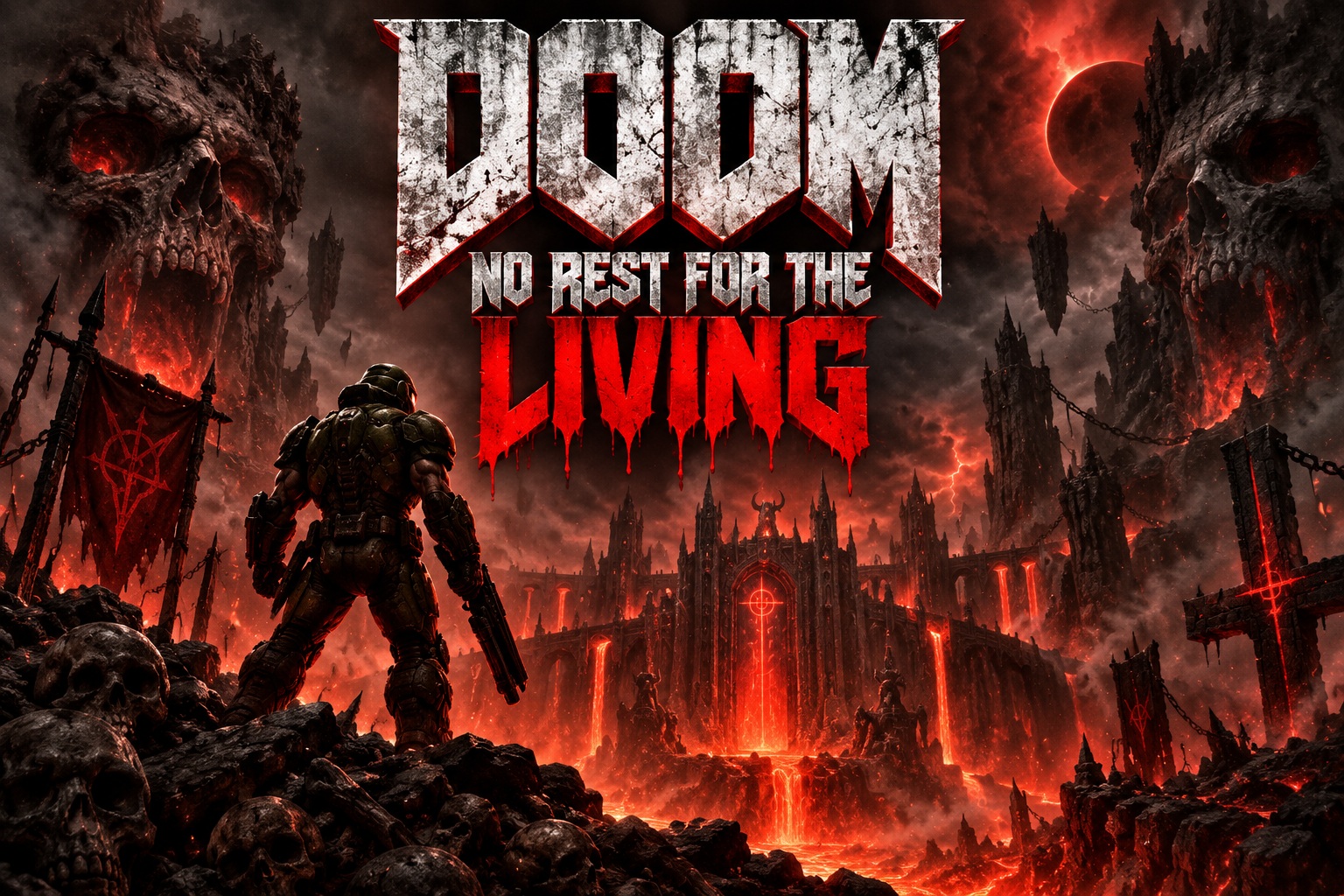
DOOM II: No Rest for the Living is an official expansion episode that takes the familiar mechanics of DOOM II and places them inside a new collection of carefully designed maps built around fast movement, brutal enemy encounters, hidden secrets, traps, and constant pressure. Rather than dramatically changing the original formula, the expansion focuses on level design and combat pacing, using the classic arsenal and familiar demon roster to create fresh situations that demand stronger awareness and smarter resource management. Every map feels designed for players who already understand how DOOM works and are ready for tighter spaces, more dangerous enemy combinations, and carefully placed ambushes. The result is a compact but highly memorable extension of DOOM II.
What makes No Rest for the Living especially effective is how confidently it uses existing mechanics without relying on new weapons or monsters. Revenants, Mancubi, Arachnotrons, Hell Knights, Pain Elementals, and Arch-viles all return, but their placement often creates encounters that feel different from the original campaign. Narrow corridors can suddenly open into large combat spaces, switches may trigger attacks from unexpected directions, and apparently safe rooms can quickly become dangerous once the level reveals another hidden threat. The familiar Super Shotgun, rocket launcher, plasma gun, and BFG 9000 therefore remain essential tools rather than nostalgic extras.
Now playable online through Lemon Web Games, DOOM II: No Rest for the Living can be experienced directly in your web browser as part of a growing collection of classic, retro, horror, action, first-person shooter, and browser-playable games. Its browser-based format makes it easy to jump directly into one of the most polished official expansions created for classic DOOM II while preserving the fast movement, weapon switching, key hunting, monster infighting, secret searching, and relentless demon-slaying combat that define the original experience. For players who already enjoy DOOM II and want another tightly designed campaign without leaving the classic gameplay behind, No Rest for the Living is an excellent continuation.
An Expansion Built for Experienced DOOM Players
No Rest for the Living assumes that players already understand the core mechanics of DOOM II. The maps are therefore less interested in teaching basic movement or weapon use and more focused on testing how well players can react under pressure. Enemy encounters frequently combine several monster types at once, forcing players to think about positioning, ammunition, and target priority instead of simply firing at the nearest demon. This gives the expansion a noticeably more deliberate rhythm than many early DOOM maps.
The difficulty often comes from how the environment and monsters are combined rather than from overwhelming numbers alone. A Revenant placed in a narrow corridor becomes much more dangerous when another enemy blocks the escape route, while an Arch-vile can turn a previously cleared area into a serious problem if it appears at the wrong moment. Players who understand enemy behavior can still use movement and monster infighting to gain control. The expansion rewards knowledge rather than brute force.
The Super Shotgun Remains Essential
The Super Shotgun continues to be one of the most important weapons throughout the expansion. Its powerful close-range blast makes it perfect for Hell Knights, Revenants, and groups of medium-strength enemies, while its slower reload forces players to use movement intelligently between shots. The weapon feels especially satisfying in No Rest for the Living because many encounters take place in spaces where close-range combat is unavoidable. A well-timed blast can completely change the flow of a dangerous room.
The regular shotgun still remains useful because it consumes less ammunition and allows faster follow-up shots, making weapon choice more important than simply selecting the strongest option. Efficient players switch naturally between the two depending on the enemy and available resources. This familiar weapon balance is part of what keeps classic DOOM combat so engaging. No Rest for the Living uses that balance extremely well.
Revenants Create Constant Pressure
Revenants appear frequently and remain one of the most dangerous enemies in the classic DOOM II roster. Their homing projectiles can force players to keep moving even when dealing with other threats, while their strong melee attacks make close encounters equally risky. In open spaces they create pressure through tracking fireballs, but in narrow corridors they can become even more dangerous because there may be very little room to dodge. Their presence often changes the entire pace of an encounter.
No Rest for the Living frequently places Revenants in positions where players cannot simply stand still and exchange fire. Movement becomes mandatory, and the environment must be used to break projectile tracking or create safe angles. This keeps combat active and encourages players to remain aware of their surroundings. Revenants are a perfect example of how the expansion uses familiar enemies in more demanding ways.
Mancubi Control Large Areas
Mancubi are especially dangerous when positioned in wider arenas or elevated locations. Their repeating projectile patterns can cover large sections of the battlefield and force players to move carefully between incoming attacks. Fighting one Mancubus can be manageable, but several together can turn an open area into a dense wall of fire. Players need to watch the attack pattern and avoid becoming trapped against walls or other enemies.
These demons also create excellent opportunities for monster infighting. Their wide projectiles frequently strike nearby enemies, causing different monster groups to begin attacking one another. Skilled players can deliberately position themselves to encourage this chaos and reduce the number of threats without spending as much ammunition. No Rest for the Living regularly rewards this kind of tactical awareness.
Arachnotrons Keep You Moving
Arachnotrons use rapid plasma fire to control open areas and punish players who remain exposed for too long. Their sustained attacks differ from the slower projectiles used by many other demons, meaning they can create constant pressure while other enemies approach from different directions. They are especially dangerous when placed on platforms or across open rooms where their fire can reach the player continuously. Eliminating them quickly can make a complicated encounter much easier.
Their mechanical appearance also adds visual variety to the otherwise hellish environments. Seeing an Arachnotron positioned on a distant ledge immediately tells experienced players that movement will be required. The combination of distance, sustained fire, and other nearby monsters often creates memorable firefights. The expansion makes strong use of this pressure.
Arch-viles Can Turn Victory Into Disaster
Arch-viles remain one of the most threatening enemies in DOOM II because they can both attack the player directly and resurrect defeated monsters. A room that seemed completely safe can suddenly become dangerous again if an Arch-vile appears and begins restoring enemies that were already eliminated. This ability makes them an immediate priority whenever they enter the battle. Ignoring one for too long can transform a manageable encounter into a disaster.
No Rest for the Living uses Arch-viles carefully rather than placing them everywhere. Their appearance usually marks a moment where players need to change priorities immediately and find cover while dealing heavy damage quickly. The distinct sound of an Arch-vile can create tension before the monster is even visible. Few enemies in the game can alter the atmosphere of a room so quickly.
Pain Elementals Can Overwhelm the Battlefield
Pain Elementals create Lost Souls instead of relying on conventional projectile attacks, which means the longer they survive, the more complicated the encounter becomes. A single Pain Elemental can fill the air with additional enemies if the player does not eliminate it quickly. In confined spaces this can become particularly dangerous because Lost Souls can block movement and interrupt attacks. The best strategy is usually to treat the Pain Elemental as a high-priority target.
The expansion uses this enemy effectively by combining it with other monsters that already demand attention. Players may need to choose between attacking a Pain Elemental immediately or dealing with a nearby Revenant or Mancubus first. These decisions create tension because the wrong priority can make the fight much harder. Target selection therefore becomes an important part of survival.
Hell Knights Provide Durable Frontline Pressure
Hell Knights remain a reliable source of pressure because they are strong enough to absorb significant damage while still appearing frequently enough to become part of ordinary combat. Their fireballs are relatively straightforward to dodge, but they become dangerous when combined with other enemies or when the environment limits movement. The Super Shotgun works particularly well against them, making close-range timing and positioning important. Multiple Hell Knights can quickly consume ammunition if players are careless.
Their role is especially effective in encounters where weaker enemies create distractions. While the player deals with Imps or Zombies, the Hell Knights continue advancing and controlling space. This combination forces movement and prevents players from focusing entirely on one target. The expansion repeatedly uses these interactions to make familiar monsters feel dangerous again.
Level Design Is the Real Star
The strongest feature of No Rest for the Living is its level design. The maps are compact enough to remain readable but complex enough to reward exploration and careful observation. Corridors frequently loop back into earlier areas, switches change the environment, and doors reveal spaces that were visible long before they became accessible. This creates a strong sense that the levels are interconnected rather than simply arranged as a sequence of separate rooms.
The layouts also make excellent use of verticality and sightlines. Enemies can attack from elevated platforms, hidden alcoves, or distant windows, forcing players to pay attention to more than just what is directly ahead. These design choices help the maps feel more modern than many original DOOM II levels without losing the classic style. Exploration and combat remain tightly connected throughout the episode.
Ambushes Are Everywhere
Many rooms in No Rest for the Living are designed to make players suspicious. Picking up a key, pressing a switch, or entering an apparently empty area can trigger doors, walls, or platforms that reveal hidden enemies. This creates a constant sense of tension because progress often comes with consequences. Experienced players quickly learn to look for escape routes before activating something important.
The best ambushes are not simply about surprising the player. They create combat situations where movement and target priority suddenly become crucial. A previously safe corridor may become blocked while enemies attack from both sides, or a new platform may reveal powerful monsters overlooking the room. These moments give the expansion a strong identity and keep players alert.
Secrets Reward Careful Exploration
Secrets remain an important part of the experience and frequently contain ammunition, health, armor, or powerful weapons. Some are hidden behind suspicious wall textures or unusual architecture, while others require players to notice less obvious clues within the environment. Finding them can make later encounters significantly easier, especially on higher difficulty settings. This encourages players to explore rather than rushing directly toward the exit.
Secret hunting also increases replay value because completing a level does not necessarily mean understanding everything it contains. Players can return later and search for hidden rooms they missed the first time. Learning these locations can dramatically improve future runs. The expansion continues the classic DOOM tradition of rewarding curiosity.
Resource Management Is Constantly Important
Ammunition management plays a major role because the expansion regularly presents strong enemies without giving players unlimited resources. Rockets and plasma cells are extremely useful but can disappear quickly during large encounters. Shells remain valuable because the Super Shotgun is so effective, but careless firing can leave the player underprepared later. Knowing when to use each weapon becomes essential.
Health and armor require similar attention. A player who takes unnecessary damage early in a map may struggle when a larger ambush appears later. Saving health pickups when possible can make the difference between surviving and restarting. The expansion constantly reminds players that every resource matters.
The Rocket Launcher Rewards Good Positioning
The rocket launcher remains one of the best options for groups of enemies or tougher targets at medium range. Its splash damage can quickly reduce large groups, but using it carelessly in tight spaces can damage the player instead. This makes positioning extremely important. No Rest for the Living frequently places enemies in spaces where rockets are powerful but risky.
Experienced players learn to create distance before firing and use corners or open areas to avoid self-damage. Rockets also work well for initiating monster infighting because explosions can affect several targets at once. When ammunition is available, the weapon becomes one of the most effective tools for controlling large encounters. It rewards confidence without allowing careless play.
The Plasma Gun Handles Dangerous Targets Quickly
The plasma gun remains ideal when a powerful enemy needs to be eliminated immediately. Its rapid energy fire can stun and damage many targets before they have time to respond effectively. This makes it especially useful against Arch-viles, groups of Revenants, or other situations where hesitation could become dangerous. The challenge is deciding when spending valuable cells is justified.
No Rest for the Living frequently creates situations where saving plasma ammunition becomes strategically important. Players may be tempted to use it during smaller encounters, only to discover a much more dangerous room later. This creates a constant tension between immediate convenience and future survival. Efficient players learn when to hold back.
The BFG 9000 Remains the Ultimate Emergency Weapon
The BFG 9000 retains its reputation as the most powerful weapon in the classic arsenal. When several strong monsters occupy the same space, a well-positioned BFG shot can completely change the encounter. The weapon is especially useful in large arenas where multiple high-health demons appear at once. Its enormous damage potential makes energy cells some of the most valuable resources in the game.
Using the BFG effectively still requires understanding its unusual damage behavior and positioning. Firing randomly wastes ammunition and reduces its usefulness, while experienced players can eliminate groups of enemies with remarkable efficiency. No Rest for the Living provides several situations where proper BFG use feels extremely rewarding. It remains one of the most satisfying weapons in FPS history.
Keys Continue to Structure Progress
Colored keys and skull keys remain essential to the map progression. Players frequently see locked doors long before finding the corresponding key, encouraging them to remember important locations and explore alternate paths. The system is simple but works extremely well because it gives players clear goals without relying on modern objective markers. The environment itself communicates where progress is blocked.
Finding a key often triggers a new phase of the level. Doors that were previously inaccessible become available, but the act of collecting the key may also trigger an ambush or reveal new enemies. This keeps progression from becoming predictable. Every important pickup can potentially change the battlefield.
The Automap Becomes Extremely Useful
Because the maps contain interconnected areas and hidden routes, the automap remains an important navigation tool. It allows players to understand which sections have already been explored and identify corridors or rooms that may still contain objectives. This is especially useful when multiple locked doors or switches are involved. The map helps without completely removing the need for spatial awareness.
Experienced players also use the automap to search for potential secrets. Unusual gaps or unexplored spaces can suggest that something is hidden nearby. This adds another layer to exploration and rewards players who take the time to examine the level structure. The automap remains one of the most useful tools in classic DOOM.
Monster Infighting Can Save Ammunition
The larger enemy combinations in No Rest for the Living make monster infighting especially valuable. A Mancubus projectile that hits another demon can start a battle between enemy groups, giving the player time to reposition or conserve ammunition. Skilled players can deliberately stand between enemies and move away at the right moment to trigger these conflicts. This turns the monsters themselves into part of the player's strategy.
Infighting also creates unpredictable and entertaining situations. Two powerful demons may spend time attacking each other while the player watches from a safe distance. The survivor can then be finished with much less ammunition. This system gives every large encounter additional tactical possibilities.
Higher Difficulty Changes Everything
Difficulty settings significantly change how demanding the expansion becomes. Additional enemies can transform familiar rooms into completely different challenges, while reduced room for error makes resource management much more important. Players who understand the map on a moderate difficulty may still struggle when stronger enemy combinations appear on higher settings. This gives the episode substantial replay value.
Higher difficulty also rewards deeper knowledge of secrets and optimal routes. Knowing where health, armor, and powerful weapons are located becomes extremely valuable. Players need to use movement more efficiently and manipulate enemy behavior whenever possible. The same map can therefore provide very different experiences depending on the selected difficulty.
The Expansion Feels Modern Without Losing Classic DOOM
One of the strongest qualities of No Rest for the Living is that the levels feel more polished and deliberate than many early 1990s maps while still remaining unmistakably classic DOOM. The architecture is more detailed, enemy placement is more carefully structured, and encounters often use the environment in clever ways. However, the core gameplay remains completely familiar. Nothing feels like it was added simply to modernize the experience artificially.
This balance makes the expansion appealing to both longtime players and those discovering classic DOOM later. Veterans receive new maps that respect the mechanics they already understand, while newer players see how much variety can be created using a relatively simple set of systems. The episode demonstrates how strong level design can refresh an old game without changing its fundamental identity.
The Compact Campaign Works in Its Favor
No Rest for the Living is smaller than a full standalone DOOM campaign, but that compact size helps maintain consistently strong pacing. There is little room for filler, and most maps introduce interesting layouts or combat ideas quickly. The campaign feels focused because every level contributes to the overall experience without overstaying its welcome. This makes it ideal for players who want a complete DOOM experience without committing to a very long megawad.
The shorter structure also encourages repeated play. Once players understand the maps, they can return to search for secrets, improve completion times, or attempt harder difficulty settings. Familiarity makes future runs faster and more confident. The expansion becomes increasingly enjoyable as map knowledge improves.
Why No Rest for the Living Still Feels Fun
No Rest for the Living remains enjoyable because it focuses entirely on the strengths of classic DOOM II. Fast movement, powerful weapons, readable enemies, interconnected levels, secret hunting, monster infighting, and limited resources all work together without unnecessary complexity. The expansion does not need new mechanics because the existing systems are already flexible enough to create fresh challenges. Good level design does most of the work.
The episode also rewards improvement very clearly. Players who initially struggle with ambushes eventually learn where enemies appear and how to control the encounter. Better weapon selection reduces ammunition waste, while improved movement prevents unnecessary damage. Each replay becomes smoother because the player's understanding grows.
Playing DOOM II: No Rest for the Living Online Today
Through Lemon Web Games, DOOM II: No Rest for the Living can now be played directly in your web browser with no downloads or setup required. Features of the web-based version include:
• Browser-based play for quick access
• No installation required
• Classic DOOM II first-person shooter gameplay
• Tight and interconnected maps filled with traps, switches, keys, and hidden secrets
• Familiar enemies including Revenants, Mancubi, Arachnotrons, Hell Knights, Pain Elementals, and Arch-viles
• The full classic arsenal including the Super Shotgun, rocket launcher, plasma gun, and BFG 9000
• Accessible play through Lemon Web Games
Playing No Rest for the Living online today makes it easy to experience one of the strongest official expansions built around the classic DOOM II formula. The browser format allows players to begin fighting almost immediately while preserving the fast movement, resource management, secret hunting, and tactical combat that make the episode memorable. It works equally well for a quick map or a longer session through several levels.
Who Should Play DOOM II: No Rest for the Living
• Players who enjoy classic first-person shooters
• Fans of DOOM II looking for additional official maps
• Players who enjoy compact but challenging level design
• Fans of the Super Shotgun, rocket launcher, plasma gun, and BFG 9000
• Players who enjoy secrets, traps, ambushes, key hunting, and monster infighting
• Anyone looking for a browser-playable expansion that stays faithful to classic DOOM
No Rest for the Living is especially suitable for players who already understand the basic mechanics of DOOM II and want something slightly more demanding. The maps expect stronger movement, better resource management, and more awareness of enemy behavior than many early campaign levels. For anyone who enjoys replaying maps to discover secrets or improve efficiency, the expansion offers excellent long-term value.
Play DOOM II: No Rest for the Living Online Now
DOOM II: No Rest for the Living is now available to play online through Lemon Web Games, giving players an easy way to experience this official expansion directly in the browser. The episode takes the familiar DOOM II arsenal and enemy roster and places them inside a new set of tightly designed maps filled with traps, ambushes, hidden areas, and increasingly dangerous combat situations. Every level encourages players to move quickly, search carefully, and think about ammunition before committing to a fight.
For players exploring the Lemon Web Games library, No Rest for the Living offers a concentrated dose of classic DOOM gameplay without feeling like a simple collection of leftover maps. Its stronger level design, aggressive enemy placement, and excellent pacing make it feel like a deliberately crafted continuation of DOOM II. Whether you are clearing Revenants with the Super Shotgun, using a Mancubus to trigger monster infighting, or searching suspicious walls for another hidden room, the expansion constantly rewards experience and attention.
Final Thoughts
DOOM II: No Rest for the Living succeeds because it understands exactly what makes classic DOOM enjoyable and focuses entirely on those strengths. The expansion does not need a new arsenal or complicated mechanics because the combination of fast movement, strong enemy design, limited resources, interconnected levels, secret areas, and carefully timed ambushes already provides enormous variety. By using those familiar elements in smarter and more demanding ways, the episode feels fresh without losing the identity of DOOM II.
Its greatest strength is the consistency of its level design. Maps are compact enough to remain readable but detailed enough to encourage exploration, while enemy placement continually creates situations where movement and target priority matter. Familiar monsters feel dangerous again because the environment gives them new opportunities to pressure the player. That makes every room feel deliberately constructed rather than randomly filled with enemies.
Through Lemon Web Games, DOOM II: No Rest for the Living can be enjoyed directly in the browser as an excellent extension of one of the most influential first-person shooters ever made. It remains a strong choice for fans of retro FPS games, classic DOOM, challenging map design, and fast combat built around skill rather than complicated progression systems. For anyone who has already survived Hell on Earth and still wants more, No Rest for the Living proves that there is always another demon-filled corridor waiting ahead.











Comments 0