

Qualcomm has introduced two new mobile chipsets aimed at making affordable smartphones feel faster, smoother, and more capable. The Snapdragon 6 Gen 5 is designed for upper midrange devices, while the Snapdragon 4 Gen 5 targets entry-level and budget-friendly phones. On paper, both platforms are not just routine yearly updates. They represent Qualcomm's continued push to bring features once associated with higher-end smartphones into more accessible price segments.
For everyday users, this matters because the midrange and entry-level phone market has become extremely competitive. Many people no longer upgrade purely for flagship-level power. Instead, they want a phone that feels smooth, opens apps quickly, handles casual gaming well, takes decent photos, and lasts through the day. Qualcomm's latest chips appear to be built around exactly that idea: improving the real-world experience without pushing phone prices too high.
A Bigger Focus On Smoothness And Everyday Responsiveness
One of the key additions across both chipsets is Snapdragon Smooth Motion UI. This is Qualcomm's new feature aimed at improving how fluid a phone feels during normal use. It is designed to reduce stutters in the interface, improve animation smoothness, and make app launching feel quicker.
This may sound like a small thing, but it can make a big difference in budget and midrange phones. Raw benchmark numbers are useful, but the average user usually notices lag, slow app opening, choppy scrolling, and inconsistent animations more than they notice processor scores. By focusing on UI smoothness, Qualcomm seems to be targeting the part of smartphone performance that people actually feel every day.
Snapdragon 6 Gen 5: A Stronger Midrange Platform
The Snapdragon 6 Gen 5 is the more powerful of the two new chipsets and is clearly aimed at phones that sit just below the premium category. Qualcomm says it delivers a 21 percent improvement in graphics performance compared to its predecessor, along with an 8 percent improvement in power efficiency.
That combination is important because midrange phones often need to balance performance and battery life carefully. A faster GPU is useful for gaming, smoother visual effects, and heavier apps, but better efficiency helps prevent the phone from draining battery too quickly or heating up too much during extended use.
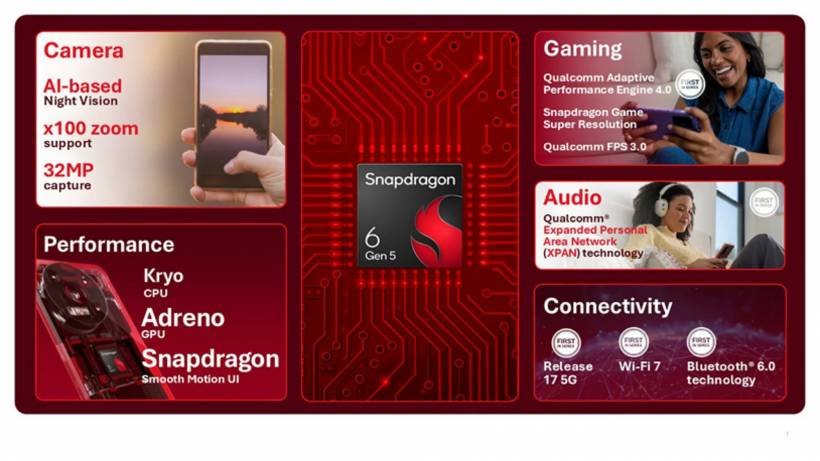
Qualcomm has also included Adaptive Performance Engine 4.0 and Adaptive Performance FPS 3.0. These features are designed to help maintain more stable frame rates during gaming. In practical terms, this should help reduce sudden performance drops when a game becomes more demanding, although the final result will still depend on how each phone manufacturer handles cooling, software tuning, and battery management.
Gaming Features Are Moving Further Down The Price Range
Another notable feature in the Snapdragon 6 Gen 5 is Snapdragon Game Super Resolution. This allows games to upscale visuals while helping reduce power consumption. Instead of rendering everything at a higher native resolution, the chipset can help improve the appearance of games more efficiently.
This kind of feature shows how gaming has become a serious focus even outside flagship phones. Many users in the midrange segment play mobile games regularly, and smoother frame rates can matter more than having the absolute highest graphics settings. The Snapdragon 6 Gen 5 also supports displays up to 144Hz at 1080p+ resolution, which means phone makers can pair the chip with high-refresh-rate screens for smoother scrolling and gameplay.
Connectivity also gets a modern upgrade here, with support for Wi-Fi 7, Bluetooth 6.0, and tri-band wireless networking. These are strong additions for a midrange platform, especially as newer routers, wireless accessories, and low-latency use cases become more common.
Camera And Imaging Improvements On Snapdragon 6 Gen 5
On the camera side, the Snapdragon 6 Gen 5 includes a 12-bit dual ISP and supports camera sensors up to 200MP. Of course, megapixel numbers alone do not guarantee great image quality, but this gives manufacturers more flexibility when building camera systems around the chip.
Qualcomm has also included AI-assisted imaging features such as AI night vision, AI image enhancement, and digital zoom support up to 100x. These features suggest that Qualcomm is leaning more heavily into computational photography, where software and AI processing help improve photos beyond what the sensor captures on its own.
Video recording support remains at 4K 30fps using H.264 or H.265 encoding. That is reasonable for this class of device, although users hoping for more advanced recording options may still need to look at higher-end chipsets.
The Snapdragon 6 Gen 5 also supports LPDDR5 memory and UFS 3.1 storage, which should help with faster app loading, smoother multitasking, and better overall responsiveness when used in properly configured devices.
Some Trade-Offs Are Still Present
Despite the upgrades, the Snapdragon 6 Gen 5 does come with a few compromises. One of the more noticeable changes is the removal of mmWave 5G support. For many markets, this may not be a major issue because sub-6GHz 5G remains far more common than mmWave. Still, it does mean the platform is slightly less complete from a 5G capability perspective.
Another downgrade is USB connectivity. The new chip supports USB 2.0 speeds, whereas the previous generation supported USB 3.2 Gen 1. For users who rarely transfer files using a cable, this may not matter much. But for those who move large videos, photos, or backup files directly from phone to computer, slower USB speeds could be disappointing.

Snapdragon 4 Gen 5: A Big Push For Budget Phones
The Snapdragon 4 Gen 5 is aimed at more affordable smartphones, but Qualcomm is positioning it as a major upgrade for the entry-level segment. The biggest claim is up to 77 percent higher GPU performance compared to the previous generation.
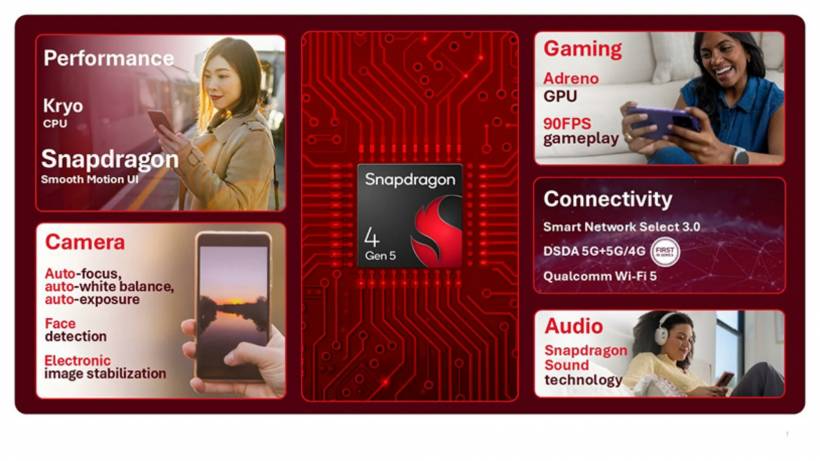
That is a significant improvement if it translates well into real-world devices. Qualcomm says this is the first Snapdragon 4-series platform capable of supporting 90FPS gaming. For budget phones, that is a notable step forward because entry-level devices have traditionally focused more on basic usability than gaming smoothness.
Snapdragon Smooth Motion UI is also included here, and Qualcomm claims it can help deliver 43 percent faster app launches and 25 percent less interface stutter compared to the earlier model. Again, these are the kinds of improvements that could make budget phones feel less frustrating in daily use.
Better Battery Efficiency And Display Support
While CPU clock speeds on the Snapdragon 4 Gen 5 have only increased slightly, Qualcomm says efficiency refinements allow for up to 10 percent better battery performance. This is especially important for lower-cost smartphones, where users often expect strong battery life and may not be upgrading every year.
The chipset also supports 1080p+ displays with refresh rates of up to 144Hz. This is interesting because high-refresh-rate displays are now becoming common even outside premium devices. If manufacturers pair the chip with a good screen and optimized software, budget phones using the Snapdragon 4 Gen 5 could feel much smoother than older models.
Camera support has also improved, with support for sensors up to 108MP and 4K video recording. The addition of 4K video is useful because it gives entry-level devices more modern media capabilities, even if actual video quality will still depend heavily on the sensor, lens, stabilization, and software processing used by each phone brand.
Improved Dual SIM 5G Support
Another useful upgrade in the Snapdragon 4 Gen 5 is the modem. Qualcomm has added Dual SIM Dual Active 5G + 5G/4G support, allowing two SIM connections to remain active at the same time.
This can be especially useful in markets where dual SIM usage is common. Users who separate work and personal numbers, or who use different mobile networks for coverage and data pricing, may benefit from better simultaneous connectivity.
Older Connectivity And Memory Limitations Remain
However, the Snapdragon 4 Gen 5 still has some clear entry-level limitations. It continues to rely on Wi-Fi 5 and Bluetooth 5.1, which are older local connectivity standards compared to what is available on higher-end platforms.
Another interesting limitation is memory support. The Snapdragon 4 Gen 5 only supports LPDDR4X RAM, while the previous generation supported LPDDR5. That may seem unusual, especially when other parts of the chip have improved. In real-world use, this could affect memory bandwidth and multitasking performance depending on how phone makers configure their devices.
What This Means For Future Affordable Smartphones
Overall, the Snapdragon 6 Gen 5 and Snapdragon 4 Gen 5 show that Qualcomm is trying to make lower-cost phones feel more polished. The Snapdragon 6 Gen 5 appears to be a strong option for midrange phones that want better gaming, newer connectivity, high-refresh-rate displays, and improved camera support. The Snapdragon 4 Gen 5, meanwhile, brings meaningful performance and smoothness improvements to the budget segment.
The real test will come when phone makers start releasing actual devices using these platforms. Chipset capability is only one part of the experience. Cooling design, software optimization, memory configuration, display quality, camera tuning, and pricing will all determine whether these new chips truly deliver better value to consumers.
Still, the direction is clear. Affordable smartphones are no longer just about basic performance. Users now expect smooth displays, capable cameras, better gaming, long battery life, and reliable 5G connectivity even at lower price points. With the Snapdragon 6 Gen 5 and Snapdragon 4 Gen 5, Qualcomm is trying to push those expectations even further into the mainstream.











Comments 0