

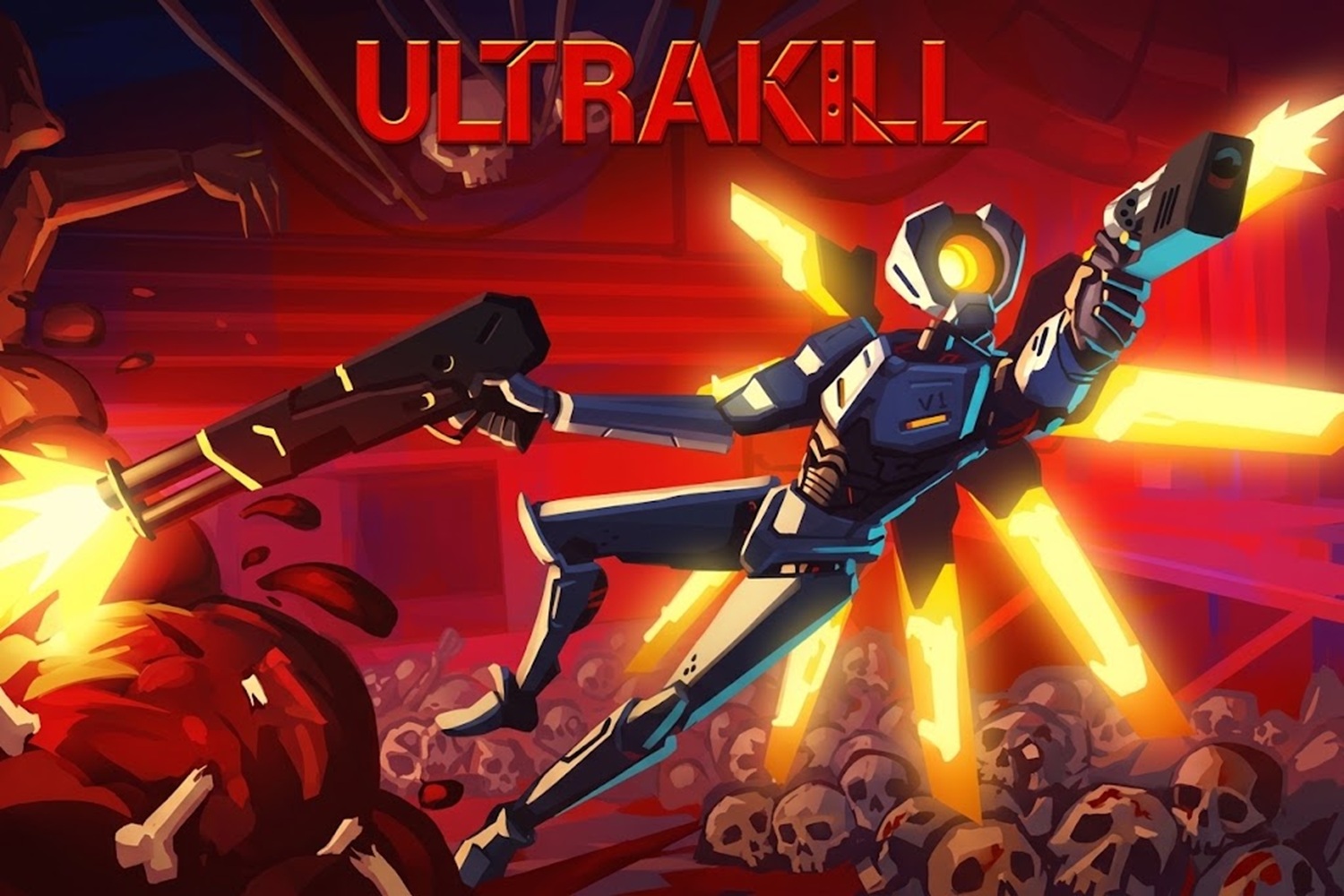
ULTRAKILL takes the speed of classic first-person shooters, mixes it with the expressive combat philosophy of stylish action games, and then pushes both ideas to an almost ridiculous extreme. Players control V1, a combat machine that descends through Hell in search of blood, tearing through demons, machines, husks, and increasingly dangerous bosses while constantly moving between weapons and advanced techniques. Standing still is rarely a viable option. Survival depends on staying aggressive, controlling space, and understanding how movement and offense can be combined into one continuous flow.
What makes ULTRAKILL especially unusual is how much freedom exists inside what initially appears to be a straightforward retro shooter. Revolvers, shotguns, nailguns, railcannons, rocket launchers, alternate weapon variants, different arms, coins, projectiles, explosions, and enemy attacks can interact in ways that reward experimentation rather than simply selecting whichever weapon has the highest damage. A shotgun blast can be punched forward as a projectile boost, enemy attacks can be parried back, coins can redirect shots toward vulnerable targets, and explosives can become part of larger combinations. The game rarely tells players there is only one correct way to fight.
Now playable online through Lemon Web Games, ULTRAKILL brings V1's hyper-aggressive descent through Hell directly into the web browser, allowing players to experience its fast movement, blood-based healing, weapon interactions, parries, style rankings, boss encounters, secrets, and high-speed arena combat without relying on a conventional installation. New players can approach the game as an intense retro FPS, while experienced players can spend far longer mastering movement techniques, weapon combinations, challenge objectives, hidden areas, and increasingly efficient ways of clearing encounters. The basic objective is easy to understand—move quickly and destroy everything—but the combat system contains enough depth to support an enormous amount of experimentation.
V1 Is a Machine That Survives on Blood
ULTRAKILL places players inside V1, a machine designed for combat in a world where humanity is gone and blood has become an essential resource. Rather than relying primarily on health packs scattered through levels, V1 can recover by getting close to enemies and covering itself in fresh blood. This creates one of the most important relationships in the entire game: aggression is not merely rewarded with faster kills, but can directly keep the player alive.
That healing mechanic immediately changes the usual FPS instinct of retreating whenever health becomes low. Running far away from enemies may create temporary safety, but it also moves V1 away from the resource needed to recover. Closing the distance and attacking aggressively can therefore be the safer long-term option. The player is constantly balancing danger against the need to remain close enough to heal.
This gives combat a distinctive rhythm. Getting hurt does not necessarily mean slowing down. It can mean becoming even more aggressive, rushing toward an enemy, dealing heavy damage, and using the resulting blood to recover. ULTRAKILL turns vulnerability into motivation.
Movement Is as Important as Gunfire
V1 is extremely mobile, and learning that movement is one of the keys to enjoying ULTRAKILL. Sliding allows the player to maintain speed across open surfaces, dashing provides rapid directional movement, jumping can be combined with momentum, and wall jumping creates additional routes through arenas. These systems make ordinary walking feel almost unnecessary once the player becomes comfortable.
The best movement is rarely random. Sliding through an arena can create enough distance from one threat while moving V1 toward another enemy that can provide healing. A dash can avoid a powerful attack while simultaneously positioning the player for a close-range shotgun blast. Good movement always has a purpose.
Experienced players eventually begin connecting movement techniques into continuous sequences. Combat stops feeling like aiming from one position and starts resembling a high-speed dance through the arena. The player is constantly attacking, repositioning, dodging, and preparing the next interaction.
Sliding Completely Changes the Pace
Sliding is one of ULTRAKILL's most important movement tools because it allows V1 to cross ground quickly while maintaining a low profile. It can be used to escape dangerous positions, move underneath certain attacks, or rapidly close the distance toward an enemy. The mechanic feels simple but becomes increasingly important as encounters become faster.
Sliding also combines naturally with other movement. Players can transition from a slide into a jump, redirect momentum, and continue attacking while moving. This makes the mechanic far more than an emergency dodge. It becomes part of ordinary navigation.
Once sliding becomes instinctive, slower movement begins feeling unnecessary. The player starts viewing arenas as spaces to flow through rather than rooms to stand inside. ULTRAKILL's speed comes as much from movement design as weapon fire.
Dashing Gives V1 Immediate Mobility
Dashing provides a rapid burst of movement that can avoid dangerous attacks or correct poor positioning. It is particularly useful when a boss launches something that cannot be comfortably sidestepped. A quick dash can move V1 out of danger almost instantly. Timing remains important because relying on it carelessly can leave the player without an immediate escape option.
Dashes also support aggressive play. Instead of waiting for an enemy to approach, players can dash directly into effective weapon range and attack before the target has time to respond. Close-range weapons become far more practical when V1 can cross space this quickly.
The strongest players use dashes as part of an overall movement plan rather than as panic buttons. Every dash creates a new position, and that position should ideally create another opportunity. Defense and offense remain connected.
Wall Jumps Make Arenas More Vertical
ULTRAKILL does not restrict movement to the floor. Wall jumping allows players to gain height and move through vertical spaces in ways that conventional shooters rarely encourage. This creates additional escape routes when ground-level enemies become overwhelming. It also opens unusual attacking angles.
Vertical movement is particularly useful against enemies whose attacks dominate horizontal space. Reaching higher ground can provide a better view of the battlefield and create time to choose another weapon. The player can then descend directly into close-range combat when the opportunity appears.
Wall jumping also makes level traversal feel faster outside combat. Rooms are not merely corridors connecting arenas. Movement itself remains enjoyable. Players can often find more efficient routes simply by understanding how V1 interacts with surfaces.
The Revolver Is Far More Than a Starting Weapon
The revolver may look like the simplest weapon in ULTRAKILL, but it remains useful throughout the game because its variations and interactions offer much more than ordinary pistol fire. Accurate shots can eliminate weaker enemies quickly, interrupt threats, or contribute to more advanced combinations. The weapon rewards precision without forcing the player to slow down.
Its greatest strength comes from how naturally it interacts with other systems. The revolver can be used to trigger certain opportunities created by coins, explosives, and vulnerable targets. This allows a supposedly basic firearm to remain relevant even after much more powerful weapons become available.
ULTRAKILL rarely makes earlier weapons obsolete. Instead, new equipment adds more tools to the player's arsenal. The revolver stays useful because the combat system values interaction rather than simple numerical progression.
The Marksman Coin Mechanic Is One of ULTRAKILL's Signature Ideas
The Marksman variation allows V1 to toss coins into the air and shoot them. A successful hit redirects the shot toward a suitable target, creating stylish ricochets that can damage enemies without requiring conventional direct aim. What initially looks like a humorous trick quickly becomes one of the deepest mechanics in the game.
Coins can be used while moving, falling, sliding, or fighting multiple targets. Experienced players can throw several coins, combine them with stronger attacks, or exploit timing to produce much greater damage. The mechanic rewards both precision and creativity.
More importantly, the coins teach one of ULTRAKILL's central lessons: weapons do not exist independently. A revolver ability can influence what another weapon does. The entire arsenal becomes a network of interacting systems.
Coin Ricochets Reward Practice
Landing a basic coin shot is relatively easy once the timing becomes familiar. Using coins efficiently during chaotic battles is considerably harder. The player needs to track enemy positions, coin trajectories, movement, and incoming attacks simultaneously. Mastery takes time.
The reward is substantial because coins allow players to damage difficult targets from unusual angles. An enemy that would normally require direct line of sight can sometimes be hit through a carefully positioned ricochet. Coins can also help maintain style by adding another technique to the player's combat rotation.
This makes the Marksman especially satisfying to learn. Early attempts may feel awkward, but eventually coin shots become something the player performs instinctively in the middle of a much larger combination. The mechanic grows alongside the player's confidence.
Shotguns Reward Close-Range Aggression
Shotguns naturally fit V1's need to remain close enough to enemies for blood healing. At short range, they can produce tremendous immediate damage and cover nearby targets efficiently. Rushing directly toward an enemy and firing at point-blank distance becomes one of the most reliable ways to regain control during dangerous encounters.
Their usefulness increases even further through ULTRAKILL's interaction systems. Shotgun projectiles can become part of advanced techniques rather than functioning only as normal pellets. This gives the weapon surprising depth.
The shotgun is therefore both beginner-friendly and highly technical. New players can appreciate its simple close-range power, while experienced players can use it as part of far more complicated combat sequences. Very few weapons in ULTRAKILL have only one purpose.
Projectile Boosting Turns the Shotgun Into Something Else
One of the game's most famous techniques involves punching a shotgun projectile immediately after firing it, effectively boosting the projectile forward and producing a powerful explosive attack. The timing takes practice, but once learned it dramatically expands the shotgun's useful range and damage potential. What looked like a close-range weapon suddenly becomes capable of explosive pressure at distance.
Projectile boosting demonstrates ULTRAKILL's design philosophy perfectly. The player is rewarded for discovering that two seemingly separate actions can interact. The shotgun fires, the arm punches, and together they produce something neither does alone.
This encourages experimentation with everything else in the arsenal. Once players realize that mechanics can combine this way, they begin asking what other interactions might exist. Curiosity becomes part of combat mastery.
Parrying Turns Enemy Attacks Against Them
Certain incoming attacks can be parried with the correct arm and timing. Successfully doing so can reflect projectiles, interrupt threats, restore health, or produce significant damage depending on the situation. Instead of treating every enemy attack as something to avoid, the player begins viewing some attacks as opportunities.
This changes the psychology of combat. A dangerous projectile coming directly toward V1 may actually be desirable if the player is confident enough to parry it. The threat becomes a resource. ULTRAKILL repeatedly encourages this aggressive reinterpretation of danger.
Parrying also provides satisfying feedback. Successfully timing the action during a chaotic encounter can completely shift momentum. A move that would have damaged V1 instead becomes part of the player's offense.
Learning Parries Makes the Game Feel Completely Different
New players often rely primarily on movement to avoid incoming attacks. That works, but understanding parry opportunities adds another layer of control. Instead of constantly moving away from danger, players can stand their ground at exactly the right moment. Confidence increases dramatically.
Boss fights often become particularly rewarding once attack patterns are understood well enough to parry consistently. An encounter that initially seemed overwhelming can eventually feel almost cooperative, with the boss unintentionally providing attacks that V1 can exploit. Knowledge changes the relationship completely.
This learning process is central to ULTRAKILL. Enemies are difficult until their mechanics become understandable. Mastery then transforms fear into opportunity.
Different Arms Expand the Combat System
V1's arms function as important tools rather than simple melee attacks. Different arm abilities can support parries, powerful punches, explosions, or other interactions depending on the situation. Switching between them expands what the player can accomplish without needing another conventional firearm.
The melee system also keeps close-range combat active. If an enemy is already within reach, a punch can interrupt or finish them without requiring the player to step backward and aim another weapon. This maintains combat flow.
Arms interact with projectiles and environmental opportunities as well. Like every major system in ULTRAKILL, they are designed to connect with the rest of the arsenal. The player's hands become another category of weapon.
The Nailgun Provides Sustained Pressure
The nailgun offers a different style from the revolver and shotgun by producing continuous fire against targets. It is useful when the player wants to maintain sustained damage rather than deliver one enormous hit. Enemies that remain vulnerable for several seconds can be punished heavily. The weapon encourages tracking rather than single-shot precision.
Its alternate functions expand the possibilities considerably. Magnets and related mechanics can influence how projectiles behave and where damage is concentrated. This turns sustained fire into another system that rewards preparation.
The nailgun also works well against targets that are awkward to approach directly. Instead of immediately rushing into danger, players can maintain pressure while repositioning. Variety in engagement distance helps prevent combat from becoming repetitive.
Magnets Create Opportunities for Setup
Certain nailgun mechanics allow magnets to be placed into enemies or locations, influencing how projectiles behave around them. This gives players another way to prepare an encounter before committing to maximum damage. A well-placed setup can cause subsequent attacks to concentrate around the target. Positioning becomes part of weapon strategy.
This mechanic rewards anticipation. Rather than reacting only to what is happening now, the player can create conditions that will become useful several seconds later. ULTRAKILL constantly moves between immediate reflexes and planned interactions.
Magnets also interact with other projectiles and systems in ways that encourage experimentation. The more players understand the underlying mechanics, the more the weapon feels like a toolkit rather than a gun. Setup becomes another form of style.
The Railcannon Delivers Enormous Precision Damage
The railcannon provides some of the game's most powerful single attacks. Its shots can cut through targets and deal heavy damage, making it particularly useful against dangerous enemies that need to be removed quickly. The long recharge prevents players from relying on it constantly. Each shot therefore feels significant.
Different variations provide different utility, ranging from straightforward high-damage attacks to explosive or utility-focused effects. Choosing the right railcannon option depends on the situation. The weapon rewards awareness rather than automatic use.
Because it can interact with other mechanics, the railcannon becomes even more powerful in experienced hands. A supposedly simple charged shot can become part of a much larger sequence involving coins or explosives. ULTRAKILL continually encourages combining systems.
Railcoining Rewards Advanced Precision
One of the more advanced uses of the arsenal involves combining coins with high-powered railcannon attacks. By redirecting a powerful shot through carefully positioned coins, players can create enormous damage and hit enemies in ways that would otherwise be difficult. The technique requires timing and understanding of how the ricochet system works.
This is not necessary for simply completing ordinary encounters, but that is exactly why ULTRAKILL's depth is so appealing. Players can finish content using relatively straightforward combat and later return to learn techniques that completely change their efficiency. The game supports multiple levels of mastery.
Advanced interactions also make replaying stages worthwhile. The same enemy can be defeated in a much faster or more stylish way once the player understands additional techniques. Improvement remains visible long after basic completion.
Rocket Launchers Add Mobility and Explosive Control
The rocket launcher naturally provides strong explosive damage, making it useful against groups or larger enemies. ULTRAKILL extends that familiar idea through interactions that allow rockets to become part of movement and advanced combat techniques. Explosives are not merely things fired at enemies. They can become part of the player's overall mobility and setup.
Rockets also reward prediction because moving targets may leave the impact area before the projectile arrives. Players need to understand enemy behaviour rather than simply aiming at the current position. This creates another type of skill compared with hitscan weapons.
The weapon's versatility increases further through alternate mechanics. Like everything else in the arsenal, the rocket launcher becomes more interesting once the player stops treating it as an isolated tool.
Weapon Switching Is Central to High-Level Play
ULTRAKILL actively discourages relying on one weapon forever. Different enemies have different vulnerabilities, but the more important reason to switch is that the style system rewards variety. Repeating the same attack eventually provides less value. Players who constantly rotate through their arsenal earn better style ratings.
This encourages combat creativity. A player might begin with a revolver shot, move into a shotgun blast, punch the projectile, switch to the railcannon, toss a coin, and finish another target with a melee attack. The game rewards this kind of improvisation.
Weapon switching also prevents the arsenal from developing into a simple hierarchy. The question is not which gun is best overall. The question is which interaction is best right now.
The Style Meter Encourages Creative Violence
ULTRAKILL features a dynamic style-ranking system that evaluates how the player fights rather than merely whether enemies were defeated. Different techniques, weapon combinations, parries, movement, and unusual kills contribute toward higher rankings. Repetition becomes less valuable, encouraging constant variation.
This creates an important psychological change. The player begins looking for entertaining solutions rather than merely efficient ones. An enemy that could be eliminated with three simple shots might instead be launched into the air, hit with a coin ricochet, and finished with an explosive. The extra complexity becomes part of the fun.
Style is therefore not only a score. It teaches players how much freedom the combat system contains. Experimentation becomes its own reward.
Higher Style Means Playing With Confidence
Maintaining a strong style rank generally requires staying active and varied. Players cannot hide in a safe corner and repeatedly use one attack while expecting the highest ratings. Movement, aggression, and creativity all contribute. The system gently pushes players toward the way ULTRAKILL is designed to feel.
This can initially seem intimidating because new players are already trying to survive. Over time, however, stylish play becomes natural. Weapon switching increases damage options, aggressive movement provides blood, and parrying removes threats. The actions that look impressive are often mechanically useful.
The style meter therefore functions almost like a teacher. It rewards habits that make combat more effective and more entertaining simultaneously. Mastery looks good because mastery actually is good.
Blood Healing Makes Close Combat Worth the Risk
Many shooters encourage players to maintain distance from dangerous enemies. ULTRAKILL repeatedly creates reasons to move closer. Fresh blood is most useful when V1 is near the enemy being damaged. Close-range aggression therefore provides healing that distant play may not.
This makes shotgun attacks, punches, and aggressive movement incredibly important when health is low. The player can transform a dangerous position into recovery by moving directly toward the threat. Retreat is no longer automatically the safest response.
The mechanic creates constant tension because close-range combat is obviously risky. The player needs enough confidence to enter danger deliberately. ULTRAKILL rewards that confidence when executed correctly.
Hard Damage Prevents Unlimited Recklessness
Healing from blood is powerful, but the game includes mechanics that prevent players from recovering infinitely without consequence under every condition. Damage can temporarily limit the amount of health that can be restored, making repeated mistakes increasingly dangerous. This keeps aggressive healing from becoming completely effortless.
The system encourages players to distinguish between calculated aggression and careless damage trading. Getting close for blood can save the run, but repeatedly absorbing avoidable attacks creates problems. Offensive play still needs discipline.
This balance is important because it preserves tension. V1 is powerful, but not invulnerable. The player must earn the right to remain aggressive through good movement and timing.
Enemies Are Designed Around Specific Pressures
ULTRAKILL's enemy roster is effective because different opponents challenge different parts of the player's skill set. Some create pressure through numbers, others dominate areas with projectiles, and larger enemies demand concentrated damage. Certain threats punish players who remain grounded, while others become dangerous when ignored for too long. Priority matters.
The most difficult encounters combine several enemy types at once. One creature may be forcing constant movement while another launches attacks that need to be parried or avoided. The player needs to identify which threat is controlling the battlefield. Killing the wrong enemy first can make the encounter harder.
This makes combat feel tactical despite its extreme speed. The player is always making decisions about positioning and priority. Fast reflexes alone are not enough.
Husks Create the Foundation of Hell's Enemy Population
Many early enemies belong to the husk-like inhabitants of Hell, providing relatively straightforward threats that teach basic movement and weapon control. Individually they may be easy to eliminate, but groups can still create danger by occupying space. Their simplicity provides room for players to learn the arsenal.
Later encounters use weaker enemies almost like environmental pressure. While the player concentrates on a more dangerous target, husks can close from another direction and interfere with movement. Small threats remain relevant because they contribute to crowd control problems.
They also provide valuable blood during close-range combat. An enemy that is not especially threatening can become a useful source of healing. This turns even weaker opponents into tactical resources.
Machines Create a Different Kind of Threat
Other combat machines reflect the violent world V1 comes from and often provide more aggressive or technically demanding encounters. Fighting another machine can feel more like facing something built around the same philosophy of relentless combat. Speed and projectile pressure increase.
These enemies also reinforce the game's setting. Hell is not populated only by demons and dead souls. Machines have entered the conflict as well, all competing for the same resource. The world feels like the aftermath of something enormous.
Machine enemies often require different tactics from basic husks. Their attacks may be faster, more accurate, or more difficult to ignore. The player needs to adjust rather than relying on one universal approach.
Cerberi Introduce Heavier Combat
Cerberi represent a noticeable increase in threat compared with ordinary enemies. Their larger bodies and powerful attacks demand more focused attention. They can control significant portions of an arena and punish players who remain in predictable positions. Heavy targets like these encourage stronger weapon combinations.
The player's mobility remains extremely valuable. Staying close can provide blood, but moving around the enemy reduces the chance of absorbing heavy attacks. Combat becomes a constant exchange between aggression and evasion.
These larger enemies also make high-damage techniques feel more meaningful. Instead of wasting a powerful railcannon shot on a weak target, players can save it for something capable of surviving ordinary attacks. Weapon priority becomes strategic.
Malicious Faces Create Ranged Pressure
Floating enemies capable of launching powerful ranged attacks force the player to pay attention to the vertical dimension of combat. They can remain dangerous even when other enemies occupy the ground. Ignoring them for too long allows projectiles to accumulate. They often become high-priority targets.
Their attacks can also create opportunities for players familiar with parrying or other advanced mechanics. What initially feels like annoying ranged pressure can eventually become something exploitable. ULTRAKILL continually turns enemy abilities into potential player resources.
This progression is deeply satisfying. The enemy does not become weaker, but the player's understanding improves. Knowledge reduces fear.
Mindflayers Demand Awareness
Certain advanced enemies create substantial pressure through mobility, projectiles, and disruptive attacks. Mindflayers are especially dangerous because they can remain active while the player is dealing with several other threats. Their presence changes how the entire encounter needs to be approached.
Eliminating them quickly can reduce the amount of chaos on the battlefield, but doing so may require temporarily ignoring other enemies. This creates difficult priority decisions. The most dangerous target is not always the closest one.
Encounters containing multiple advanced enemies demonstrate how tactical ULTRAKILL becomes at high speed. Players are constantly deciding what needs attention next. Combat looks chaotic but is built around rapid decision-making.
Boss Battles Test Understanding Rather Than Raw Firepower
ULTRAKILL's bosses are memorable because they demand more than simply holding down the fire button. Strong movement, parrying, weapon switching, pattern recognition, and careful use of openings all become important. Bosses often feel overwhelming until their behaviour becomes understandable. Learning is part of the fight.
The best encounters reward aggression without allowing recklessness. Staying close may provide blood and strong damage opportunities, but bosses can punish careless positioning immediately. Players need to know when to press forward and when to create space.
Repeated attempts gradually transform these battles. Attacks that initially looked impossible to avoid become predictable. A frightening boss can eventually become an opportunity for stylish play.
V2 Creates a Mirror-Like Rival
V2 is one of the game's most recognizable opponents because fighting another highly mobile machine creates a very different kind of challenge from battling slower creatures. The encounter feels less like fighting a traditional monster and more like confronting something that understands movement and weapon pressure. Speed becomes central.
V2 can reposition rapidly, forcing the player to maintain aim while moving aggressively. The fight rewards familiarity with both shooting and traversal. Standing still makes the player an easy target.
The rivalry also helps establish V1 within the game's wider machine hierarchy. V1 may be incredibly powerful, but it is not the only advanced combat machine. The encounter gives the protagonist a mechanical counterpart.
Gabriel Provides Some of the Most Dramatic Encounters
Gabriel stands among ULTRAKILL's most important recurring characters and provides boss battles that combine speed, aggressive melee attacks, projectiles, and dramatic presentation. His confrontations feel personal in a way that many ordinary arena encounters do not. Dialogue and story context give the battles additional weight.
Mechanically, Gabriel tests the player's ability to follow a fast target while avoiding sudden attacks. The fight can initially feel overwhelming because he refuses to remain conveniently positioned. Players need to use V1's mobility fully.
As with many bosses, familiarity changes everything. Once his patterns become understandable, the encounter becomes a test of execution rather than confusion. Mastery creates confidence.
Prime Sanctums Offer Extreme Optional Challenges
ULTRAKILL contains hidden high-level challenges that push the combat system much further than ordinary progression requires. Reaching these areas demands strong performance elsewhere, while surviving what waits inside requires a deep understanding of movement, parrying, weapon interactions, and damage optimization. These challenges exist for players who want to go far beyond basic completion.
Prime encounters have developed a reputation for extreme difficulty because they punish hesitation and poor mechanics immediately. They are deliberately designed for players who have already mastered the fundamentals. Simply possessing strong weapons is not enough.
Their existence gives high-level players meaningful long-term goals. Completing ordinary stages does not represent the end of what the combat system can offer. There is always another level of mastery.
Secrets Reward Exploration Between Battles
Despite its reputation for nonstop violence, ULTRAKILL also rewards players who slow down and explore. Hidden areas, secret encounters, alternate routes, and unusual discoveries can be found throughout levels. These provide reasons to revisit stages after surviving them once.
Secrets often reveal the developers' sense of humor as well. ULTRAKILL is extremely intense, but it is not permanently serious. Strange discoveries and unexpected references provide moments of relief between difficult battles.
Exploration also encourages players to use movement abilities creatively outside combat. A suspicious opening or distant platform may be reachable through wall jumps, dashes, or momentum techniques. Traversal becomes a puzzle.
Secret Levels Can Completely Change the Genre
Some hidden stages deliberately abandon the normal combat structure and experiment with entirely different ideas. This unpredictability makes exploration especially rewarding because players never know whether a secret will contain another battle or something completely unexpected. The game is willing to make fun of its own intensity.
These diversions also prevent the experience from becoming exhausting. After several levels of relentless combat, encountering something strange or humorous can reset the player's expectations. Variety helps preserve the impact of the action.
The secret content demonstrates how confident ULTRAKILL is in its identity. It can temporarily become something completely different without losing its personality. The game understands when to be absurd.
Challenge Objectives Encourage Replayability
Levels can contain additional challenges beyond simply reaching the exit. These objectives may require players to complete a stage under unusual conditions or approach encounters differently from a normal run. The challenges push players out of comfortable habits. A technique that worked previously may no longer be appropriate.
This provides another reason to revisit familiar areas. Once the main route is understood, challenge objectives ask players to see the level differently. The environment becomes a puzzle again.
Completing optional goals also provides a stronger sense of mastery. Finishing a stage proves survival. Finishing it under unusual restrictions proves deeper understanding.
P-Ranks Turn Levels Into Performance Tests
ULTRAKILL allows skilled players to pursue extremely high level rankings based on speed, kills, style, and other performance requirements. Achieving a P-rank demands far more than simply surviving. The player needs to clear the stage efficiently while maintaining strong combat variety. Mistakes that are acceptable during an ordinary run suddenly matter.
This transforms familiar levels into optimization challenges. Players begin planning routes between encounters, deciding which enemies should be eliminated first, and choosing techniques that maintain style without wasting time. Every second becomes relevant.
P-ranking also provides a clear long-term progression goal that depends almost entirely on player skill. There is no equipment grind that automatically produces the result. Performance needs to improve.
Speedrunning Fits the Movement System Naturally
ULTRAKILL's fast traversal makes it especially suitable for players interested in completing levels as quickly as possible. Sliding, jumping, dashing, wall movement, explosions, and momentum interactions create opportunities to reduce travel time dramatically. A casual route and an optimized route can look completely different.
Speedrunning also reveals just how flexible the level geometry can be. Players may discover movement techniques that bypass sections or reach locations far faster than expected. Mechanical mastery becomes route knowledge.
Even players uninterested in formal speedrunning can experience this progression. Revisiting an early level after several hours often results in a much faster completion naturally. The player simply moves more confidently.
The Low-Resolution Visual Style Is Deliberate
ULTRAKILL embraces an intentionally retro visual presentation rather than attempting photorealism. Textures, models, effects, and environments evoke older 3D shooters while supporting extremely fast performance and strong visual clarity. The style also helps the game maintain a unique identity.
This presentation works particularly well during combat because enemies remain readable even when explosions, blood, and projectiles fill the screen. The player needs immediate information rather than enormous visual detail. Performance and clarity support speed.
The retro appearance also contrasts with the complexity of the mechanics. ULTRAKILL may look like an old shooter at first glance, but its combat systems are extremely modern and interconnected. The game uses nostalgia as a foundation rather than a limitation.
Hell Is Divided Into Distinctive Layers
V1's journey descends through different regions of Hell, each with its own visual themes, enemies, and environmental ideas. This prevents the campaign from feeling like one endless industrial corridor. One layer may emphasize monumental architecture while another creates a completely different atmosphere. The journey continually changes.
The environments also reflect the game's loose inspiration from classical depictions of Hell while freely reinterpreting them through its own surreal style. ULTRAKILL is not trying to present a realistic underworld. It creates something strange, mechanical, violent, and often beautiful.
Each new layer therefore feels like a genuine progression. The player is not simply entering another level. They are descending farther into a world that keeps becoming stranger.
The Story Exists Without Constantly Interrupting Combat
ULTRAKILL contains substantial lore, recurring characters, environmental storytelling, terminals, and larger themes surrounding humanity, machines, Hell, and divine authority. Yet it rarely stops the player for lengthy conventional exposition. Much of the story can be absorbed while continuing to play or explored more deeply through optional reading.
This approach suits the game's pace. Players who primarily want intense shooting can continue moving, while those interested in the world can spend more time investigating. The narrative supports the action without constantly interrupting it.
The result is a game that can feel simple or surprisingly deep depending on how closely the player looks. V1's immediate objective may be blood and survival, but the world surrounding that journey contains much larger questions.
The Soundtrack Drives the Combat Forward
Music is a major part of ULTRAKILL's intensity. Tracks can move between atmospheric sections and extremely aggressive compositions as combat begins, giving encounters additional momentum. Fast percussion, distorted guitars, electronic elements, and dramatic shifts reflect the chaos happening on screen.
The soundtrack works particularly well because it reacts emotionally to level progression. Exploration can feel ominous or quiet before combat suddenly erupts. The transition makes arenas feel more explosive.
Boss battles receive especially memorable musical treatment. The soundtrack reinforces that something important is happening before the player even fully understands the encounter. Audio becomes part of the game's identity.
Sound Effects Make Mechanical Feedback Extremely Clear
Weapons need to communicate power instantly in a game this fast. Revolver shots, shotgun blasts, parries, explosions, railcannon attacks, coin interactions, and enemy deaths all have recognizable audio feedback. Players can often understand whether something worked correctly without looking directly at the result.
The parry sound is particularly important because it immediately confirms successful timing. Similar feedback exists for other advanced interactions. Clear audio makes technical mechanics easier to learn.
This helps the game remain readable even when the screen becomes chaotic. Visual information can become overwhelming, but sound provides another channel for understanding what happened. Strong feedback supports mechanical mastery.
ULTRAKILL Rewards Experimentation More Than Memorization
Learning enemy patterns and level layouts obviously helps, but the combat system continually rewards players who ask what else might be possible. Can this projectile be punched? Can this shot interact with a coin? Can an explosion launch something into another enemy? Can a movement technique create a faster route? Curiosity often produces useful discoveries.
This is why the game feels unusually expressive. The developers provide systems rather than only predetermined solutions. Players discover combinations through experimentation. Some techniques become community standards precisely because someone explored an interaction deeply enough to find them.
The result resembles a sandbox inside a structured shooter. Arenas have objectives, but the method of completing them can vary enormously. Creativity becomes a mechanical advantage.
Beginners Do Not Need Every Advanced Technique
The enormous number of possible interactions can make ULTRAKILL look intimidating from the outside. Fortunately, new players do not need to master railcoining, advanced rocket movement, complicated projectile setups, or perfect parries immediately. Basic shooting and movement are enough to begin. Complexity can be learned gradually.
This is an important strength. The game provides depth without demanding that players understand everything during the first level. New weapons arrive gradually, allowing each system to be explored before another is added.
Players naturally learn according to curiosity. Someone may become comfortable with shotgun boosting early while ignoring advanced coin techniques until much later. The game supports individual learning paths.
Higher Difficulties Demand Better Fundamentals
Increasing difficulty changes how forgiving encounters feel. Enemies become more dangerous, and mistakes that were manageable before can become fatal quickly. Players need stronger movement, better priority decisions, and more reliable weapon combinations. Knowledge becomes increasingly important.
Higher difficulties also make parrying and blood management more valuable. The player has less room to absorb unnecessary damage. Every interaction needs to become more deliberate.
This allows ULTRAKILL to remain challenging after the campaign is understood. Completing levels on one setting does not necessarily mean the combat system has been mastered. Difficulty provides another progression path.
Combat Can Look Chaotic While Remaining Highly Controlled
Watching an experienced ULTRAKILL player can make the game appear almost impossible to follow. Coins fly through the air, weapons switch constantly, enemies explode, V1 slides across the arena, projectiles are parried, and the camera rarely stops moving. Despite the apparent chaos, almost every action has purpose.
That is one of the game's greatest achievements. High-level play looks wild precisely because the player understands the systems well enough to control them. What appears random is often carefully coordinated.
New players gradually experience this transformation personally. Early combat feels chaotic because events are difficult to track. Later, the same type of encounter feels manageable because threats and opportunities are recognized immediately. Knowledge creates control.
The Game Encourages Personal Combat Style
There is no requirement that every player use exactly the same combination of weapons and techniques. Someone may love coins and revolvers, while another relies heavily on shotguns and aggressive close combat. Another player may prioritize explosives or nailgun setups. The arsenal supports different preferences.
The style meter encourages variety, but variety does not mean identical play. Players can rotate through tools in different orders and emphasize the mechanics they enjoy most. Combat develops a personal rhythm.
This is one reason watching different people play ULTRAKILL can be entertaining. Two skilled players may clear the same arena using completely different sequences. Mastery creates individuality rather than uniformity.
Boss Mastery Can Become Almost Rhythmic
Once a difficult boss has been fought repeatedly, attacks begin feeling less surprising and more like parts of a sequence. Players recognize cues, know when to dash, anticipate parries, and understand where damage opportunities will appear. The fight becomes rhythmic.
This transformation is extremely satisfying because the boss itself has not become weaker. The player's understanding has changed. An encounter that originally produced panic can later become one of the most enjoyable places to experiment with style.
ULTRAKILL repeatedly rewards this kind of mastery. Difficulty is not only an obstacle. It is an invitation to learn something deeply enough that it eventually becomes expressive.
Deaths Usually Teach Something Useful
Fast difficulty works best when failure provides information. ULTRAKILL generally makes it clear whether the problem involved poor movement, missed parry timing, weak target priority, or an enemy attack the player did not yet understand. Another attempt can begin with a specific adjustment in mind.
This keeps difficult encounters from feeling completely arbitrary. The player may need many attempts, but progress is visible. Surviving longer or dealing more damage confirms that the new strategy is working.
Quick retries reinforce this loop. Failure rarely creates a large interruption. The player can immediately test what they just learned.
Secrets and Rankings Give Levels Long-Term Replay Value
Completing a level once rarely means there is nothing left to do. Hidden secrets may remain undiscovered, challenge objectives may be incomplete, and rankings can be improved. A stage that initially took a long time can later become a fast route for P-rank attempts. Familiar content evolves with player skill.
This is particularly effective because ULTRAKILL levels are relatively compact compared with enormous open-world environments. Players can remember routes and refine them. Every repeated run becomes easier to compare against the previous one.
The game therefore supports both ordinary campaign progression and long-term mastery. Players can move forward whenever they want or spend hours perfecting one stage. Both approaches are valid.
Why ULTRAKILL Feels Different From Other Retro Shooters
Many modern shooters borrow the visual language of classic FPS games, but ULTRAKILL goes much further by combining that speed with mechanics inspired by stylish character-action games. The player is not merely asked to survive. They are encouraged to make survival look creative.
Blood healing pushes aggression, style rankings punish repetition, coins reward precision, parries turn attacks into opportunities, and movement constantly opens new offensive possibilities. Every system points in the same direction. The game wants the player to keep moving and experimenting.
This cohesive design is what makes ULTRAKILL stand out. Individual mechanics are clever, but the real strength comes from how they interact. The entire game feels built around expressive violence.
Playing ULTRAKILL Online Today
Through Lemon Web Games, ULTRAKILL can now be played directly in your web browser with no downloads or setup required. Features of the web-based version include:
New players should concentrate first on movement and blood healing rather than trying to memorize every advanced technique immediately. Stay mobile, experiment with sliding and dashing, and remember that attacking enemies at close range can restore health. Learn one weapon interaction at a time and gradually add it into ordinary combat. ULTRAKILL becomes far less overwhelming once movement feels natural.
Experienced players can begin treating every level as an opportunity for optimization. Mix weapons constantly, experiment with coins, parries, projectile boosts, explosive interactions, and movement shortcuts, then revisit stages to improve rankings and complete challenges. The game rewards curiosity heavily. If two mechanics appear as though they might interact, testing that idea is often worthwhile.
Who Should Play ULTRAKILL
ULTRAKILL is particularly suitable for players who enjoy games that become deeper the more time they spend experimenting. Basic shooting is immediately satisfying, but every weapon hides additional possibilities that become useful once players begin combining systems. The difference between a beginner and an expert is not simply accuracy. Experienced players understand how the entire arsenal interacts.
It is also an excellent choice for players who enjoy movement as much as shooting. Traversing an arena efficiently can be just as important as weapon selection, and advanced movement gradually becomes inseparable from combat. Players who enjoy learning mechanics until difficult encounters begin feeling almost rhythmic will find enormous depth here.
Play ULTRAKILL Online Now
ULTRAKILL combines retro FPS speed, stylish action mechanics, aggressive blood-based healing, and an arsenal designed around experimentation. V1 can slide through arenas, dash past attacks, wall jump, parry projectiles, launch coins into the air, boost shotgun blasts, fire massive railcannon shots, manipulate explosives, and constantly switch weapons while the style meter rewards variety. Every encounter becomes an opportunity to discover another interaction.
Through Lemon Web Games, players can experience ULTRAKILL directly in a modern browser and begin exploring one of the most mechanically expressive shooters of its generation. Newcomers can enjoy the immediate satisfaction of fast movement and powerful weapons, while experienced players can pursue higher rankings, secrets, advanced techniques, faster routes, and increasingly creative combat. The game continually reveals additional depth as the player's understanding improves.
Final Thoughts
ULTRAKILL succeeds because every major system encourages the same philosophy: move faster, stay aggressive, experiment constantly, and never settle into one repetitive solution. Blood healing makes close-range combat valuable, the style meter rewards weapon variety, parries transform threats into opportunities, and movement gives players the freedom to reposition almost instantly. Instead of forcing one ideal strategy, the game provides a collection of interacting systems and lets players discover what they can do with them.
The arsenal is especially impressive because very few weapons become obsolete. Revolvers remain valuable because of coins and precision, shotguns support projectile boosting and aggressive healing, nailguns create sustained pressure and setups, railcannons deliver massive utility and damage, while rockets expand both explosive combat and movement possibilities. Arms, parries, movement, and environmental interactions connect those weapons even further. The result is less like carrying several independent guns and more like controlling one enormous interconnected combat system.
Through Lemon Web Games, ULTRAKILL can be experienced directly in the browser as a relentless first-person shooter that rewards both raw mechanical skill and imagination. It can be enjoyed as a fast retro FPS, approached as a demanding score-attack game, studied as a movement system, or mastered as an almost endless collection of combat interactions. For players who believe the best action games should become more expressive rather than more restrictive as skill increases, ULTRAKILL delivers exactly that kind of experience.











Comments 0