

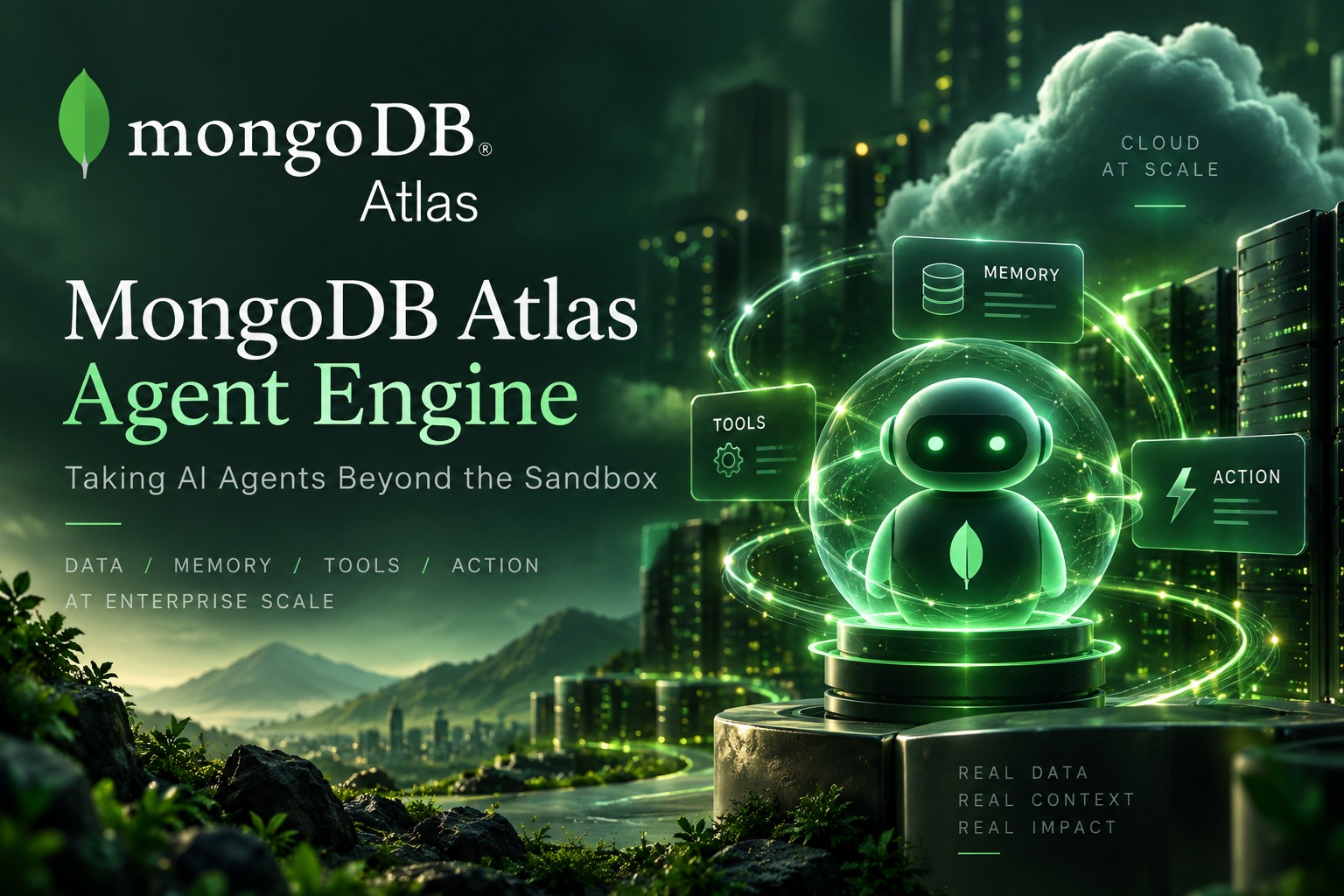
AI agents have become relatively easy to demonstrate in controlled environments. Getting them to work reliably inside a real enterprise, however, is a very different challenge. MongoDB is trying to close that gap with Atlas Agent Engine, a new platform that combines execution, persistent memory, data access, security and governance into a single environment for building production-ready AI agents.
The platform is designed around a problem many organisations are beginning to encounter: an agent may perform well during a proof of concept, but production deployment introduces persistent state, identity, permissions, auditing, cost controls and rapidly changing AI models. Without a common layer connecting all of those pieces, engineering teams often end up assembling their own collection of frameworks and services that becomes difficult to maintain.
From AI Demonstrations to Production Systems
An AI agent running inside a sandbox usually has a relatively simple job. It receives some context, performs a task and returns a result. Production agents may need to operate continuously, remember previous interactions, access multiple databases and applications, and make decisions according to strict organisational policies.
Those additional requirements dramatically increase complexity. If memory lives in one service, identity in another, retrieval somewhere else and governance inside yet another platform, developers are left maintaining several interconnected components.
MongoDB wants Atlas Agent Engine to become the underlying layer that brings those requirements together.
Pablo Stern-Plaza, MongoDB's Chief Product Officer for AI and Emerging Products, argues that enterprises have traditionally faced an uncomfortable choice: adopt one vendor's complete AI runtime and accept lock-in, or construct their own stack and take responsibility for memory, security and governance themselves.
Atlas Agent Engine is intended to provide a third option.
Any Model, Framework or Cloud
One of MongoDB's biggest promises is flexibility.
The company says organisations can use different AI models, agent frameworks and cloud environments without designing their entire system around one provider. That could become increasingly important as the AI market continues changing quickly and organisations regularly reassess which models provide the best combination of capability, cost and reliability.
A production agent built entirely around one model provider can become expensive to change later. If the underlying architecture separates the agent's memory, governance and data layer from the model itself, switching models becomes much easier.
MongoDB is effectively betting that the long-term value of an agent platform lies in everything surrounding the model rather than the model alone.
Persistent Memory Becomes Part of the Database Layer
Memory is one of the most important differences between a simple chatbot and a persistent AI agent.
Many experimental agents effectively begin fresh every time they execute. Developers then have to build additional pipelines to recover relevant information from previous interactions or external systems.
Atlas Agent Engine moves that memory capability closer to MongoDB's database layer.
The platform combines native MongoDB queries with Voyage AI embeddings and reranking, allowing agents to retrieve information semantically while also maintaining persistent context across repeated interactions.
This means an agent can potentially remember what happened during previous work rather than reconstructing everything from the beginning every time it runs.
Why Better Retrieval Matters
An AI agent is only as useful as the information it can retrieve.
Large language models may be capable of sophisticated reasoning, but they still need accurate context about the organisation, user and task. Poor retrieval can provide irrelevant or incomplete information, causing even a strong model to make weak decisions.
MongoDB highlights the performance of Voyage AI models on the Retrieval for Enterprise Benchmark, or RTEB, which focuses on realistic business retrieval workloads rather than purely academic datasets.
By tightly connecting retrieval with stored application data, the company says agents can access more relevant context while reducing unnecessary token usage.
That efficiency can become particularly important for agents that operate repeatedly throughout the day.
Less Repeated Context Can Mean Lower AI Costs
Persistent memory is not only about improving continuity. It can also reduce how much information needs to be repeatedly sent to the model.
Without an effective memory system, applications may repeatedly include large amounts of historical context inside prompts. That increases token usage and can make every agent interaction more expensive.
A memory layer that retrieves only the most relevant information allows the model to work with a smaller, more focused context.
At scale, those savings could become substantial, especially for organisations running thousands or millions of agent interactions.
Memory and Governance Can Be Used Separately
MongoDB is also making the platform modular.
Organisations can adopt the memory and governance capabilities independently or combine them with the full Atlas Agent Runtime. That gives engineering teams more flexibility when they already have parts of an AI infrastructure in place.
A company may already be comfortable with its preferred agent framework, for example, but still want MongoDB to handle persistent memory and policy enforcement.
This modular approach also reduces the pressure to redesign an existing AI stack simply to introduce one new production capability.
Governance Moves Into the Core Architecture
Governance is another area that becomes much more important once AI agents begin performing real actions.
A production agent may be able to access customer records, financial data, internal documents or business systems. Organisations therefore need to know exactly which agent performed an action, what information it accessed and which policies were applied.
Atlas Agent Engine places these controls into a shared governance layer.
MongoDB says every operation is associated with an authenticated identity, whether the actor is a human user or an autonomous agent. Runtime policies can then determine what that identity is permitted to do.
Critically, those policies cannot simply be disabled by the agent itself.
Agents Need Identity Just Like Human Users
The idea of assigning identities to AI agents may become increasingly important as businesses deploy them more widely.
Traditional security systems were designed around people and applications. A person logs in and receives permissions, while a service account represents a specific application.
Autonomous agents introduce something between those two categories. They can make decisions dynamically, interact with several systems and potentially perform actions on behalf of different users.
Treating each agent as an authenticated identity creates a clearer audit trail.
Instead of simply knowing that "the AI system" accessed a record, administrators can identify which specific agent performed the operation and under which policy.
Security Verification Can Become Faster
MongoDB also claims that centralising governance, memory and data access can significantly reduce the effort required to verify agent permissions.
In traditional architectures, security teams may need to examine several systems to understand how one agent is configured. Credentials may exist in one console, access policies somewhere else and behavioural rules inside the application code.
A unified platform provides one place to inspect those controls.
MongoDB argues that checks that previously required lengthy investigation can potentially be resolved much faster when identity and policy information are available through the same operational system.
That could make agent deployments easier to audit and approve.
Paysafe Sees Potential in Faster Investigations
Payments company Paysafe is among the organisations looking at the potential of Atlas Agent Engine.
Amar Akshat, SVP of Architecture at Paysafe, explained that investigating unusual activity currently requires analysts to manually combine information from several systems, often while working under significant time pressure.
An intelligent agent with access to the necessary context could potentially reduce the time between detecting a problem and taking action.
The objective is not necessarily to eliminate human analysts. Instead, an agent could handle much of the repetitive investigation while leaving the final judgement to experienced staff.
That model may become one of the more practical uses of enterprise AI agents.
Context Is Becoming the Critical Ingredient
RedMonk co-founder James Governor similarly argues that context is one of the central requirements for successful agentic applications.
An AI agent may have access to an excellent model, but without the right business context it cannot reliably understand what information matters or how different systems relate to each other.
Enterprises often struggle because important data is spread across databases, applications, documents and internal services.
Atlas Agent Engine attempts to give agents a consistent memory and identity layer across those environments.
In that sense, MongoDB is positioning itself less as an AI-model provider and more as the infrastructure connecting AI reasoning to enterprise data.
Open Standards Aim to Reduce Vendor Lock-In
MongoDB is also emphasising interoperability through open standards.
Atlas Agent Engine supports protocols including Model Context Protocol (MCP) and Agent2Agent (A2A). These standards are intended to make it easier for AI models, tools and agents to communicate without depending entirely on proprietary integrations.
For developers, that means switching a model or framework may require configuration changes rather than rewriting the surrounding application architecture.
This could become increasingly valuable because today's preferred AI framework may not remain the preferred framework two years from now.
Building around open protocols gives organisations more freedom to evolve without rebuilding everything from scratch.
Deployment Is Designed to Work Across Environments
MongoDB says workloads can run across major cloud providers, on-premises infrastructure or even local developer environments.
That is important for enterprises with mixed technology estates. Many large organisations do not operate entirely inside one public cloud, and regulated workloads may still need to remain within private infrastructure.
A cross-cloud agent platform could therefore allow organisations to apply consistent memory and governance patterns regardless of where individual workloads execute.
MongoDB has also joined the Open Secure AI Alliance and the Agentic AI Foundation under the Linux Foundation, reinforcing its position around interoperability and shared standards.
Accenture Is Bringing the Platform Into Enterprise Projects
Systems integrators are also beginning to incorporate Atlas Agent Engine into their delivery strategies.
Accenture is among the partners planning to use the platform with clients. Ram Ramalingam, Accenture's Global Lead of Software Engineering and Head of RDE, describes the technology as providing the context and operational constraints required to make AI agents practical at enterprise scale.
That partnership matters because many large organisations will not build agentic systems entirely in-house.
Consulting and systems integration firms are likely to play a major role in connecting AI agents to existing ERP systems, databases, security controls and business workflows.
Having governance available as part of the underlying platform could simplify those deployments.
AI Agent Infrastructure Is Becoming Its Own Category
The announcement also highlights how rapidly the AI industry is changing.
Early generative AI development focused heavily on selecting the best language model. The next phase increasingly involves the infrastructure required to make those models useful in persistent applications.
Memory, identity, retrieval, permissions, monitoring, auditing and tool access are becoming just as important as raw model intelligence.
A model can generate an excellent answer.
An enterprise agent needs to know what data it is allowed to see, remember what happened yesterday, interact with business systems and prove exactly what it did afterward.
Those are infrastructure problems rather than purely model problems.
MongoDB Wants the Database to Sit at the Centre
MongoDB is naturally positioning its database platform as the logical foundation for that new architecture.
Because many AI agents ultimately need access to enterprise data, placing memory and retrieval directly alongside that data can reduce the number of separate systems developers need to manage.
This is especially relevant for applications that already use MongoDB Atlas.
Instead of introducing another dedicated vector database, memory service and governance tool, organisations could consolidate more of those responsibilities inside their existing data platform.
Whether that consolidation proves attractive will depend on how well Atlas Agent Engine integrates with the wide variety of AI frameworks already being used.
Consumption-Based Pricing Uses Existing Atlas Commitments
Commercially, MongoDB says Atlas Agent Engine will use consumption-based billing.
Usage can draw against an organisation's existing Atlas financial commitments, meaning customers already purchasing MongoDB services do not necessarily need to establish an entirely separate procurement arrangement.
That could make experimentation easier for existing enterprise customers.
It also reinforces MongoDB's strategy of extending Atlas from a database service into a broader application and AI platform.
Available in Public Preview
Atlas Agent Engine is currently available in public preview, alongside MongoDB 9.0 and Atlas Infinite.
That preview status means the technology is still at a relatively early stage, particularly compared with MongoDB's mature database products. Organisations experimenting with the platform will likely be testing not only its capabilities but also how well its approach fits their existing AI architecture.
Enterprise agent infrastructure remains a rapidly developing field.
Different companies are taking very different approaches to memory, orchestration, security and model access, so it may take time before clear standards emerge.
Final Thoughts
MongoDB Atlas Agent Engine reflects an important shift in the AI conversation.
The question is no longer simply whether an AI agent can complete a demonstration. The harder question is whether that agent can operate reliably for months inside a production environment while retaining useful memory, accessing the correct data, respecting permissions and remaining auditable.
MongoDB's answer is to bring execution, memory, retrieval, identity and governance into one platform while avoiding dependence on any single AI model or cloud provider.
That approach could be particularly attractive to enterprises worried about committing too deeply to an AI ecosystem that may look completely different a year from now.
The model may still be the intelligence behind the agent.
But as AI moves into production, the systems surrounding that intelligence may ultimately determine whether the agent can be trusted to do real work.











Comments 0