


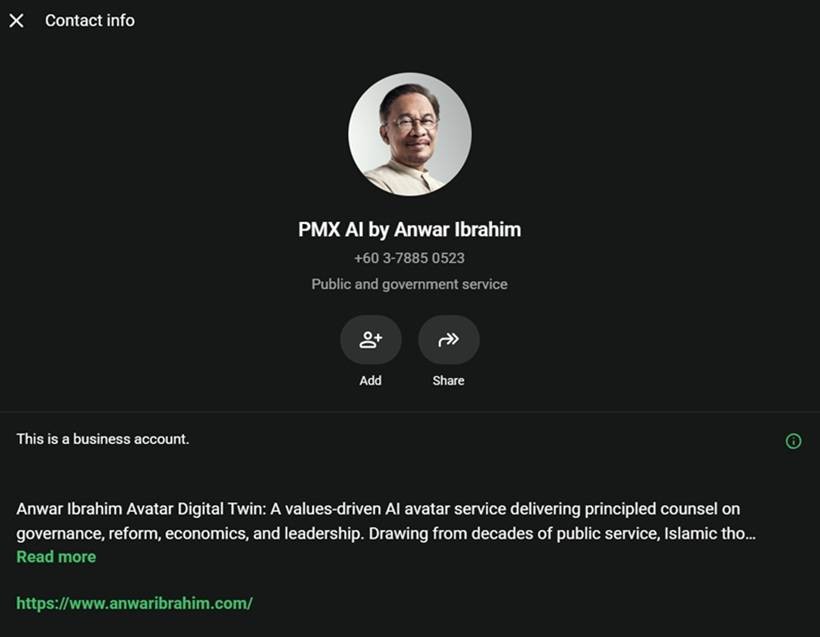
Malaysians can now interact with an artificial intelligence-powered version of Prime Minister Datuk Seri Anwar Ibrahim through WhatsApp following the official launch of PMX.AI. Described as a digital twin of the Prime Minister, the chatbot has been introduced as a new communication channel where members of the public can share ideas, raise concerns, provide feedback, and discuss issues affecting the country.
There is also a rather fitting coincidence behind the technology: the initials "AI" can represent both Anwar Ibrahim and artificial intelligence. Beyond the clever wordplay, however, PMX.AI represents a broader attempt to explore how emerging technology could support public engagement and government services.
A Virtual Prime Minister—But Only Through Chat for Now
The launch video presents the AI-generated Prime Minister in several fictional situations, creating the impression of a more advanced virtual assistant capable of appearing in different environments.
At present, however, PMX.AI is not a fully animated digital personality. Its actual public-facing form is a WhatsApp chatbot, meaning users communicate with it mainly through text-based conversations.
The promotional scenes therefore appear to represent the longer-term vision behind the project rather than its current capabilities. For now, the focus is on making an AI-powered version of the Prime Minister accessible through a platform already used daily by millions of Malaysians.
Using WhatsApp also removes some of the barriers normally associated with government technology platforms. Users do not have to learn a new system or navigate a complicated portal—they can simply begin a conversation through a familiar messaging application.
Designed as a Digital Extension of Anwar Ibrahim
Anwar described PMX.AI as a digital extension of himself—one that can continue listening to Malaysians even when he is unable to engage with everyone personally.
The concept is not that the chatbot physically replaces the Prime Minister. Instead, it is intended to expand the government's ability to receive public feedback at any time and from a much larger number of people.
This could be especially useful for younger Malaysians who may be more comfortable expressing their concerns through digital channels than through formal letters, physical meetings, or government feedback forms.
The project also reflects a growing expectation that public institutions should become more accessible and responsive. Citizens increasingly expect to communicate with organisations through real-time digital platforms rather than waiting for traditional engagement sessions.
Whether PMX.AI can turn those conversations into meaningful action will ultimately determine how valuable the platform becomes.
How PMX.AI Learns to Respond
PMX.AI was developed by Zetrix AI Berhad. According to information shared about the project, the system has been trained using material connected to Anwar, including his public speeches, writings, policies, viewpoints, preferences, and broader political vision.
This information is intended to help the chatbot generate answers that resemble the Prime Minister's general style of thinking and communication.
However, users should understand that PMX.AI remains an artificial intelligence system. Its replies are created by analysing patterns in its training data together with the rules and instructions established by its developers.
That means a response generated by PMX.AI should not automatically be treated as a personal statement, official decision, or direct promise from Anwar himself.
There may be situations where the chatbot simplifies an issue, misunderstands a question, produces an incomplete answer, or responds differently from how the Prime Minister would have answered personally.
Clear labelling will therefore be important, particularly when conversations involve sensitive political issues, government policies, public assistance, legal matters, or major national decisions.
More Than a Question-and-Answer Chatbot
The project may eventually extend beyond general conversations.
Zetrix AI has indicated that PMX.AI includes agentic AI capabilities. Agentic systems are designed not only to provide information but potentially to guide users through tasks and interact with other digital services.
In the future, this could allow citizens to receive assistance when applying for government aid, locating the correct public service, checking eligibility requirements, or completing selected administrative processes.
Such features could make government services easier to navigate, particularly for people who are unsure which ministry, department, or online portal they need to approach.
However, connecting an AI chatbot to actual government transactions would require strong safeguards. Identity verification, information accuracy, cybersecurity, data protection, accessibility, and clear accountability would all need to be addressed before the platform could safely handle important applications or personal records.

Malaysia Joins a Growing Global Trend
Malaysia is not the first country to experiment with artificial intelligence in political communication.
Political leaders and election campaigns in other countries have already used AI-generated avatars, automated translations, synthetic voices, and virtual assistants to reach wider audiences.
South Korean President Lee Jae Myung previously used an AI avatar during an election campaign to answer public questions, while Indian Prime Minister Narendra Modi has used artificial intelligence to make speeches available in multiple languages.
These examples demonstrate how AI can help political leaders communicate across different regions, languages, and time zones. At the same time, they raise difficult questions about authenticity.
Citizens need to know whether they are interacting with a real person, a member of that person's team, or an automated system trained to imitate them. Without clear disclosure, AI-generated political communication could create confusion over who is responsible for a particular statement.
Public Conversations May Be Analysed
One of the most important details surrounding PMX.AI involves how conversations may be used.
Because the chatbot operates through WhatsApp, interactions are connected to users' WhatsApp accounts and associated phone numbers. Zetrix AI has also indicated that conversations may be analysed by the Prime Minister and his team to understand public sentiment and support future policymaking.
This could provide the government with a large amount of feedback about the issues Malaysians care about. When analysed collectively, the conversations could reveal recurring concerns involving living costs, healthcare, employment, education, public transport, housing, or government assistance.
However, users should not assume that their conversations are completely private or equivalent to an anonymous public survey.
Before sharing sensitive information, people should understand what data is collected, how long it is retained, who can access it, whether it is anonymised, and whether it may be combined with other information.
A clear privacy notice should also explain whether messages are reviewed individually or processed only as broader trends. Users should be told how they can request the deletion of their data and where to report inaccurate, inappropriate, or harmful responses.
The Challenge of Turning Messages Into Meaningful Feedback
Opening another communication channel is relatively easy. The more difficult challenge is ensuring that public feedback leads somewhere useful.
If thousands of Malaysians submit concerns through PMX.AI, the system will need a reliable method for categorising, prioritising, escalating, and responding to them.
Urgent matters cannot simply disappear into a large database of conversations. There should be a clear distinction between general opinions, requests for information, formal complaints, emergency situations, and cases requiring attention from a particular government agency.
The platform will also need to manage expectations. A chatbot may acknowledge a complaint immediately, but that does not mean the issue has been officially investigated or resolved.
For PMX.AI to build public trust, users should be informed about what happens after they submit feedback and whether their concerns have been forwarded to the relevant ministry or department.
AI Innovation Must Be Supported by Clear Governance
PMX.AI is an interesting demonstration of how artificial intelligence could reshape communication between political leaders and the public.
Its success, however, will depend on more than the novelty of chatting with a virtual Prime Minister. The platform must provide accurate information, communicate its limitations honestly, protect personal data, and clearly distinguish AI-generated responses from official government decisions.
Independent testing and regular audits may also be necessary to check for inaccurate answers, political bias, security vulnerabilities, and inappropriate handling of personal information.
The system should be designed to support public participation rather than create the illusion that citizens are speaking directly to the Prime Minister when they are actually communicating with an automated model.
Final Thoughts
PMX.AI offers Malaysians a new and potentially more convenient way to communicate their concerns, ideas, and aspirations. It could also help the government identify public priorities more quickly and make selected services easier to access.
At the same time, users should approach it with realistic expectations. PMX.AI is an AI assistant inspired by Anwar Ibrahim's speeches, policies, and public positions—it is not the Prime Minister himself.
The real measure of the initiative will not be how convincingly the chatbot imitates Anwar's communication style. It will be whether public feedback is handled responsibly, personal information is properly protected, and conversations are translated into meaningful improvements for Malaysians.











Comments 0