

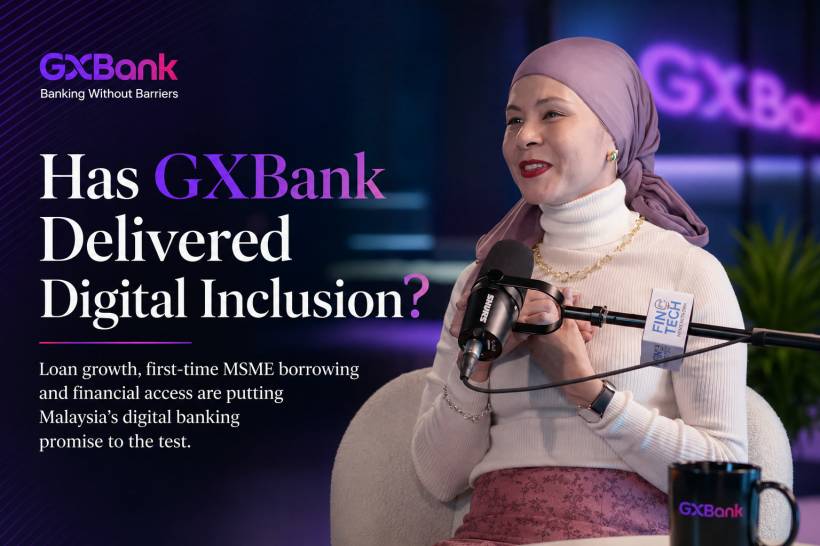
Malaysia's digital banks were not created simply to look modern or offer another mobile app for everyday savings. Their bigger promise was financial inclusion — reaching people and small businesses that traditional banking has often overlooked. For GXBank, that promise is now being tested through the numbers it has started to report, especially among micro, small and medium enterprise borrowers.
One of the clearest signs is this: 87% of GXBank's MSME borrowers had never taken a loan before. That figure says a lot about the kind of customers digital banks are trying to serve. These are not necessarily large businesses with proper finance departments, audited accounts and neat separation between personal and business banking. Many are sole proprietors, gig workers, traders, home-based sellers and small operators who may have real income activity but do not always fit the traditional banking profile.
The Real Inclusion Gap Is Not Just About Having a Bank Account
Financial inclusion is often discussed as though the problem ends once someone has a bank account. But for many Malaysians, the harder challenge is access to fair, practical and timely credit.
A sole proprietor may have sales coming in every month, but if their business income is mixed with their personal account, they may struggle to convince a traditional bank that they are creditworthy. Some may not have formal business documentation. Others may simply feel uncomfortable walking into a branch and explaining their situation.
This is where digital banks can play a different role. Instead of judging a customer only through conventional paperwork, GXBank is trying to use transaction patterns, personal and business bank statements, and alternative data models to understand whether a borrower can repay.
That matters because many small businesses do not fail because they have no demand. They struggle because cash flow is uneven. A small amount of working capital at the right time can help pay suppliers, repair equipment, fund advertising, or handle short-term gaps.
GXBank's Growth Shows There Is Demand
GXBank has reportedly crossed RM1 billion in loans within a single month, while its deposit book has also passed RM1 billion. More than 60% of its depositors come from the B40 and M40 income groups, which suggests the bank is not only attracting affluent early adopters.
Another interesting detail is that over 30% of retail depositors show spending behaviour that looks business-like, such as recurring advertising payments. In other words, some customers who appear to be personal banking users may actually be running small business activities in the background.
That insight appears to have shaped GXBank's lending direction. Instead of building a generic loan product and hoping customers come, the bank is designing around behaviour already visible within its own customer base.
Why Sole Proprietors Need a Different Underwriting Approach
GXBank's approach to small business lending focuses on combining personal and business financial data. For some applications, approval can happen in minutes, while cases involving third-party guarantees may take longer.
The bank's partnership with CGC Digital, the fintech arm of Credit Guarantee Corporation Malaysia Berhad, is also important. The arrangement supports financing access for smaller borrowers, and GXBank's GX FlexiLoan limit was raised to RM150,000 under the expanded partnership.
The most practical part is that GXBank is willing to accept personal bank statements from sole proprietors who have not formally separated business and personal funds. This reflects the reality on the ground. Many small operators do not start with company accounts, finance software or proper documentation. They start with a phone, a customer base and money moving in and out of the same account.
If Malaysia's MSME financing gap is estimated at around RM90 billion, then solving this problem requires more than polished banking apps. It requires credit assessment models that understand informal but legitimate business activity.
Profit and Purpose Still Need Each Other
One of the more important points in the discussion is the balance between doing good and staying profitable. Financial inclusion cannot survive if it is treated purely as charity. A bank still has to protect depositors, pay its staff, satisfy regulatory expectations and remain commercially viable.
That may sound less idealistic, but it is actually important. If a digital bank cannot build a sustainable business model, it will not be able to keep serving underserved customers at scale.
This is also tied to Bank Negara Malaysia's digital banking framework. Digital banks are expected to show that they can meet inclusion goals before graduating fully from their foundational phase. In simple terms, inclusion is not just a marketing slogan; it is part of the licence journey.
The Risk of Easier Credit
Of course, wider access to credit comes with a serious question: does it help people build financial resilience, or does it push them into more debt?
That concern is fair. Easier credit can support emergencies and business growth, but it can also become harmful if used for unnecessary spending. GXBank's position appears to be that not all consumer borrowing should be treated the same. Borrowing for medical bills, car repairs or urgent cash-flow needs is different from borrowing for lifestyle purchases that create no lasting value.
This is where financial literacy becomes essential. Giving people access to credit without helping them understand cash flow, repayment discipline and the difference between needs and wants can create new problems.
Financial Literacy Must Be Practical, Not Preachy
GXBank's financial literacy programme, Celik Kewangan, sits under its wider Impian Gigih initiative. The programme includes education partnerships, scholarships and content intended to make money management easier to understand.
The important point here is tone. Financial education often fails when it feels judgmental or too technical. Many people already feel embarrassed when they are short on money. If the advice sounds like a lecture, they may avoid it completely.
A better approach is practical and human. Teach people how to manage irregular income, how to plan for sudden expenses, when credit is useful, when it becomes dangerous, and how to ask for help before a small problem spirals.
GXBank Still Needs to Move Beyond Klang Valley
Despite the encouraging numbers, GXBank's growth is not evenly distributed. Its customer base remains heavily concentrated in the Klang Valley, even though it has some presence in Sabah and Sarawak.
That is an important gap. If Malaysia's first digital bank mainly serves urban users, it risks becoming another convenience product for people who already have options. The deeper inclusion opportunity lies in reaching customers in smaller towns, rural communities, East Malaysia, and underserved business segments outside the usual urban digital economy.
GXBank's challenge is not just acquiring more users. It needs broader geographic trust.
Trust Looks Different for Retail Users and MSMEs
For retail customers, trust in a digital bank may come from app reliability, fast support, fraud response and convenient daily use. If a suspicious card transaction can be resolved quickly and a replacement issued without branch visits, users may start to feel that digital banking is not only convenient but dependable.
For MSMEs, trust is more complicated. Small business owners often rely on community networks, referrals, associations and relationships. They may trust a bank because someone they know has used it successfully, not because they saw an advertisement.
That means GXBank will likely need more than digital campaigns to grow its MSME base. It may need partnerships, community outreach, merchant ecosystems and on-the-ground engagement to build credibility outside its current strongholds.
Could Digital Banking Become Everyday Financial Advice?
One of the more interesting long-term ideas is whether a digital bank can offer personalised financial guidance to ordinary users — the kind of support traditionally reserved for wealthier customers.
In theory, AI could help spot idle cash, suggest better savings options, alert users when spending patterns look risky, or recommend safer ways to manage short-term liquidity. Done properly, this could make financial advice more accessible.
But this area needs caution. Automated advice must be suitable for the user's risk level, income stability and financial knowledge. A customer with limited savings should not be pushed into volatile products simply because an algorithm detects unused funds. The role of AI should be to guide, not pressure.
Final Thoughts
GXBank's early numbers suggest that Malaysia's digital banking inclusion story is beginning to show substance. The fact that a large majority of its MSME borrowers had never held a loan before is significant. It points to a real underserved segment that may have been economically active but invisible to traditional credit systems.
Still, the real test is only beginning. GXBank must prove that it can lend responsibly, educate users meaningfully, expand beyond Klang Valley, build trust with small businesses and remain financially sustainable.
If it succeeds, digital banking in Malaysia could become more than a cheaper, faster version of traditional banking. It could become a practical bridge for people and businesses that have always been active in the economy, but never fully recognised by the financial system.











Comments 0