

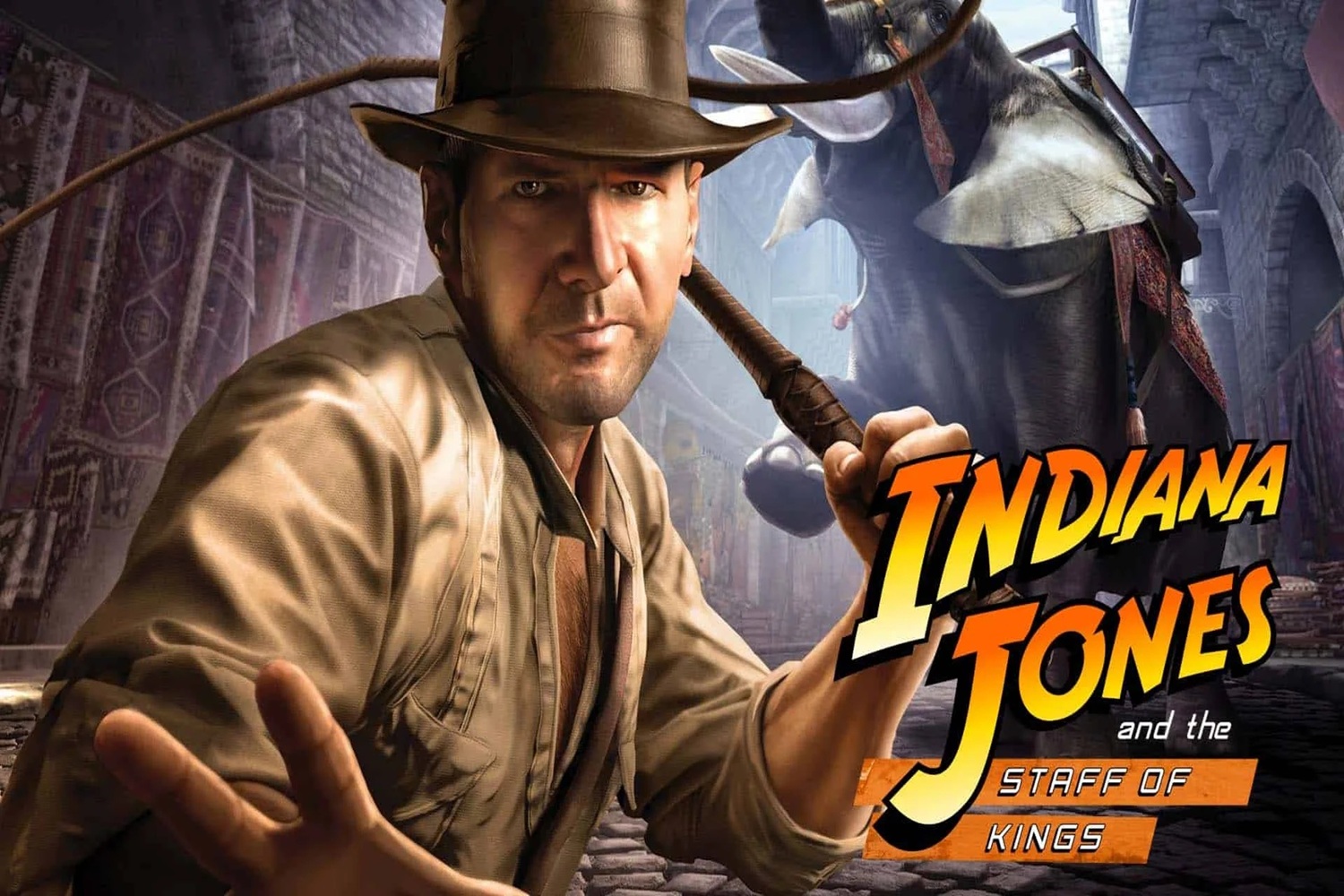
Indiana Jones and the Staff of Kings brings the world's most famous archaeologist into another globe-spanning adventure filled with ancient ruins, dangerous enemies, collapsing environments, secret artifacts, and the kind of impossible escapes that define the Indiana Jones films. Released in 2009, the game tells an original story set in 1939 and sends Indy racing against dangerous rivals in search of the Staff of Moses, an artifact believed to possess extraordinary power. Instead of focusing entirely on gunplay, the adventure combines hand-to-hand fighting, whip mechanics, exploration, environmental interaction, light puzzle solving, shooting sequences, and large cinematic set pieces. The result is a game built around making players feel less like a conventional action hero and more like Indiana Jones improvising his way through another archaeological disaster.
The story begins in Sudan, where Indy is searching for an ancient ram's head idol and soon crosses paths with his rival Magnus Völler. What initially appears to be another archaeological expedition develops into a much larger race involving Professor Charles Kingston, photographer Maggie O'Mally, hostile soldiers, ancient clues, and the legendary Staff of Moses. Indy's journey takes him from archaeological ruins to San Francisco, the jungles of Panama, Istanbul, Nepal, and eventually one of the adventure's most elaborate final confrontations. Like the films, the story constantly moves forward through discoveries, betrayals, narrow escapes, and situations that become considerably more dangerous than Indy expected.
Now playable online through Lemon Web Games, Indiana Jones and the Staff of Kings brings this cinematic action-adventure directly into the web browser, allowing players to explore ruins, brawl with enemies, use Indy's famous bullwhip, solve environmental challenges, and follow the hunt for the Staff of Moses without relying on the original console hardware. The adventure regularly switches between exploration, close-range fighting, shooting, platforming, and larger action sequences, helping each chapter feel like another scene from an Indiana Jones movie. Hidden artifacts and optional objectives also give players reasons to investigate environments rather than rushing toward the next fight. For fans of archaeological adventures, classic action games, and Indiana Jones himself, Staff of Kings remains an entertaining journey packed with familiar series ingredients.
An Original Indiana Jones Story Set in 1939
Staff of Kings takes place in 1939, placing the adventure around the same historical period as Indy's classic cinematic exploits. Rather than adapting one of the existing films, the game tells an original story built around another legendary artifact. This gives the developers freedom to introduce new characters, locations, and dangers while maintaining the familiar tone of the franchise. The central mystery revolves around the Staff of Moses, believed to be the same biblical staff associated with the parting of the Red Sea.
That premise immediately fits the Indiana Jones formula. A seemingly impossible historical object attracts competing archaeologists and military forces, while Indy becomes caught between genuine scholarly curiosity and enemies interested primarily in the artifact's power. Ancient clues gradually reveal where the staff may be hidden. Every discovery naturally leads toward another location and another dangerous situation.
The story draws heavily from the adventurous spirit associated with Raiders of the Lost Ark. Archaeology and mythology provide the mystery, dangerous rivals provide the conflict, and the supernatural qualities of the artifact gradually become more important. Indy may begin the story looking for historical treasure, but eventually the stakes extend far beyond academic discovery.
Magnus Völler Becomes Indy's Main Rival
Magnus Völler serves as Indy's primary rival during the search for the Staff of Moses. He is an archaeologist with his own knowledge of ancient artifacts, making him more dangerous than an ordinary soldier or treasure hunter. The conflict between the two characters is therefore not simply about strength. Both understand the historical significance of what they are pursuing.
Völler's willingness to work with hostile forces gives him resources that Indy cannot match directly. Soldiers, vehicles, weapons, and organized expeditions frequently appear between Indy and his objective. Instead of confronting these forces head-on every time, players often need to use the environment and Indy's agility to survive. This helps reinforce the idea that Indy succeeds through improvisation rather than overwhelming military power.
Their rivalry also provides the adventure with continuity as the story moves between countries. Völler remains connected to the hunt regardless of where the next clue leads. Each time Indy appears close to solving the mystery, there is always a danger that his rival will arrive first. The race for the Staff of Moses becomes increasingly personal as the story progresses.
The Adventure Begins in Sudan
Sudan provides an appropriately dramatic opening for the adventure. Indy explores ancient ruins while searching for a valuable ram's head idol, giving players an immediate opportunity to become familiar with climbing, movement, combat, and the whip. Naturally, retrieving an archaeological treasure causes the surrounding situation to become considerably more dangerous. Ancient structures, hostile forces, and collapsing environments quickly turn the expedition into an escape.
The opening also introduces many of the mechanics that will remain important throughout the adventure. Players learn that objects within the environment are often useful rather than purely decorative. A nearby structure may become part of a fight, while the whip can manipulate objects or help Indy reach another area. Combat and exploration are designed to overlap.
The Sudan chapter establishes the game's cinematic pacing immediately. Indy rarely has time to admire an artifact before something begins collapsing or an enemy appears. Even relatively quiet archaeological moments can become chase sequences within seconds. That unpredictability captures much of the spirit associated with the character.
San Francisco Brings the Adventure Back to Civilization
After the opening expedition, the story eventually brings Indy to San Francisco while he investigates information connected to his missing colleague Professor Charles Kingston. The urban setting provides a sharp contrast with the ancient ruins of Sudan. Streets, buildings, docks, Chinatown locations, and interior environments create a different type of adventure. Indy may have returned to civilization, but the danger has followed him.
Close-range fights become particularly entertaining in these environments because surrounding objects can become improvised weapons. Chairs, bottles, shelves, hanging decorations, and other pieces of scenery can influence a brawl. Enemies can be thrown into objects or placed beneath environmental hazards. The room itself effectively becomes part of Indy's arsenal.
This style of combat fits the character far better than a perfectly disciplined martial arts system would. Indiana Jones has always survived fights by improvising with whatever happens to be nearby. Staff of Kings deliberately recreates that feeling. Winning a fight can sometimes involve noticing the environment rather than simply performing the same punch combination repeatedly.
Panama Introduces Jungle Exploration and Ancient Ruins
The search eventually leads Indy toward Panama, where the adventure returns to dense vegetation, hidden archaeological sites, and ancient mysteries. The jungle environment provides opportunities for climbing, whip swinging, environmental puzzles, and combat against enemies operating far away from ordinary civilization. This section feels much closer to the traditional image of Indiana Jones exploring forgotten places. Every path seems capable of hiding another trap or clue.
Maggie O'Mally becomes increasingly important around this stage of the journey. Initially appearing as a photographer, she becomes directly involved in Indy's search and the larger conspiracy surrounding the Staff of Moses. Their interactions contribute additional personality to the story. Indy is rarely allowed to conduct a quiet archaeological expedition alone.
Ancient structures within the jungle gradually reveal information connected to Professor Kingston's research. Exploring these places requires more than combat because doors, mechanisms, platforms, and environmental objects must often be manipulated. The puzzle elements remain approachable but provide useful changes of pace. A dangerous temple should require more than simply defeating everyone inside it.
Istanbul Continues the Hunt for the Staff
Istanbul brings another substantial change in architecture and atmosphere as Indy follows the trail of the artifact. Historical structures and crowded environments provide a fitting setting for another chapter of archaeological investigation. By this stage, the race for the Staff has developed far beyond the original Sudan expedition. Indy knows the artifact is real and understands that Völler cannot be allowed to obtain it.
The environment once again encourages careful observation. Clues, mechanisms, hidden areas, and hostile forces can all exist within the same location. Players need to recognize where Indy's whip or other actions can manipulate the surroundings. Progress often comes from understanding how the level has been constructed.
The constant movement between countries is essential to the game's personality. Staff of Kings would feel considerably less like an Indiana Jones adventure if every chapter took place inside similar ruins. Changing geography gives the story a genuine globe-trotting quality. Each location becomes another stage in the archaeological race.
Nepal Brings the Search Closer to Its Goal
Nepal becomes one of the most important locations as Indy finally approaches the resting place of the Staff. The remote setting creates a strong sense that the expedition has reached somewhere genuinely significant. By now, the clues gathered throughout the earlier chapters are beginning to connect. Professor Kingston's involvement also becomes much clearer.
The adventure becomes increasingly dangerous as Völler's forces close in. What began as a search for an artifact transforms into a struggle over who will control something capable of extraordinary power. Indy must continue moving forward even when allies become endangered. The personal stakes rise alongside the archaeological ones.
The mountainous and temple environments also provide another excellent setting for traversal. Climbing, whip interactions, environmental obstacles, and combat remain closely connected. Players are rarely doing only one thing for very long. Staff of Kings constantly tries to maintain the feeling of moving through an action sequence.
The Bullwhip Is More Than a Weapon
Indy's bullwhip is naturally one of the most important tools in the game. During combat, it can strike or stun enemies, interfere with their weapons, pull them off balance, and create openings for follow-up attacks. The whip provides range that ordinary punches cannot match. This makes it useful for controlling opponents before moving into close combat.
The whip is equally important outside fighting. Specific points allow Indy to swing across gaps, reach distant platforms, or interact with objects that cannot be accessed directly. Environmental mechanisms can also be manipulated from a distance. This ensures that the whip remains relevant even when there are no enemies nearby.
Players gradually learn to look for opportunities rather than viewing the whip as a simple attack button. A hanging object above an enemy may be more useful than striking the enemy directly. A platform can sometimes be manipulated to create a safer route. The best moments occur when combat and environmental interaction overlap.
Hand-to-Hand Fighting Captures Indy's Improvised Style
Indiana Jones has never fought like a flawless martial artist. His film battles are usually messy contests involving punches, dodges, improvised weapons, environmental hazards, and whatever desperate idea happens to work. Staff of Kings attempts to reproduce that style through close-range combat built around punches, combinations, blocking, evasive movement, and counters. Battles feel deliberately physical.
Enemies can sometimes defend themselves effectively against repeated basic attacks, encouraging the player to vary their approach. Dodging an incoming strike can create an opportunity for a counterattack. Stronger combinations can break through defensive opponents. These mechanics give brawling more structure without making Indy look unnaturally elegant.
The system becomes most enjoyable when environmental interactions are added. A technically difficult opponent can sometimes be defeated quickly by throwing them into something dangerous. Players begin scanning rooms for useful objects before committing to a prolonged fight. That is exactly the kind of behavior an Indiana Jones game should encourage.
The Environment Becomes a Weapon
Interactive environmental combat is one of Staff of Kings' defining features. Certain areas contain specially designed objects that can be used against nearby enemies. Shelves can collapse, hanging fixtures can fall, windows can become convenient destinations for unwanted opponents, and loose objects can become temporary weapons. This gives fights a cinematic quality beyond ordinary punching.
The most enjoyable environmental attacks often require positioning. An enemy standing beneath a heavy object creates an obvious opportunity, but the player still needs to manipulate the situation correctly. Pulling something down with the whip at exactly the right moment can end a fight spectacularly. Environmental awareness becomes another combat skill.
These interactions also prevent locations from feeling like static backgrounds. A bar, workshop, ruin, or warehouse behaves differently because the objects inside it provide different possibilities. Players begin looking around immediately when another fight starts. The environment becomes part of the puzzle.
Improvised Weapons Keep Brawls Unpredictable
Indy can use various nearby objects as temporary weapons during fights. Bottles, chairs, tools, and other pieces of scenery can provide stronger or more entertaining alternatives to bare fists. These weapons are usually temporary rather than permanent additions to the inventory. That encourages players to use whatever happens to be available.
The system fits perfectly with the character's personality. Indy rarely enters a fight carrying an elaborate melee arsenal. Instead, he grabs whatever is close enough to help. A normal object can suddenly become extremely useful when several enemies surround him.
Improvised weapons also make repeated fights feel less identical. One room may encourage throwing bottles, while another provides heavier objects or environmental traps. Players can approach the same basic enemy type differently depending on where the fight occurs. This gives the environments greater gameplay value.
Indy's Revolver Handles Ranged Threats
The revolver remains another iconic part of Indiana Jones' equipment. When enemies are too distant for fists or the whip, the firearm provides a straightforward ranged solution. Certain sections place greater emphasis on shooting, allowing players to target enemies positioned across larger environments. These sequences create a change of pace from brawling.
Ammunition and positioning remain important because the revolver is not intended to replace every other mechanic. Using firearms constantly would remove much of the distinctive personality from the combat. The game instead alternates between gunplay and close-range encounters. Players regularly need to switch their thinking.
The combination works because Indiana Jones himself frequently shifts between these approaches in the films. One moment he may be trading punches, the next he is reaching for the revolver, and seconds later the whip becomes necessary for an escape. Staff of Kings tries to maintain that constant improvisation.
Platforming and Climbing Keep Indy Moving
Exploration frequently requires Indy to climb ledges, cross narrow surfaces, jump between platforms, and navigate unstable environments. These sections help transform archaeological locations into actual obstacles rather than rooms containing enemies. Ancient ruins naturally become more interesting when reaching the artifact is a challenge in itself. Movement becomes part of the adventure.
Whip-swinging extends those traversal options by allowing Indy to cross gaps impossible to jump normally. Players need to recognize suitable attachment points and position themselves correctly before swinging. These sequences reinforce the visual identity of the character. Few actions say Indiana Jones more clearly than swinging across danger with a bullwhip.
Balance sections and environmental hazards add further variety. A narrow path becomes more dangerous when falling has meaningful consequences. Collapsing environments can turn ordinary traversal into a timed escape. The game frequently uses movement to maintain cinematic momentum.
Environmental Puzzles Provide Breathing Room
Not every ancient site can be solved with punches and revolver shots. Staff of Kings includes environmental puzzles involving mechanisms, movable objects, switches, valves, platforms, and other interactive elements. These sequences give players time to examine the surroundings rather than constantly fighting. They also reinforce Indy's identity as an archaeologist capable of interpreting ancient structures.
The puzzles are generally designed to keep the pace moving rather than stopping the adventure for extremely complicated logic challenges. Players usually need to understand how nearby objects interact and identify which mechanism opens the path forward. The whip occasionally becomes part of the solution. Exploration and tool use remain closely connected.
These quieter moments make the action more effective when it returns. A long sequence of uninterrupted fighting would eventually become repetitive. Moving between puzzles, exploration, traversal, and combat creates a more varied rhythm. The game feels closer to an adventure movie because of those changes in pace.
Action Sequences Push Beyond Ordinary Exploration
Staff of Kings regularly introduces larger cinematic sequences designed to recreate the spectacular escapes associated with the films. Vehicle pursuits, dangerous crossings, collapsing structures, and other scripted moments force the player to react quickly. These sequences often use different mechanics from normal exploration. The sudden change creates a stronger sense of spectacle.
Some situations require rapid inputs or precise timing to survive an unfolding disaster. The player may be escaping rather than fighting, making immediate reactions more important than combat strategy. These moments can be unforgiving, but they also provide memorable breaks from the standard structure. The adventure rarely remains calm for very long.
The best sequences feel like playable versions of the famous action scenes that define Indiana Jones cinema. They may not reproduce a particular film moment directly, but the inspiration is obvious. The game understands that Indy should frequently escape situations that looked impossible seconds earlier.
The Story Builds Toward the Zeppelin Odin
As the search reaches its later stages, Völler's forces attempt to secure the Staff and transport it using the massive airship Odin. The zeppelin becomes one of the adventure's most dramatic locations, combining infiltration, rescue, combat, and story developments. By this stage, the archaeological race has become a direct confrontation. There is little mystery about what will happen if Völler succeeds.
Moving through the airship creates a very different atmosphere from the temples and jungles encountered earlier. Metal corridors and military spaces replace ancient ruins while the danger remains just as high. Indy must rescue allies and continue pursuing the Staff. The setting reinforces how far the adventure has travelled from its opening excavation.
The Odin also helps propel the story toward the final confrontation. Once Völler gains control of the artifact, the adventure moves rapidly toward its climax. The Staff's supernatural abilities can no longer be dismissed as legend. Indy finally witnesses exactly why the object was so dangerous to pursue.
The Staff of Moses Delivers the Supernatural Payoff
Indiana Jones stories frequently begin with archaeology and end with undeniable supernatural power. Staff of Kings follows that tradition closely. The legendary staff is eventually revealed to be far more than a symbolic historical relic. Its ability to manipulate the Red Sea demonstrates why Völler was willing to devote enormous resources to obtaining it.
This revelation changes the scale of the final chapters. The conflict is no longer simply about recovering stolen archaeological treasure. A powerful artifact is being used in a way capable of reshaping the surrounding environment itself. Indy must stop Völler before the situation becomes even more destructive.
The supernatural climax gives the long archaeological search a satisfying payoff. Players have spent much of the game hearing about the Staff, following clues, and fighting people determined to obtain it. Finally witnessing its power justifies the obsession surrounding it. The story closes in appropriately dramatic Indiana Jones fashion.
Artifacts Reward Players Who Explore
Hidden artifacts provide another reason to examine levels carefully. These collectibles are frequently positioned away from the most direct route and reward players willing to investigate side areas. A suspicious ledge, room, or alternate pathway may contain something worth finding. Exploration becomes more meaningful than simply locating the exit.
Collectibles also fit naturally within an Indiana Jones adventure. Archaeological objects feel considerably more appropriate than arbitrary glowing tokens scattered through the environment. Finding one reinforces Indy's identity as someone interested in historical relics rather than merely surviving action sequences. The theme and progression work together.
Players interested in completion can revisit previously completed sections to search for anything they missed. This gives individual levels additional replay value. Once the main route is understood, the focus can shift toward discovering every hidden artifact.
Fortune and Glory Capture the Spirit of Indy
The phrase "fortune and glory" has long been associated with Indiana Jones, and Staff of Kings incorporates that idea into its optional progression and unlockables. Hidden artifacts and special achievements encourage players to approach encounters creatively rather than simply reaching the next checkpoint. Completing these additional objectives can unlock extras. The game rewards players who engage more deeply with each level.
Some objectives naturally encourage environmental combat. Instead of defeating enemies using the safest method every time, players may be challenged to perform a more dramatic interaction. Pulling down part of the scenery or using an improvised environmental attack becomes more meaningful. This encourages experimentation with the systems the developers built into each stage.
These optional goals also make repeat playthroughs more interesting. A player who completed the story normally can return and focus on missed artifacts or special actions. The environment becomes a playground for discovering interactions that may have been ignored initially. Completion rewards curiosity.
The PS2 Version Emphasizes Environmental Interaction
The PlayStation 2 version uses conventional controller inputs rather than the gesture-focused controls associated with the Wii release, creating a more traditional third-person action experience. Indy's whip, combat actions, shooting, and environmental interactions are handled through familiar buttons and analog controls. This can make the game feel more immediately recognizable to players accustomed to conventional action-adventure controls. The mechanics remain focused on the same cinematic interactions.
Environmental "HotSet" moments are particularly important. Specific objects within a scene can become opportunities for dramatic attacks or puzzle solutions. Players are encouraged to look around before assuming every encounter must be solved through direct combat. A nearby object may provide a much faster and more entertaining solution.
The controller-based approach also makes pulling and manipulating enemies with the whip feel deliberate. Indy can use the whip to disrupt an opponent before moving in for close-range attacks. This relationship between distance control and brawling gives the weapon practical value beyond visual authenticity.
The Soundtrack Reinforces the Adventure-Movie Atmosphere
Music plays an enormous role in making an Indiana Jones game feel authentic. Staff of Kings uses musical themes associated with the films alongside original material designed to support the new story. Familiar orchestral sounds immediately create the feeling of another Indiana Jones expedition. Quiet exploration and frantic action are given appropriately different musical energy.
The soundtrack becomes especially effective during major escapes and combat sequences. A dangerous situation feels considerably more cinematic when energetic orchestration begins building behind it. Conversely, mysterious ruins benefit from quieter compositions that emphasize discovery. Music guides the mood without requiring additional dialogue.
For fans of the films, hearing familiar musical ideas while controlling Indy provides an immediate connection to the larger franchise. The game may tell a completely new story, but the soundtrack helps it feel like part of the same adventurous world. Audio becomes as important as visual references.
Why Staff of Kings Feels Like Indiana Jones
The game's strongest quality is not any single combat mechanic or puzzle. It is the way several systems combine to recreate the improvisational style of Indiana Jones. Indy punches enemies, uses his whip, fires a revolver, grabs nearby objects, destroys parts of the environment, climbs dangerous structures, solves archaeological problems, and escapes disasters that continually become worse. No individual mechanic completely dominates the experience.
The constantly changing locations reinforce that identity. An Indiana Jones adventure should travel, and Staff of Kings moves regularly between countries, environments, and architectural styles. Sudan feels different from San Francisco, which feels different from Panama, Istanbul, Nepal, and the Odin. The player experiences an actual journey rather than one prolonged excavation.
Humor also remains important. Indy can be heroic without being completely serious, and his dry responses help prevent the adventure from becoming overly dramatic. The character's personality survives the transition into gameplay. Even during impossible situations, he remains recognizably Indiana Jones.
Playing Indiana Jones and the Staff of Kings Online Today
Through Lemon Web Games, Indiana Jones and the Staff of Kings can now be played directly in your web browser with no downloads or setup required. Features of the web-based version include:
Playing Staff of Kings through a browser provides a convenient way to experience an Indiana Jones adventure that combines several different forms of action rather than concentrating on one mechanic. A single chapter may move from exploration into a fistfight, transition into whip-assisted platforming, and finish with a cinematic escape. This constant variety helps maintain the adventure-movie feeling. Players are frequently reacting to another problem before the previous one has completely settled.
Returning players can revisit favorite encounters and search for artifacts they missed, while newcomers can experience an original Indiana Jones story outside the films. The combat naturally reflects the design of its era, but environmental interactions and the whip still give encounters plenty of personality. The journey is particularly enjoyable for players willing to experiment rather than relying exclusively on ordinary punches and gunfire.
Who Should Play Indiana Jones and the Staff of Kings
Indiana Jones and the Staff of Kings is particularly suitable for players who enjoy action games that regularly change pace. Combat is important, but it is surrounded by exploration, platforming, environmental puzzles, shooting sequences, and dramatic escapes. Players who enjoy looking around and discovering how the environment can be manipulated will get more from the game than those who simply rush directly toward every enemy. The best fights often involve something nearby that Indy can turn to his advantage.
It is equally appealing to Indiana Jones fans interested in an original adventure rather than another adaptation of an existing film. The Staff of Moses, Magnus Völler, Professor Kingston, Maggie O'Mally, and the globe-spanning search give the game its own story while remaining faithful to familiar franchise themes. Ancient history, supernatural artifacts, dangerous rivals, and dry humor are all present. It feels recognizably like another Indy expedition.
Play Indiana Jones and the Staff of Kings Online Now
Indiana Jones and the Staff of Kings delivers a traditional archaeological adventure built around exactly the kinds of situations that repeatedly get Indy into trouble. Players travel across the globe, investigate ancient clues, fight hostile enemies, swing across gaps with the bullwhip, fire the revolver when necessary, manipulate environmental objects, and survive action sequences that become increasingly dangerous. The search for the Staff of Moses provides a strong central mystery while Magnus Völler ensures that Indy is never the only person following the clues. Every location brings another step toward an artifact capable of extraordinary power.
Through Lemon Web Games, players can step into Indy's boots directly through a modern browser and experience the adventure without relying on the original console. The mixture of brawling, environmental combat, platforming, puzzles, gunplay, and collectibles provides enough variety to keep the journey moving. Hidden artifacts also reward players who explore beyond the obvious route. For anyone wanting another globe-spanning Indiana Jones story filled with ruins, rivals, danger, and improbable escapes, Staff of Kings remains an enjoyable adventure.
Final Thoughts
Indiana Jones and the Staff of Kings works best when it embraces the qualities that make Indiana Jones such an entertaining action hero. Indy is capable, but he is not invincible; he succeeds because he improvises with his whip, fists, revolver, nearby objects, and whatever part of the environment happens to be useful. The game's interactive combat system captures that particularly well, turning shelves, furniture, hanging objects, and temporary weapons into opportunities rather than simple decoration. When these mechanics come together, fights feel far more like Indiana Jones brawls than conventional action-game encounters.
The globe-spanning story also gives the adventure the proper scale. Sudan introduces the archaeological mystery, San Francisco moves the investigation forward, Panama returns the search to hidden ruins, and later journeys through Istanbul and Nepal bring Indy closer to the Staff of Moses. Magnus Völler's pursuit keeps pressure on the expedition until the supernatural power of the artifact finally becomes undeniable. The progression from historical mystery to impossible supernatural spectacle follows a formula that suits Indiana Jones perfectly.
More than a decade after its original release, Staff of Kings remains an interesting entry in Indiana Jones gaming because it attempts to combine archaeology, action, exploration, humor, and cinematic spectacle rather than reducing the character to a conventional fighter. Through Lemon Web Games, players can revisit this journey directly in their browser, search for hidden artifacts, experiment with environmental attacks, and follow Indy into another adventure where finding the treasure is usually only the beginning of the trouble.











Comments 0