

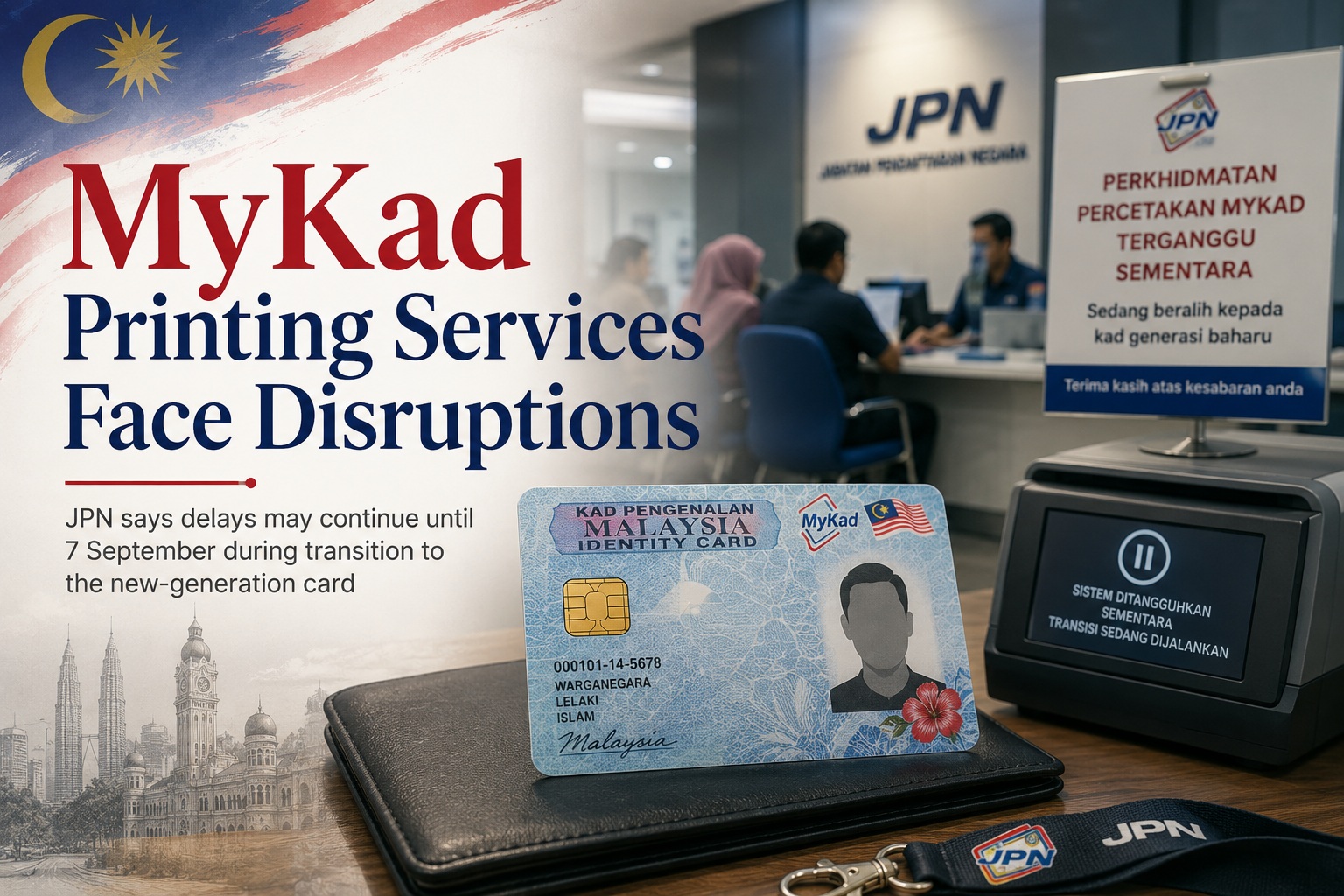
Malaysians planning to apply for or replace their MyKad may want to wait a few more days, as the National Registration Department (JPN) has announced temporary disruptions to MyKad printing services while it transitions from the existing card structure to the new-generation MyKad.
According to JPN, the disruption is expected to continue until 7 September 2026. Those who do not urgently need a replacement are advised to postpone their application until after the transition period to avoid unnecessary delays or inconvenience.
Parents of 12-Year-Olds Are Also Advised to Wait
The temporary delay also affects children who are turning 12 and would normally replace their MyKid with their first MyKad.
JPN is encouraging parents and guardians to hold off on the process for now so that eligible children can receive the new-generation MyKad once it becomes available. This avoids having them issued the existing version only to potentially replace it again later.
The department thanked Malaysians for their patience during the transition and apologised for any inconvenience caused.
Existing MyKad Cards Remain Valid
There is no need for Malaysians to rush out and replace their current MyKad simply because a newer version is being introduced.
JPN had already clarified earlier this year that the existing MyKad remains valid for official transactions. The transition to the new generation does not automatically make current identity cards obsolete.
Priority is instead being given to Malaysians who are still carrying much older versions of the national identification card.
These include people still using the Plastic Identity Card (KPP), the High Quality Identity Card (KPT) and the earliest-generation MyKad that does not include the ghost-image security feature found on newer cards.
For most Malaysians already carrying a relatively recent MyKad, there is therefore no immediate reason to replace it.
Replacement Fees Will Stay the Same
The introduction of the new-generation MyKad will also not result in higher application or replacement fees.
Home Minister Saifuddin Nasution Ismail previously confirmed that the existing fee structure will remain unchanged.
For an ordinary replacement, the standard processing fee remains RM10, unless the card has been repeatedly lost, where different penalties may apply depending on the circumstances.
This means Malaysians will not have to pay a premium simply because the replacement card uses the newer design and security structure.
The New MyKad Costs the Government RM40 Per Card
While the public fee remains unchanged, the government itself reportedly pays around RM40 for each new-generation MyKad under the current procurement arrangement.
The overall supply contract is valued at approximately RM732.72 million over six years.
The higher production cost reflects the broader technology, security and manufacturing requirements involved in producing a national identity card that must remain durable while resisting counterfeiting and tampering.
MyKad is used across countless government and private-sector transactions, so introducing stronger security features is an important part of keeping the identity system reliable.
Why the Temporary Disruption Is Happening
The current inconvenience is essentially part of the technical and operational transition between the existing MyKad infrastructure and the new card generation.
A national identity system cannot simply switch card designs overnight. Printing equipment, card stock, security components, backend systems and issuance procedures all need to work together correctly before nationwide production can begin.
That makes a temporary interruption understandable, particularly when millions of Malaysians depend on the system.
For people who urgently require identification documents, it is still worth checking directly with JPN for the latest service availability before visiting a branch.
For everyone else, waiting until after 7 September may be the easier option.
Final Thoughts
The temporary disruption to MyKad printing is expected to last only until 7 September 2026, so Malaysians who do not urgently need a replacement should consider waiting until the transition is completed. Parents whose children are turning 12 are also being encouraged to delay the switch from MyKid so that their children can receive the new-generation MyKad directly.
More importantly, there is no need for Malaysians to replace their existing MyKad simply because a new version is coming. Current cards remain valid for official transactions, while priority is being given to people still carrying older-generation identity cards. Once the transition is complete, JPN should gradually begin issuing the new MyKad without changing the standard replacement fee.











Comments 0