

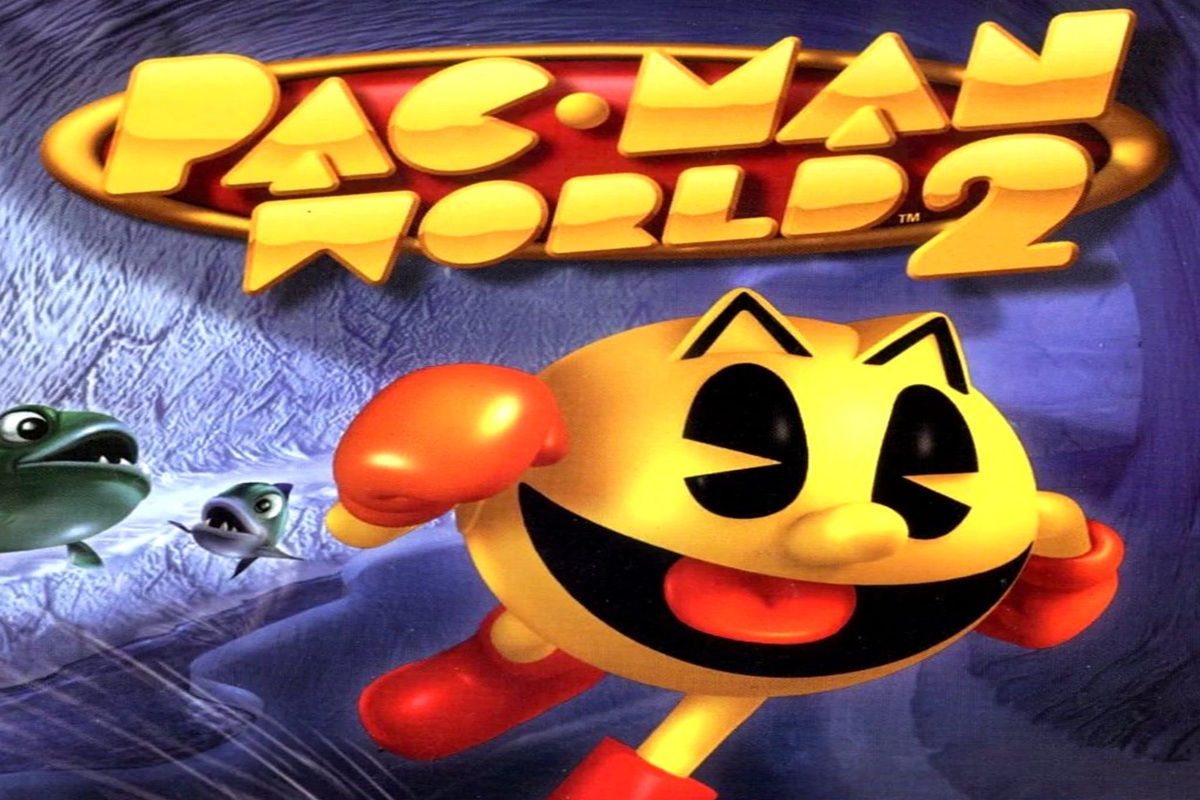
Pac-Man World 2 expands Pac-Man's adventures far beyond the familiar arcade maze, sending the iconic yellow hero across forests, mountains, volcanic regions, haunted locations, and other dangerous environments. Originally introduced as a 3D platforming adventure, the Game Boy Advance version adapts the journey into a distinctive handheld format built around platforming, exploration, collectibles, and Pac-Man's growing selection of movement abilities. Players must recover the stolen Golden Fruit while battling enemies, navigating hazardous terrain, and gradually working their way toward the evil ghost Spooky. The result is a colorful adventure that combines recognizable Pac-Man ideas with the mechanics of a traditional mascot platformer.
Released for the Game Boy Advance in 2005, this handheld interpretation differs significantly from the larger console versions while retaining the same central story and many of Pac-Man's signature abilities. The perspective and environments were redesigned around portable hardware, creating stages that emphasize depth, careful positioning, environmental interaction, and collectible hunting. Familiar moves such as the Butt-Bounce and Rev Roll return, alongside jumping, Flip Kicks, Power Pellets, and other mechanics that help Pac-Man survive increasingly complicated stages. Although smaller in scope than the console adventure, the GBA release remains a distinctive interpretation of Pac-Man World 2 rather than a simple scaled-down conversion.
Now playable online through Lemon Web Games, Pac-Man World 2 brings this classic handheld platforming adventure directly into modern web browsers without requiring the original console. Players can explore Pac-Land, recover the Golden Fruit, master Pac-Man's movement abilities, discover hidden areas, and confront the Ghost Gang on the journey toward Spooky. The browser-based experience also provides a convenient way to revisit a version of Pac-Man World 2 that differs considerably from its better-known console counterparts. Whether you remember the Game Boy Advance release or are discovering it for the first time, its mixture of platforming, collectibles, and familiar Pac-Man mechanics still provides an enjoyable retro adventure.
The Ghost Gang Unleashes an Ancient Evil
The story begins when Blinky, Pinky, Inky, and Clyde sneak into Pac-Village and steal the magical Golden Fruit from an ancient tree. Their mischief has consequences far greater than they expected because the fruit was helping keep an ancient evil named Spooky imprisoned beneath the tree. Once the fruit is removed, Spooky is released and once again threatens Pac-Land. Pac-Man therefore sets out to recover the stolen fruit and prevent Spooky from taking control.
The story gives the game a traditional adventure structure that is much broader than Pac-Man's arcade origins. Instead of simply clearing mazes and chasing high scores, players travel through several themed regions while gradually recovering what was stolen. Members of the Ghost Gang appear throughout the journey, often becoming directly involved in major confrontations. Each recovered fruit brings Pac-Man closer to restoring the seal and stopping Spooky.
Spooky serves as a particularly suitable antagonist because he represents a threat beyond the four familiar ghosts. Blinky, Pinky, Inky, and Clyde have always caused trouble for Pac-Man, but they are now responsible for releasing something significantly more dangerous than themselves. This creates a simple but effective reason for Pac-Man to explore the wider world. It also gives the adventure a central villain capable of supporting a full platforming storyline.
A Different Experience from the Console Versions
The Game Boy Advance version of Pac-Man World 2 should not be considered a direct miniature reproduction of the console release. Hardware limitations meant the game had to be redesigned substantially, resulting in different stage layouts, presentation, and progression. Instead of attempting to recreate fully three-dimensional environments, the handheld game uses a depth-oriented perspective with two-dimensional character artwork. This gives it a visual identity of its own.
Pac-Man still travels through many environments inspired by the larger adventure, but the way players navigate them is noticeably different. Platform positioning becomes especially important because movement can involve both horizontal directions and depth within the scene. Players must carefully judge where Pac-Man is standing before attempting jumps or moving toward platforms. This makes the handheld version feel closer to an isometric-style platformer than the console game's free-roaming 3D approach.
The adaptation also rearranges and simplifies certain elements to better suit portable play. Some sequences found in the console game were omitted or reworked, while the handheld version introduces its own encounters and challenges. Despite these differences, the central Pac-Man World mechanics remain recognizable. Butt-Bouncing, Rev Rolling, collecting fruit, activating switches, and defeating ghosts still form the foundation of the adventure.
Pac-Man's Butt-Bounce Returns
The Butt-Bounce remains one of Pac-Man's most useful abilities. By jumping and slamming downward, Pac-Man can attack enemies beneath him, activate switches, break certain objects, and interact with parts of the environment. Repeated bouncing can also help him gain additional height in situations where a standard jump is not enough. The move quickly becomes essential for both combat and exploration.
Many stages are designed around knowing when to use the Butt-Bounce rather than treating it purely as an attack. Ground switches may open doors or activate platforms, while breakable objects can reveal useful collectibles. Certain enemies are also easier to defeat from above than by approaching directly. This combination of offensive and environmental functions makes the Butt-Bounce useful throughout the entire adventure.
The ability also gives Pac-Man a movement style that feels different from more traditional platforming characters. Instead of relying exclusively on ordinary jumping, players frequently chain jumps and bounces together while navigating complicated areas. The mechanic is easy to understand but becomes increasingly important as stages introduce more hazards. Mastering its timing is one of the first steps toward becoming comfortable with the game.
Building Speed with the Rev Roll
The Rev Roll provides Pac-Man with another signature movement ability. By charging in place and releasing the move, Pac-Man launches forward at high speed, allowing him to climb slopes, attack enemies, or cross sections where ordinary movement would be too slow. The technique introduces momentum into the platforming and often requires players to judge both direction and timing. Releasing the roll carelessly can send Pac-Man directly toward a hazard.
Rev Rolls also interact with special environmental objects. Certain ramps and mechanisms are designed specifically around building enough speed before moving forward. Players may need to charge the move fully before attempting to reach a distant platform or climb a steep surface. These situations turn what initially appears to be a simple dash into an important puzzle-solving tool.
Once players become familiar with the Rev Roll, it can make movement feel much faster and more energetic. It is particularly useful when revisiting stages because experienced players can navigate some sections more efficiently. However, the depth-oriented perspective means accuracy remains important. Speed is useful only when Pac-Man is properly aligned with his destination.
Jumping and the Flip Kick
Standard jumping naturally remains at the center of the platforming experience, but Pac-Man also has access to the Flip Kick. This move gives him another way to attack enemies positioned around or above him while maintaining momentum. It complements the downward-focused Butt-Bounce and forward-moving Rev Roll by providing another directional option during encounters. Together, these moves form a surprisingly flexible movement set.
The Flip Kick can be useful when dealing with enemies that are difficult to approach from above. Rather than stopping to reposition completely, Pac-Man can attack during movement and continue navigating the stage. This becomes increasingly helpful when hazards leave little room for standing still. The move also reinforces the game's emphasis on combining platforming and combat rather than treating them as separate systems.
Pac-Man's abilities are deliberately simple enough to fit the handheld control scheme. There are no complicated combinations to memorize, and most actions serve multiple purposes. This makes the controls approachable while still giving players several ways to deal with environmental challenges. Much of the difficulty comes from applying the correct movement at the correct moment.
Pac-Dots, Fruit, and Familiar Collectibles
Collecting remains an important part of Pac-Man World 2, maintaining one of the strongest connections to the character's arcade heritage. Pac-Dots appear throughout the stages and contribute to the player's score while encouraging exploration beyond the most direct path. Fruit also returns as a familiar collectible, appearing throughout the different environments. These objects make even unfamiliar platforming stages immediately recognizable as part of the Pac-Man universe.
Some collectibles are positioned in relatively safe areas, while others require more careful platforming or exploration. Players interested in simply completing the adventure can concentrate on reaching each stage's goal, but completion-focused players have additional reasons to search every route. Hidden items can appear behind environmental obstacles or along less obvious paths. This gives stages a modest amount of replay value.
The presence of Pac-Dots is particularly effective because they frequently guide movement through an area. Lines of dots can indicate a route, encourage a difficult jump, or draw attention toward a hidden section. This is similar to the way collectible trails are used in many platformers, but the mechanic feels especially natural for Pac-Man. Eating dots has always been central to his identity.
Power Pellets Turn the Tables on Ghosts
The familiar Ghost Gang remains an important part of the adventure, and Power Pellets continue to provide Pac-Man with his classic advantage against them. Normally, ghosts represent a dangerous obstacle that must be approached carefully. After consuming a Power Pellet, however, Pac-Man temporarily gains the ability to chase and eat them. This instantly recreates one of the most iconic mechanics from the original arcade game.
Placing this familiar interaction inside a platformer gives it a different rhythm. Players may encounter ghosts while navigating environments rather than inside traditional enclosed mazes. Finding a Power Pellet can therefore transform a dangerous section into an opportunity to clear nearby threats. The temporary nature of the effect still creates the familiar urgency associated with classic Pac-Man.
This is one of the best examples of Pac-Man World 2 preserving the franchise's roots while expanding into a new genre. The surrounding gameplay may involve jumping, environmental puzzles, and boss fights, but the relationship between Pac-Man, ghosts, and Power Pellets remains instantly familiar. Longtime players do not need complicated explanations to understand what happens after collecting one. The mechanic simply works within the larger adventure.
Exploring Forests and Natural Environments
Pac-Man's journey begins across greener environments filled with woodland paths, platforms, animals, and environmental hazards. These early areas introduce the main controls while giving players enough space to practice movement without immediately overwhelming them. Rev Rolls, Butt-Bounces, and jumps gradually become part of normal navigation. The relatively bright environments also establish the game's cheerful visual style.
Natural obstacles become more complicated as the adventure progresses. Moving platforms, narrow paths, enemies, and dangerous gaps force players to use Pac-Man's abilities more carefully. Some routes contain optional collectibles that require additional risk to reach. These sections encourage players to understand the game's unusual perspective before later worlds become more demanding.
The forest environments also establish the sense that Pac-Land is much larger than Pac-Village. Pac-Man is no longer simply travelling between nearby rooms or mazes but moving through substantial outdoor regions. This helps the adventure feel like a genuine journey. Recovering the Golden Fruit becomes a quest across an entire world rather than a sequence of disconnected challenges.
Ice and Mountain Challenges
Icy and mountainous areas change the platforming by introducing more dangerous terrain and less forgiving movement. Narrow routes and slippery-looking environments create a greater sense of risk, especially when Pac-Man must judge depth accurately. Falling from a platform or misaligning a jump can quickly result in lost progress. These stages require more patience than the opening regions.
Pac-Man's movement abilities remain familiar, but the environment changes how they must be used. A Rev Roll across stable ground feels very different when the route leads toward a narrow platform surrounded by danger. Butt-Bounces may be required to activate switches positioned in awkward locations. Players need to combine the same basic abilities with greater precision.
The visual change also helps the adventure maintain variety. Bright forests give way to colder environments where snow, ice, and elevated terrain dominate the scenery. This creates a stronger feeling of progression as Pac-Man travels farther from Pac-Village. Each region becomes another step toward recovering the missing Golden Fruit.
Volcanic Areas Raise the Danger
Volcanic regions introduce another major change in atmosphere, replacing cooler environments with lava, fire, and dangerous industrial-looking obstacles. These stages tend to leave less room for mistakes because environmental hazards can punish poor positioning immediately. Players must pay attention to both enemies and the terrain rather than focusing entirely on one threat. Pac-Man's movement becomes increasingly important.
The Rev Roll can be particularly risky in these areas. High speed is useful for clearing certain obstacles, but overshooting a destination can send Pac-Man directly into danger. Butt-Bounces and precise jumping provide safer options in tighter sections. The game increasingly expects players to understand which ability is most appropriate rather than using the same movement repeatedly.
Volcanic areas also demonstrate how Pac-Man World 2 builds challenge through environmental design rather than complicated controls. Pac-Man does not suddenly gain an enormous collection of new abilities. Instead, familiar mechanics are tested under more demanding circumstances. This keeps the game understandable while allowing later stages to become noticeably harder.
Ghostly Areas and Spookier Environments
As Pac-Man moves closer to Spooky's influence, the environments become increasingly supernatural. Haunted-looking stages fit naturally within a franchise built around ghosts, but Pac-Man World 2 pushes those ideas beyond the colorful maze enemies of the original arcade game. Darker scenery, unusual creatures, and more dangerous platform arrangements create a stronger sense that Pac-Man is approaching the source of the threat. These sections provide an effective tonal change from the brighter opening areas.
The spooky environments also allow traditional ghosts to feel more at home within the surroundings. Power Pellets remain useful whenever Pac-Man needs to reverse the advantage against ghost enemies. Other creatures and hazards require standard platforming abilities instead. Switching between classic Pac-Man mechanics and newer movement challenges helps maintain variety.
Despite the darker atmosphere, the game never abandons its colorful cartoon presentation. The haunted environments remain playful rather than genuinely frightening. This keeps the experience suitable for the wider Pac-Man audience while giving the adventure some visual contrast. Spooky may be the central villain, but the overall tone remains firmly within Pac-Man's energetic world.
Galaxian Challenges and Maze-Inspired Bonus Areas
Pac-Man World 2 also maintains a connection to maze-based gameplay through special Galaxian collectibles and bonus challenges. Discovering the appropriate item can provide access to maze-inspired sections that shift attention away from ordinary platforming. These sequences recall Pac-Man's arcade roots while offering additional content beyond the main stages. They act as enjoyable breaks from the regular adventure.
Maze challenges naturally emphasize pellets, ghosts, and route planning rather than Butt-Bounces or Rev Rolls. Players familiar with traditional Pac-Man immediately recognize the change in priorities. The objective becomes navigating efficiently while avoiding dangerous ghosts until Power Pellets provide an opportunity to fight back. This creates a nostalgic contrast with the surrounding platforming levels.
Including maze-inspired gameplay is particularly appropriate because Pac-Man World 2 is ultimately built around a character famous for one specific genre. The bonus challenges acknowledge that history without forcing the entire game to follow the original formula. Players can experience both styles within the same adventure. This balance helps Pac-Man World maintain its identity as a platforming series while respecting its arcade origins.
Boss Battles Against the Ghost Gang
Members of the Ghost Gang appear as more than ordinary enemies, becoming involved in larger boss encounters throughout Pac-Man's journey. These battles frequently place Pac-Man against unusual machines or environmental threats rather than simply asking him to chase a ghost around the stage. Players need to observe attack patterns and determine when it is safe to retaliate. This provides a welcome change from standard platforming.
Boss battles also act as milestones between major areas. Defeating a member of the Ghost Gang usually signals that Pac-Man has overcome another significant part of the adventure and is closer to recovering the Golden Fruit. The encounters become progressively more demanding as players gain experience with the controls. Familiar abilities such as jumping and attacking are tested under more focused conditions.
The exaggerated machines and attacks fit the playful personality of the Ghost Gang. Blinky, Inky, Pinky, and Clyde may be familiar arcade enemies, but Pac-Man World 2 gives them opportunities to create much larger problems. This makes their presence feel appropriate within a platforming adventure. They remain recognizable while participating in challenges that go far beyond the original maze.
Wormwood Adds a Handheld-Specific Challenge
The Game Boy Advance adaptation also includes content that distinguishes it from the larger console adventure, including an encounter involving Wormwood. This additional threat gives the handheld version another memorable challenge and reinforces the idea that it was redesigned rather than simply compressed. Players familiar with another version of Pac-Man World 2 may therefore encounter situations they do not immediately recognize. This makes the portable release interesting even for those who already know the original adventure.
Wormwood fits naturally into the game's increasingly strange environments as Pac-Man approaches Spooky. The encounter provides another obstacle between Pac-Man and the final confrontation, extending the adventure beyond the battles against the four familiar ghosts. It also provides a stronger sense that Spooky's influence has affected more than the Ghost Gang. The final stages therefore feel increasingly separated from the more ordinary world seen near Pac-Village.
Differences like this are important when comparing versions of Pac-Man World 2. The handheld adaptation uses the same fundamental story but does not reproduce every stage exactly. Its unique encounters and redesigned environments give it a separate identity. Players should approach it as its own interpretation of the adventure.
Time Trial Challenges Encourage Faster Play
After learning a stage through normal exploration, players can return to certain areas and attempt Time Trial challenges. These modes change the objective from careful collectible hunting to reaching the end as quickly as possible. Familiar paths suddenly become opportunities to optimize movement and use Pac-Man's abilities more aggressively. Rev Rolls become especially useful once players know exactly where they are going.
Time Trials reward knowledge of stage layouts. A player who has memorized where platforms move, where enemies appear, and which routes are safe can move much more quickly than during an initial attempt. Mistakes that are minor during ordinary exploration become more costly when every second matters. This gives experienced players a different type of challenge.
The mode also increases replay value without requiring completely new stages. Instead, the same environment is approached with a different goal and pacing. Players who enjoy improving their performance can repeatedly attempt faster times. It is a simple addition that complements the movement-focused gameplay well.
A Password System Reflects Its Handheld Roots
The Game Boy Advance version uses a password-based progression system that allows players to return to previously reached stages. Password systems were already becoming less common by the mid-2000s, making their presence an interesting reminder of older game design. Instead of relying entirely on traditional save data, players can record a code associated with their progress. Entering it later restores access to the relevant point in the adventure.
From a modern perspective, remembering or recording passwords can feel unusual. However, the system fits the game's relatively straightforward stage-based progression. Players do not need to preserve complicated character inventories or RPG statistics between sessions. The password mainly needs to represent which parts of the adventure have been reached.
For retro gaming enthusiasts, systems like this are part of the historical experience. They reflect a period when games used many different methods to preserve progress. Pac-Man World 2 therefore combines relatively modern platforming ideas with a progression method associated with much earlier generations. It is a small but interesting characteristic of the handheld release.
Colorful Sprite Artwork and Depth-Oriented Environments
Visually, Pac-Man World 2 uses colorful sprites and carefully constructed environments to create the impression of depth on the Game Boy Advance. Pac-Man remains immediately recognizable, while enemies and environmental objects are large enough to read clearly on the original handheld screen. The art style maintains the cheerful personality associated with Pac-Man even when the surroundings become more dangerous. Bright colors also help important objects stand out from the scenery.
The depth-oriented perspective is both one of the game's strengths and one of its challenges. It allows environments to feel more dimensional than a traditional side-scroller but can occasionally make precise alignment more difficult. Players may need to adjust Pac-Man's position carefully before jumping toward narrow platforms. With practice, the perspective becomes easier to understand.
Different regions use distinct environmental themes to prevent the adventure from appearing repetitive. Forests, icy areas, volcanic stages, and haunted locations all introduce different visual identities. The graphical technology is naturally simple by modern standards, but the variety gives the journey a strong sense of progression. It is an effective example of adapting a larger platforming concept to portable hardware.
Why Pac-Man World 2 Remains Enjoyable
Pac-Man World 2 succeeds because it gives Pac-Man enough new abilities to function as a platforming hero without abandoning the mechanics people already associate with him. Pac-Dots, fruit, ghosts, and Power Pellets coexist naturally with Butt-Bounces, Rev Rolls, Flip Kicks, moving platforms, and environmental challenges. Players are constantly reminded that this is Pac-Man even when the gameplay has moved far beyond an arcade maze. That balance remains one of the game's strongest qualities.
The handheld adaptation is also interesting because of how much it changes the presentation while preserving the basic adventure. Players familiar with the console release will recognize the central storyline and many mechanics but encounter a significantly different style of level design. This makes the Game Boy Advance version more than a portable substitute. It offers another interpretation of the same Pac-Man adventure.
Its straightforward controls also make the game easy to revisit. Most abilities can be understood quickly, allowing players to concentrate on platforming rather than complicated command inputs. Later stages become challenging through environmental hazards and precision rather than mechanical complexity. For fans of classic mascot platformers, that simplicity has plenty of retro appeal.
Playing Pac-Man World 2 Online Today
Through Lemon Web Games, Pac-Man World 2 can now be played directly in your web browser with no downloads or setup required. Features of the web-based version include:
Playing Pac-Man World 2 through a browser provides a convenient way to experience this distinctive handheld adaptation without relying on aging hardware. The level structure works well for shorter gaming sessions, while collectibles and Time Trials provide additional reasons to return to previously completed stages. Pac-Man's controls are straightforward enough to learn quickly, but later areas still require careful timing and accurate movement. This makes the game approachable without removing the challenge expected from a classic platformer.
For returning players, the browser-based version provides an opportunity to revisit a Pac-Man adventure that can easily be overshadowed by the better-known console edition. New players may also find the Game Boy Advance interpretation interesting because of its unusual depth-oriented presentation and redesigned encounters. The adventure retains enough familiar mechanics to remain recognizably Pac-Man while offering a very different experience from traditional maze games. It is a compact but varied piece of Pac-Man history.
Who Should Play Pac-Man World 2
Pac-Man World 2 is particularly suitable for players who enjoy platforming games where a small set of abilities is used in many different ways. Butt-Bouncing, Rev Rolling, jumping, and Flip Kicking remain useful throughout the adventure rather than being forgotten after their introduction. The environments continually place these familiar mechanics into new situations. This provides a satisfying sense of mastery as players become increasingly comfortable controlling Pac-Man.
The game is also worth exploring for players interested in alternate versions of familiar titles. The Game Boy Advance release differs substantially from the home console editions, making it an interesting adaptation rather than a simple downgrade. Its redesigned perspective and unique encounters provide a separate experience while maintaining the same central story. For Pac-Man enthusiasts, comparing the different versions is part of the appeal.
Play Pac-Man World 2 Online Now
Pac-Man World 2 offers a colorful platforming journey built around the simple idea of taking Pac-Man beyond his maze and giving him an entire world to explore. Players can recover the Golden Fruit, confront the Ghost Gang, navigate forests and dangerous environments, discover hidden routes, and eventually challenge Spooky. The combination of familiar collectibles and new movement mechanics gives the adventure a recognizable Pac-Man identity without restricting it to traditional arcade gameplay. Boss battles and Time Trials provide additional variety beyond ordinary exploration.
Through Lemon Web Games, players can experience this classic handheld adaptation directly in their browsers without requiring the original cartridge or console. Returning players can rediscover its unusual perspective and familiar abilities, while newcomers can experience a lesser-known version of one of Pac-Man's most substantial platforming adventures. The straightforward controls make it easy to begin playing, while increasingly demanding environments provide enough challenge to maintain interest. It remains a fun example of Pac-Man successfully moving into a broader style of gameplay.
Final Thoughts
Pac-Man World 2 demonstrates how effectively Pac-Man can work as a platforming character when his abilities are designed around the personality of the franchise. Butt-Bouncing, Rev Rolling, Flip Kicking, eating Pac-Dots, collecting fruit, and using Power Pellets all feel naturally connected to the familiar yellow hero. Rather than replacing classic Pac-Man ideas, the game builds new platforming mechanics around them. This allows the adventure to feel fresh without losing the identity that made Pac-Man recognizable in the first place.
The Game Boy Advance version is especially interesting because it reinterprets the larger adventure around the limitations and strengths of handheld hardware. Its depth-oriented perspective, redesigned stages, additional encounters, maze-inspired bonuses, and Time Trial challenges give it a personality separate from the console releases. Some platforming sequences require careful alignment because of the perspective, but learning how to judge Pac-Man's movement becomes part of mastering the game. The variety of environments also ensures that the journey continues changing as Pac-Man moves closer to Spooky.
More than two decades after its handheld release, Pac-Man World 2 remains an enjoyable example of classic mascot platforming from an era when developers were constantly experimenting with how established arcade characters could evolve. Its mechanics are easy to understand, its environments are colorful, and its mixture of collectibles, boss fights, and movement challenges provides plenty of traditional platforming appeal. Through Lemon Web Games, players can once again recover the Golden Fruit, confront the Ghost Gang, and take the fight to Spooky directly through a modern browser. For Pac-Man fans and retro platforming enthusiasts, it remains a distinctive adventure worth rediscovering.











Comments 0